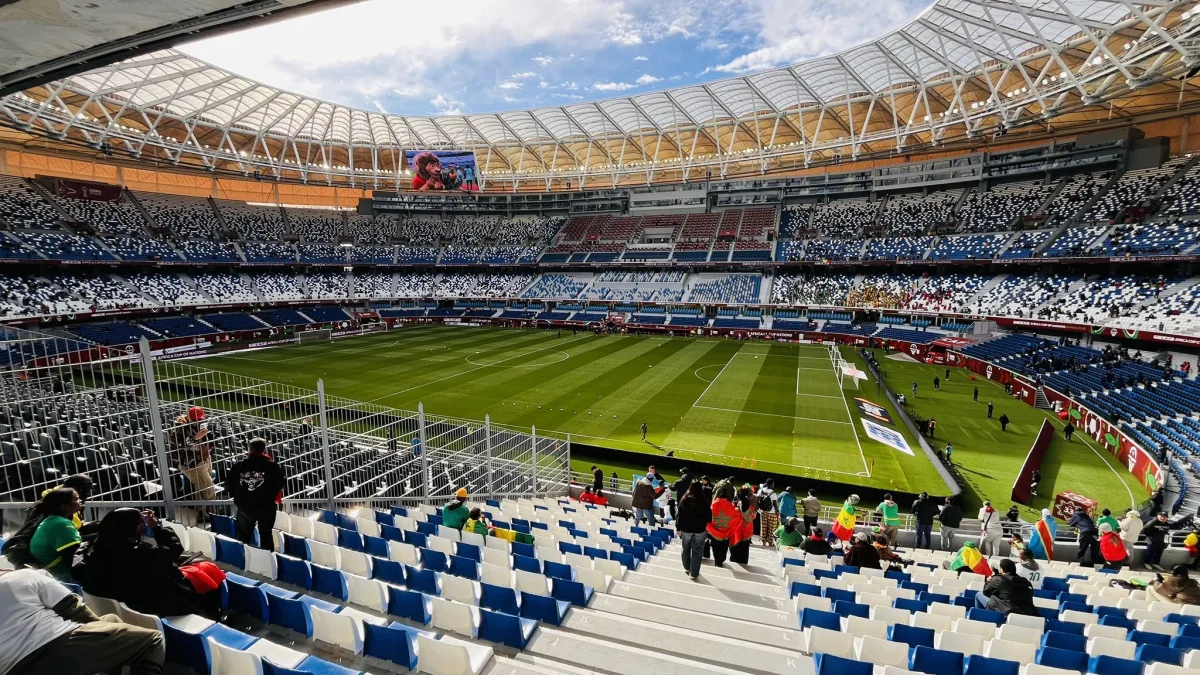
About Ibn Batouta
Ibn Batouta Stadium is Tangier’s grand ground, and after a top-to-bottom overhaul it is now one of the biggest in Morocco. It sits about 10 kilometres southwest of the old city, out toward the airport that carries the same name, both honoring Ibn Battuta, the 14th-century Tangier-born traveler whose journeys across the medieval world made him one of history’s great explorers. The home club is Ittihad Tanger, and the Morocco national team plays there too.
The stadium opened in 2011 as a multi-purpose arena with an athletics track and about 44,500 seats. What stands today is a very different building. A renovation between 2023 and 2025, carried out for the Africa Cup of Nations and the 2030 World Cup, tore out the track, pulled the stands in close to the pitch, added a lower tier and crowned the whole thing with a vast new roof, nearly doubling capacity to around 75,500.
That roof is the signature. A white tensile-fabric canopy on a spoke-wheel cable structure, one of the largest stadium covers in Africa, it was engineered by the German firm Schlaich Bergermann Partner and erected in a startling 69 days. Underneath it, the ground gained 142 skyboxes, giant screens and a perimeter LED ring, turning a decade-old athletics stadium into a football-first arena fit for a World Cup.
For 2030, when Morocco co-hosts with Spain and Portugal, Ibn Batouta is in line to stage knockout matches, likely quarterfinals and a semifinal. It reopened in November 2025 and was immediately put to work at the Africa Cup of Nations, so by the time the World Cup arrives it will be a thoroughly proven venue.
Getting to Ibn Batouta
The ground sits well outside the old city, so unlike a downtown stadium this is a trip you plan, by taxi, bus or car.
Public Transit
Tangier has no tram or metro, so getting to the stadium on public transport means a city bus.
→ Via city bus: Tangier’s bus network serves the stadium area southwest of the city. The Tanja Mobilité app tracks buses in real time and even shows stadium parking availability, which is worth having on match day.
→ From the airport: The Aerobus links Tangier Ibn Battouta Airport with the central railway station, from where a local bus or taxi finishes the trip.
Driving + Parking
Its out-of-town setting means driving is a genuine option here, more so than at a cramped city-center ground.
→ Parking: The complex has very large parking, cited in the thousands of spaces, split across VVIP, VIP and general lots. It still fills for a big match, so come early.
→ From the center: A drive of roughly 20 to 25 minutes southwest from central Tangier outside match traffic.
Rideshare
Tangier runs on its petits taxis for short city hops and grands taxis for longer trips, and a taxi is the simplest way to the stadium for most visitors. App-based rideshare is thinner on the ground here than the licensed taxis, so agreeing a fare or using the meter is the norm, especially heading back into the city after the final whistle.
From the Airport
→ Tangier Ibn Battouta (TNG): The city airport is only about 4 kilometres from the stadium, which shares its name, a short taxi ride away.
→ Into the city: The airport is roughly 25 minutes by taxi from central Tangier, or you can take the Aerobus to the railway station.
Matchday at Ibn Batouta
For a stadium out beyond the edge of the city, Ibn Batouta gets loud. The engine of it is Ultras Hercules, Ittihad Tanger’s ultras group, who fill a curva with capo-led chants, banners and standing support, and the club has pulled home crowds north of 20,000 for years, reaching close to 24,000 in its 2017-18 title-winning season. On a Botola day the atmosphere is a proper northern-Moroccan football occasion.
The bigger nights belong to the national team. Morocco’s 2-1 win over Brazil here in 2023 drew 63,500, the reopening against Mozambique in 2025 pulled around 60,000, and the Africa Cup of Nations semifinal in early 2026 filled it again. When the ground is full under its new white roof, which was designed in part to keep the sound in, it becomes one of the more intimidating venues in African football.
A word of honesty about the visitor detail: this is a stadium that only reopened in late 2025, so the fine-grained matchday lore, the best food stalls, the stand-by-stand seating wisdom, has not yet been written down the way it has for century-old grounds. What is clear is the shape of the day. No alcohol is sold inside, in line with Moroccan grounds generally, and the real eating happens beforehand, in Tangier’s medina and around the Grand Socco, where the street food and cafés are the point.
The other thing to plan for is the location. Because the stadium sits about 10 kilometres from the center, near the airport, getting in and out is a transport exercise, not a stroll. Give yourself time before kickoff, and after a big match expect the taxis and buses to be busy, so a little patience at the exit goes a long way. Come for the roof, the noise and a city that is one of the most atmospheric in Morocco.
Construction & Design
Ibn Batouta had a long and halting birth. Ground was broken back in September 2002, but the project dragged for the better part of a decade, and the stadium only opened on April 26, 2011, with a friendly between Ittihad Tanger and Atlético Madrid’s B team. The architect was the Tangier practice of Anouar Amaoui, and the result was a multi-purpose bowl of about 44,500 seats wrapped around an athletics track.
The building that matters now is the one that emerged from the 2023 to 2025 renovation. With Morocco preparing to host the Africa Cup of Nations and co-host the 2030 World Cup, the old stadium was gutted and remade as a football-specific arena. The athletics track came out, the pitch was brought closer and lower, a new lower tier went in, and capacity climbed to around 75,500. Inside came 142 skyboxes, two giant screens and a perimeter LED ring, with VIP areas reportedly modeled on those at Mercedes-Benz Stadium in Atlanta.
The centerpiece of the work is the roof. Engineered by the German structural firm Schlaich Bergermann Partner, it is a spoke-wheel cable structure carrying a white PTFE-and-glass tensile membrane of more than 52,000 square metres, among the largest stadium covers on the continent. Most remarkably, the roof modification was completed in just 69 days, a pace that became part of the venue’s story, and it does double duty, sheltering the stands and helping hold the crowd’s noise inside.
History of Ibn Batouta
Since it finally opened in 2011, Ibn Batouta has punched well above the weight of a club ground, and its history is really a run of big neutral occasions. Within months of opening it hosted the French Super Cup, the Trophée des Champions, which returned again in 2017 for Paris Saint-Germain against Monaco. In 2018 it staged the Spanish Super Cup, Barcelona beating Sevilla 2-1, drawing one of Europe’s showpiece finals to the Moroccan coast.
The continental and global game came too. Tangier hosted matches at the 2018 African Nations Championship and, in early 2023, semifinal and third-place matches of the delayed 2022 FIFA Club World Cup. Its most famous night as a home venue arrived on March 25, 2023, when Morocco, fresh off their World Cup semifinal run in Qatar, beat Brazil 2-1 in front of 63,500, a result that captured the country’s rising football confidence.
Then came the reinvention. Closed for its major renovation, the stadium reopened on November 14, 2025 with a Morocco win over Mozambique, and was thrown straight into the 2025 Africa Cup of Nations, hosting group games through to a semifinal. A ground that had spent years as a well-traveled neutral host had been rebuilt into something bigger.
Its next assignment is the largest yet. As a confirmed venue for the 2030 World Cup, Ibn Batouta is set to host knockout football on the game’s biggest stage. From a stadium that took nine years to build to one remade in barely two, Tangier’s ground has become one of the venues on which Morocco’s World Cup will turn.
Sources & Further Reading
- Wikipedia entry on Tangier Grand Stadium: en.wikipedia.org/wiki/Tangier_Grand_Stadium. Capacity, dates, events and the renovation.
- CAF on the AFCON 2025 venue: cafonline.com. Location, capacity and tournament role.
- Anadolu Agency on the renovation: aa.com.tr. The cost, architect, roof and 2030 plans.
- Schlaich Bergermann Partner on the roof: sbp.de. The engineering of the tensile roof.
- Wikipedia entry on Ittihad Tanger: en.wikipedia.org/wiki/Ittihad_Tanger. The club, its support and Ultras Hercules.
Quick Facts
Everything you need at a glance.
Stadium specs
- Capacity
- 75,500
- Opened
- 2011
- Cost
- Approximately €80 million (2011)
- Roof
- Open
- Surface
- Natural Grass
- Tenants
- Ittihad Tanger, Morocco national team
Construction & location
- Groundbreaking
- 2002
- Architects
- Anouar Amaoui
- Engineering
- Schlaich Bergermann Partner
- General contractor
- Not separately recorded
- Address
- Avenue des Forces Armées Royales, Tangier, Morocco
- GPS
- 35.7412°N, 5.8581°W
Photo Gallery
Fun Facts
The 2025 renovation nearly doubled the stadium, from about 44,500 seats when it opened in 2011 to roughly 75,500 today.
Its new white tensile-fabric roof, one of the largest stadium covers in Africa at over 52,000 square metres, was installed in just 69 days.
In March 2023 the ground saw one of Moroccan football's great nights, a 2-1 win over Brazil in front of 63,500 fans.
Stadium Location
Frequently Asked Questions
- Is Ibn Batouta Stadium new or renovated?
- It is a heavily renovated version of the stadium that opened in 2011, not a new build. A 2023 to 2025 overhaul for the Africa Cup of Nations and the 2030 World Cup removed the old athletics track, brought the stands closer to the pitch, added a lower tier, and installed a large new roof, reopening on November 14, 2025.
- What is the capacity of Ibn Batouta Stadium?
- About 75,500 after the 2025 renovation, up from around 44,500 when it opened in 2011. That nearly doubles its size and makes it one of the largest stadiums in Morocco. Reports of a further expansion for 2030 exist but are not firmly confirmed, so 75,500 is the reliable current figure.
- What is Ibn Batouta Stadium's role in the 2030 World Cup?
- It is a confirmed venue for the 2030 World Cup, which Morocco co-hosts with Spain and Portugal, and is positioned to host knockout matches, likely quarterfinals and a semifinal. Its 2025 renovation was carried out specifically to bring it up to the standard the tournament requires.
- What is the atmosphere like at Ibn Batouta Stadium?
- Loud. Ittihad Tanger's ultras, Ultras Hercules, drive a curva of capo-led chants, tifo displays and standing support, and the club has drawn home crowds above 20,000 for years. Morocco national-team nights are bigger still, with 63,500 for a friendly against Brazil in 2023 and around 60,000 for the reopening in 2025.
- How do you get to Ibn Batouta Stadium?
- The stadium is about 10 kilometres southwest of central Tangier, so plan on a taxi or bus rather than a walk. A taxi from the center takes 20 to 25 minutes, city buses serve the ground, and there is large parking on site. It sits only about 4 kilometres from Tangier Ibn Battouta Airport, which shares its name.
- Who plays at Ibn Batouta Stadium?
- The home club is Ittihad Tanger, known as IRT, of the Moroccan Botola Pro league, who have played there since it opened in 2011. The Morocco national team also uses it for selected matches, and it has hosted a run of major one-off events over the years.
- What food is there at Ibn Batouta Stadium?
- There is no well-documented signature offering at the ground, which only reopened in late 2025, and, as at Moroccan stadiums generally, no alcohol is sold inside. The better plan is to eat beforehand in Tangier, where the medina and the Grand Socco are full of street food and cafés.
- What major matches has Ibn Batouta Stadium hosted?
- Plenty for a club ground. It has staged the French Super Cup twice, the Spanish Super Cup in 2018, when Barcelona beat Sevilla, a 2022 FIFA Club World Cup semifinal, and matches at the 2025 Africa Cup of Nations, including a semifinal. It is a regular neutral venue for continental showpieces.
Last updated: 2026-07-18