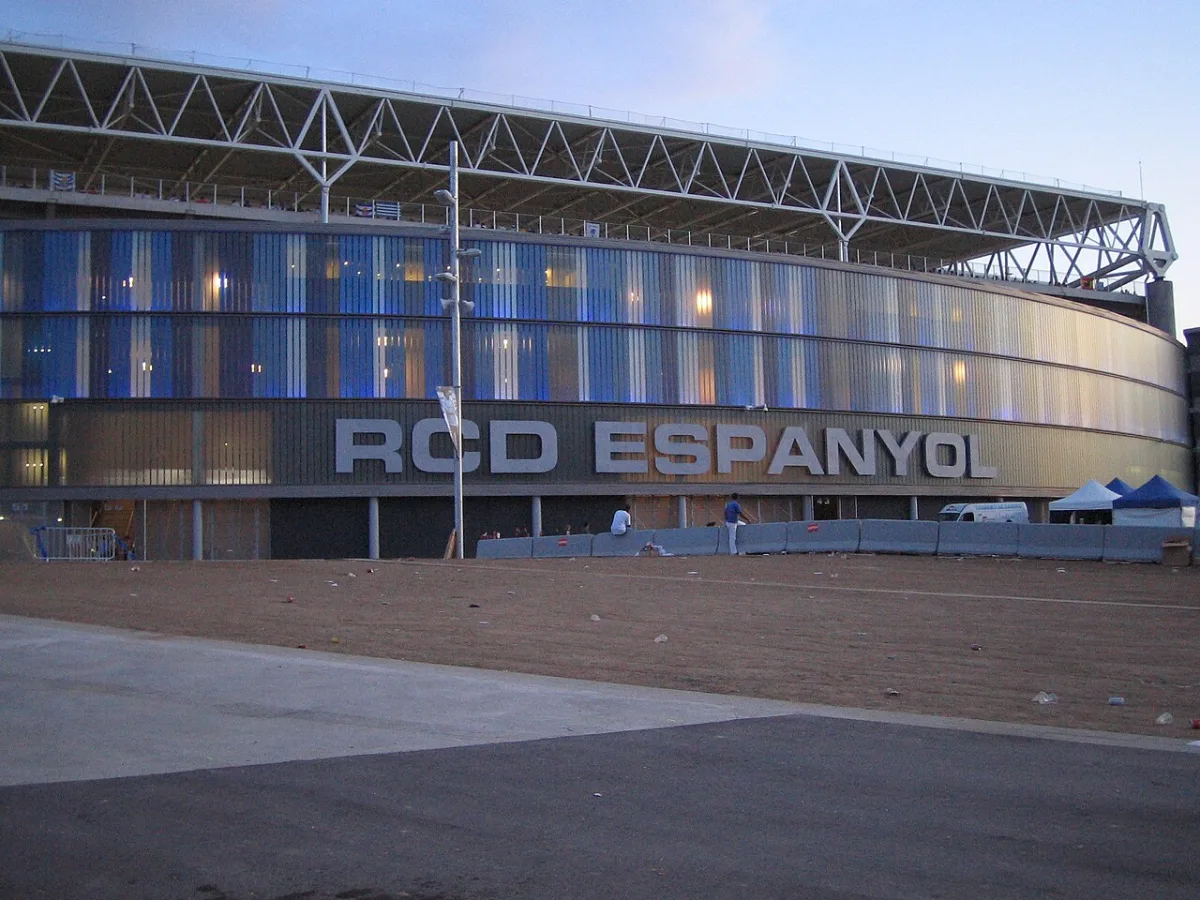
About RCDE Stadium
For a club that spent twelve years as a lodger, having a home of its own means everything. RCDE Stadium, on the industrial southern edge of Barcelona in Cornellà de Llobregat, is the house that RCD Espanyol finally built: a 40,500-seat bowl wrapped in a translucent facade that glows blue and white on match nights. After selling their historic Sarrià ground to clear debts and then borrowing the Olympic Stadium on Montjuïc, Espanyol opened this place in 2009 and stopped being anyone’s guest.
The design is unashamedly English in spirit. The stands are steep and pulled in tight to the touchlines, with no running track to push the crowd back, so the noise falls straight onto the pitch. A cantilevered roof covers roughly 92 percent of the seats and seems to hover overhead, leaving only the four corners open to the Catalan sky. The surface is natural grass, 105 metres by 68.
It sits closer to the airport than to the cathedral, which tells you something: this is not a tourist stadium in the heart of the city, but a genuine football ground in a working suburb. Espanyol own it outright, share it with lower-league neighbors UE Cornellà, and have watched it collect a startling run of sponsor names, concerts, and one 250-million-dollar scandal.
Getting to RCDE Stadium
The ground is out in the metropolitan area rather than central Barcelona, but the transport network reaches it easily. Here is how to arrive however you are traveling.
Public Transit
The best option is the FGC. Take the L8 line to Cornellà Riera and it is about a five-minute walk to the gates, and that same station carries a clutch of regional S and R services from the middle of Barcelona. If you would rather use the city metro, L5 terminates at Cornellà Centre, roughly a twelve-minute walk, and the Trambaix T1 and T2 trams run there from the Diagonal. The club likes to say it is fifteen minutes from the center of town, which is optimistic but not wildly so.
Driving + Parking
Getting here by car is straightforward, since the Ronda de Dalt and Ronda Litoral ring roads and the Gran Via all funnel toward Cornellà. Parking is plentiful by stadium standards: the neighbouring Westfield Splau center has around 900 spaces for a couple of euros, and the Fira de Cornellà and the Almeda industrial estate add thousands more, reached off the S-15. The area still snarls up on match days, so leave early and be patient getting out toward Sant Boi afterward.
Rideshare
This is the weak spot. Ride-hailing is heavily restricted across Catalonia, and apps like Uber, Cabify, and Bolt generally cannot do on-demand street pickups the way they can elsewhere, often routing you to a licensed taxi or requiring a booking well in advance. For a trip to or from the stadium, the reliable move is simply a traditional taxi, which can drop you right on Avinguda del Baix Llobregat.
From the Airport
Here is the stadium’s quiet superpower: it is barely 16 kilometres from Barcelona-El Prat airport, one of the shortest airport-to-ground hops in Spanish football. A taxi covers it in ten to fifteen minutes for something like thirty euros. Public transport is less tidy, with no single direct line; you connect through the Cornellà interchange on a Renfe R4 train or Metro L5, which realistically takes the better part of an hour. For most visitors landing at BCN, the taxi wins.
Construction & Design
Espanyol’s road to its own stadium ran through loss. The club sold and demolished its cramped, adored Sarrià ground in the 1990s to survive financially, then spent from 1997 sharing the Olympic Stadium up on Montjuïc, a cavernous athletics bowl that never felt like home. By the club’s own count the Cornellà ground is the eighth stadium in Espanyol’s history, and the first in a generation that was truly theirs. So when the chance came to build, the brief was clear: an intimate, English-style football ground, not another multipurpose arena, something that would finally give a proud but overshadowed club a room of its own in the shadow of its enormous city rival.
The commission went to Fenwick Iribarren Architects, the practice of Mark Fenwick and Javier Iribarren, which won an international competition ahead of names as big as Jean Nouvel, HOK, and Arquitectonica. Working with Gasulla, structural engineers Indus, and contractor FCC alongside Copisa, they delivered a stand that hugs the pitch and a roof that appears to float on four enormous beams spanning up to 200 metres, covering all but the corners. At night the transparent facade lights up in club colors like a lantern. The whole point was atmosphere: by pulling the lower tier right up to the touchline and steepening the rake, the architects built a bowl that feels far bigger and louder than 40,000 seats usually do.
The money is a little slippery in the record. The stadium itself came in around 60 million euros, with the figure rising to roughly 83 million once the surrounding infrastructure is counted, and the whole complex covers some 80,000 square metres. It went up between about 2005 and 2009, and it opened to instant acclaim, taking a Stadium Business award for venue of the year within twelve months.
History of RCDE Stadium
The first night set the tone. On 2 August 2009 Espanyol christened the ground by beating Liverpool 3-0, the opening goal fittingly scored by Luis García, a former Anfield favorite. Less than two years later, on 13 February 2011, the stadium recorded its highest crowd, 40,240 for the visit of Real Madrid. The loudest nights, though, are the derbies against Barcelona, when the tight English-style bowl gives a club used to living in its neighbor’s shadow a stage of its own. The stadium has also had to weather Espanyol’s habit of yo-yoing between La Liga and the second division, a run of relegations and promotions that would test any ground’s atmosphere.
Then came the naming saga. The ground opened as Estadi Cornellà-El Prat, became the Power8 Stadium in 2014 until that sponsor was unmasked as an alleged pyramid fraud, reverted to RCDE Stadium, briefly took the name Stage Front in 2023, and reverted again in 2024 after that deal collapsed over unpaid fees. Few grounds have burned through sponsors quite so dramatically.
Between the football it has become a reliable concert venue. The Black Eyed Peas christened it as a music stage in 2010, Rammstein drew a crowd of 33,825 in 2019, and Robbie Williams played in 2025, the open corners and tight bowl making it a favorite for touring productions. In June 2025 it hosted an unusual international too, staging Andorra’s “home” World Cup qualifier against England because the tiny principality lacks a stadium of the required size.
Now the ground finds itself on the candidate list for the 2030 World Cup, which Spain will co-host with Portugal and Morocco. It would be a fitting next chapter for a stadium that took Espanyol so long to build, and that even now cannot seem to hold on to a sponsor’s name for more than a few seasons at a time.
Sources & Further Reading
- RCD Espanyol official site: rcdespanyol.com. The club’s own pages on the stadium, capacity, and facilities.
- Wikipedia entry on RCDE Stadium: en.wikipedia.org/wiki/RCDE_Stadium. Construction history, the naming timeline, and events with sourcing.
- Fenwick Iribarren Architects project page: fenwickiribarren.com. The design firm’s own account of winning the competition and the roof concept.
- The Stadium Business: thestadiumbusiness.com. Reporting on the collapse of the Stage Front naming deal.
Quick Facts
Everything you need at a glance.
Stadium specs
- Capacity
- 40,500
- Opened
- 2009
- Cost
- €60 million
- Roof
- Cantilevered roof (open corners)
- Surface
- Natural grass
- Tenants
- RCD Espanyol (La Liga)
Construction & location
- Groundbreaking
- 2005
- Architects
- Mark Fenwick & Javier Iribarren (Fenwick Iribarren Architects), Gasulla Arquitectura
- Engineering
- Indus
- General contractor
- FCC Construcción (with Copisa)
- Address
- Avinguda del Baix Llobregat, 100, 08940 Cornellà de Llobregat, Barcelona, Spain
- GPS
- 41.3478°N, 2.0756°E
Photo Gallery
Fun Facts
Espanyol opened the ground in style on 2 August 2009 by beating Liverpool 3-0 in a friendly, with Luis García scoring the stadium's first-ever goal against his old club.
The stadium has run through five names in its short life, one of them the ill-fated Power8 Stadium, after the sponsor was exposed as an alleged 250 million dollar pyramid fraud and the deal was torn up.
Less than a year after opening it was named Venue of the Year at the 2010 Stadium Business Awards in Dublin, and it later earned a UEFA four-star elite rating.
Stadium Location
Frequently Asked Questions
- What is the capacity of RCDE Stadium?
- The standard capacity is 40,500, which is how the stadium is usually listed. Some seating configurations are counted lower, around 37,776, so a smaller figure occasionally circulates, but 40,500 is the headline number.
- Who plays at RCDE Stadium?
- It is the home of RCD Espanyol, who own the ground and have played there since 2009. The smaller club UE Cornellà also uses it, and Spain has hosted the occasional match here.
- Why is it called RCDE Stadium?
- RCDE stands for Reial Club Deportiu Espanyol, the club's initials. The ground has cycled through several sponsor names since 2009 and currently carries no title sponsor, so it uses the club's own initials.
- When did RCDE Stadium open?
- It opened on 2 August 2009 with a friendly against Liverpool, giving Espanyol its own home again after years of ground-sharing at the Olympic Stadium on Montjuïc.
- How do I get to RCDE Stadium from Barcelona?
- The quickest rail option is the FGC L8 train to Cornellà Riera, a five-minute walk away. Metro L5 and the Trambaix trams also reach Cornellà Centre, about twelve minutes on foot.
- How close is RCDE Stadium to the airport?
- Very close. Barcelona-El Prat airport is only about 16 kilometres away, roughly a 10 to 15 minute taxi ride, one of the shortest airport-to-stadium hops in Spanish football.
- Is RCDE Stadium covered by a roof?
- The cantilevered roof covers around 92 percent of the seats, leaving only the four corners open. The pitch itself is uncovered natural grass.
- Will RCDE Stadium host 2030 World Cup matches?
- It is listed among the candidate venues for the 2030 World Cup, which Spain will co-host with Portugal and Morocco. The final list of host stadiums is still being confirmed.
Last updated: 2026-07-13