About Geodis Park
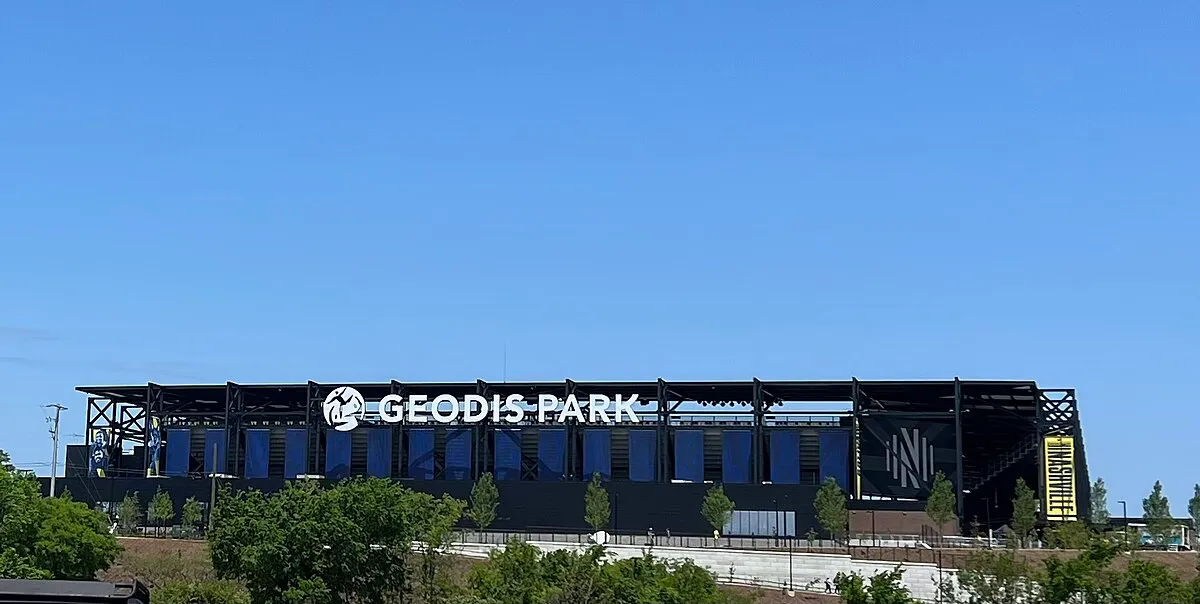
On the Nashville Fairgrounds campus, two miles south of downtown and the honky-tonks of Broadway, Geodis Park is the largest soccer-specific stadium in the United States and Canada. Just barely. At 30,109 seats it finishes ahead of Toronto’s BMO Field by 109, which is a quarter of one section, and Toronto would take it back with one extra row.
Home to Nashville SC since 2022, the stadium was purpose-built for soccer by Populous, the same firm behind Tottenham Hotspur Stadium and Wembley. The playing field was excavated below street level to create an intimate bowl, with a 360-degree structural steel canopy that covers every seat while leaving the field open to the Tennessee sky. The canopy traps crowd noise and creates an atmosphere that punches well above what you’d expect from a mid-market expansion team.
Construction cost approximately $335 million and took about 21 months, finishing 7 weeks ahead of schedule despite breaking ground during the COVID-19 pandemic. The project team was pursuing LEED Silver at completion, and the pitch is natural Bermuda grass, overseeded with ryegrass in cooler months. Throughout the concourses, the “Soundwaves” gallery rotates local Nashville artwork, a fitting touch for a city built on creative culture.
Beyond Nashville SC, Geodis Park has hosted U.S. national team matches, CONCACAF tournaments, FIFA Club World Cup 2025 group stage matches, and concerts from Guns N’ Roses to P!NK. In 2023, the venue welcomed over 1 million guests across its first full calendar year of operation.
Getting to Geodis Park
Public Transit
Nashville’s WeGo bus system makes getting to Geodis Park surprisingly easy on match days. Routes 52 (Nolensville Pike) and 77 (Thompson/Wedgewood) are completely free all day when Nashville SC plays at home.
→ From Downtown Nashville: Take WeGo Route 77 heading south. The ride takes about 15 minutes. Buses drop off on Wedgewood Avenue near Lot 11.
→ From Murfreesboro or Antioch: Express buses run from the Stones River Mall and Hickory Hollow park-and-ride lots for $2 each way. Return buses depart 30 minutes after the match.
Nashville BCycle has a bikeshare station at the stadium’s southwest corner, and a free bike valet operates at Gate C on match days. If you’re staying downtown, biking the two miles south is a legitimate option.
Driving + Parking
Geodis Park is less than a mile from I-65, making it one of the most freeway-accessible stadiums in MLS. GPS users should enter “501 Benton Avenue, Nashville, TN 37203.”
→ From Downtown Nashville (~2 mi): Take I-65 South to Exit 81 (Wedgewood Avenue), head east. The stadium is at the Nashville Fairgrounds on your right. Alternatively, take 8th Avenue South directly, about 5 minutes on surface streets.
→ From Nashville Airport (BNA) (~8 mi): Take I-40 West to I-24 West, merge onto I-65 North, then Exit 81 (Wedgewood Avenue) east to the Fairgrounds.
→ From Murfreesboro (~35 mi): Take I-24 West to I-65 North, Exit 81 (Wedgewood Avenue) east.
The stadium has 12 on-campus lots. Most allow tailgating, Lots 1, 2, 5, 6, 7, 8, and 11 are the most popular pre-match gathering spots. Pre-purchase your parking online, day-of inventory is limited. A free Chestnut Lot is available 1.2 miles from the stadium if you don’t mind the walk.
Rideshare
Uber and Lyft pick up and drop off on Craighead Street, organized into four numbered zones. Look for your zone and communicate it to your driver. Pickup is only permitted in this designated area, not at the stadium gates.
Pro tip: Arriving by rideshare is easy. Leaving is the challenge, 30,000 fans all ordering rides at once. Walk a few blocks toward Wedgewood or 8th Avenue for faster pickups and lower surge.
From the Airport
→ Nashville International Airport (BNA): 8 miles east, about 15 minutes by car. BNA is a major hub with direct flights to most U.S. cities. By rideshare, expect $15-25 to the stadium. There’s no direct transit connection, a car or rideshare is your best option from the airport.
Watching a Match at Geodis Park
The thing to understand before choosing a seat is that this is the biggest soccer-specific stadium in the United States or Canada, and it does not feel like it. Not remotely. The stands are steep, the canopy comes 85 feet in over the upper tier, and the whole bowl leans toward the pitch rather than away from it. Thirty thousand people here sound like considerably more than thirty thousand.
The supporters’ end is the north side, and it has its own dedicated entry gate, which tells you how the building was planned rather than adapted. Seven official supporters’ groups share it, filling the Backline sections behind the goal. Fans who want the noise without the commitment do what visiting supporters everywhere do and buy a seat in the tier immediately above them: you get the chants, the flags and the drums coming up at you, and you also get to sit down.
Two specific tips circulate among season-ticket holders and neither is obvious from a seating map. Fans put the players’ tunnel on the far side of the lower bowl, around sections 132 to 134, which makes that stretch the place to stand if you want a photograph or an autograph as the teams come off, and regulars will tell you to head down to the front quickly at full time. The club does not mark the tunnel on its published seating map, so treat the section number as fan lore rather than gospel. And the seats immediately behind the benches, in the low C sections, are closer to the coaching staff than most people expect: close enough that stewards there spend part of the match asking fans not to shout into the back of the substitutes’ heads.
Everything else is unusually easy. The canopy covers all the seating, so rain is somebody else’s problem, and the pitch is Bermuda grass overseeded with ryegrass when it turns cold, which keeps it green through a Tennessee winter. Along the concourses the Soundwaves gallery rotates work by local artists, which is a better use of concrete than most stadiums manage.
Construction & Design
GEODIS Park’s headline is its size: at 30,109 seats it is the largest soccer-specific stadium in the United States and Canada, bigger than any other purpose-built ground in Major League Soccer. Metro Nashville owns the building, and put $37.6 million in before a revised 2020 deal handed the club the construction costs. Populous designed it with the local firm HASTINGS Architecture. Walter P Moore engineered the structure. A Mortenson-Messer joint venture built it between the July 2020 groundbreaking and the May 2022 opening.
The engineering everyone notices is overhead. A 360-degree steel canopy wraps the entire bowl and cantilevers roughly 85 feet inward over the upper seats, carried on slender columns and braced by exposed X-frames at the back that have become the building’s visual signature. Because the canopy reaches so far, the concourses and upper rows stay largely column-free, and the roof pulls crowd noise down onto the pitch. It is a big stadium engineered to feel loud.
For all its scale, the design keeps the intimacy MLS crowds expect, with steep stands and a dedicated supporters’ end, planted on the Nashville Fairgrounds just south of downtown. The build itself became part of the story: the joint venture put the whole stadium up in about twenty-one months and delivered it roughly seven weeks early, even though ground broke in mid-2020 as the pandemic was scrambling construction schedules everywhere. The gamble was that Nashville, a football and country-music town more than a soccer one, would fill 30,000 seats for a young expansion club. The sold-out inaugural match answered that immediately, a sellout of 30,109, and the stadium has anchored the ongoing redevelopment of the Fairgrounds site ever since.
History of Geodis Park
Nashville got the franchise before it had anywhere to put it. The city was awarded an MLS expansion team on December 20, 2017, becoming the league’s 24th, and the ownership group committed to a dedicated soccer stadium at the Nashville Fairgrounds in Wedgewood-Houston. That meant demolishing the existing trade show buildings first. A $335 million project on a site that had to be cleared before anyone could break ground. Populous designed the venue with HASTINGS Architecture as the local partner, and Mortenson and Messer Construction broke ground on July 22, 2020. Four months into a pandemic.
- Groundbreaking (July 22, 2020): Construction began during the COVID-19 pandemic. Despite supply chain disruptions, a peak workforce of over 800 workers kept the project on track.
- Naming Rights Announced (March 10, 2022): GEODIS, a France-based global logistics company with its North American headquarters in nearby Brentwood, Tennessee, became the naming rights partner.
- Inaugural Match (May 1, 2022): Nashville SC hosted Philadelphia Union before a sellout crowd of 30,109, a full house at 30,109. Nashville rallied for a 1-1 draw with Randall Leal converting a penalty in the 85th minute.
- First International Match (February 19, 2023): The USWNT defeated Japan 1-0 in the SheBelieves Cup before 25,471 fans, the first international soccer match at the venue.
- USMNT Debut (October 17, 2023): The U.S. men’s national team played at Geodis Park for the first time, beating Ghana 4-0 in a friendly.
- FIFA Club World Cup 2025 (June 2025): Geodis Park hosted three group stage matches in the inaugural expanded tournament: Los Angeles FC vs. Esperance de Tunis, Auckland City vs. Boca Juniors, and Al Hilal vs. Pachuca.
- Concert Venue Emergence (2023-present): Guns N’ Roses (with Carrie Underwood), P!NK, and Shania Twain have all played the stadium, establishing Geodis Park as one of Nashville’s premier live music destinations.
- 2028 Olympics (upcoming): Geodis Park takes nine matches of the Olympic soccer tournament, one of six venues outside Los Angeles. LA28 published the round-by-round schedule in March 2026: group-stage games from July 10 to 17, then a men’s quarterfinal on July 20 and a women’s quarterfinal on July 21, 2028. After that the tournament moves west, the semifinals splitting between San Diego and Pasadena and both gold medal games finishing at the Rose Bowl. Every venue is mapped in our Los Angeles 2028 Olympics guide.
Sources & Further Reading
- Wikipedia entry on GEODIS Park: en.wikipedia.org/wiki/Geodis_Park. Construction, the canopy design, and capacity.
- Walter P Moore, GEODIS Park project page: walterpmoore.com. The structural engineer on the 360-degree steel canopy.
- Mortenson, GEODIS Park project page: mortenson.com. The builder’s account of the 20-month construction.
- GEODIS Park official site: geodispark.com. Events, tickets, and visitor information.
Quick Facts
Everything you need at a glance.
Stadium specs
- Capacity
- 30,109
- Opened
- 2022
- Cost
- Around $335 million (2022). Metro Nashville owns the stadium; under the revised 2020 deal the club funds construction, with public contributions earlier in the process
- Roof
- Open
- Surface
- Natural Grass
- Tenants
- Nashville SC (MLS)
Construction & location
- Groundbreaking
- July 22, 2020
- Architects
- Populous, HASTINGS Architecture (associate)
- Engineering
- Walter P Moore
- General contractor
- Mortenson-Messer (joint venture)
- Address
- GEODIS Park, 501 Benton Avenue, Nashville, TN 37203
- GPS
- 36.1301°N, 86.7659°W
Photo Gallery
Fun Facts
Geodis Park is the largest soccer-specific stadium in the United States and Canada at 30,109 seats, and it sold every one of them for its first match.
The stadium was built in about 21 months and finished 7 weeks ahead of schedule, despite launching construction during the COVID-19 pandemic.
The concourses double as a gallery: the rotating 'Soundwaves' exhibit currently hangs 39 works by 32 local artists, and it is rehung rather than left to fade.
Stadium Location
Frequently Asked Questions
- What is the seating capacity of Geodis Park?
- Geodis Park seats 30,109, making it the largest soccer-specific stadium in the United States and Canada. The capacity includes approximately 27,000 standard seats and 3,000 premium spaces including suites, club seating, and terraces.
- Where is Geodis Park located?
- Geodis Park is at 501 Benton Avenue in the Wedgewood-Houston neighborhood of Nashville, on the Nashville Fairgrounds campus. It sits less than a mile from I-65 and about 2 miles south of downtown Nashville.
- Where should I sit at Geodis Park?
- The stands are steep and the canopy reaches 85 feet in over the upper tier, so height costs you far less here than the 30,109 capacity suggests. For atmosphere without obligation, take the tier directly above the supporters' end on the north side, where the Backline's chants and drums come up at you while you stay seated. For a chance at a photograph as the players come off, fans point to sections 132 to 134, where they place the players' tunnel, though the club does not mark it on its seating map. And the low C sections behind the benches put you close enough to the coaching staff that stewards routinely ask fans not to shout into the substitutes' heads.
- Is Geodis Park covered, and what is the pitch?
- A 360-degree structural steel canopy covers every seat while leaving the field open to the sky, so rain is not a consideration for spectators. The surface is Bermuda grass overseeded with ryegrass through the cooler months, which is what keeps it green across a Tennessee winter.
- How do I get to Geodis Park by public transit?
- WeGo bus routes 52 (Nolensville Pike) and 77 (Thompson/Wedgewood) are free all day on Nashville SC match days. Express buses run from park-and-ride lots in Murfreesboro and Antioch for $2 each way. Return buses depart 30 minutes after the match.
- Is there parking at Geodis Park?
- Yes. Geodis Park has 12 on-campus lots with varying prices. Most lots allow tailgating. A free lot (Chestnut Lot) is available 1.2 miles from the stadium. Pre-purchasing is strongly recommended as day-of availability is limited.
- When was Geodis Park built?
- Geodis Park broke ground on July 22, 2020, and opened on May 1, 2022, about 21 months of construction, finishing 7 weeks ahead of schedule. It was designed by Populous and built by Mortenson and Messer Construction at a cost of approximately $335 million.
- Does Geodis Park have a roof?
- Geodis Park is open-air with a 360-degree structural steel canopy covering all seating areas, protecting fans from rain and sun. The playing field remains exposed to the elements. At its deepest the canopy cantilevers about 85 feet in over the upper bowl.
- Can you tailgate at Geodis Park?
- Yes. Tailgating is allowed in most on-campus lots, including Lots 1, 2, 5, 6, 7, 8, 9, 10, and 11. It's not permitted in Lot 3, the Nashville PBS Lot, the Lot 12 Garage, or the Chestnut Lot.
- What is the bag policy at Geodis Park?
- Geodis Park enforces a clear bag policy. Bags must be clear plastic and no larger than 12 x 12 x 6 inches. Non-transparent clutches must not exceed 4.5 x 6.5 inches. A bag check is available between Gates B and C for a nominal fee.
Last updated: 2026-08-18