About Hard Rock Stadium
Roughly 27 kilometres (17 miles) north of the Art Deco towers and beach umbrellas most people picture when they hear “Miami,” Hard Rock Stadium sits in Miami Gardens, Florida. The venue opened on August 16, 1987 as Joe Robbie Stadium, named for the Dolphins founding owner who financed the $115 million original construction privately, without a dollar of public money. An unusual arrangement for a 1980s NFL build. The trade-off was that corporate naming rights became essential to recoup costs, which triggered the long sequence of renames that followed over the next three decades.
The name changes almost form a timeline of late-20th-century American brand strategy. Joe Robbie Stadium (1987-1996). Pro Player Park (1996-1997). Pro Player Stadium (1997-2005). Dolphins Stadium (2005-2006). Dolphin Stadium (2006-2009, after the “s” was quietly dropped). Land Shark Stadium (2009-2010, sponsored by Jimmy Buffett’s beer brand). Sun Life Stadium (2010-2016). And finally Hard Rock Stadium, under an 18-year deal reportedly worth $250 million, which runs through 2034.
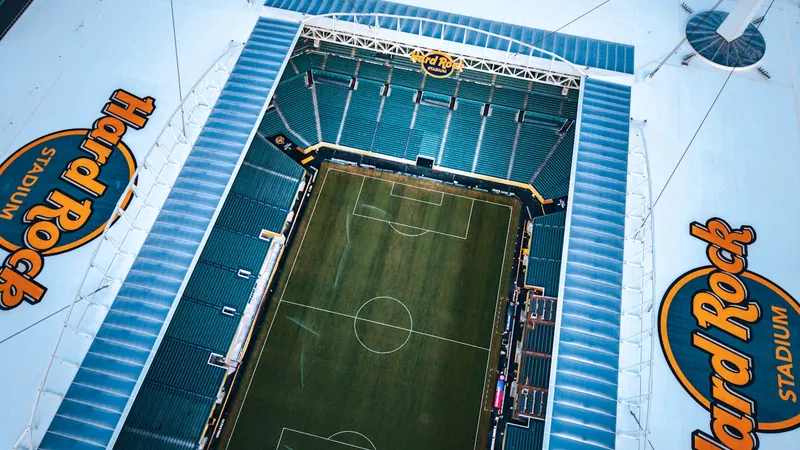
The facility’s defining moment came in 2015 when owner Stephen Ross, who had acquired the stadium in 1994 and the Miami Dolphins in 2009, committed more than $500 million of his own money to a comprehensive renovation. The project kept the 1987 concrete shell intact and rebuilt essentially a new stadium inside it. Ross’s team converted the upper deck into luxury pod seating, opened premium clubs at multiple tiers, and widened the main concourses throughout. The most visible change, though, was overhead. Four open-air canopies, cantilevering inward from the stadium’s perimeter, now shade the main seating bowl while leaving a football-field-sized hole of open sky above the pitch itself. The canopy was a direct response to the single most persistent fan complaint at the venue across three decades. Miami’s sun and humidity.
Seating capacity was reduced from around 75,000 at original opening to 64,767 after the renovation, which is typical of modern stadium economics (premium seats generate more revenue than raw volume). The original playing surface, Tifway 419 Bermuda grass, was kept in place. The warm South Florida climate keeps natural turf playable year-round, a real operational advantage over colder-climate NFL venues that have to switch to synthetic. The stadium also contains four video tower boards installed during the 2016 renovation, positioned at the corners of the bowl.
The event calendar is unusually broad. Six Super Bowls hosted to date (XXIII in 1989, XXIX in 1995, XXXIII in 1999, XLI in 2007, XLIV in 2010, and LIV in 2020), second only to the New Orleans Superdome among single venues, and enough that, with the old Orange Bowl’s five, Miami ties New Orleans for the most Super Bowls of any city. Multiple Orange Bowls, BCS National Championships, and College Football Playoff games. WrestleMania XXVIII in April 2012. Two seasons as a MLB postseason-capable venue for the Florida Marlins, who shared the stadium from 1993 to 2011. The Miami Hurricanes have used the venue for college football home games since 2008. The Miami Open tennis tournament relocated here from Crandon Park on Key Biscayne in 2019, using a purpose-built tennis complex on the stadium grounds and a 14,000-seat center court configured under the canopy during the two-week tournament each spring.
The most ambitious addition came in 2022, when the Formula 1 Miami Grand Prix debuted. A temporary racing circuit was constructed in the parking lots and around the stadium’s perimeter, with the F1 paddock, team garages, and hospitality built inside the stadium’s lower bowl. The race has run annually every May since. No other venue in the world hosts an NFL franchise, a Grand Slam-level tennis tournament, a Formula 1 race, college football, and international soccer matches. For the 2026 FIFA World Cup, Hard Rock Stadium has been assigned seven matches, including the third-place playoff, a fitting assignment for the most multi-sport venue in North America.
Getting to Hard Rock Stadium
Public Transit
The transit profile here is weak, honestly. Miami-Dade County has never built its Metrorail network out to Miami Gardens, and the stadium has always been a drive-in destination. That said, a few options exist.
→ Miami-Dade Transit Bus Route 99: Runs along NW 199th Street. The primary bus line serving the stadium. Connects to Tri-Rail’s Opa-Locka station, which links Miami, Fort Lauderdale, and West Palm Beach on a single commuter rail line.
→ Miami-Dade Transit Bus Route 27: Runs along NW 27th Avenue, stopping within walking distance on event days. Connects to the Metrorail at Dr. Martin Luther King Jr. station.
→ Event-day express shuttles: For Dolphins games, Miami Open matches, and major events, dedicated express buses run from designated park-and-ride locations and Tri-Rail stations. For the 2026 World Cup, FIFA and Miami-Dade Transit are expected to significantly expand shuttle service from hubs throughout Miami-Dade and Broward counties.
If you do not have a car, rideshare is the most reliable option. Bus routes are workable but infrequent. Plan extra time if using transit, and verify schedules closer to match days.
Driving + Parking
Driving is how the vast majority of fans reach the stadium, and highway access is straightforward. GPS: 347 Don Shula Drive, Miami Gardens, FL 33056.
→ From I-95 (east approach): Exit at NW 199th Street (Exit 12B) and head west. About 3 kilometres (2 miles) to the stadium. The most direct route from downtown Miami, Miami Beach, and Fort Lauderdale.
→ From the Florida Turnpike (west approach): Exit at NW 199th Street (Exit 54) and head east. Around 2.4 kilometres (1.5 miles) to the stadium. Best route from the western suburbs and central Florida.
→ From downtown Miami: I-95 North for around 24 kilometres (15 miles), exit at NW 199th Street. 20 minutes without traffic, 45-60 on event days.
→ From Fort Lauderdale: I-95 South for around 32 kilometres (20 miles). Exit NW 199th Street. 25-30 minutes without traffic, 40-60 on event days.
More than 25,000 parking spaces are distributed across multiple lots around the stadium. General parking runs $40-60 for NFL games. Premium lots closer to the gates cost more. Pre-purchase online through the stadium website or ParkMobile. Prices rise at the gate and close-in lots sell out early. Lots open 4-5 hours before kickoff. Tailgating is a serious Miami Gardens institution, particularly for Dolphins and Hurricanes games, and the same culture is expected to carry into the World Cup.
Rideshare
Uber and Lyft are the primary alternatives to driving, particularly for visitors without rental cars. Designated pickup and drop-off zones are located at the southeast corner of the stadium property, marked on event days. A ride from downtown Miami runs $25-40. From Miami Beach, $30-50. From Fort Lauderdale, $40-65. After events, expect 20-40 minutes of wait and significant surge pricing. The standard trick works here as well. Walk a few blocks away from the stadium to a residential street before opening the app, and the surge multiplier often drops.
From the Airport
→ Miami International Airport (MIA): Around 27 kilometres (17 miles) south of the stadium, the primary airport for most visitors. Drive north on I-95 or the Palmetto Expressway (SR 826). 25-40 minutes without event traffic, stretching to 45-70 minutes on match days. Rideshare $25-40.
→ Fort Lauderdale-Hollywood International (FLL): Around 48 kilometres (30 miles) north. Often cheaper for flights and less chaotic than MIA. Take I-95 South. 35-50 minutes normally, up to 75 minutes on event days. Rideshare $40-65.
→ Palm Beach International (PBI): Around 113 kilometres (70 miles) north. Only practical if you are already in the Palm Beach area. Roughly 75-90 minutes by car via I-95 or the Turnpike.
FIFA World Cup 2026 at Hard Rock Stadium
Seven matches have been assigned to Hard Rock Stadium, including the third-place playoff and six group or knockout stage games. The first match is scheduled for June 15, 2026. Under FIFA’s branding policy, the stadium will be temporarily renamed “Miami Stadium” in all broadcasts, signage, and printed materials throughout the tournament.
Natural grass advantage: Unlike several other 2026 venues that need to install temporary natural grass over synthetic turf, Hard Rock already plays on Tifway 419 Bermuda year-round. The warm Miami climate keeps the pitch in peak condition through June and July. One less logistical variable for FIFA to manage.
Climate: South Florida summer is hot and humid. June and July regularly see 32-35°C (90-95°F) with humidity above 80%. The canopy provides substantial shade over most seating areas and redirects airflow through the bowl, but the stadium is not air-conditioned. FIFA is expected to schedule matches in the late afternoon or evening to minimise peak heat exposure. Evening kickoffs will also benefit broadcast ratings for European audiences.
Copa América 2024 was the operational dress rehearsal. Hard Rock hosted multiple Copa América matches in July 2024, including the final between Argentina and Colombia. The final was marred by security breaches and overcrowding at entry gates, which delayed the match by over an hour. The incident prompted an extensive review of ingress protocols, perimeter security, and crowd-flow design. Updates to all three are being implemented ahead of the 2026 World Cup. FIFA and the local organising committee have cited the Copa América debrief directly as a blueprint for what to fix.
South Florida soccer culture: Greater Miami has one of the largest Latin American populations in the United States, with deep roots in Colombian, Argentine, Brazilian, Venezuelan, Cuban, and Honduran communities. World Cup matches at Hard Rock will not feel like neutral-site games. Every group stage draw has a passionate, knowledgeable local fan base within driving distance.
Third-place match: The assignment is unusual in that it brings a very high-profile knockout-round fixture to a venue without a semi-final. For both teams playing (typically the losing semi-finalists), the third-place match is their tournament finale. It will draw a full 60,000+ attendance and a large international broadcast audience.
Construction & Design
Joe Robbie built his stadium the hard way: with his own money. Groundbreaking came on December 1, 1985, and the $115 million construction was financed entirely by the Dolphins founding owner without any public subsidy, an unusual arrangement for a 1980s NFL stadium. The economics required corporate naming rights to recoup the investment, which is why the stadium has been renamed more often than nearly any other major American venue. Design was handled by HOK Sport, the Kansas City firm that has since rebranded as Populous and is responsible for dozens of modern stadium projects around the world. Structural engineering was performed by Bliss & Nyitray Inc.
Opening was on August 16, 1987. The original bowl seated approximately 75,000 for football and could be reconfigured for baseball when the Florida Marlins joined as a second tenant in 1993. The Marlins played here through 2011 before moving to their own domed ballpark in Little Havana. The stadium was a conventional 1980s open-air football bowl. Functional but unremarkable architecturally. Concrete and steel, limited shade, the same complaint from fans across three decades. Miami sun and Miami heat.
Stephen Ross bought the stadium in 1994 and acquired the Dolphins in 2009. By the early 2010s he had committed to a comprehensive rebuild. The 2015-2016 renovation was a privately-funded project of more than $500 million, executed in two phases across two NFL offseasons without ever forcing the Dolphins to relocate. The original concrete shell was preserved, while the interior underwent substantially new construction. Ross’s team converted the upper deck into luxury pod seating, opened premium clubs at three distinct levels (lower bowl, mid-tier, upper-tier), widened the main concourses, and replaced the original locker rooms and broadcast infrastructure. Capacity dropped from the original 75,000 to the current 64,767 in the process, which is a typical trade-off in modern stadium economics. Premium seats generate more revenue per occupant than raw volume ever could.
The most visible architectural change was the canopy. Four open-air canopy structures now cantilever inward from the perimeter, covering most of the main seating bowl while leaving a football-field-sized opening of sky directly above the pitch. The canopy was specifically designed to address Miami’s climate. It reduces direct sunlight on seats by a wide margin. It redirects sea breeze through the bowl during afternoon games. Four video tower boards were installed in the corners of the stadium as part of the same renovation phase. The building has no enclosed roof and no air conditioning. South Florida climate handles the rest.
Peripheral sporting facilities were added over the following years. The Miami Open tennis tournament moved in during 2019, with a purpose-built tennis complex on the stadium grounds that includes a 14,000-seat center court configured underneath the canopy during the annual spring tournament. The Formula 1 Miami Grand Prix debuted in 2022, with a temporary racing circuit constructed in the parking lots and around the stadium footprint. The F1 paddock, team garages, and broadcast centre are installed inside the stadium’s lower bowl during race week each May. Ross’s original vision for a multi-sport regional anchor has been fully realised. There is now, arguably, no other venue in the world that hosts an NFL franchise, a Grand Slam-level tennis tournament, a Formula 1 race, college football, and international soccer matches. The operational complexity is significant. The event-day cultures of each sport could not be more different.
History of Hard Rock Stadium
Joe Robbie founded the Miami Dolphins as an AFL expansion franchise in 1966. The team joined the NFL in 1970 and played at the Orange Bowl in downtown Miami through the 1986 season. By the early 1980s, the Orange Bowl had aged substantially. The city of Miami was unwilling to fund a replacement. Robbie, in a move that was almost unique for the era, financed a new stadium privately. He secured $115 million in private loans, acquired the Miami Gardens site, and broke ground in December 1985. The stadium opened on August 16, 1987 as Joe Robbie Stadium. Initially conceived as a football-only venue, it was modified to accommodate baseball in 1993 when the Florida Marlins joined as co-tenants.
Joe Robbie died in January 1990. Ownership of the stadium passed to his estate and then to the Marlins-Dolphins partnership, which included H. Wayne Huizenga. Stephen Ross acquired full ownership of the stadium in 1994 and purchased majority control of the Dolphins in 2009. Under Ross, the stadium diversified substantially beyond football. The 2015-2016 renovation and the subsequent additions of the Miami Open (2019) and F1 Miami Grand Prix (2022) were part of a coordinated strategy to turn the property into a year-round multi-sport regional destination rather than a venue used primarily for 10 NFL home games per season.
Notable events:
- Super Bowl XXIII, January 22, 1989: San Francisco 49ers defeated the Cincinnati Bengals 20-16. The stadium’s first Super Bowl, less than 18 months after opening.
- Super Bowl XXIX, January 29, 1995: San Francisco 49ers defeated the San Diego Chargers 49-26. Steve Young threw six touchdown passes, a then-Super Bowl record.
- Super Bowl XXXIII, January 31, 1999: Denver Broncos defeated the Atlanta Falcons 34-19, John Elway’s final NFL game.
- Super Bowl XLI, February 4, 2007: Indianapolis Colts defeated the Chicago Bears 29-17 in the first Super Bowl ever played in rain.
- Super Bowl XLIV, February 7, 2010: New Orleans Saints defeated the Indianapolis Colts 31-17.
- Super Bowl LIV, February 2, 2020: Kansas City Chiefs defeated the San Francisco 49ers 31-20.
- WrestleMania XXVIII, April 1, 2012: WWE event featuring The Rock vs. John Cena. Attendance 78,363.
- Copa América 2024 Final, July 14, 2024: Argentina defeated Colombia 1-0 in extra time. Match delayed by over an hour due to ingress security breaches at perimeter gates.
- Orange Bowl: Hosted annually since 1996 (except 1999), a major college football bowl game tied to ACC championship access.
- F1 Miami Grand Prix: Held annually every May since 2022 on a temporary circuit around the stadium.
- Miami Open Tennis: Held annually since 2019 after relocating from Crandon Park on Key Biscayne.
Hard Rock Stadium has hosted six Super Bowls, more than any venue except the New Orleans Superdome, the most recent being LIV in February 2020. The assignment of a seventh Super Bowl is widely expected within the next decade. The 2026 World Cup third-place match, combined with six earlier tournament fixtures, represents the largest soccer-specific event portfolio in the venue’s history. An unusually broad event profile for a stadium approaching its 40th year of operation.
Sources & Further Reading
Starting with the basics. The Hard Rock Stadium official site (hardrockstadium.com) handles ticketing, parking, event calendars, and venue policy. The Miami Dolphins team site (miamidolphins.com/stadium) overlaps on general information but leans harder on Dolphins-specific content and premium seating programs.
For 2026 World Cup match schedules and venue assignments, the official FIFA page (fifa.com) is the authoritative source, updated as draws progress.
Transit information is split across multiple agencies. Miami-Dade Transit (miamidade.gov/transit) covers buses and Metrorail. Tri-Rail (tri-rail.com) operates commuter rail between Miami, Fort Lauderdale, and West Palm Beach, with event-day shuttle service to the stadium area.
Historical and architectural depth comes from Wikipedia (en.wikipedia.org/wiki/Hard_Rock_Stadium), which remains the most comprehensive single reference on naming history, capacity changes, and the renovation timeline. The F1 Miami Grand Prix maintains its own site (f1miamigp.com), useful mainly during race weekends in May. The Miami Open has an official tournament page (miamiopen.com) that covers the tennis-specific configuration.
Quick Facts
Everything you need at a glance.
Stadium specs
- Capacity
- 64,767
- Opened
- 1987
- Cost
- $115 million (1987) + over $500 million renovation (2015-2016) (~$344 million (1987 build in 2025 dollars) today)
- Roof
- Partial (Canopy)
- Surface
- Natural Grass
- Tenants
- Miami Dolphins (NFL), Miami Hurricanes (NCAA), Miami Open (Tennis)
- WC 2026
- Third-Place Match · 7 matches
- First WC match
- June 15, 2026
Construction & location
- Groundbreaking
- December 1, 1985
- Architects
- HOK Sport (now Populous)
- Engineering
- Bliss & Nyitray Inc.
- Address
- 347 Don Shula Drive, Miami Gardens, FL 33056, USA
- GPS
- 25.9580°N, 80.2389°W
Photo Gallery
Fun Facts
Six Super Bowls hosted (XXIII, XXIX, XXXIII, XLI, XLIV, LIV), second only to the New Orleans Superdome among single venues. Add the old Orange Bowl's five and Miami ties New Orleans for the most of any city.
Stephen Ross spent more than $500 million on a privately-funded renovation from 2015 to 2016, adding the canopy structure, new luxury suites, and a reimagined concourse. The existing stadium shell was kept. A new building was essentially rebuilt inside it.
The Formula 1 Miami Grand Prix has run since 2022 on a temporary circuit in the parking lots, with the F1 paddock inside the lower bowl of the stadium itself. No other venue in North America hosts NFL, F1, Grand Slam-level tennis, and a World Cup.
Stadium Location
Frequently Asked Questions
- What is the seating capacity of Hard Rock Stadium?
- Current NFL capacity is 64,767, which is a reduction from the 75,000+ the original bowl seated between 1987 and 2014. The 2015-2016 renovation converted a large portion of the upper deck into premium seating and luxury pods, which reduced raw capacity but increased revenue per seat. For major events, temporary seating can push attendance above 70,000. For the 2026 World Cup, FIFA's configuration will depend on pitch and seating requirements.
- Where is Hard Rock Stadium located?
- 347 Don Shula Drive, Miami Gardens, Florida 33056. About 27 kilometres (17 miles) north of downtown Miami, between I-95 to the east and the Florida Turnpike to the west. Miami Gardens itself is a Miami-Dade County city that was only incorporated in 2003, long after the stadium opened in 1987.
- How many World Cup 2026 matches will Hard Rock Stadium host?
- Seven matches, including the third-place playoff and six group or knockout stage games. The first match at the venue is scheduled for June 15, 2026. Under FIFA's branding policy, the stadium will be temporarily renamed 'Miami Stadium' for the tournament, with corporate naming rights resuming afterwards.
- Does Hard Rock Stadium have a roof?
- A partial one. The canopy structure added during the 2015-2016 renovation covers most of the main seating bowl but leaves a football-field-sized hole in the middle, open to the sky. The canopy reduces direct sunlight on seats by a wide margin and redirects airflow through the bowl. Miami summers are hot and humid, so it is functionally essential. The stadium is not fully enclosed, and there is no air conditioning.
- How do I get to Hard Rock Stadium by public transit?
- The transit profile here is weak. Miami-Dade County has never built its rail network out to Miami Gardens, and most fans drive. Bus routes 99 (NW 199th Street) and 27 (NW 27th Avenue) serve the stadium area but run infrequently. On event days, express shuttles typically run from Tri-Rail stations and designated park-and-ride locations. For the 2026 World Cup, FIFA and Miami-Dade Transit are expected to significantly expand shuttle service, with schedules confirmed closer to match dates.
- How much is parking at Hard Rock Stadium?
- $40-60 for NFL games in stadium-managed lots. Premium lots closer to the gates cost more. The complex has more than 25,000 parking spaces across multiple lots. Pre-purchase through the stadium website or ParkMobile. Prices increase at the gate. Lots open 4-5 hours before kickoff. Tailgating is a significant pre-game institution here.
- What was Hard Rock Stadium previously called?
- The stadium has gone through more name changes than almost any major venue in American sports. Joe Robbie Stadium (1987-1996), Pro Player Park (1996-1997), Pro Player Stadium (1997-2005), Dolphins Stadium (2005-2006), Dolphin Stadium (2006-2009, yes they dropped the s), Land Shark Stadium (2009-2010, sponsored by Jimmy Buffett's beer), Sun Life Stadium (2010-2016), and finally Hard Rock Stadium since 2016. The current naming rights deal runs through 2034 and is reportedly worth $250 million over 18 years.
- How far is Hard Rock Stadium from Miami International Airport?
- Around 27 kilometres (17 miles) south of the stadium. By car, 25-40 minutes without event traffic, stretching to 45-70 minutes on match days. Rideshare runs $25-40. Fort Lauderdale-Hollywood International Airport (FLL) is roughly 48 kilometres (30 miles) north, which is sometimes a cheaper flight option.
- When was Hard Rock Stadium built?
- Groundbreaking was on December 1, 1985. Opening was on August 16, 1987, when the venue was known as Joe Robbie Stadium. It was originally financed privately by Dolphins founding owner Joe Robbie, without public money. That was unusual for a 1980s NFL build. The trade-off was that naming rights became essential to recoup costs, which triggered the long sequence of corporate renames that followed.
- Who designed and built Hard Rock Stadium?
- The original 1987 building was designed by HOK Sport (now rebranded as Populous), with structural engineering by Bliss & Nyitray Inc. The 2015-2016 renovation that added the canopy and reconfigured the seating bowl was a privately-funded project of more than $500 million commissioned by owner Stephen Ross. The renovation kept the original stadium shell and essentially built a new venue inside it.
- How much did Hard Rock Stadium cost to build?
- The original 1987 construction cost was $115 million, approximately $344 million in 2025 dollars. The 2015-2016 renovation added more than $500 million, entirely funded by Dolphins owner Stephen Ross without public contribution. Combined lifetime investment in the facility now exceeds $600 million in nominal dollars.
- Who owns Hard Rock Stadium?
- Stephen Ross, the real estate developer and founder of Related Companies, has owned the stadium since 1994 and purchased the Miami Dolphins in 2009. Under his ownership, the venue has diversified far beyond football. The Miami Open tennis tournament relocated from Crandon Park in 2019. The Formula 1 Miami Grand Prix debuted in 2022. Copa América matches were hosted in 2024. This multi-sport strategy made Hard Rock a serious FIFA candidate for 2026.
- What is the F1 Miami Grand Prix?
- A Formula 1 race held on a temporary street circuit built in the parking lots and grounds surrounding Hard Rock Stadium, with the F1 paddock and team facilities located inside the stadium's lower bowl. The race has run every spring since 2022. It is one of three annual F1 races held in the United States, alongside Austin (Circuit of the Americas) and Las Vegas. The integration of a Grand Prix track into a regular NFL stadium's footprint is unique in world motorsport.
- Will Hard Rock Stadium be renamed for the World Cup?
- Yes. Under FIFA's corporate naming policy, all venues are referred to by neutral geographic names during the tournament. Hard Rock Stadium will be temporarily known as 'Miami Stadium' in all broadcasts, signage, printed materials, and ticketing. Corporate naming rights resume after the tournament ends.
- What is the surface at Hard Rock Stadium?
- Tifway 419 Bermuda grass, a natural surface that has been in place since the original 1987 opening. Unlike several other 2026 World Cup venues that will need to install temporary natural grass over synthetic turf, Hard Rock already plays on grass year-round. The warm Miami climate keeps the turf playable through winter. One less variable for FIFA to manage during the tournament.
Last updated: 2026-07-04