About the Cotton Bowl
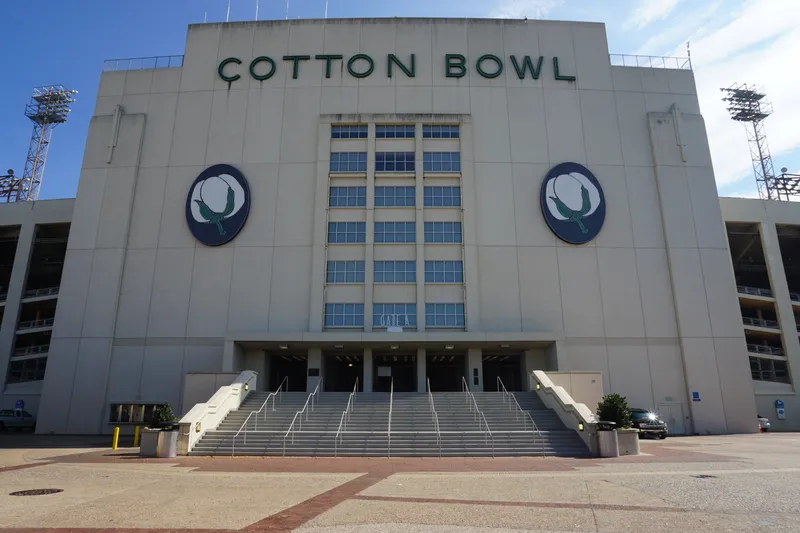
Inside Fair Park in Dallas, one of America’s ten largest stadiums has no permanent team. The Cotton Bowl opened in 1930, the oldest surviving stadium in Texas, and it lives on the strength of a single game each October: the Red River Rivalry between Texas and Oklahoma. Its history runs from the Great Depression through the 1994 World Cup to the present day, a monument sustained by one rivalry game and the State Fair of Texas.
The stadium was originally called Fair Park Stadium, built for $328,000 as part of the State Fair of Texas complex. It became the Cotton Bowl in 1936 when the Cotton Bowl Classic, one of college football’s original New Year’s Day bowl games, made it its home. For decades, the Cotton Bowl was one of the most important venues in American sports: the Dallas Cowboys played here from 1960 to 1971, the Cotton Bowl Classic was appointment television on New Year’s Day, and the State Fair of Texas turned the surrounding fairgrounds into the biggest party in the South every October.
The Red River Rivalry is the Cotton Bowl’s reason for being. Every October, during the State Fair, Texas and Oklahoma split the stadium 50/50, burnt orange on one side, crimson on the other, the 50-yard line as the dividing border. The spectacle of 92,000 fans in two colors, Big Tex standing outside, the smell of fried food in the air, it is one of the most distinctive game-day settings in all of American sports and the single event that has kept this stadium relevant for nearly a century.
The Cotton Bowl hosted six matches during the 1994 FIFA World Cup, proving it could stage top-level soccer on the international stage. A major renovation in 2008–2010 added 17,000 seats, modernized the infrastructure, and preserved the Art Deco character of the Fair Park complex. The stadium is a Texas landmark, its survival tied to the Red River Rivalry and the enduring pull of Fair Park itself.
Getting to the Cotton Bowl
Public Transit
The Cotton Bowl is served by DART light rail, with Fair Park station steps from the stadium.
→ Via DART Green Line: Fair Park station is adjacent to the Cotton Bowl, about a 5-minute walk from the gates. From downtown Dallas (West End or Akard stations), the ride takes about 10 minutes. Fare is $2.50 with a DART GoPass.
→ Via DART Bus: Several bus routes serve Fair Park, including routes 2 and 56 along Parry Avenue and Martin Luther King Jr. Boulevard.
DART is the best option, especially during the State Fair of Texas when parking is scarce and expensive. The Green Line drops you at the gates, fast, cheap, and avoids the nightmare of Fair Park traffic.
Driving + Parking
The stadium address is 3750 The Midway, Dallas, TX 75210. I-30 is the primary approach from all directions.
→ From Downtown Dallas (~2 mi): I-30 East to the 2nd Avenue or Haskell Avenue exits. About 10 minutes without traffic.
→ From Fort Worth (~35 mi): I-30 East to the Fair Park exits. About 35–45 minutes.
→ From North Dallas/Plano (~20 mi): US-75 South to I-30 East. About 25–35 minutes.
Fair Park surface lots cost $10–$30 on event days. During the State Fair (late September through October), parking is more expensive and fills very early. Neighborhood parking is restricted and enforced during events. DART is strongly recommended during the State Fair, driving to Fair Park during the fair is a test of patience.
Rideshare
Uber and Lyft have designated zones on Parry Avenue near the Fair Park entrance. From downtown Dallas hotels, expect $8–$12. From Uptown, $10–$15. During the State Fair, surge pricing is heavy, take DART. Post-event pickups are easier from the 2nd Avenue gate on the east side.
From the Airport
→ Dallas Love Field (DAL): 8 miles northwest, about 15–20 minutes by car. Hub for Southwest Airlines with extensive domestic service. DART bus route 39 connects Love Field to downtown; transfer to the Green Line for Fair Park. Rideshare runs $12–$18.
→ Dallas/Fort Worth International (DFW): 22 miles northwest, about 30–40 minutes by car. Major hub for American Airlines with extensive domestic and international service. DART Orange Line connects DFW to downtown; transfer to the Green Line for Fair Park. Rideshare runs $25–$35.
Construction & Design
The Cotton Bowl was built for a fair, not a football team. In 1930 the architect Mark Lemmon designed a 45,507-seat concrete bowl for the State Fair of Texas grounds at Fair Park, and it opened simply as Fair Park Stadium for about $328,200. The Art Deco buildings around it, the largest such collection in the country, still frame the approach. The stadium took the Cotton Bowl name in 1936, after the bowl game it would come to host.
Then Doak Walker happened. The SMU running back drew such crowds in the late 1940s that the stadium had to grow to hold them, which is how it earned the nickname “The House That Doak Built.” A second deck went onto the west side in 1948, lifting capacity to 67,000, and the east side was double-decked the next year to reach 75,504. For decades after, the Cotton Bowl was one of the biggest stadiums in the country with no permanent tenant.
The modern shape arrived between 2008 and 2010. A renovation of roughly $57 million encircled the upper deck, added around 17,000 seats, and brought capacity to today’s 92,100, all while keeping the building’s historic character intact. The same stretch saw the Cotton Bowl Classic decamp to AT&T Stadium in Arlington, leaving the old bowl its name but not its signature game.
The field has changed with the times. Natural grass gave way to AstroTurf in 1970, grass was reinstalled specifically for the 1994 World Cup, and the stadium now plays on an artificial Matrix Turf surface. A new two-year renovation, announced in late 2023 and budgeted near $140 million, is the largest investment in the place since the upper deck was closed, a sign that Dallas still has plans for a stadium that turns 100 in 2030.
History of the Cotton Bowl
The Cotton Bowl was built in 1930 as Fair Park Stadium, a 46,000-seat venue designed by architect Mark Lemmon as part of the State Fair of Texas complex. It was renamed the Cotton Bowl in 1936 when the first Cotton Bowl Classic was played, and the stadium’s identity became inseparable from the bowl game and the fair.
Dallas Cowboys Era (1960–1971): The Cotton Bowl was the original home of the Dallas Cowboys. Tom Landry, Don Meredith, Bob Lilly, and Roger Staubach all played here before the team moved to Texas Stadium in Irving. The Cowboys’ first 12 NFL seasons were played inside these walls, including the 1966 NFL Championship Game on January 1, 1967, a narrow loss to the Packers the year before the two teams met again in Green Bay’s famous “Ice Bowl.”
1994 FIFA World Cup (June–July 1994): The Cotton Bowl hosted six World Cup matches, more than any other venue in the southern United States. The tournament’s success in Dallas helped establish MLS and proved that American soccer could thrive in a football town. FC Dallas’s existence owes something to those six games.
Red River Rivalry: The annual Texas vs. Oklahoma game has been a Fair Park fixture during the State Fair of Texas since 1929, and has filled the Cotton Bowl itself since 1932. The stadium splits 50/50 between burnt orange and crimson, Big Tex looming outside, fried food and rivalry in the air. It is the single event that has kept this venue relevant for nearly a century, and it remains one of the most distinctive spectacles in American sports.
2008–2010 Renovation: A roughly $57 million renovation added about 17,000 seats, encircled the upper deck, installed modern amenities, and brought capacity to 92,100, all while preserving the Art Deco character of Fair Park. A separate, larger renovation budgeted near $140 million followed for 2024-2025. The Cotton Bowl Classic moved to AT&T Stadium in Arlington in 2010, but the stadium retained its name and its identity.
From the Cowboys’ first touchdown to six World Cup matches to 92,000 fans split in two colors every October, the Cotton Bowl is a Texas monument, the oldest stadium in the state, sustained by a rivalry, a fair, and a city that has never stopped finding reasons to fill it.
Sources & Further Reading
- Wikipedia entry on the Cotton Bowl: en.wikipedia.org/wiki/Cotton_Bowl_(stadium). Capacity, the expansion timeline, costs, surface history, and the 1994 World Cup.
- Cotton Bowl official site: cottonbowlstadium.com. Events, seating, and visitor information at Fair Park.
- FIFA, “USA 1994: three memorable games in Dallas”: fifa.com. The Cotton Bowl’s role in the 1994 World Cup.
Quick Facts
Everything you need at a glance.
Stadium specs
- Capacity
- 92,100
- Opened
- 1930
- Cost
- $328,200 (1930 original); 2008-2010 expansion around $57 million; 2024-2025 renovation around $140 million
- Roof
- Open
- Surface
- Matrix Turf (Artificial)
- Tenants
- Red River Rivalry (NCAA Big 12/SEC)
Construction & location
- Groundbreaking
- 1930 (exact date not recorded)
- Architects
- Mark Lemmon (original, 1930), George Dahl (1936), HOK (1993-94 renovation), Overland Partners (2024-25 renovation)
- Engineering
- Chappell, Stokes & Brenneke (1948-49 double-decking)
- General contractor
- Not publicly recorded
- Address
- Cotton Bowl, 3750 The Midway, Fair Park, Dallas, TX 75210
- GPS
- 32.7796°N, 96.7596°W
Photo Gallery
Fun Facts
The Cotton Bowl is the oldest surviving stadium in Texas, built in 1930 during the State Fair of Texas expansion of Fair Park, and its 92,100 capacity makes it one of the 10 largest stadiums in the United States, despite no longer hosting a permanent college or professional tenant.
The Red River Rivalry between Texas and Oklahoma, played at the Cotton Bowl every October during the State Fair of Texas, splits the stadium 50/50 between burnt orange and crimson, with the 50-yard line serving as the dividing line in one of the most visually distinctive settings in college football.
The Cotton Bowl hosted six matches during the 1994 FIFA World Cup, more than any other venue in the southern United States, including a Spain vs. South Korea group match that drew 63,998 fans and proved that Dallas could support top-level soccer on the international stage.
Stadium Location
Frequently Asked Questions
- What is the seating capacity of the Cotton Bowl?
- The Cotton Bowl seats 92,100, making it one of the 10 largest stadiums in the United States. The current capacity was achieved after a major 2008–2010 renovation that added 17,000 seats and modernized the facility while preserving its historic character.
- Where is the Cotton Bowl located?
- The Cotton Bowl is at 3750 The Midway in Dallas, Texas 75210. It sits within Fair Park, a 277-acre complex of Art Deco buildings about 2 miles east of downtown Dallas.
- What is the Red River Rivalry?
- The Red River Rivalry (also called the Red River Showdown) is the annual college football game between Texas and Oklahoma, played at the Cotton Bowl every October during the State Fair of Texas. The stadium is split 50/50 between the two fan bases, with the 50-yard line as the dividing line.
- How do I get to the Cotton Bowl?
- DART's Green Line stops at Fair Park station, adjacent to the Cotton Bowl. From downtown Dallas, the ride takes about 10 minutes. By car, approach via I-30 to the 2nd Avenue or Haskell Avenue exits. Parking is available in Fair Park lots at $10–$30 on event days.
- Is there parking at the Cotton Bowl?
- Fair Park has extensive surface parking lots at $10–$30 on event days. During the State Fair (September–October), parking is more expensive and fills early. DART is strongly recommended during the State Fair. Residential neighborhood parking is restricted during events.
- Did the Cotton Bowl host the World Cup?
- Yes. The Cotton Bowl hosted six matches during the 1994 FIFA World Cup, the most of any venue in the southern United States. They included Spain vs. South Korea, Germany vs. South Korea, a Round of 16 game, and the Netherlands vs. Brazil quarterfinal on July 9, 1994. The success of the 1994 games helped establish Dallas as a major soccer market.
- What is the Cotton Bowl Classic?
- The Cotton Bowl Classic was one of college football's original New Year's Day bowl games, first played in 1937. The game moved to AT&T Stadium in Arlington in 2010, but the Cotton Bowl stadium retains its name. The First Responder Bowl and other college games are still played at the venue.
- How far is the airport from the Cotton Bowl?
- Dallas Love Field (DAL) is 8 miles northwest, about 15–20 minutes by car. Hub for Southwest Airlines. Dallas/Fort Worth International (DFW) is 22 miles northwest, about 30–40 minutes. DFW is the major hub for American Airlines. DART connects DFW to Fair Park via the Orange Line with a transfer.
- When was the Cotton Bowl built, and how old is it?
- The Cotton Bowl opened in 1930 as Fair Park Stadium, designed by Dallas architect Mark Lemmon for the State Fair grounds. That makes it the oldest surviving stadium in Texas, built six years before it took the Cotton Bowl name.
- Why is it called the Cotton Bowl?
- The stadium was renamed the Cotton Bowl in 1936, taking the name of the bowl game it would host. It is also nicknamed 'The House That Doak Built' after SMU running back Doak Walker, whose huge crowds in the late 1940s drove the stadium's double-decking expansions.
- Who designed and built the Cotton Bowl?
- Mark Lemmon designed the original 1930 stadium for about $328,200. George Dahl led the 1936 renovation, the firm Chappell, Stokes & Brenneke engineered the 1948-49 double-decking, and HOK handled the 1993-94 renovation. The original cost is roughly $6 million in today's money.
- What is the playing surface at the Cotton Bowl?
- The stadium now uses an artificial Matrix Turf surface. It was natural grass for much of its history, switched to AstroTurf from 1970 to 1993, and had grass reinstalled specifically for the 1994 World Cup before later moving to its current synthetic field.
- Is the Cotton Bowl being renovated?
- Yes. A two-year renovation budgeted around $140 million was announced in late 2023 for 2024 and 2025, the largest investment in the stadium since the 2008-2010 expansion. It upgrades the concourses, premium areas, and infrastructure while keeping the historic Art Deco character of Fair Park.
Last updated: 2026-07-10