About Progressive Field
In downtown Cleveland, a 34,830-seat ballpark has hosted three World Series and, for six seasons, an unbroken run of 455 sellouts on the same patch of Kentucky bluegrass. Clevelanders still call it “The Jake,” and Progressive Field still plays like the venue that saved baseball in this city.
The park opened in 1994 as Jacobs Field, named for team owner Richard E. Jacobs, and immediately transformed a franchise that had been an afterthought in American sports. Designed by HOK Sport (now Populous) for $175 million, it anchored the Gateway Sports and Entertainment Complex alongside what is now Rocket Mortgage FieldHouse. The Indians sold out 455 consecutive games from 1995 to 2001, an MLB record at the time, with all 81 home games selling out before Opening Day in five separate seasons. The team retired the number 455.
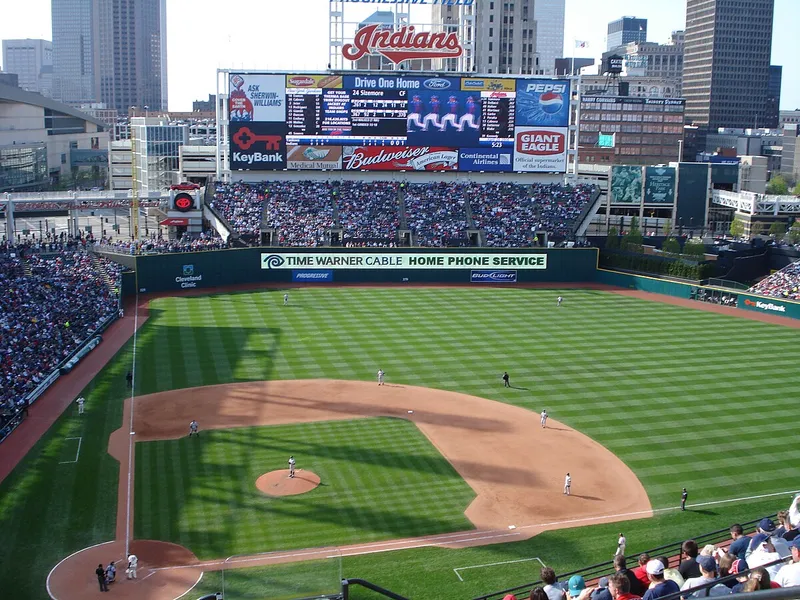
Progressive Corporation purchased the naming rights in January 2008 for $57.6 million over 16 years, extended through 2036, and despite the name change, the ballpark’s identity has never wavered. It was voted the best in MLB in a 2008 Sports Illustrated fan poll, and its intimate sightlines, exposed steel architecture, and views of the Cleveland skyline beyond the outfield remain among the finest in the sport.
The park also hosted both the All-Star Game and the World Series in the same season, 1997, the first ballpark to pull off that double since 1977.
Getting to Progressive Field
Public Transit
Progressive Field has one of the best transit connections of any ballpark in the American League, three rail lines converge at a station connected by an enclosed walkway.
→ Via RTA Rapid Transit: Take the Red, Blue, or Green Line to Tower City-Public Square station. A 1,050-foot enclosed walkway connects the Tower City food court to the arena district, right across the street from the ballpark. The walkway opens 3 hours before every game.
→ Via HealthLine BRT: The Euclid Avenue bus rapid transit line stops near the ballpark at Ontario Street and Carnegie Avenue, a 5-minute walk to the gates.
RTA runs service for 60 minutes after games. Free parking is available at outlying RTA park-and-ride stations, ride the Red Line in and skip the downtown parking hassle entirely.
Driving + Parking
The ballpark address is 2401 Ontario Street, Cleveland, OH 44115. I-77 and I-90 are the primary approaches.
→ From Akron (~34 mi): I-77 North to downtown Cleveland. About 42 minutes.
→ From Columbus (~143 mi): I-71 North to downtown. About 2 hours 15 minutes.
→ From Pittsburgh (~130 mi): I-76 West to the Ohio Turnpike. About 2 hours 15 minutes.
The Gateway East Garage (enter via Bolivar Road) offers parking for $10–$15. The Great Day Garage at 650 E Huron Rd is the official fan garage. Surrounding lots range from $5–$20. All passes are mobile-only via the MLB Ballpark app, pre-book through SpotHero or ParkWhiz for popular games.
Rideshare
Uber and Lyft have a designated pickup/drop-off zone at Erie Court and East 9th Street. From downtown hotels, expect $8–$15. From CLE airport, about $25–$35. Post-game surge is moderate, walk a few blocks toward East 4th Street for a faster pickup and a better selection of bars while you wait.
From the Airport
→ Cleveland Hopkins International (CLE): 12 miles west, about 15–20 minutes by car. The RTA Red Line runs directly from the airport to Tower City station near the ballpark in about 37 minutes for $2.50, one of the best airport-to-ballpark transit connections in MLB. Rideshare runs $25–$35.
Construction & Design
When it opened as Jacobs Field on April 4, 1994, the ballpark anchored the two-venue Gateway Sports and Entertainment Complex that Cleveland built to pull activity back into its downtown core, paired with the arena now known as Rocket Mortgage FieldHouse. HOK Sport, the Kansas City firm since rebranded as Populous, served as lead architect, working with local associates Whitley & Whitley and Triad Design, while Cleveland’s Osborn Engineering handled structural work and Huber, Hunt & Nichols built it for roughly $175 million. The design was a foundational entry in the 1990s retro-modern ballpark movement, trading the symmetrical concrete bowls of the 1970s for an intimate, baseball-only park with sightlines angled toward home plate and the Cleveland skyline framed beyond the outfield.
Rather than hide its structure behind masonry, HOK celebrated it. White-painted exposed steel frames the seating decks and concourses, giving the park an industrial character that echoes Cleveland’s manufacturing heritage. The most recognizable feature is the set of slender vertical light towers rising above the upper deck, locally nicknamed the “toothbrush” lights, whose vertical arrays help outfielders track fly balls without glare while punctuating the downtown skyline. The playing field is deliberately asymmetric, with a 19-foot left-field wall, a mini-Green Monster nod to Fenway, contrasting with 8-foot fences in center and right over a Kentucky bluegrass surface.
The park’s original 42,865-seat capacity supported the record 455 consecutive sellouts from 1995 to 2001, but the venue has since been reshaped around fan experience rather than raw seat count. The 2014-2015 Progressive Field Evolution reworked the Gate C entrance, moved the bullpens into the outfield seating, and added social spaces, trimming capacity into the high 30,000s. The far larger 2023-2025 Progressive Field Reimagined project, $202.5 million within a $435 million lease package that keeps the Guardians in Cleveland through at least 2036, opened up the steep upper deck for panoramic skyline views, added a left-field beer garden and the right-field Pennant District, and delivered the first full rebuild of both clubhouses since 1994. Manica led the design with Moody Nolan as architect of record and Mortenson as construction manager, settling capacity near 35,000.
History of Progressive Field
Progressive Field was built to replace Cleveland Stadium, a cavernous lakefront facility the Indians shared with the Browns. The $175 million project, designed by HOK Sport, opened in 1994 as Jacobs Field and immediately became one of the most celebrated ballparks in the game.
First Game (April 4, 1994): The Cleveland Indians defeated the Seattle Mariners 4-3 before a sellout crowd. The new ballpark’s intimate design, a dramatic contrast to the 74,000-seat Cleveland Stadium, made every seat feel close to the action.
455 Consecutive Sellouts (1995–2001): From June 12, 1995 to April 4, 2001, the Indians sold out 455 straight games, an MLB record at the time. Demand was so intense that all 81 home games sold out before Opening Day in five separate seasons.
1997 All-Star Game and World Series: The first ballpark since 1977 to host both in the same season. The AL won the All-Star Game 3-1 in July, and the Indians reached the World Series in October but fell to the Florida Marlins in seven heartbreaking games.
2016 World Series (October–November 2016): The Indians hosted Games 1, 2, 6, and 7 against the Chicago Cubs. Game 7, routinely ranked among the greatest World Series games ever played, went to extra innings in a rain delay before the Cubs won their first championship in 108 years.
From the 455 sellout streak to three World Series to the skyline views beyond the outfield, Progressive Field is where Cleveland baseball lives, a ballpark that transformed a franchise and a downtown, still intimate, still electric, still “The Jake” to anyone who was there for those sellout years.
Sources & Further Reading
- Wikipedia entry on Progressive Field: en.wikipedia.org/wiki/Progressive_Field. Opening, original cost and capacity, dimensions, and naming-rights history.
- Ballparks of Baseball, Progressive Field: ballparksofbaseball.com. A ballpark reference covering the HOK design and history.
- Mortenson, Progressive Field Renovations: mortenson.com. The construction manager’s record of the $202.5M Reimagined project.
- Cleveland Guardians official ballpark page: mlb.com/guardians/ballpark. Events, tickets, and visitor information.
Quick Facts
Everything you need at a glance.
Stadium specs
- Capacity
- 34,830
- Opened
- 1994
- Cost
- Around $175 million (1994); 2023-2025 Progressive Field Reimagined renovation ~$202.5 million
- Roof
- Open
- Surface
- Natural Grass (Kentucky Bluegrass)
- Tenants
- Cleveland Guardians (MLB)
Construction & location
- Groundbreaking
- January 13, 1992 (opened April 4, 1994)
- Architects
- HOK Sport (now Populous), Whitley & Whitley and Triad Design (associate architects)
- Engineering
- Osborn Engineering
- General contractor
- Huber, Hunt & Nichols
- Address
- Progressive Field, 2401 Ontario Street, Cleveland, OH 44115
- GPS
- 41.4963°N, 81.6860°W
Photo Gallery
Fun Facts
From June 12, 1995 to April 4, 2001, the Indians sold out 455 consecutive home games at Jacobs Field, an MLB record at the time, with all 81 home games selling out before Opening Day in five separate seasons. The team retired the number 455 in honour of the streak.
Progressive Field was the first ballpark in two decades, since 1977, to host the All-Star Game and the World Series in the same season, both in 1997, when the American League won the Midsummer Classic 3-1 in July and the Indians fell to the Florida Marlins in seven games that October.
The ballpark was voted the best in Major League Baseball in a 2008 Sports Illustrated fan opinion poll, the same year it was renamed from Jacobs Field to Progressive Field after Progressive Corporation purchased the naming rights for $57.6 million over 16 years.
Stadium Location
Frequently Asked Questions
- What is the seating capacity of Progressive Field?
- Progressive Field seats 34,830 fans. The original capacity was 42,865 when the park opened in 1994 as Jacobs Field, but renovations have reduced it to create a more intimate atmosphere. The ballpark was designed by HOK Sport (now Populous) at a cost of $175 million.
- Where is Progressive Field located?
- Progressive Field is at 2401 Ontario Street in Cleveland, Ohio 44115. It sits in the Gateway Sports and Entertainment Complex alongside Rocket Mortgage FieldHouse (home of the Cavaliers), about 5 blocks south of Public Square in downtown Cleveland.
- Why was Jacobs Field renamed Progressive Field?
- On January 11, 2008, Progressive Corporation purchased the naming rights for $57.6 million over 16 years. The park had been Jacobs Field since 1994, named after then-owner Richard E. Jacobs. Many fans still call it 'The Jake.' The deal was extended through 2036.
- How do I get to Progressive Field by public transit?
- Take the RTA Red, Blue, or Green Line to Tower City-Public Square station. A 1,050-foot enclosed walkway connects Tower City to the arena district right across from the ballpark. The HealthLine BRT on Euclid Avenue also stops nearby. RTA park-and-ride lots offer free parking at outlying stations.
- Is there parking at Progressive Field?
- The Gateway East Garage (enter via Bolivar Road) offers parking for $10-$15. The Great Day Garage at 650 E Huron Rd is the official fan garage. Surrounding surface lots range from $5-$20. All passes are mobile-only via the MLB Ballpark app. Pre-booking through SpotHero is recommended.
- What World Series games have been played at Progressive Field?
- Progressive Field hosted World Series games in 1995 (Indians vs. Braves), 1997 (Indians vs. Marlins), and 2016 (Indians vs. Cubs). The 2016 Game 7, routinely ranked among the greatest World Series games ever, went to extra innings before the Cubs won their first title in 108 years.
- How far is the airport from Progressive Field?
- Cleveland Hopkins International Airport (CLE) is 12 miles west, about 15-20 minutes by car. The RTA Red Line connects the airport directly to Tower City station near the ballpark in about 37 minutes for $2.50, one of the best airport-to-ballpark transit connections in MLB.
Last updated: 2026-07-04