About the Santiago Bernabéu
Rebuilt inside its own skin, the Santiago Bernabéu is the same stadium Real Madrid has called home since 1947 and, at the same time, something entirely new. The ground sits on the Paseo de la Castellana in Madrid’s Chamartín district, at Avenida de Concha Espina 1, roughly 5 kilometres (3 miles) north of the city center. A 2019-2024 renovation costing around 1.76 billion euros wrapped the old concrete bowl in a curving stainless-steel facade, dropped a retractable roof over the seats, and buried a retractable grass pitch beneath the field. The result is one of the most expensive stadium projects ever undertaken, spent not on a new building but on reinventing an old one.
The capacity is a slippery number. Real Madrid does not publish an exact post-renovation figure, and reported totals range from about 78,000 to 85,000, with 83,186 the most commonly cited. Club president Florentino Pérez has said the venue is authorized for roughly 80,000, since going higher would demand additional emergency exits. Whatever the precise count, the Bernabéu remains one of the largest football stadiums in Europe, and home to the most successful club in the history of the European Cup.
Real Madrid is the only tenant, and always has been. The club has won its record haul of European titles with this ground as its base, including the first five European Cups in a row between 1956 and 1960. The stadium is named after Santiago Bernabéu Yeste, the club president who spent the 1940s pushing to replace Real Madrid’s cramped old Chamartín ground with something far more ambitious, and whose name it has carried since 1955.
The renovation is what everyone talks about now. The retractable pitch, engineered by Sener, splits into six trays that descend into a climate-controlled chamber below the field, which lets the bowl host concerts and other events without destroying the grass. Taylor Swift’s Eras Tour played the reborn stadium in May 2024, and in November 2025 the Bernabéu staged the first NFL regular-season game ever held in Spain. The pitch technology has not been without its critics, with some questioning the quality and durability of the shallow turf profile, but the ambition behind it is unmistakable: a football stadium built to make money 365 days a year.
Getting to the Santiago Bernabéu
Public Transit
Madrid’s Metro is the easy way in. Line 10 stops at Santiago Bernabéu station, whose exits open right onto the stadium, a two to three minute walk from the platform.
→ From central Madrid: There is no direct single-line ride from Sol or Gran Via. Take Line 1 or Line 5 to a Line 10 interchange such as Tribunal, then ride Line 10 north to Santiago Bernabéu. The whole trip runs about 15 to 20 minutes.
→ From Barajas Airport: Take Metro Line 8 from the airport to Nuevos Ministerios, then transfer to Line 10 for one stop. Around 30 minutes, and remember the 3 euro airport metro supplement on top of the normal fare.
→ By commuter rail: Renfe Cercanías lines converge at Nuevos Ministerios, a short walk south of the ground, connecting to Metro Lines 6, 8 and 10.
City buses 14, 27, 40, 43, 120, 126, 147 and 150 also serve the surrounding avenues, with stops on the Castellana and at Plaza de Lima. On match days, the Metro is faster and less painful than anything on wheels.
Driving + Parking
The stadium fronts the Paseo de la Castellana, with the M-30 ring road close by for cross-city access. GPS address: Avenida de Concha Espina 1, 28036 Madrid.
→ From the city center: Head north up the Castellana. Without traffic it is 10 to 15 minutes, though match-day congestion around the ground is heavy.
→ From the M-30: Exit toward Chamartín or Nuevos Ministerios and follow signs for the Castellana.
The renovation built a large underground car park on the site, with access reported from Calle Padre Damián and Calle Rafael Salgado, though the club’s official parking details were still listed as coming soon at the time of writing. Match-day driving is not recommended: access restrictions and congestion make the Metro the sensible choice.
Rideshare
Uber, Cabify, Bolt and FreeNow all operate in Madrid, alongside the city’s licensed taxis. Drop-offs typically happen along the Castellana or the side streets around Concha Espina and Padre Damián. A ride from the center runs roughly 10 to 18 euros in normal conditions, more with post-match surge and the usual slow pickups once 80,000 people spill out at once.
From the Airport
→ Adolfo Suárez Madrid-Barajas (MAD): About 13 kilometres away. By Metro, take Line 8 to Nuevos Ministerios and switch to Line 10, roughly 30 minutes. By taxi, Madrid charges a fixed 33 euro flat fare between the airport and anywhere inside the M-30 ring, which includes the Bernabéu, a trip of 15 to 20 minutes depending on traffic.
Barajas is the only major airport serving Madrid, so there is no second-airport decision to make. The flat taxi fare removes any meter-anxiety, and the Metro option is cheap and reliable if you are travelling light.
The Bernabéu Reborn
For decades the Bernabéu was a great stadium in an awkward body: a beloved but ageing concrete bowl, boxed in by city streets, generating money only on the 30-odd days a year Real Madrid played at home. The renovation set out to fix exactly that. Approved and financed largely through club borrowing, the roughly 1.76 billion euro project ran from 2019 to 2024, transforming the ground while Real Madrid kept playing through most of it.
Three moves define the new Bernabéu. The retractable roof, first closed for a match in September 2023, seals the bowl against weather and, more importantly, against noise complaints, which is what makes big indoor concerts possible. The retractable pitch slides underground into its climate-controlled chamber, so the field can be cleared and the floor handed over to a stage or a gridiron. And the wraparound stainless-steel facade turns the whole exterior into a screen, lit and animated, a landmark on the Castellana skyline rather than a grey hulk beside it.
The payoff arrived fast. Taylor Swift’s Eras Tour played two nights in May 2024, the first major concerts inside the reborn stadium. In November 2025 the NFL brought a regular-season game to Spain for the first time, the Dolphins edging the Commanders in overtime. Add the year-round tour operation, the new hospitality tiers, the rooftop views and the underground car park, and the logic is clear: a stadium engineered to earn its keep every week, not every other Sunday. The pitch has been the sticking point, drawing criticism over turf quality and player safety that the club is still working through, a reminder that reinventing a living stadium is harder than building a new one.
Construction & Design
The redesign came out of a 2014 international competition that drew the biggest names in the business. The winning team paired the German practice gmp (von Gerkan, Marg and Partners) with the Spanish firms L35 Arquitectos and Ribas & Ribas Arquitectos, chosen ahead of Foster + Partners, Herzog & de Meuron, Populous and Rafael Moneo. Their brief was unusual: not to build a stadium, but to encase and modernize one that had to keep operating throughout, with FCC Construcción as the main contractor.
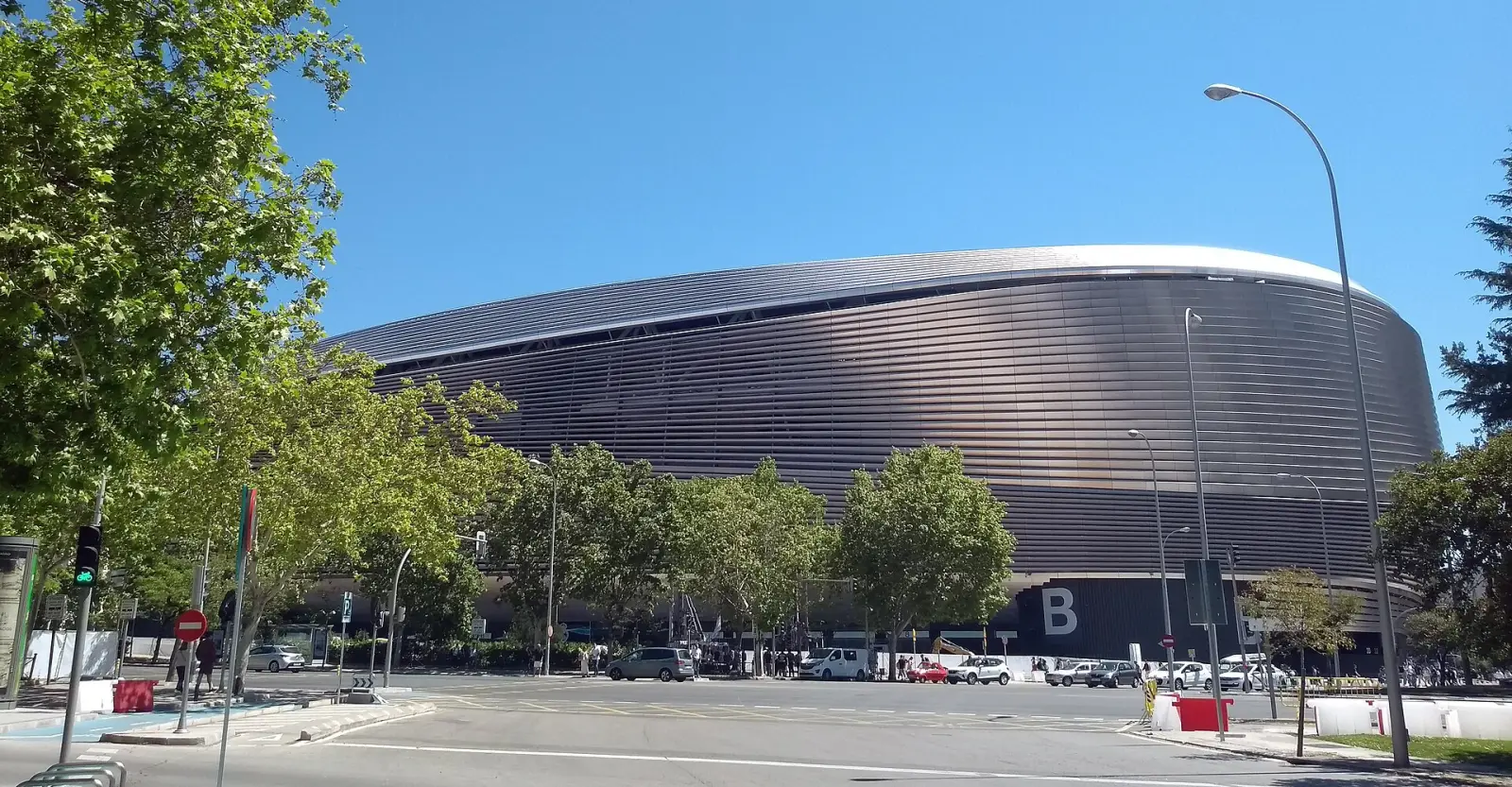
The facade is the signature. Roughly 7,500 curved, V-shaped stainless-steel slats wrap the old structure in a continuous metallic skin, backlit so the exterior can shift color and carry animation. It reads as a single sculpted surface from the street, which hides the fact that a 1940s concrete bowl is still sitting underneath it. Above the seats, the retractable roof runs on steel trusses carrying two panels of inflatable ETFE cushions, a system heavy enough to be measured in tens of thousands of tonnes and slow enough to take about 35 minutes to open or close.
The most ingenious piece is out of sight. The natural-grass pitch, engineered by Sener under the system name Hypogea, divides into six trays that descend on lifts into an underground hall beneath the field, where LED lighting and controlled climate keep the grass alive between matches. It is a greenhouse buried under a football stadium, and it is what lets the Bernabéu switch from pitch to concert floor and back without wrecking the surface. The trade-off is a shallow turf profile over a support structure, which is the root of the pitch-quality debate that has followed the reopening.
None of this erased the original. The stadium that opened in 1947 was itself an ambitious build for its time, designed by Manuel Muñoz Monasterio and Luis Alemany Soler after they won a 1944 competition, and constructed by Huarte y Compañía. Every renovation since has worked around that bones-deep structure rather than replacing it, and the 2024 version is simply the most dramatic example: a nearly 80-year-old stadium, still standing, still Real Madrid’s, now dressed in steel.
History of the Santiago Bernabéu
Real Madrid’s search for a proper home ran through the early 20th century, from the Campo de O’Donnell in the 1910s to the old Chamartín ground in the 1920s. Neither was big enough for Santiago Bernabéu’s ambitions. Elected club president in 1943, he pushed for a stadium on a scale Spanish football had never seen, secured the land and financing, and opened the Nuevo Estadio Chamartín on 14 December 1947, with Real Madrid beating Os Belenenses 3-1. The name changed to the Estadio Santiago Bernabéu in 1955, while the man himself was still running the club.
The capacity swung wildly across the decades. From about 75,000 at opening, the ground was expanded past 120,000 in the standing-terrace era of the mid-1950s, which is when it recorded its all-time high crowd. Successive modernizations, safety rules and the shift to all-seater stadiums then pushed the number back down, to roughly 90,000 for the 1982 World Cup and eventually to the low 80,000s by the 2000s.
Notable events:
- Record attendance (19 April 1956): A crowd of 129,690 watched Real Madrid beat AC Milan in a European Cup semi-final, still the largest gathering the stadium has ever held.
- 1982 FIFA World Cup Final (11 July 1982): Italy beat West Germany 3-1, with goals from Rossi, Tardelli and Altobelli, in front of around 90,000. It remains the biggest single match the Bernabéu has hosted.
- European finals: The ground has staged four European Cup finals (1957, 1969, 1980 and the 2010 Champions League final, Inter Milan 2-0 Bayern Munich) and the 1964 European Nations’ Cup final, Spain beating the Soviet Union 2-1.
- Copa Libertadores final (9 December 2018): The second leg of the all-Argentine final was moved from Buenos Aires to Madrid for safety reasons, and River Plate beat Boca Juniors 3-1.
- New era events: Taylor Swift’s Eras Tour (May 2024) and the first NFL regular-season game in Spain (November 2025) marked the reborn stadium’s arrival as a year-round venue.
The naming rights have their own saga. In 2014, tied to the redevelopment, the club announced a sponsorship alliance with Abu Dhabi’s IPIC, with names such as IPIC Bernabéu floated publicly. The deal collapsed, and a later arbitration ruling went against Real Madrid, so no commercial title was ever added. The stadium has quietly rebranded to simply “Bernabéu” across its official channels, and its naming rights are frequently described as the most valuable unsigned property in European sport, but through the reopening no title sponsor has been confirmed.
For all the steel and technology, the appeal is old-fashioned. This is the home of the most decorated club in European football, in the middle of a great capital city, reachable by a Metro stop named after it, and now able to fill its calendar the way modern stadiums must. The building changed. What it means did not.
Sources & Further Reading
- Real Madrid official stadium site: bernabeu.realmadrid.com. Visitor information, transit, and the stadium’s history and events.
- Wikipedia entry on the Bernabéu: en.wikipedia.org/wiki/Bernabéu_(stadium). Capacity history, construction detail, and attendance records.
- gmp Architekten project page: gmp.de. The renovation design team and facade details from the lead architects.
- ArchDaily on the renovation: archdaily.com. The design competition, the facade, and the project scope.
- Madrid Metro: metromadrid.es. Line 10 service to Santiago Bernabéu station and network maps.
Quick Facts
Everything you need at a glance.
Stadium specs
- Capacity
- 83,186
- Opened
- 1947
- Cost
- €1.76 billion (2019-2024 renovation)
- Roof
- Retractable
- Surface
- Retractable natural grass
- Tenants
- Real Madrid (La Liga)
Construction & location
- Groundbreaking
- 1944 (original); 2019 (renovation)
- Architects
- gmp von Gerkan, Marg and Partners (2019-2024 renovation), L35 Arquitectos (renovation), Ribas & Ribas Arquitectos (renovation), Manuel Muñoz Monasterio (original, 1947), Luis Alemany Soler (original, 1947)
- General contractor
- FCC Construcción (renovation); Huarte y Compañía (original)
- Address
- Avenida de Concha Espina 1, 28036 Madrid, Spain
- GPS
- 40.4531°N, 3.6884°W
Photo Gallery
Fun Facts
The Bernabéu's record attendance is 129,690, set on 19 April 1956 for a European Cup semi-final against AC Milan, back when much of the ground was standing terraces.
The playing surface retracts into the ground: the pitch splits into six trays that descend into a climate-controlled underground chamber, letting the bowl convert for concerts or other events in a matter of hours.
The 2019-2024 renovation cost roughly 1.76 billion euros, which is more than the reported construction cost of most brand-new stadiums, and it was spent rebuilding an existing one rather than starting from scratch.
Stadium Location
Frequently Asked Questions
- What is the capacity of the Santiago Bernabéu?
- Real Madrid does not publish an exact post-renovation capacity, so reported figures range from about 78,000 to 85,000. The most commonly cited number is around 83,186, up from the pre-renovation all-seater capacity of 81,044. Club president Florentino Pérez has said the venue is authorized for roughly 80,000 because exceeding that would require additional emergency exits. Concert configurations with standing floor reach 85,000 or more.
- Where is the Santiago Bernabéu located?
- The stadium sits at Avenida de Concha Espina 1, 28036 Madrid, in the Chamartín district on the Paseo de la Castellana, one of Madrid's main north-south avenues. It is roughly 5 kilometres north of the city center and about 13 kilometres from Adolfo Suárez Madrid-Barajas Airport.
- When was the Santiago Bernabéu built?
- It opened on 14 December 1947, originally named the Nuevo Estadio Chamartín, with Real Madrid beating the Portuguese club Os Belenenses 3-1 in the inaugural match. It was renamed the Estadio Santiago Bernabéu in 1955, in honor of the club president Santiago Bernabéu Yeste, who drove its construction.
- Does the Santiago Bernabéu have a roof?
- Yes. The 2019-2024 renovation added a retractable roof, built from two large panels of inflatable ETFE cushions running on steel trusses. It takes around 35 minutes to open or close, and the first match played under the closed roof was against Getafe on 2 September 2023. An older, non-retractable partial roof had covered the stands since the 1990s.
- Who plays at the Santiago Bernabéu?
- The Santiago Bernabéu is the home of Real Madrid, which has played there continuously since 1947. Real Madrid is the record holder for European Cup and Champions League titles, and the Bernabéu was the stage for the club's dynasty that won the first five European Cups between 1956 and 1960.
- How do I get to the Santiago Bernabéu by metro?
- Take Madrid Metro Line 10 to Santiago Bernabéu station, which exits right at the stadium. There is no single-line ride from the very center, so from Sol or Gran Via you transfer to Line 10 at an interchange such as Tribunal. The commuter-rail hub at Nuevos Ministerios is also a short walk south.
- How much did the Bernabéu renovation cost?
- The 2019-2024 renovation cost approximately 1.76 billion euros. That figure is the total budget; reported spending part-way through was lower, reflecting the phased nature of the work. It is one of the most expensive stadium projects in the world, notable because the money rebuilt an existing venue rather than constructing a new one.
- Who designed the Bernabéu renovation?
- The renovation was designed by the German firm gmp (von Gerkan, Marg and Partners) in cooperation with L35 Arquitectos and Ribas & Ribas Arquitectos, who won an international competition in 2014 ahead of Foster + Partners, Herzog & de Meuron and Populous. The original 1947 stadium was designed by Manuel Muñoz Monasterio and Luis Alemany Soler.
- What is the record attendance at the Santiago Bernabéu?
- The record is 129,690, set on 19 April 1956 for a European Cup semi-final in which Real Madrid beat AC Milan. That figure reflects the standing-terrace era; the all-seater conversions from the 1990s onward brought the modern capacity down to the low 80,000s.
- Has the Santiago Bernabéu hosted a World Cup final?
- Yes. The Bernabéu hosted the 1982 FIFA World Cup Final, in which Italy beat West Germany 3-1 on 11 July 1982. It also staged the 1964 European Nations' Cup final, four European Cup finals (1957, 1969, 1980 and the 2010 Champions League final), and the second leg of the 2018 Copa Libertadores final.
- Why does the Bernabéu pitch go underground?
- The renovation installed a retractable natural-grass pitch, engineered by Sener, that splits into six trays and lowers into a climate-controlled underground chamber sometimes called the greenhouse. Storing the grass below ground lets the bowl be cleared for concerts and other events without ruining the surface, and it is grown under LED lighting between matches.
- Did the NFL play at the Santiago Bernabéu?
- Yes. On 16 November 2025 the Bernabéu hosted the first NFL regular-season game ever played in Spain, with the Miami Dolphins beating the Washington Commanders 16-13 in overtime. Madrid became the fourth European city to stage a regular-season NFL game, after London, Munich and Frankfurt.
Last updated: 2026-07-12