About Lusail Stadium
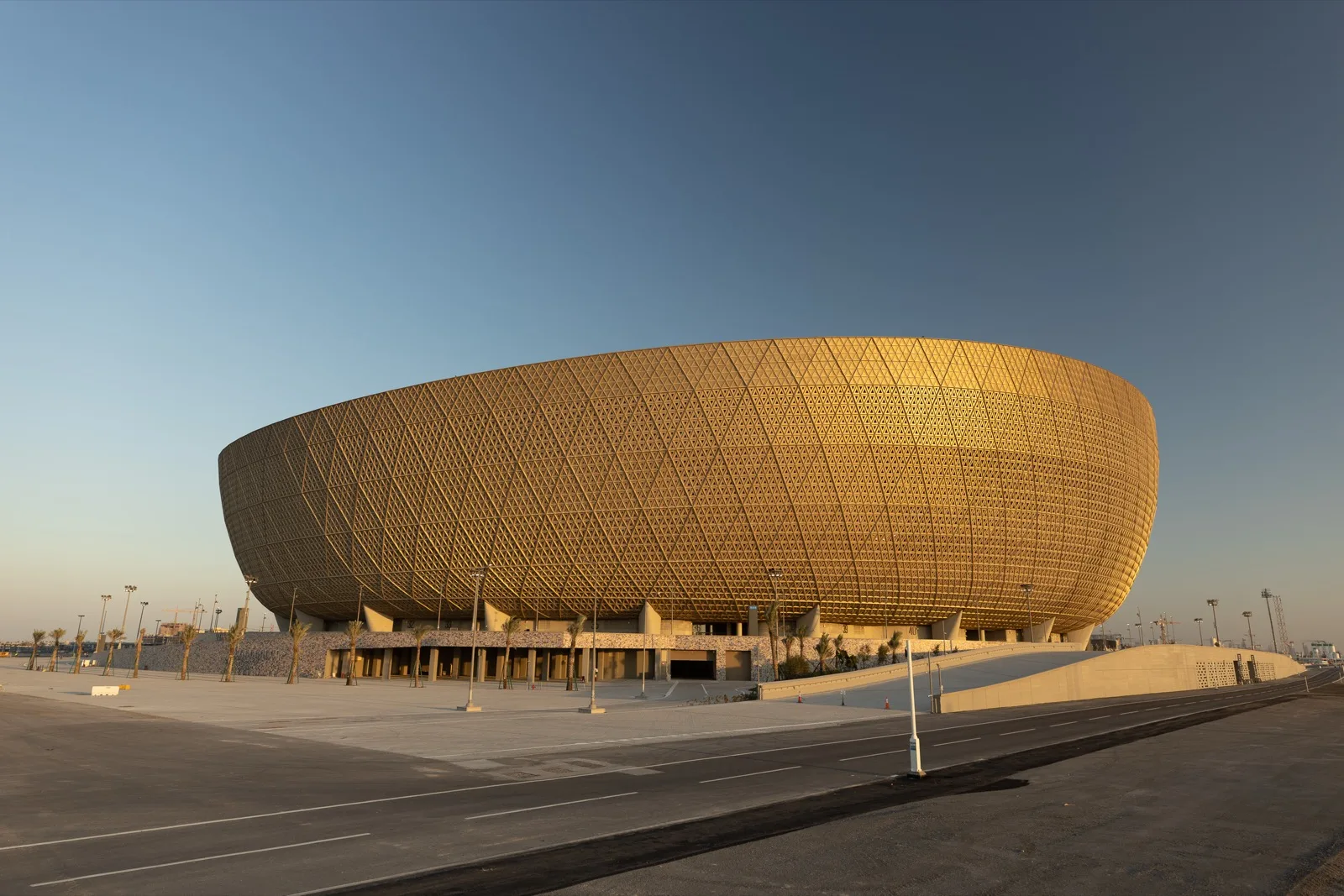
On the night of December 18, 2022, the most talked-about building in the Arab world glowed gold above the desert while Lionel Messi finally lifted the World Cup inside it. That building is Lusail Stadium, the largest of Qatar’s eight tournament venues and the stage for the greatest final in living memory. With 88,966 seats, it was the biggest stadium ever built for a World Cup final, and the golden bowl has become the defining image of the 2022 tournament.
The stadium anchors Lusail, an entire city that was built more or less from scratch on the coast about 20 kilometres (12 miles) north of central Doha. Lusail has no permanent club tenant in the way most big stadiums do. It was conceived as a national icon, a venue for the biggest occasions, and since the World Cup it has hosted the Qatar national team, the final of the 2023 AFC Asian Cup, and the annual Lusail Super Cup. The surrounding precinct, with its marina, towers, and malls, was designed to grow up around the stadium rather than the other way around.
Lusail was designed by Foster + Partners with Populous as sports architect and engineered by Arup, and built by a joint venture of HBK Contracting and the China Railway Construction Corporation. The seating bowl is wrapped in a burnished golden skin, perforated with triangular openings that shade the concourse and scatter light across it. Above the seats sits a vast cable-net roof, one of the largest of its kind in the world, that shelters the stands while leaving the pitch open to the sky. The grass below was grown and cooled to FIFA standards in a desert summer, supported by a cooling system that runs in part on solar power.
What sets Lusail apart from almost every other stadium of its size is what comes next. Rather than leave nearly 89,000 seats to gather dust, Qatar planned from the start to take the upper tier apart and turn it into something a city actually uses day to day. The capacity is being cut toward 40,000, and the space freed up is being rebuilt into shops, cafes, schools, and a health clinic. The building that held the final is slowly becoming a neighborhood.
Getting to Lusail Stadium
Public Transit
The Doha Metro is the easy answer. The Red Line runs the length of the country’s spine, and its northern terminus, Lusail QNB, sits a short walk from the stadium.
→ From central Doha: Board the Red Line at Msheireb, the main interchange, and ride north to Lusail QNB. The trip takes about 20 minutes. From there it is a 10-minute walk or a quick ride on the Lusail Tram.
→ From Hamad International Airport: The Red Line connects the airport directly to Lusail QNB with no transfer, which is often faster than a taxi on match days.
On event days, Metrolink shuttle buses cover the final stretch from the station to the gates, and the metro runs extended hours. Trains fill quickly after the whistle, so it is worth lingering 20 minutes or heading out a touch early to beat the crush.
Driving + Parking
Lusail is reached from central Doha along the Lusail Expressway and Al Khor Coastal Road. GPS users can search “Lusail Stadium, Lusail.”
→ From central Doha (~20 km): Head north on the Lusail Expressway, about 20-30 minutes outside of peak traffic.
→ From Al Wakrah (~40 km): Take the highway north through Doha toward Lusail, roughly 45 minutes depending on traffic.
On-site parking is limited and mostly reserved, so the smarter move for big matches is the free park-and-ride at Lusail QNB metro station, where a shuttle bus runs to the stadium. Driving straight to the gates on a sold-out night is rarely worth the headache.
Rideshare
Uber and the Gulf’s home-grown Careem both operate across Doha and Lusail, alongside the metered Karwa taxis. Expect surge pricing and long queues right after major events, when tens of thousands leave at once.
Pro tip: Walk a few minutes away from the stadium toward the Marina or Place Vendôme before requesting a ride. You will clear the worst of the post-match gridlock and shorten the wait.
From the Airport
→ Hamad International Airport (DOH): About 30 km (19 mi) south, 35-45 minutes by car. The Doha Metro Red Line links the airport straight to Lusail QNB station, which is usually the quickest and cheapest route on a match day.
→ Doha International Airport (DIA): The old airport handles limited traffic today. For nearly all visitors, Hamad International is the point of arrival.
The 2022 World Cup at Lusail Stadium
Lusail was always going to be the main stage. It hosted 10 matches, more than any other venue at Qatar 2022: six group games, a Round of 16, a quarter-final, a semi-final, and the final on December 18.
The final: Argentina and France produced a match that will be replayed for decades. Argentina led 2-0 and looked home until Kylian Mbappé scored twice in 97 seconds to force extra time. Messi restored Argentina’s lead, Mbappé completed his hat-trick, the first in a World Cup final since 1966, and the game went to penalties at 3-3. Emiliano Martínez saved, Argentina held their nerve, and Messi finally had the trophy that had escaped him across four previous tournaments.
Argentina’s home: The eventual champions played five of their seven matches at Lusail, so by the time of the final the building already felt like Argentine territory, with the stands awash in light blue and white.
The atmosphere: With 88,966 inside and the golden facade lit against the night, Lusail delivered the visual signature of the whole tournament. For a venue that had staged its first competitive match only weeks earlier, hosting the most-watched football match in history was a remarkable debut.
Construction & Design
Lusail had to be two things at once: a stadium grand enough to host a World Cup final, and a structure that could be taken apart afterward. Foster + Partners, working with Populous and the engineers at Arup, answered with a design that hides its scale behind a single striking idea. The seating bowl is expressed on the outside as a golden vessel, a skin of triangular panels that catches the desert sun by day and glows by night. Those triangular openings are not just decoration. They form a perforated screen that shades the concourse and filters light, a modern take on the patterned screens found across the region.
The engineering headline is the roof. Arup designed a cable-net structure 307 metres (1,007 feet) across, one of the largest tensile roofs ever built over a stadium. It works by tying an outer compression ring to a central tension ring through a web of cables, which lets the roof span the entire bowl without a single internal column to block a sightline. A translucent membrane stretched across the cables shelters the seats while leaving the pitch open to the sky.
Keeping a grass pitch and 88,966 people comfortable through a Gulf climate took serious cooling. The stadium uses an advanced cooling system, drawing in part on solar power, and the high-performance facade and roof were tuned to cut energy use. The result earned a five-star rating under Qatar’s Global Sustainability Assessment System.
The build itself was a megaproject. Construction began in April 2017, after enabling works on the raw desert site that started around 2015, and ran through to a 2021 handover. It was delivered by a joint venture of Qatar’s HBK Contracting and the China Railway Construction Corporation, with the stadium reportedly costing around $767 million, a figure that does not capture the earlier site works. Every part of the upper structure was planned with disassembly in mind, so the same building that held the final could later shed tens of thousands of seats and become something smaller and permanent.
History of Lusail Stadium
Lusail Stadium did not exist in any form before Qatar won the right to host the 2022 World Cup, and neither did much of the city around it. The venue and the district were planned together, with the stadium as the centerpiece of a brand-new urban development on the coast north of Doha.
- Groundbreaking (April 11, 2017): Construction began on the main stadium, following enabling works on the site that had started around 2015.
- Structural completion (2021): The stadium was handed over and became operational, with the cable-net roof and golden facade in place.
- Official opening (September 9, 2022): Lusail staged its first match, the Lusail Super Cup, in which Saudi side Al Hilal beat Egypt’s Zamalek, weeks before the World Cup kicked off.
- World Cup final (December 18, 2022): Argentina beat France on penalties in front of 88,966 fans, the climax of the tournament and the most-watched football match ever played.
- AFC Asian Cup final (February 10, 2024): Lusail hosted the final of the 2023 Asian Cup, where Qatar beat Jordan 3-1, with Akram Afif scoring a hat-trick of penalties to retain the title on home soil.
Since the tournament, Lusail has entered its second life. The reconfiguration from nearly 89,000 seats toward roughly 40,000 is the most ambitious stadium legacy plan of any World Cup host, turning the upper bowl into shops, cafes, schools, athletic facilities, and a health clinic. For now the golden bowl still stands at full size, a landmark on the Lusail skyline and the place where Messi got his crown.
Sources & Further Reading
- Foster + Partners project page: fosterandpartners.com. The architects’ description of the golden vessel facade, the cable-net roof, and the legacy plan.
- Populous showcase: populous.com. The sports architect’s account of the seating bowl and tournament design.
- Wikipedia entry on Lusail Stadium: en.wikipedia.org/wiki/Lusail_Stadium. Capacity, contractors, timeline, the final, and the legacy conversion.
- Doha Metro and Lusail Tram (Qatar Rail): qr.com.qa. Red Line and tram routes, timings, and event-day service to Lusail QNB.
Quick Facts
Everything you need at a glance.
Stadium specs
- Capacity
- 88,966
- Opened
- 2022
- Cost
- estimated $767 million
- Roof
- Partial (cable-net canopy)
- Surface
- Natural Grass
- Tenants
- Qatar National Team (selected matches)
Construction & location
- Groundbreaking
- April 11, 2017
- Architects
- Foster + Partners (design architect), Populous (sports architect)
- Engineering
- Arup
- General contractor
- HBK Contracting Company / China Railway Construction Corporation (CRCC) joint venture
- Address
- Lusail Stadium, Lusail City, Al Daayen, Qatar
- GPS
- 25.4208°N, 51.4902°E
Photo Gallery
Fun Facts
Lusail's roof is a 307-metre (1,007-foot) cable-net structure, one of the largest tensile cable-net roofs of any stadium in the world, spanning the entire bowl without a single internal column.
On December 18, 2022, Lusail hosted the World Cup final, a 3-3 thriller between Argentina and France settled 4-2 on penalties, watched by a global audience estimated above 1.5 billion.
The golden bowl was built to come apart: after the tournament Lusail is being reconfigured from 88,966 seats toward roughly 40,000, with its upper levels turned into shops, cafes, schools, and a health clinic.
Stadium Location
Frequently Asked Questions
- What is the seating capacity of Lusail Stadium?
- Lusail Stadium held 88,966 for the 2022 World Cup, making it the largest of Qatar's eight tournament venues. In legacy mode the capacity is being reduced to about 40,000 as the upper tier is converted into community spaces.
- Where is Lusail Stadium located?
- Lusail Stadium is in Lusail, a planned city in the Al Daayen municipality about 20 km (12 mi) north of central Doha, Qatar. It sits at the heart of the new Lusail district, beside its own metro station.
- What was the 2022 World Cup final result at Lusail Stadium?
- On December 18, 2022, Argentina and France drew 3-3 after extra time, and Argentina won 4-2 on penalties. Kylian Mbappé scored a hat-trick in defeat, Lionel Messi scored twice, and Argentina lifted their third World Cup and first since 1986.
- How do I get to Lusail Stadium by metro?
- Take the Doha Metro Red Line to Lusail QNB, the final station on the line, then walk about 10 minutes or take the connecting Lusail Tram. The Red Line runs directly from Hamad International Airport, so no transfer is needed from the airport.
- Is there parking at Lusail Stadium?
- On-site parking is limited and usually reserved, so most fans use the free park-and-ride at Lusail QNB metro station and ride a shuttle bus to the gates on event days. For big matches, the metro is by far the easiest option.
- How many 2022 World Cup matches did Lusail Stadium host?
- Lusail hosted 10 matches, more than any other Qatar 2022 venue: six group-stage games, a Round of 16, a quarter-final, a semi-final, and the final. Argentina played several of their matches here, including the final.
- Who designed and built Lusail Stadium?
- Lusail was designed by Foster + Partners as design architect with Populous as sports architect, and engineered by Arup. It was built by a joint venture of HBK Contracting Company and the China Railway Construction Corporation (CRCC), with construction starting in 2017.
- What is the golden facade of Lusail Stadium inspired by?
- Foster + Partners describe the seating bowl as a burnished golden vessel that sparkles in the sunlight, drawing on the decorative bowls and vessels found across the Arab and Islamic world, and the play of light and shadow of the fanar lantern. The triangular openings form a screen that shades the concourse and filters dappled light.
- Does Lusail Stadium have a roof?
- Yes, a cable-net roof spans the seating bowl, but the pitch is left open to the sky. The 307-metre (1,007-foot) tension structure is one of the largest of its kind in any stadium, and it holds a translucent membrane that shelters the stands without internal columns.
- How far is Lusail Stadium from Hamad International Airport?
- Hamad International Airport (DOH) is about 30 km (19 mi) south of the stadium, roughly 35-45 minutes by car. The Doha Metro Red Line connects the airport directly to Lusail QNB station, which is often quicker than driving on match days.
- When was Lusail Stadium built?
- Construction began on April 11, 2017, after enabling works that started around 2015. The stadium became operational in 2021 and was officially opened on September 9, 2022, with the Lusail Super Cup between Al Hilal and Zamalek, weeks before the World Cup.
- What is happening to Lusail Stadium after the World Cup?
- Lusail is being reconfigured from nearly 89,000 seats toward about 40,000. The removed upper levels are being repurposed as shops, cafes, schools, athletic facilities, and a health clinic, turning the venue into a community hub for Lusail city's residents.
- Is Lusail Stadium grass or turf?
- Natural grass. For the 2022 World Cup the pitch was grown and cooled to FIFA specifications in the desert climate, supported by the stadium's advanced cooling system, which is partly solar-powered.
- What other major events has Lusail Stadium hosted?
- Beyond the 2022 World Cup, Lusail hosted the opening match and the final of the 2023 AFC Asian Cup (held in early 2024), where Qatar beat Jordan 3-1 on February 10, 2024. It also staged the 2022 Lusail Super Cup and continues to host major Qatari and international fixtures.
- How sustainable is Lusail Stadium?
- Lusail earned a five-star rating under Qatar's Global Sustainability Assessment System. Its high-performance facade and roof cut energy use, its cooling draws on solar power, and the whole upper structure was designed to be dismantled and reused rather than demolished, which is the heart of its post-tournament legacy plan.
Last updated: 2026-07-10