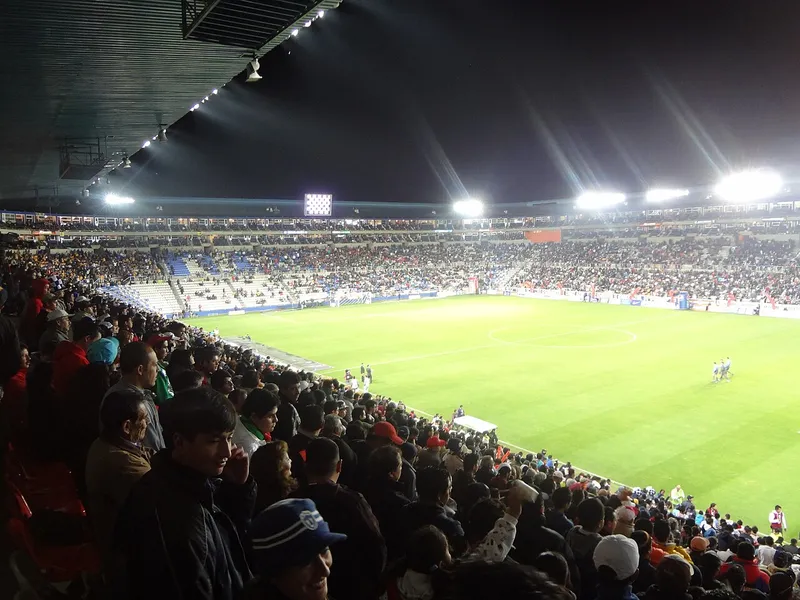
About Estadio Hidalgo
The oldest football club in Mexico waited a full century for a stadium to call its own. C.F. Pachuca, founded in 1892 by Cornish miners who carried the game from England to the silver hills of Hidalgo, spent decades at borrowed and modest grounds around the city before a permanent home finally rose in the early 1990s. Estadio Hidalgo is that home, a compact 25,922-seat bowl where the club’s improbable dynasty was built and where the thin mountain air does half the defending.
The number that matters most here is not capacity. It is 1892. That founding date makes Pachuca the birthplace of organized Mexican football, the reason the city carries the nickname “Cuna del Fútbol Mexicano,” the Cradle of Mexican Football. The Cornish connection is not folklore either. Real del Monte, the old mining town 12 km up the mountain, still sells pastes, the local descendant of the Cornish pasty, and the club’s supporters still call themselves “Los Tuzos,” the gophers, after the miners who tunneled through the hills.
Named for Miguel Hidalgo y Costilla, the priest who launched Mexico’s War of Independence, the stadium opened on February 14, 1993. It has carried a second name for most of its life. Opponents came to know it as “El Huracán,” the Hurricane, a label earned during the years when almost nobody left Pachuca with points. The altitude is the reason so often cited: at roughly 2,400 meters (7,874 feet) above sea level, the venue ranks among the highest professional grounds anywhere in the Americas, and visiting legs tend to go heavy well before the final whistle.
Pachuca the city is a compact mountain capital of roughly 300,000, all colonial stone, steep streets, and a monumental clock tower at its center. The stadium sits in the Ex Hacienda de Coscotitlán neighborhood, minutes from the bus terminal, in a town where the link between English mining heritage and Mexican football is visible almost everywhere. The nearby football museum traces that thread from the 1892 founding through the modern trophy years, and the club’s academy has become an export machine, feeding Liga MX and Europe with a steady line of graduates.
Getting to Estadio Hidalgo
Public Transit
Pachuca has no metro or rail system. Intercity buses and local combis carry the load, and the good news for visitors is that the main terminal sits close to the ground.
→ Via Intercity Bus from Mexico City: First-class buses depart frequently from Terminal Norte (Central del Norte) to Pachuca’s central bus terminal. The trip runs about 1.5 hours. From the terminal, a taxi or DiDi to the stadium is roughly 10 minutes.
→ Via Local Buses: Several city routes (combis and colectivos) pass near the stadium. Ask for “Estadio Hidalgo.” The venue is well known and drivers will point you the right way.
The terminal-to-stadium hop is one of the easiest in Mexican football. No transfers, no line changes, just a short ride across town.
Driving + Parking
The stadium is in central Pachuca, reached via Highway 85D from Mexico City.
→ From Mexico City (~90 km): Highway 85D north. About 1 hour 30 minutes.
→ From Puebla (~160 km): Highway 150D west to Highway 85D north. About 2 hours 30 minutes.
→ From Querétaro (~250 km): Highway 57D south, then Highway 85D north via Mexico City’s periférico. About 3 hours 15 minutes.
Street parking is available in the surrounding neighborhoods. Private lots near the ground charge 30 to 60 MXN ($2 to $3 USD). Arrive early. Pachuca’s narrow colonial streets turn tight on match day, and the approach roads bottleneck fast.
Rideshare
Uber does not operate in Hidalgo state, so DiDi is the app to have. It is widely available across Pachuca. From downtown, expect 40 to 80 MXN ($2 to $4 USD) and about 10 minutes. Traditional taxis are easy to hail at the bus terminal too, and drivers there know the stadium run cold.
From the Airport
→ Mexico City International (MEX): About 100 km (62 miles) southwest, 1.5 to 2 hours by car via Highway 85D. Alternatively, take a bus from the airport area to Terminal Norte, then a Pachuca-bound bus (total journey about 2.5 hours). Rideshare from MEX runs 800 to 1,200 MXN ($40 to $60 USD).
Pachuca has no commercial airport. Every flight routes through Mexico City. The most practical plan for visitors is simple: fly into MEX, bus up to Pachuca, and use DiDi locally.
Construction & Design
Ground was broken on July 14, 1992, when Governor Adolfo Lugo Verduzco laid the first stone. What followed was fast, even by the standards of a purpose-built football ground. The Mexican engineering firm ICA (Ingenieros Civiles Asociados) drove the project from bare lot to finished bowl in a little over five months, and the stadium was inaugurated on February 14, 1993, with the same governor cutting the ribbon. Roughly 1,500 workers built it. The bones of the place are a plain accounting of the effort: about 869 tons of steel and 6,741 cubic meters of concrete, poured into a single continuous tier that wraps the natural-grass pitch of 105 by 68 meters (344 by 223 feet).
The original design leaned toward function over spectacle. The seating bowl held around 25,000 with, as the early promotional material promised, a clear view from any angle, plus 230 plateas and 180 palcos, the private boxes that first sold for 400,000 pesos apiece. There is no retractable roof, no video-board arms race, no architectural signature reaching for the skyline. That restraint is arguably the point. The stadium was conceived as a working home for a working-class mining town, not a monument, and it still reads that way.
The building that fans know today is really the 2004 version. Grupo Pachuca, which had taken over operation of the state-owned venue under a comodato concession in 1999, closed the stadium for a full modernization and reopened it on August 1, 2004, with a Campeón de Campeones win over Pumas. New seating, upgraded lighting, and refreshed facilities came with that overhaul, and capacity figures crept upward, which is why some listings now put the venue near 30,000 while the precise seated count holds at 25,922. A further round of improvements between 2009 and 2011, including FIFA-standard lighting and expanded parking, prepared the ground to host matches at the 2011 FIFA U-17 World Cup.
Two load-bearing details resist confirmation, and it is more honest to say so than to guess. The name of the architect behind the 1993 design is not part of the public record, and no reliable total construction cost has ever been published beyond the 400,000-peso price of an original box. ICA gets the credit as builder. The blueprint author remains, for now, anonymous.
History of Estadio Hidalgo
The stadium was built to give a historic club a stage worthy of its ambitions, and the timing proved uncanny. Within a decade of opening, Pachuca went from a club that had bounced between divisions to one of the most decorated sides in the confederation. The trophies did not trickle in. They arrived in a flood.
A continental dynasty (2002–2024): Pachuca has won six CONCACAF Champions Cup / Champions League titles, in 2002, 2007, 2008, 2009–10, 2016–17, and 2024. Only América and Cruz Azul, with seven apiece, have won more, which places Pachuca firmly among the elite of the modern era. The 2007 and 2008 back-to-back run stands out, and so does the most recent chapter, staged at home.
The 2024 final (June 1, 2024): Pachuca beat Columbus Crew 3-0 in a single-match final at Estadio Hidalgo, sealing a sixth continental crown in front of its own crowd. The win booked a place at the FIFA Intercontinental Cup and the 2025 FIFA Club World Cup, and it turned the altitude into a talking point all over again as the visitors faded.
2011 FIFA U-17 World Cup: Mexico hosted the tournament and won it, and Estadio Hidalgo was one of the venues along the way, staging a run of matches including wins for the host nation. The atmosphere at altitude made it one of the loudest rooms of the competition.
A domestic foundation: Beyond the continental nights, the stadium has been the backdrop for Liga MX title runs and countless clásicos against Cruz Azul, América, and the rest. Pachuca even carried the flag abroad in 2006, becoming the first CONCACAF club to win a CONMEBOL trophy when it lifted the Copa Sudamericana, an achievement still cited as one of Mexican football’s boldest.
From Cornish miners to continental champions, Estadio Hidalgo is where Mexico’s oldest football tradition still lives. A modest bowl at 2,400 meters, where roughly 130 years of history and a very real altitude advantage combine into one of the hardest tickets to survive in the Americas. Few grounds punch so far above their seat count.
Sources & Further Reading
- Wikipedia entry on Estadio Hidalgo: en.wikipedia.org. Capacity, ownership, tenants, and event history reference.
- C.F. Pachuca club and honors record: en.wikipedia.org. Founding date, CONCACAF title years, and stadium opening date.
- CONCACAF Champions Cup all-time record: concacaf.com. Confirms Pachuca’s six continental titles and the América/Cruz Azul lead of seven each.
- Pachuca stadium history and construction detail: pachucavive.com. Groundbreaking date, ICA as builder, materials, and the February 1993 inauguration.
Quick Facts
Everything you need at a glance.
Stadium specs
- Capacity
- 25,922
- Opened
- 1993
- Cost
- Not publicly documented (Not publicly documented today)
- Roof
- Open
- Surface
- Natural Grass
- Tenants
- C.F. Pachuca (Liga MX)
Construction & location
- Groundbreaking
- July 14, 1992
- Architects
- Not publicly documented
- General contractor
- ICA (Ingenieros Civiles Asociados)
- Address
- Ex Hacienda de Coscotitlán, 42064 Pachuca de Soto, Hidalgo, Mexico
- GPS
- 20.1053°N, 98.7561°W
Photo Gallery
Fun Facts
C.F. Pachuca, founded in 1892 by Cornish miners from England, is the oldest football club in Mexico and one of the oldest in the Americas, which makes Estadio Hidalgo the home ground of the 'Cradle of Mexican Football.'
Pachuca has won 6 CONCACAF Champions Cup / Champions League titles (2002, 2007, 2008, 2009–10, 2016–17, and 2024), a haul bettered only by América and Cruz Azul, and the 2024 final was won 3-0 at Estadio Hidalgo itself.
At roughly 2,400 meters (7,874 feet) above sea level, Estadio Hidalgo is one of the highest-altitude professional football stadiums in the Americas, and the thin air gives Pachuca a measurable home advantage as visiting players fatigue in the second half.
Stadium Location
Frequently Asked Questions
- What is the seating capacity of Estadio Hidalgo?
- Estadio Hidalgo seats 25,922, the figure carried by its Wikipedia entries and by C.F. Pachuca's own records. Some listings put the venue closer to 30,000 following the 2004 modernization, but the precise seated count is 25,922. The stadium opened on February 14, 1993, and reopened after a Grupo Pachuca overhaul on August 1, 2004.
- Where is Estadio Hidalgo located?
- The stadium sits in Pachuca de Soto, the capital of Hidalgo state, roughly 90 km (56 miles) northeast of Mexico City, in the Ex Hacienda de Coscotitlán neighborhood. It stands at approximately 2,400 meters (7,874 feet) above sea level.
- How do I get to Estadio Hidalgo from Mexico City?
- Drive north via Highway 85D, roughly 90 km and 1.5 hours. Alternatively, take a first-class bus from Terminal Norte to Pachuca's central bus terminal (about 1.5 hours, frequent departures). From the bus terminal, a DiDi or taxi to the stadium takes about 10 minutes.
- Is Uber available near Estadio Hidalgo?
- Uber does not operate in Hidalgo state. Use DiDi instead, which is widely available in Pachuca. Traditional taxis also wait at the bus terminal and around the stadium.
- Why is Pachuca called the cradle of Mexican football?
- Cornish miners working Pachuca's silver mines founded C.F. Pachuca in 1892, the oldest football club in Mexico. They brought the game with them from England, which makes Pachuca the birthplace of organized football in the country.
- How many CONCACAF titles has Pachuca won?
- Six. Pachuca lifted the CONCACAF Champions Cup / Champions League in 2002, 2007, 2008, 2009–10, 2016–17, and 2024. Only América and Cruz Azul (seven each) have won more. The 2024 final was decided at Estadio Hidalgo, where Pachuca beat Columbus Crew 3-0 on June 1, 2024.
- How far is Estadio Hidalgo from the airport?
- Pachuca has no commercial airport. Mexico City International Airport (MEX) is roughly 100 km (62 miles) southwest, about 1.5 to 2 hours by car. From MEX, take a bus from Terminal Norte to Pachuca or use rideshare.
- What is the altitude of Estadio Hidalgo?
- The stadium sits at approximately 2,400 meters (7,874 feet) above sea level, among the highest professional football venues in the Americas. The thin air reduces aerobic capacity and tends to leave visiting teams fatigued in the closing half hour.
- Who owns and operates Estadio Hidalgo?
- The stadium is owned by the government of the State of Hidalgo and operated by Grupo Pachuca, which has run the venue under a comodato (concession) arrangement since 1999. Grupo Pachuca financed the 2004 modernization that reshaped the seating bowl.
- Why is Estadio Hidalgo nicknamed El Huracán?
- The nickname 'El Huracán' (The Hurricane) grew out of Pachuca's ferocious home form during its championship era, when few visitors left with a result. The altitude, the noise, and the tight bowl combine into one of the toughest away days in the Americas.
Last updated: 2026-07-10