About Estadio BBVA
Estadio BBVA is the newest and most architecturally striking of Mexico’s three FIFA World Cup 2026 venues. It opened in 2015 on the eastern edge of the Monterrey metropolitan area, purpose-built for CF Monterrey (Rayados) at a cost of roughly US$200 million, replacing the aging Estadio Tecnológico where the club had played for 63 years.
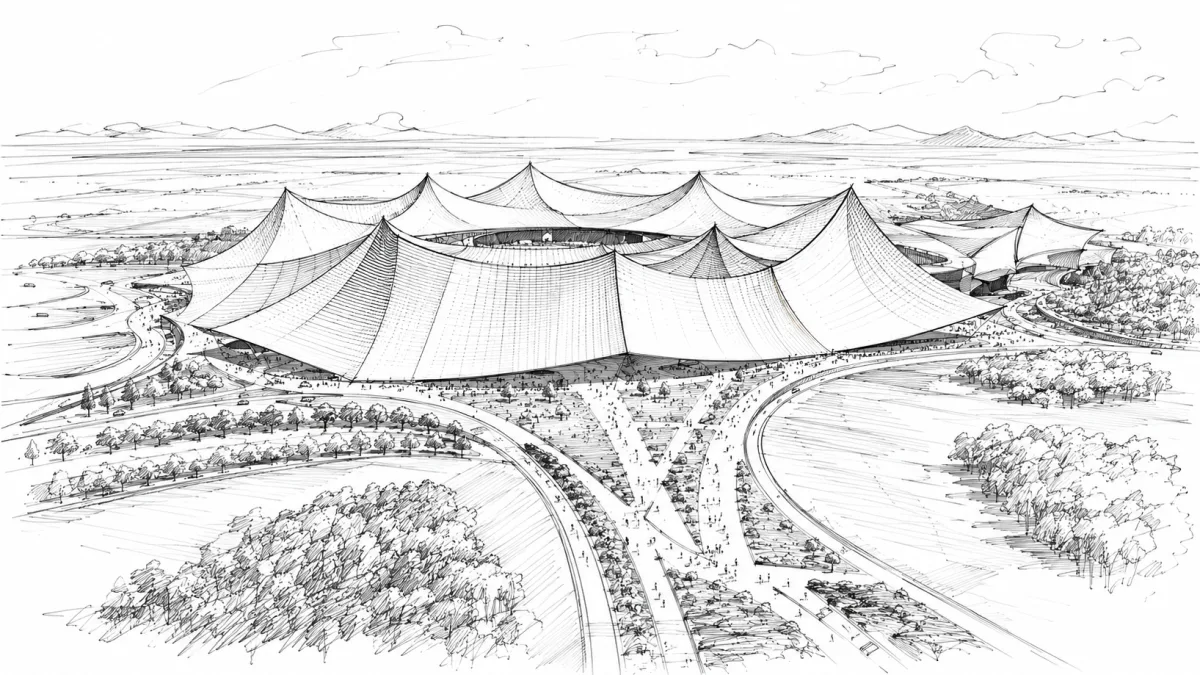
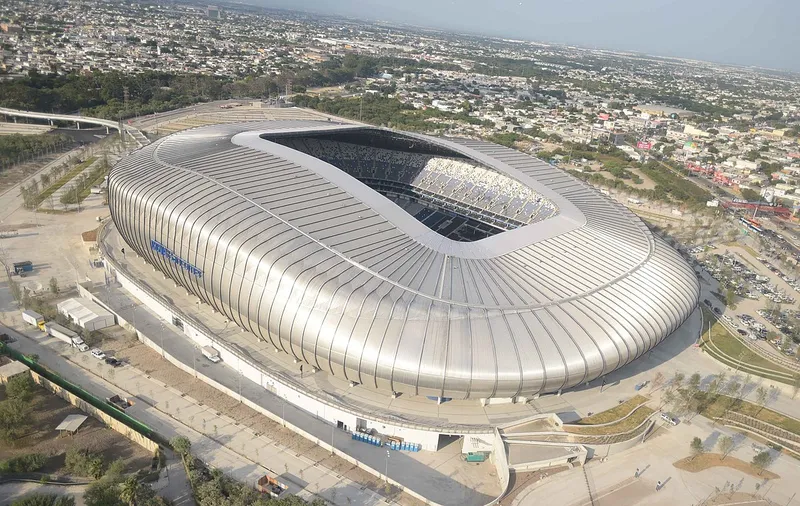
The design, by global sports architecture firm Populous with Mexican studio VFO and Federico Velasco, is a love letter to Monterrey itself. The jagged steel roofline mirrors the peaks of the Sierra Madre Oriental, specifically Cerro de la Silla, the saddle-shaped mountain that dominates the city’s skyline and is visible from the stadium’s northwestern seats. The metallic exoskeleton earned the venue its nickname: “El Gigante de Acero,” The Steel Giant, a reference to Monterrey’s century-old identity as Mexico’s industrial steel capital.
The cantilevered partial roof extends up to 55 meters over the seating bowl, providing shade and weather protection while keeping natural ventilation through aluminum “gill” panels. The bowl itself is raked at 34 degrees, one of the steepest in Liga MX, and the gap between the front row and the pitch is the minimum FIFA allows. The result feels open and airy despite the 53,500-seat capacity, and almost nobody is far from the action.
Estadio BBVA is home to one of the fiercest derbies in all of Latin American football: the Clásico Regio between Monterrey and crosstown rivals Tigres UANL. When these two clubs meet, the intensity inside the stadium reaches a level few venues in the world can match.
Construction & Design
CF Monterrey had outgrown the Estadio Tecnológico, and in August 2011 the club broke ground on a replacement that would do more than seat more fans. It would put Monterrey’s industrial identity into the architecture itself.
Populous, the firm behind Wembley and Tottenham Hotspur Stadium, led the design alongside Mexican studio VFO and Federico Velasco. The build was handled by a joint venture of three local heavyweights: Aceros Lozano, GGP, and Maíz Mier. The total cost ran to about US$200 million. Steel and aluminum are everywhere, which is the point in a city that built its fortune on metal.
The engineering choices were deliberate. A 34-degree grandstand rake keeps the upper deck close to the pitch. The minimum-allowed setback between seats and field pulls the crowd right on top of the action. A cantilevered canopy reaches up to 55 meters over the bowl, shading fans without sealing the air in. And the whole thing carries LEED Silver certification, thanks to under-turf ventilation, water management, and energy-efficient systems.
It opened on August 2, 2015, with the 8th Eusébio Cup. Monterrey beat Benfica 3-0 in front of a sold-out house. The Steel Giant was open for business.
Getting to Estadio BBVA
Public Transit
Monterrey’s Metrorrey system is the most practical way to reach the stadium without a car.
Metro: Take Line 1 to Exposicion station. From the station, it’s approximately a 15-minute walk to the stadium’s North entrance near the Expo Ganadera area. From downtown Monterrey, the journey takes about 25 minutes. Metrorrey is affordable and efficient.
Bus: Multiple routes from Avenida Juarez in central Monterrey serve the stadium area, including routes 2, 70, 71, 72, 73, 77, 89, 99, 108, and 131. Service is frequent on match days, though buses get crowded.
Important for World Cup visitors: Expect heavy congestion on match days. Arrive at least 2 hours before kickoff, and plan for slow exits after the final whistle. Walking to a nearby secondary metro station after the match can save significant wait time.
Driving + Parking
The stadium’s South entrance is directly on Avenida Pablo Livas, with good highway connectivity to Monterrey’s road network. However, match-day traffic around the stadium is heavy, and parking lots fill up quickly.
Official parking is available in the stadium lots. Street parking in the surrounding neighborhood is not recommended. Budget extra time for traffic, since Monterrey’s roads can be congested on regular days, and match days make it significantly worse.
Rideshare
Uber and DiDi both operate in Monterrey. A ride from downtown to the stadium costs approximately 80-150 pesos ($5-9 USD) under normal conditions. Surge pricing on match days can increase this significantly.
Pro tip: Have your driver drop you 2-3 blocks from the stadium to avoid the worst traffic near the gates. After the match, walk several blocks away before requesting a ride, you’ll get picked up faster and avoid surge pricing.
From the Airport
→ General Mariano Escobedo International Airport (MTY): Approximately 22 minutes from the stadium by car. Authorized taxis and vans are available at official kiosks inside the terminal with zone-based fares. Budget around $8-10 USD for a taxi to the stadium. Uber and DiDi pickups are available from designated zones outside arrivals.
FIFA World Cup 2026 at Estadio BBVA
For the 2026 World Cup, Estadio BBVA is renamed Estadio Monterrey under FIFA’s policy on commercial naming rights. The venue hosts 4 matches: three group stage games and one Round of 32 knockout match.
Match schedule:
- June 14: UEFA Playoff B Winner vs. Tunisia (Group F)
- June 20: Tunisia vs. Japan (Group F)
- June 24: South Africa vs. South Korea (Group A)
- June 29: Winner Group F vs. Runner-up Group E (Round of 32)
The pitch uses a GrassMaster hybrid system, natural grass reinforced with synthetic fibers and backed by under-turf ventilation, to hold up through Monterrey’s summer heat.
Climate factor: Monterrey in June is hot. Temperatures regularly exceed 100°F (38°C). FIFA scheduled most matches for the evening to account for it, but the heat and humidity remain significant factors for players and fans alike. Stay hydrated and seek shade whenever possible.
Fan zones: The official FIFA Fan Festival in Monterrey is at Parque Fundidora, the sprawling urban park built on a former steel foundry about 3 miles from the stadium. Giant screens, live music, food, and merchandise run throughout the tournament.
History of Estadio BBVA
Estadio BBVA’s story begins with CF Monterrey’s ambition to replace the Estadio Tecnológico, the club’s home of 63 years. The Rayados broke ground in August 2011, and four years later they had a building that would quickly become one of the most admired venues in the Americas.
August 2, 2015: The stadium opened with the 8th Eusébio Cup. Monterrey beat Portuguese giants S.L. Benfica 3-0 in front of a sold-out crowd, christening the venue in style.
2016: Capacity grew from its original 51,000 to 53,500 to meet demand from Rayados supporters, with premium club sections folded into the existing bowl.
Clásico Regio: The stadium became the stage for one of Latin America’s most electric derbies. When Monterrey hosts Tigres UANL, more than 53,000 fans fill a cauldron of blue and white, the Sierra Madre mountains looming behind.
Beyond football: Estadio BBVA has hosted CONCACAF Champions League finals, Copa MX finals, Mexico national team matches, and major concerts. Coldplay alone drew more than 112,000 across two nights. Its modern facilities and dramatic setting have made it one of the most sought-after event venues in Mexico.
At just 11 years old when the World Cup arrives, Estadio BBVA is the youngest of Mexico’s three host venues, a striking contrast to the 60-year-old Estadio Azteca that hosts the Opening Match 500 miles to the south.
Notable Events at Estadio BBVA
- Opening match (August 2, 2015): CF Monterrey 3, S.L. Benfica 0, in the 8th Eusébio Cup before a sold-out crowd.
- Clásico Regio: The recurring Monterrey vs Tigres derby, routinely a 53,000-plus sellout and one of the loudest atmospheres in Liga MX.
- CONCACAF Champions League finals: Monterrey has lifted continental trophies on this pitch during its run as one of the region’s strongest clubs.
- Mexico national team: El Tri has played qualifiers and friendlies here, drawing on the city’s deep football culture.
- Coldplay (Music of the Spheres tour): More than 112,000 fans across two nights, among the largest concert crowds in the stadium’s history.
- June 14, 2026: The venue’s first World Cup match, opening a four-game slate that runs through a June 29 Round of 32.
Sources & Further Reading
- Wikipedia entry on Estadio BBVA: en.wikipedia.org/wiki/Estadio_BBVA. Capacity, design, tenants, and the 2026 World Cup role.
- Populous project page: populous.com. The architects’ account of the mountain-framed design.
- C.F. Monterrey (Rayados) official site: rayados.com. The home club and operator of the stadium.
Quick Facts
Everything you need at a glance.
Stadium specs
- Capacity
- 53,500
- Opened
- 2015
- Cost
- US$200 million
- Roof
- Open (Partial Canopy)
- Surface
- GrassMaster (Hybrid)
- Tenants
- CF Monterrey (Liga MX)
- WC 2026
- Round of 32 · 4 matches
- First WC match
- June 14, 2026
Construction & location
- Groundbreaking
- August 2011
- Architects
- Populous, VFO, Federico Velasco
- General contractor
- Aceros Lozano, GGP, and Maíz Mier (joint venture)
- Address
- Avenida Pablo Livas 2011, La Pastora, 67140 Guadalupe, Nuevo León, Mexico
- GPS
- 25.6692°N, 100.2446°W
Photo Gallery
Fun Facts
Nicknamed 'El Gigante de Acero' (The Steel Giant), the stadium's metallic exoskeleton is a tribute to Monterrey's identity as Mexico's industrial steel capital. The aluminum and steel construction literally embodies the city's manufacturing DNA.
The jagged roofline was deliberately designed to mirror the peaks of Cerro de la Silla, the saddle-shaped mountain that dominates Monterrey's skyline and is visible from inside the stadium itself.
Estadio BBVA holds LEED Silver certification, a nod to its under-turf ventilation, water systems, and energy-efficient design.
The grandstand is raked at 34 degrees, and the gap between the front row and the pitch is the minimum FIFA allows. The result is one of the steepest, closest bowls in Liga MX.
Stadium Location
Frequently Asked Questions
- What is the seating capacity of Estadio BBVA?
- Estadio BBVA seats 53,500, including roughly 43,000 general seats, about 4,500 club seats, and 324 luxury suites. For the 2026 World Cup it operates near full capacity with minor seating adjustments to meet FIFA standards. It is the smallest of Mexico's three host venues but among the most modern.
- Where is Estadio BBVA located?
- Estadio BBVA is at Avenida Pablo Livas 2011, in the La Pastora area of Guadalupe, a municipality in the Monterrey metropolitan area of Nuevo León. It sits about 8 miles east of downtown Monterrey, with Cerro de la Silla mountain rising directly behind it.
- What World Cup 2026 matches will be played at Estadio BBVA?
- Estadio BBVA (renamed Estadio Monterrey for the tournament) hosts 4 matches: three group stage games on June 14, June 20, and June 24, plus one Round of 32 knockout match on June 29, 2026. The first match is on June 14.
- What will Estadio BBVA be called during the World Cup?
- Estadio Monterrey, often rendered as Monterrey Stadium. FIFA requires non-sponsor names for World Cup venues, so the commercial 'BBVA' name is not used in official tournament broadcasts, signage, and ticketing.
- Why is Estadio BBVA called the Steel Giant?
- The nickname 'El Gigante de Acero' (The Steel Giant) comes from the stadium's metallic exoskeleton, a tribute to Monterrey's identity as Mexico's industrial steel capital. The aluminum-and-steel construction is a deliberate reference to the city's manufacturing heritage.
- Who designed and built Estadio BBVA?
- It was designed by global sports architects Populous with Mexican firm VFO and Federico Velasco, and built by a joint venture of Aceros Lozano, GGP, and Maíz Mier. Construction began in August 2011 at a cost of about US$200 million, and the stadium opened in 2015.
- Who owns Estadio BBVA?
- Estadio BBVA is owned by FEMSA, the Monterrey-based beverage and retail conglomerate that also owns CF Monterrey (Rayados). The stadium was purpose-built as the club's home, replacing the Estadio Tecnológico after 63 years.
- How do I get to Estadio BBVA by public transit?
- Take Metrorrey Line 1 to Exposicion station, about a 15-minute walk from the stadium. Multiple bus routes from Avenida Juárez in central Monterrey also serve the area. On match days, transit gets very crowded, so arrive early and expect slow exits after the final whistle.
- How far is the airport from Estadio BBVA?
- General Mariano Escobedo International Airport (MTY) is approximately 22 minutes from the stadium by taxi or rideshare. Authorized taxis are available at official kiosks inside the terminal, with a fare around $8-10 USD, and Uber and DiDi pick up from designated zones outside arrivals.
- What is the weather like in Monterrey in June?
- Hot and humid. June temperatures in Monterrey regularly hit 85-100°F (29-38°C). FIFA has scheduled most matches for the evening to ease the heat, but it remains a real factor. Stay hydrated, wear sunscreen, and bring a hat for daytime arrivals.
- When did Estadio BBVA open?
- Estadio BBVA opened on August 2, 2015, with the 8th Eusebio Cup, where CF Monterrey beat Portuguese side S.L. Benfica 3-0 in front of a sold-out crowd. At 11 years old when the World Cup arrives, it is the youngest of Mexico's three host venues.
- Is Estadio BBVA environmentally certified?
- Yes. Estadio BBVA holds LEED Silver certification, recognizing its under-turf ventilation, water management, and energy-efficient systems.
- What is the playing surface at Estadio BBVA?
- Estadio BBVA uses a GrassMaster hybrid surface, which stitches synthetic fibers into natural grass and pairs it with under-turf ventilation to stay playable through Monterrey's summer heat. The pitch meets FIFA's required dimensions for World Cup matches.
- What is the Clásico Regio?
- The Clásico Regio is the derby between CF Monterrey (Rayados) and crosstown rivals Tigres UANL, one of the fiercest rivalries in Latin American football. When the two meet at Estadio BBVA, more than 53,000 fans turn the steep bowl into a wall of noise, with the Sierra Madre mountains behind.
Last updated: 2026-07-04