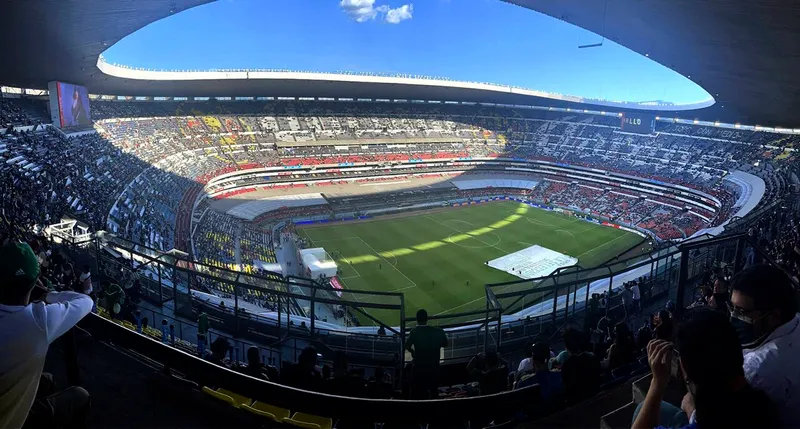
Have you ever watched a goalkeeper kick the ball downfield at Estadio Azteca? Something looks a little different. The ball hovers, the ball flies. It seems to hit the grass ten yards past where the defenders expected it to land.
That’s not the goalkeeper’s strength, he isn’t stronger than others. The air just happens to be thinner at this altitude. At 2,200 meters above sea level, there’s approximately a quarter less air pushing back on the ball, and a quarter less oxygen reaching the lungs of the 22 players chasing it.
Mexico City has hosted World Cup football three times so far. And every team that plays at Azteca has to face the same invisible opponent. Here’s what 7,200 feet actually does to a match.
2,200 meters (7,200 feet): Estadio Azteca’s elevation, the highest of all 16 World Cup 2026 venues by a wide margin.
How high Estadio Azteca sits, and why 2,200 meters changes the game
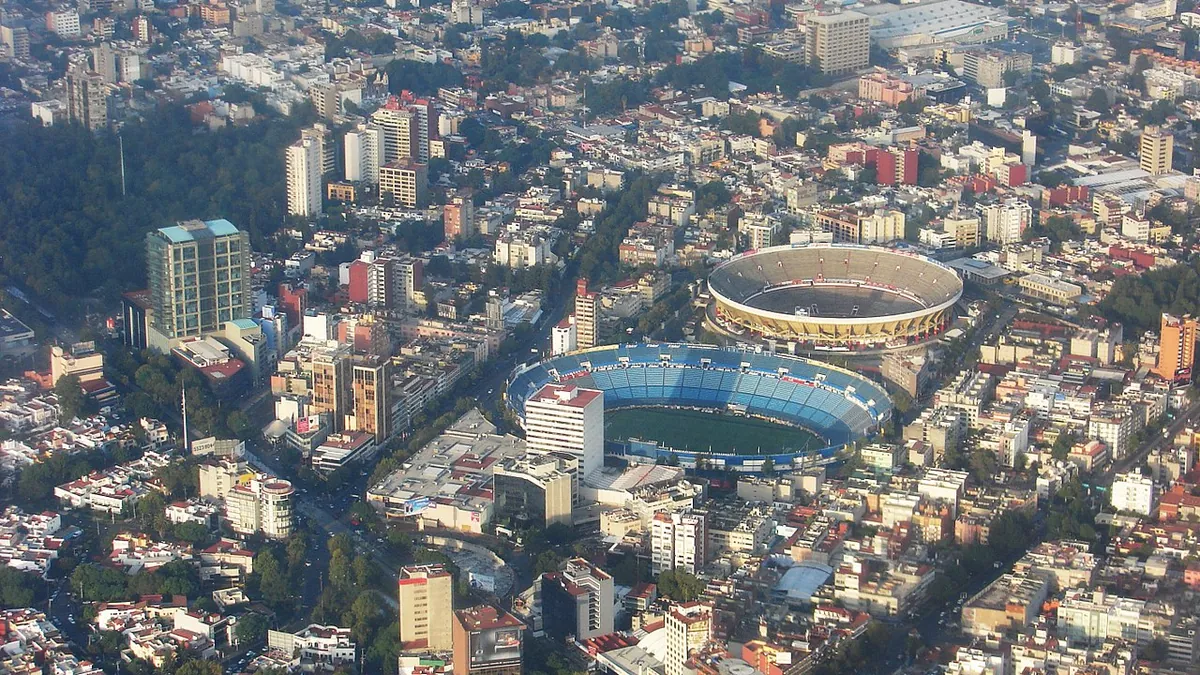
Estadio Azteca is approximately 2,200 meters (7,200 feet) above sea level in southern Mexico City. It’s high enough that basic physics in a football game just doesn’t add up. At that elevation, air pressure falls to around 77% of its sea-level value. That means the air you breathe has approximately a quarter less oxygen. It also means that the air pushes back on a moving ball with around 23% less force. Both numbers don’t sound dramatic on paper, but on the field, they are sometimes a deciding factor. The reduced oxygen drains players who are not used to playing at this elevation. And the reduced air density makes the ball fly faster and further than at lower elevations. Mexico’s national team has actually spent decades turning this into a home advantage. The visiting teams have spent decades complaining about this.
What’s important to understand is that altitude does not have the same effect on everyone. A Mexican or Bolivian player trained in thin air barely notices any difference. But a team coming from London or Buenos Aires feels the difference within one hour of playing.
The World Cup 2026 opener is the showcase. Mexico opened the tournament at Azteca on June 11, and four more matches will follow at the same venue. Every one of those games will be played in conditions most of the planet’s footballers have never trained in before.
What thin air does to the ball
Thin air changes how a football behaves because there’s simply less air to slow the ball down. At Azteca’s 2,200 meters, the air carries about 23 percent less mass per cubic meter than at sea level, and aerodynamic drag scales directly with air density. Less drag means a struck ball keeps its speed longer, dips later, and swerves less through the air. Long passes skid past their target. Goal kicks that should land near midfield can travel toward the final third. Free kicks hit with the same force travel measurably faster. Goalkeepers, who spend a career calibrating exactly when a cleared ball will start to drop, find their timing suddenly off by a fraction that turns into a yard.
This is the part of altitude that shows up in the first ten minutes, before anyone is tired. The stories around the 1970 World Cup, the first one Azteca hosted, were full of players describing balls that “wouldn’t stop.” They weren’t expecting this.
For a striker, that’s an edge. For a defender clearing under pressure, it’s a problem. Crosses that used to be routine now carry an extra beat of hang time and an extra few feet of distance, and the back line has to readjust on the go.
What altitude does to the players
Altitude punishes players by starving the muscles of oxygen, and the effect compounds as a match wears on. Above roughly 1,500 meters, the body’s maximum aerobic capacity (the VO2 max that powers repeated sprints) starts to drop, and at 2,200 meters a player who isn’t used to the altitude loses a meaningful slice of it. The legs still work. What fails is recovery. The 30-second window between high-intensity efforts that a player relies on at sea level no longer fully refills the tank, so by the second half the sprints get shorter and the gaps between them get longer. Coaches who know Azteca plan their substitutions around the 60 to 70 minute mark, when the wall tends to arrive for visiting teams.
Look at any match Mexico plays at home and you see the shape of it. The opponent stays competitive for an hour. Then the legs go.
Hydration makes it worse or better depending on preparation. The dry, thin air at altitude pulls moisture out of the body faster than players expect, and dehydration sharpens every other altitude symptom. It’s why medical staff obsess over fluid intake in the days before a Mexico City match, not just during it.
About 23 percent: how much less dense the air is at Estadio Azteca than at sea level, cutting both ball drag and oxygen per breath.
What the data actually shows about altitude and results
The strongest evidence that altitude swings football matches comes from Patrick McSharry, an Oxford researcher who published a study in the British Medical Journal in 2007. McSharry analyzed 1,460 international matches played across ten South American countries between 1900 and 2004, a region that ranges from sea-level Buenos Aires to La Paz at 3,600 meters. The pattern was clear and statistically significant: as the altitude gap between two teams grew, the high-altitude side scored more, conceded fewer, and won more often. Altitude wasn’t a tiebreaker. It was a measurable, repeatable advantage, and it held whether the high-altitude team was playing at home or away (ScienceDaily summary of the McSharry study).
Later work on the 2010 World Cup found the same pattern in the data. Teams accustomed to altitude held up better in matches played above sea level, while lowland teams faded.
None of this is fringe sports science. It’s the reason Bolivia has beaten Brazil and Argentina in World Cup qualifiers at altitude that it would never win on neutral ground, and it’s the quiet reason a Mexico home draw at Azteca has always been worth more than the bare odds suggest.
The time FIFA tried to ban football this high
FIFA actually tried to outlaw high-altitude football, and the episode tells you exactly where Azteca sits on the risk scale. In May 2007, FIFA banned international matches above 2,500 meters (8,200 feet), citing player health and competitive fairness. The trigger was a Copa Libertadores match in Potosi, Bolivia, at 3,967 meters, where visiting Flamengo players were filmed sucking on bottled oxygen. The ban set off a political fight. Bolivian president Evo Morales played a match at altitude in protest, Diego Maradona called the rule discriminatory against Latin America, and within weeks FIFA raised the limit to 3,000 meters. Thirteen months later, in 2008, it scrapped the ban altogether (Wikipedia: high-altitude football controversy).
Here’s the detail that matters for 2026. Azteca, at 2,200 meters, was always comfortably below even the strictest version of that line. The ban was aimed at La Paz, Potosi, Quito, and Bogota, the genuinely extreme venues where oxygen tanks come out. Mexico City never came close to being affected.
That’s the sweet spot Azteca occupies: high enough to bend a match, low enough that nobody can credibly argue it should be off-limits (NPR coverage of the 2007 ban).
2,500 meters: FIFA’s short-lived 2007 altitude ceiling. Azteca, at 2,200 meters, sat safely under it.
How teams prepare for the thin air
Teams preparing for altitude face a genuine dilemma, and the worst thing they can do is split the difference. The sports-science consensus offers two viable windows. A team can fly in less than 24 hours before kickoff and play before the body fully registers the thin air, banking on adrenaline and a single hard match before fatigue compounds. Or it can arrive around two weeks early and acclimatize properly, giving the blood time to build the extra oxygen-carrying capacity that altitude demands. The trap is the middle window, roughly three to five days out, when acute mountain sickness symptoms (headaches, broken sleep, sluggish legs) tend to peak. A squad that lands four days before a match often plays at its physical worst.
Most major nations at the 2026 World Cup know this cold. The federations with sports-science budgets model it down to the flight time.
For host Mexico, none of this applies. The squad lives and trains at altitude, and that familiarity is worth more than any acclimatization plan a visitor can buy. It’s the same edge the team carried in 1970 and 1986, and it walks out with them again in 2026.
Mexico’s three World Cup cities sit at three very different altitudes
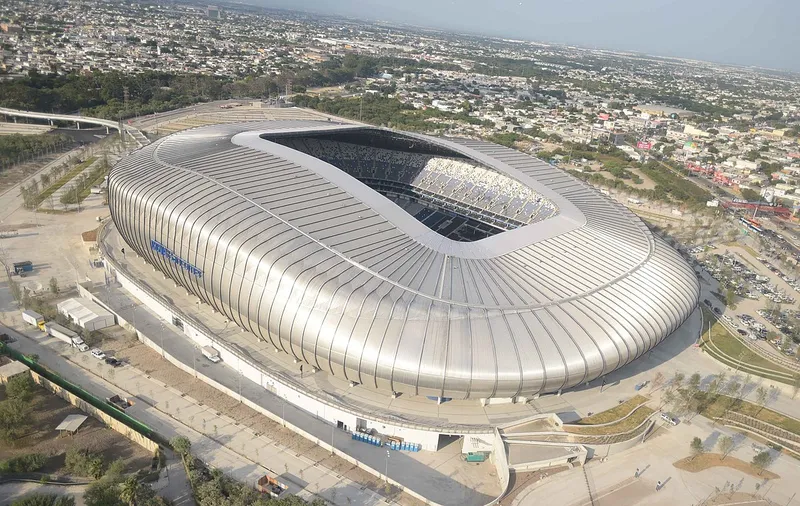
Mexico’s three World Cup 2026 host venues span more than 1,600 meters of elevation, which means “playing in Mexico” is really three different physical tests. Estadio Azteca in Mexico City is the extreme at roughly 2,200 meters. Estadio Akron in Guadalajara sits at about 1,560 meters, high enough to matter but a noticeable step down. Estadio BBVA near Monterrey is practically lowland at around 540 meters. A team that draws a group match in Monterrey faces almost none of the altitude challenge that the same team would meet at Azteca three days later.
| Venue | City | Elevation | Altitude challenge |
|---|---|---|---|
| Estadio Azteca | Mexico City | 2,200 m (7,200 ft) | Severe |
| Estadio Akron | Guadalajara | 1,560 m (5,120 ft) | Moderate |
| Estadio BBVA | Monterrey | 540 m (1,770 ft) | Minimal |
That spread is easy to miss when the schedule just says “Mexico.” It isn’t trivia. A side built to grind out a result in the thin air of Mexico City is solving a different problem than one playing near sea level in Monterrey, and the World Cup draw quietly handed some teams a harder version of the country than others. And altitude shapes Mexican football well beyond the host cities: Puebla’s Estadio Cuauhtémoc sits even higher than Guadalajara, at over 2,100 meters.
What altitude means for World Cup 2026
For World Cup 2026, altitude is the one variable at Estadio Azteca that no amount of money or talent fully neutralizes. The venue hosts five matches, starting with the June 11 opener, and every visiting side that plays there carries the same disadvantage Mexico has exploited for over half a century. Of the 16 host venues reshaped for this tournament, Azteca is the only one where the air itself is part of the test. The teams that handle it best will be the ones that respected the science: the ones that either flew in late or came early, hydrated hard, and planned their bench around the hour mark. The ones that treated Mexico City like any other road trip will find out around the 65th minute why it isn’t.
It’s a long way, in every sense, from the final at sea-level MetLife Stadium in New Jersey. Same tournament, completely different air.
Azteca has been making lowland teams uncomfortable since 1970, and it still rates among the most intimidating venues of the 2026 tournament. The stadium that became the only venue to host three World Cup openers didn’t earn that record only on history and prestige. Some of it is just altitude, doing what it has always done.
Sources
- ScienceDaily: high-altitude soccer teams have a significant advantage. Summary of Patrick McSharry’s 2007 British Medical Journal study analyzing 1,460 South American international matches.
- Wikipedia: high-altitude football controversy. FIFA’s 2007 ban on matches above 2,500 meters, the protests led by Evo Morales and Diego Maradona, and its repeal in 2008.
- NPR: high-altitude soccer matches banned. Contemporary reporting on the 2007 FIFA altitude ban and the Flamengo oxygen incident in Potosi.
- Wikipedia: Estadio Azteca. Stadium elevation, capacity, and World Cup history.
- FOX Sports: Mexico City’s altitude poses a key challenge for 2026 World Cup teams. 2026 tournament context on how altitude affects visiting squads.