About Oriole Park at Camden Yards
In the heart of downtown Baltimore, Oriole Park at Camden Yards changed the way America builds stadiums. When it opened on April 6, 1992, it proved that a baseball park could be intimate, beautiful, and woven into the fabric of its city, and it rendered every cookie-cutter multipurpose stadium in the country obsolete overnight.
The Orioles have called Camden Yards home since 1992, after 38 seasons at Memorial Stadium. The ballpark was designed by HOK Sport (now Populous), with architect Joseph Spear leading a design team that studied classic parks like Wrigley Field, Fenway Park, and Ebbets Field. The result was something new and old at the same time, a modern facility with the character and quirks of a ballpark from the early 1900s.
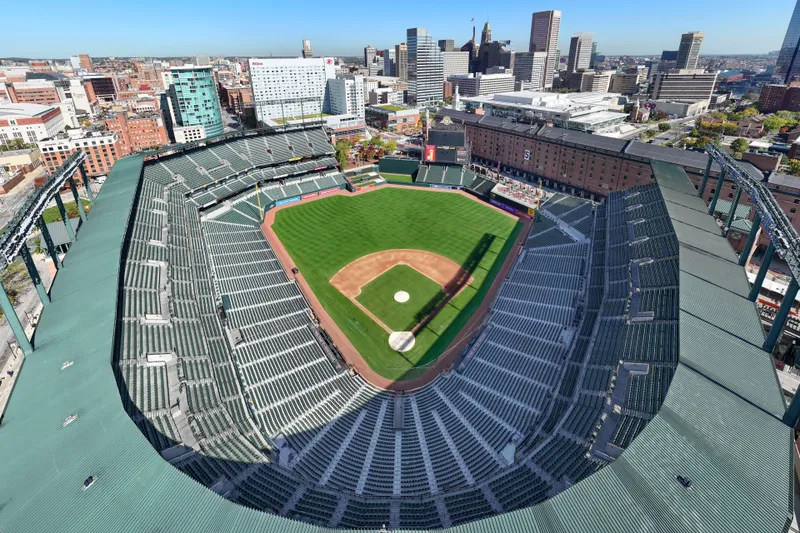
Built for $110 million on the site of the old Camden Yards rail terminal, the park incorporates the massive B&O Warehouse, a 1,016-foot-long brick building that anchors the right-field view and connects the ballpark to Baltimore’s industrial heritage. The asymmetric field dimensions, natural grass, exposed steel, and brick facade created a template that Coors Field, PNC Park, Oracle Park, and a generation of ballparks would follow.
A $60 million renovation in 2022 modernized concourses, added a left-field social area, and reduced capacity from 45,971 to 44,970 for a more intimate experience. Camden Yards looks as good as ever, and the Orioles’ return to contention has brought the energy back to a ballpark that never lost its charm.
Getting to Oriole Park at Camden Yards
Public Transit
Camden Yards has one of the best transit connections of any ballpark in the country, the Light Rail stops directly at the entrance.
→ Via Light Rail: The Camden Yards station is at the ballpark entrance on Camden Street. Light Rail runs from BWI Airport in the south to Hunt Valley in the north, passing through downtown. Service runs every 8–15 minutes on game days. Fare is $1.90 with CharmCard.
→ Via Metro Subway / Charm City Circulator: The Baltimore Metro Subway’s Lexington Market station is a 10-minute walk east. The free Charm City Circulator Purple Route also stops near the ballpark.
The Light Rail from BWI Airport to Camden Yards is one of the best airport-to-stadium connections in American sports, 25 minutes, $1.90, and a stop at the front door.
Driving + Parking
The ballpark address is 333 West Camden Street, Baltimore, MD 21201. I-95 to I-395 North is the most direct approach.
→ From Washington, D.C. (~40 mi): I-95 North (or Baltimore-Washington Parkway) to I-395 North into downtown. About 50 minutes to 1 hour depending on traffic.
→ From Philadelphia (~100 mi): I-95 South to I-395 North into Baltimore. About 1 hour 45 minutes.
→ From Annapolis (~30 mi): I-97 North to I-695 West to I-95 North to I-395. About 35 minutes.
Stadium lots B and C cost $15–$25 on game days. Inner Harbor garages run $10–$20 with a short walk. Street metered parking is available but fills quickly. The Light Rail is the easiest option for fans coming from BWI or the northern suburbs.
Rideshare
Uber and Lyft are widely available in downtown Baltimore. Drop-off zones are along Camden Street and Conway Street. From Inner Harbor hotels, expect $6–$8. From Fells Point, $8–$12. Post-game surge pricing is minimal, Camden Yards crowds disperse quickly due to Light Rail and walkability.
From the Airport
→ Baltimore/Washington International (BWI): 10 miles south of the ballpark, about 15–20 minutes by car. Major hub for Southwest Airlines with extensive domestic service. The Light Rail connects BWI to Camden Yards station in about 25 minutes for $1.90. Rideshare runs $20–$30.
→ Ronald Reagan Washington National (DCA): 45 miles south. Amtrak and MARC train connect to Baltimore Penn Station (about 45 minutes), then Light Rail or Circulator to Camden Yards.
The Food at Camden Yards, and What to Know Before You Go
Ask a Baltimore fan what makes Camden Yards worth the trip and a lot of them will talk about the food before they talk about the baseball. That is not a knock on the baseball. Camden Yards’ concessions regularly land near the top of national ballpark-food rankings, and Boog’s BBQ has been singled out as the best barbecue in the majors. The locals will defend the reputation.
The thing you should not leave without is a pit beef sandwich from Boog’s BBQ, the smoker run under the name of 1970 MVP and Orioles great Boog Powell, parked on the Eutaw Street concourse behind right field. After that the menu is all Maryland: a lump crab cake sandwich, the crab mac and cheese dog (a hot dog buried under baked mac and cheese and crab meat), and Old Bay on more or less everything. The newer name to hunt down is Ekiben, a beloved Baltimore restaurant that now runs a stand near section 49 all season, whose steamed buns pull a genuine local following, not just a stadium-food one.
Here is the honest part, because Orioles fans are honest about it. A concessions vendor change a couple of seasons ago thinned out some of what regulars loved, and lines at the popular stands can run long enough to cost you an inning. The reputation is real and mostly earned. Just do not expect every stand to clear the bar, and get to Boog’s before the crowds do.
The move most first-timers miss: you can bring your own food in. Camden Yards runs one of the more relaxed policies in baseball. Each person may carry one approved bag, a clear plastic bag up to 12 by 6 by 12 inches, a one-gallon freezer bag, or a small clutch, and pack it with your own food plus one factory-sealed, non-alcoholic drink up to 20 ounces. No cans, no glass, no alcohol. You also never have to buy water here: there are fountains throughout the park, and on a hot day the stands will usually hand you a cup of ice for nothing. For a family, that single policy is worth more than any promotion.
Leave time for Eutaw Street, the pedestrian promenade that runs between the seats and the old warehouse. Brass baseballs are set into the pavement wherever a home run has reached the street, so you can stand on the exact spot one came down. When the national anthem hits “O say does that star-spangled banner yet wave,” the whole ballpark shouts the “O” in unison, an Orioles ritual that startles every first-time visitor. And the drink to order is a Natty Boh, the National Bohemian lager Baltimore treats as a civic mascot.
One note on where to sit. For a day game, regulars point you to the third-base side, which slides into shade earlier than the sun-exposed first-base line and right field. It is also the better angle on the warehouse. The comfortable seats and the good-looking ones happen, for once, to be the same seats.
Construction & Design
Oriole Park at Camden Yards is the building that ended an era. Before it, new ballparks were concrete multipurpose bowls shared with football teams: round, symmetrical, and interchangeable. The Maryland Stadium Authority hired HOK Sport to try something else on the site of an old Baltimore & Ohio rail yard, and architect Joe Spear, working with the Orioles’ Janet Marie Smith, went looking backward instead of forward. Ground broke on June 28, 1989. Barton Malow built it. It opened on April 6, 1992, at a cost of about $110 million, part of a roughly $225 million development that included the land and infrastructure.
The result looked a century old on purpose. Brick and exposed steel instead of concrete. An asymmetric outfield with real quirks. A playing field sunk below street level, and the whole thing wedged into downtown two blocks from the harbor. The old B&O Warehouse, one of the longest buildings on the East Coast, was left standing beyond right field as a backdrop, with Eutaw Street running between it and the seats as a pedestrian promenade studded with brass plaques marking where the longest home runs landed. Every retro ballpark that followed, Coors Field, PNC Park, and a dozen others, traces its lineage here.
Not every change since has been beloved. In 2022 the Orioles hauled the left-field wall back and up, deepening the park so drastically that hitters nicknamed it “Walltimore” and home runs vanished by the dozen. In 2025 the club admitted it had overcorrected and pulled the wall partway back in, chasing a happier medium.
History of Oriole Park at Camden Yards
Oriole Park at Camden Yards was built to replace Memorial Stadium, where the Orioles had played since 1954. The Maryland Stadium Authority commissioned HOK Sport to design a ballpark that would honor baseball’s architectural past while providing modern amenities. The $110 million project broke ground in 1989 on the site of the former Camden Yards rail terminal, incorporating the historic B&O Warehouse into the design.
First Game (April 6, 1992): The Orioles defeated the Cleveland Indians 2–0 before a sellout crowd of 44,568. The ballpark was an instant sensation, praised by critics, players, and fans as the most beautiful new stadium in American sports.
Cal Ripken’s 2,131 (September 6, 1995): Ripken broke Lou Gehrig’s consecutive games played record in one of baseball’s most emotional nights. When the game became official in the fifth inning, Ripken circled the field for 22 minutes as the crowd roared. He then hit a home run in the same game, a storybook moment that is still replayed every September.
Empty Stadium Game (April 29, 2015): During the Baltimore unrest following the death of Freddie Gray, the Orioles played the Chicago White Sox in a closed stadium with no fans, the first time in MLB history a game was played before zero spectators. Chris Davis hit a three-run homer to an empty ballpark.
2022 Renovation: A $60 million project modernized concourses, added a left-field standing area, and reduced capacity for better sightlines. The renovation preserved everything that made Camden Yards special while bringing it into the modern era.
From the ballpark that changed an industry to Cal Ripken’s streak to a renaissance under new ownership, Oriole Park at Camden Yards is where the retro ballpark revolution began, and three decades later, it remains one of the best places in America to watch a baseball game.
Sources & Further Reading
- Maryland Stadium Authority, Oriole Park: mdstad.com. The owner’s venue facts, capacity, and address.
- Ballparks of Baseball, Camden Yards: ballparksofbaseball.com. Cost, dimensions, and construction history.
- SABR, Oriole Park at Camden Yards: sabr.org. Design team, the naming compromise, and event history.
- Wikipedia, Oriole Park at Camden Yards: en.wikipedia.org/wiki/Oriole_Park_at_Camden_Yards. Timeline and the retro-ballpark legacy.
Quick Facts
Everything you need at a glance.
Stadium specs
- Capacity
- 44,970
- Opened
- 1992
- Cost
- $110 million (~$250 million (2025 dollars) today)
- Roof
- Open
- Surface
- Natural Grass (Kentucky Bluegrass Blend)
- Tenants
- Baltimore Orioles (MLB)
Construction & location
- Groundbreaking
- June 28, 1989
- Architects
- HOK Sport (Populous)
- General contractor
- Barton Malow
- Address
- 333 West Camden Street, Baltimore, MD 21201, USA
- GPS
- 39.2838°N, 76.6216°W
Photo Gallery
Fun Facts
Oriole Park at Camden Yards is widely credited with launching the 'retro ballpark' movement, its 1992 opening inspired every major stadium built in the following two decades, from Coors Field to PNC Park to Oracle Park, to abandon the cookie-cutter multipurpose stadium model.
The B&O Warehouse beyond right field is 1,016 feet long, the longest building on the East Coast when it was built in 1905, and no player has ever hit a home run that struck the warehouse on the fly during a game, though Ken Griffey Jr. hit it during the 1993 Home Run Derby.
On September 6, 1995, Cal Ripken Jr. played in his 2,131st consecutive game at Camden Yards, breaking Lou Gehrig's 'unbreakable' record in one of baseball's most celebrated moments.
Stadium Location
Frequently Asked Questions
- What is the seating capacity of Oriole Park at Camden Yards?
- Oriole Park at Camden Yards seats 44,970 after a 2022 renovation reduced capacity from 45,971. The original 1992 capacity was approximately 48,000. The reduction added wider concourses, a left-field bar and social area, and improved sightlines.
- Where is Oriole Park at Camden Yards located?
- Oriole Park at Camden Yards is at 333 West Camden Street in Baltimore, Maryland 21201. It sits in downtown Baltimore's Camden Yards sports complex, adjacent to the historic B&O Warehouse and two blocks from the Inner Harbor.
- How do I get to Camden Yards by public transit?
- The Baltimore Light Rail stops at Camden Yards station directly at the ballpark entrance. The Light Rail connects to BWI Airport, Hunt Valley, and Penn Station. The Baltimore Metro Subway's Lexington Market station is a 10-minute walk. The free Charm City Circulator bus also serves the area.
- Is there parking at Camden Yards?
- Stadium lots B and C cost $15–$25 on game days. Nearby garages in the Inner Harbor area run $10–$20. Street metered parking is available but competitive. The Light Rail from BWI or northern suburbs is an excellent alternative. Pre-purchase through SpotHero or the Orioles website.
- What is the B&O Warehouse?
- The B&O Warehouse is the 1,016-foot-long brick building beyond right field, the longest building on the East Coast when completed in 1905. Built for the Baltimore & Ohio Railroad, it now houses Orioles offices, private event spaces, and the Orioles Hall of Fame. No player has hit the warehouse on the fly during a regular-season game.
- Why is Camden Yards considered so important?
- Oriole Park at Camden Yards, designed by HOK Sport (now Populous), is credited with launching the retro ballpark movement when it opened in 1992. It proved that baseball stadiums could be intimate, architecturally distinctive, and integrated into their urban surroundings, rejecting the cookie-cutter multipurpose stadiums of the 1960s–1980s. Virtually every major ballpark built since has followed Camden Yards' model.
- What happened on Cal Ripken's streak night?
- On September 6, 1995, Cal Ripken Jr. played in his 2,131st consecutive game, breaking Lou Gehrig's 56-year-old record. When the game became official in the middle of the fifth inning, Ripken took a 22-minute victory lap around the field as fans gave him a standing ovation. He then hit a home run. It is one of baseball's most iconic moments.
- How far is the airport from Camden Yards?
- Baltimore/Washington International Airport (BWI) is 10 miles south of the ballpark, about 15–20 minutes by car. The Light Rail connects BWI to Camden Yards station in about 25 minutes for $1.90, one of the best airport-to-stadium transit connections in American sports. Rideshare runs $20–$30.
- Can you bring food into Oriole Park at Camden Yards?
- Yes, and it is one of Camden Yards' best-kept secrets. Each guest may bring one approved bag: a clear plastic bag no larger than 12 by 6 by 12 inches, a one-gallon plastic freezer bag, or a small clutch or fanny pack up to 5 by 7 inches. Inside it, you can pack your own food. Hard-sided coolers and oversized bags are not permitted, and every bag is searched at the gate.
- Can you bring water or drinks into Camden Yards?
- Yes. Each person may bring one factory-sealed, non-alcoholic beverage no larger than 20 ounces, in a plastic bottle. Cans, glass bottles, and outside alcohol are not allowed. You do not really need to bring water anyway: there are fountains throughout the ballpark, and on hot days the concession stands will usually give you a cup of ice for free.
- What is the best food at Camden Yards?
- Camden Yards is regularly ranked among the best ballparks in America for food, and Boog's BBQ has been named the best barbecue in the majors. The signature is its pit beef sandwich on the Eutaw Street concourse, run under the name of Orioles great Boog Powell. Local favorites also include the Maryland crab cake sandwich, loaded fries, the crab mac and cheese dog, and the steamed buns from Ekiben. Fair warning: lines at the popular stands can be long, so hit them early.
- What is Ekiben at Camden Yards?
- Ekiben is a popular Baltimore restaurant, known for its Asian-style steamed buns, with a stand near section 49 at Camden Yards all season. It is one of several local Baltimore vendors the Orioles have brought in, and it draws fans who would seek it out even without a game on.
- Which side of Camden Yards is in the shade?
- For a day game, the third-base side of Camden Yards falls into shade earlier than the first-base line and the right-field seats, which stay in the sun the longest. The third-base side also gives you the best view of the B&O Warehouse, so the shadier seats and the prettier ones tend to be the same seats. Upper-deck seats under the overhang stay coolest of all.
- What is not allowed at Camden Yards?
- The main restrictions are on what you carry in. Hard-sided coolers, glass bottles, cans, and outside alcohol are not permitted, and bags must fit the approved sizes (one clear bag up to 12 by 6 by 12 inches, a one-gallon freezer bag, or a 5-by-7-inch clutch per person). Every bag is searched at the gate, so traveling light is the fastest way in. The Orioles publish a full A-to-Z guide of prohibited items on their website.
Last updated: 2026-07-15