About Estadio Metropolitano
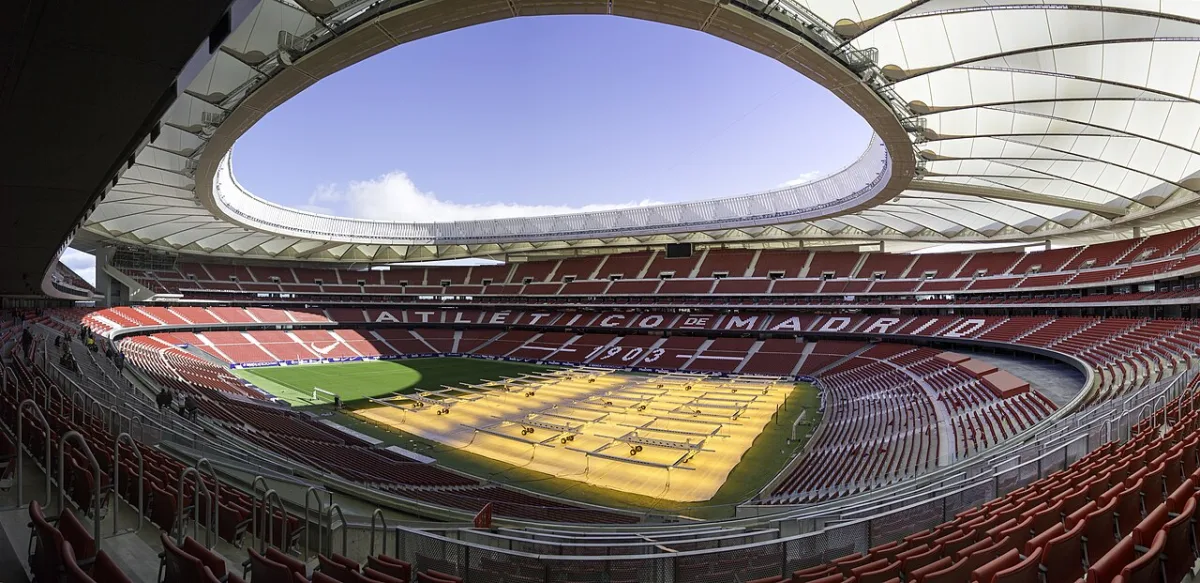
The roof is the first thing you notice: a great white sheet that ripples across the top of the stands like a wave frozen mid-break. This is the Estadio Metropolitano, Atlético Madrid’s home in the eastern reaches of the city, a 70,692-seat bowl that gave the club a modern fortress after decades on the banks of the Manzanares. It is officially the Riyadh Air Metropolitano now, the latest in a run of sponsor names, but Madrid just calls it the Metropolitano.
The stadium did not start life as a stadium at all. It grew out of La Peineta, a half-finished athletics arena from 1994, which the architects Cruz y Ortiz wrapped in a full football bowl and a tensioned cable-net roof. The pitch is natural grass, 105 metres by 68, and the roof shelters 96 percent of the seats while leaving the turf open to the Madrid sky. When it reopened in 2017 it became the first football ground on earth lit entirely by LED.
Atlético own it outright and have played here since September 2017, and in that short time the ground has hosted a Champions League final, a Copa del Rey final, and a world-record women’s football crowd. It is not in the tourist heart of Madrid, out past the M-40 near the airport and the fairgrounds, but on a derby night it is one of the most intimidating rooms in Europe.
Getting to Estadio Metropolitano
Madrid’s metro makes this an easy trip, even though the ground sits well out to the east. Here is how to reach it however you are traveling.
Public Transit
The clean answer is Line 7. The Estadio Metropolitano station sits directly across from the ground, a couple of minutes’ walk to the gates, and from Sol or Nuevos Ministerios in the center it is a straight ride of about twenty-five minutes with no change. On the busiest nights the platforms back up afterward, so it helps to know the backups: Las Rosas on Line 2 and Canillejas on Line 5 are each about a fifteen-minute walk away, and city buses serve the nearby Canillejas interchange.
Driving + Parking
Driving is practical here by stadium standards, because the M-40 ring road runs right past the ground with clearly signed exits onto Avenida de Luis Aragonés and Avenida de Arcentales. Parking is plentiful too: more than 4,000 spaces across an underground garage and outdoor lots, though on match days these are largely reserved for season-ticket holders and fans who pre-bought a pass. Lots open around midday and fill fast for derbies, so come early and be patient on the M-40 approaches.
Rideshare
Unlike Barcelona, Madrid is friendly to ride-hailing, and Uber, Cabify, and Bolt all operate freely alongside the licensed FreeNow taxis. Cabify, the home-grown Spanish app, usually has the biggest local fleet. A 2026 city reform caps surge pricing on big event days, so expect fares that are elevated but no longer wild around a sold-out match. Drivers drop off around the stadium perimeter, though after the whistle the metro is normally quicker out.
From the Airport
Here is a quiet perk: Madrid-Barajas airport is barely 13 kilometres away on the same eastern edge of the city, one of the shorter airport-to-stadium hops you will find. A taxi covers it in ten to fifteen minutes for around twenty-five to thirty euros on the fixed-fare system. By metro there is no single line; the fastest route runs Line 8 to Nuevos Ministerios, then Line 10 and Line 7, about fifty-five minutes plus the airport supplement.
Construction & Design
The Metropolitano is really two buildings in one. Its bones belong to La Peineta, an athletics stadium Cruz y Ortiz designed in 1994 for a Madrid Olympic bid that never came, and which sat largely mothballed for years. When Atlético needed to leave the cramped Vicente Calderón, the same architects came back and built a full football stadium around the old single grandstand, extending the tiers into a continuous bowl and lifting a vast roof over the top.
That roof is the signature. Engineered by Schlaich Bergermann Partner, the German firm behind the Maracanã and Soccer City canopies, it is a tensioned cable-net membrane covering 96 percent of the seats, its wave-like profile rising as high as 57 metres above the pitch on a steel structure of some 6,336 tons. The membrane itself, a fibreglass-and-PTFE fabric, wraps tens of thousands of square metres and was lifted into place over the finished bowl rather than built up from the ground. FCC handled construction, the engineers TYPSA oversaw the structure, and the whole conversion cost somewhere around 240 to 250 million euros, depending on the source. The club leaned into technology too, making it the first stadium anywhere lit fully by LED, a detail it still advertises on the ground’s own literature.
The result feels bigger and louder than its footprint suggests. Steep tiers, that low-hanging roof to trap the noise, and a red-and-white wall of support have made the Metropolitano a genuine home-field weapon, which is exactly what Atlético wanted when they left the river behind. The old Calderón had been famous for its din, hemmed in by apartment blocks and a motorway underneath the stand; the new ground was built to bottle that same intensity at nearly twice the size.
History of Estadio Metropolitano
The name is a callback. Atlético played at an original Estadio Metropolitano from the 1920s until 1966, then spent half a century at the riverside Vicente Calderón before moving east. Reviving the Metropolitano title tied the new stadium to the club’s deep past even as everything about it looked to the future, and the move roughly doubled Atlético’s capacity, giving them a stage to match Real Madrid’s Bernabéu across town.
September 16, 2017: the stadium opened with a 1-0 win over Málaga, Antoine Griezmann scoring the first goal in front of King Felipe VI. The big occasions came quickly. On 21 April 2018 it staged the Copa del Rey final, a 5-0 rout of Sevilla by Barcelona, and on 1 June 2019 it hosted the Champions League final, where Liverpool beat Tottenham 2-0. Between them, in March 2019, an Atlético women’s match against Barcelona drew 60,739, then a world record for women’s club football, proof of how quickly the new ground could fill. It has pulled big non-football crowds too, from major concerts to the 2023 creator-boxing spectacle La Velada del Año, which shifted more than 70,000 tickets.
The name outside kept changing even as the walls stayed put. It opened as the Wanda Metropolitano, became the Cívitas Metropolitano in 2022, and in October 2024 took its current sponsor title, the Riyadh Air Metropolitano, part of the wave of Saudi money flowing into European football.
The crowds kept climbing too. In September 2024 a league match against Real Madrid drew 70,112, the ground’s record football attendance, and in 2025 UEFA handed the Metropolitano the 2027 Champions League final, a second European showpiece for a stadium not yet a decade old. For a ground grafted onto an abandoned athletics arena, it has become one of the most sought-after venues in Europe in remarkably little time.
Sources & Further Reading
- Atlético Madrid official site: atleticodemadrid.com. Club pages on the stadium, capacity, roof, and history.
- Wikipedia entry on Metropolitano Stadium: en.wikipedia.org/wiki/Metropolitano_Stadium. Capacity timeline, construction, and events with sourcing.
- TYPSA project page: typsa.com. The engineer’s account of the conversion and structure.
- Structurae: structurae.net. Technical data on the roof and steelwork.
- UEFA Champions League: uefa.com. The 2019 final record and the 2027 final award.
Quick Facts
Everything you need at a glance.
Stadium specs
- Capacity
- 70,692
- Opened
- 2017
- Cost
- €240 million
- Roof
- Roof over stands (open pitch)
- Surface
- Natural grass
- Tenants
- Atlético Madrid (La Liga)
Construction & location
- Groundbreaking
- 2011
- Architects
- Cruz y Ortiz Arquitectos
- Engineering
- Schlaich Bergermann Partner (roof)
- General contractor
- FCC
- Address
- Avenida de Luis Aragonés, 4, 28022 Madrid, Spain
- GPS
- 40.4361°N, 3.5994°W
Photo Gallery
Fun Facts
When it reopened in 2017 the Metropolitano became the first football stadium in the world lit entirely by LED, and its undulating roof shelters 96 percent of the seats.
The ground was not built from scratch: architects Cruz y Ortiz wrapped a full football bowl and roof around the half-finished La Peineta athletics stadium, a 1994 arena nicknamed 'the comb' for its spiky grandstand.
The wave-like tensioned roof was engineered by Schlaich Bergermann Partner, the same firm behind the roofs of the Maracanã in Rio and Soccer City in Johannesburg.
Stadium Location
Frequently Asked Questions
- What is the capacity of Estadio Metropolitano?
- The stadium holds 70,692, making it one of the largest in Spain. That figure grew in stages from 68,456 at the 2017 opening to 70,460 after a 2023 expansion.
- Who plays at Estadio Metropolitano?
- It is the home of Atlético Madrid, who own and operate the stadium and have played there since 2017. The Spain national team also hosts selected matches here.
- Why is it also called the Riyadh Air Metropolitano?
- The enduring name is Estadio Metropolitano, but sponsors have renamed it: Wanda Metropolitano from 2017, Cívitas Metropolitano from 2022, and Riyadh Air Metropolitano from October 2024.
- When did Estadio Metropolitano open?
- It opened on 16 September 2017 with a 1-0 win over Málaga, Antoine Griezmann scoring the first goal, replacing Atlético's old riverside Vicente Calderón.
- Did Estadio Metropolitano host a Champions League final?
- Yes. It hosted the 2019 final, where Liverpool beat Tottenham 2-0, and UEFA has already awarded it the 2027 Champions League final as well.
- How do I get to Estadio Metropolitano by metro?
- Take Metro Line 7 to Estadio Metropolitano station, right across from the ground. From central Madrid it is about 25 minutes with no change.
- How close is Estadio Metropolitano to the airport?
- Very close. Madrid-Barajas airport is only about 13 kilometres away on the same side of the city, roughly a 10 to 15 minute taxi ride.
- Is the pitch covered by a roof?
- The roof covers around 96 percent of the seats, but the pitch itself is left open to the sky. The playing surface is natural grass.
Last updated: 2026-07-13