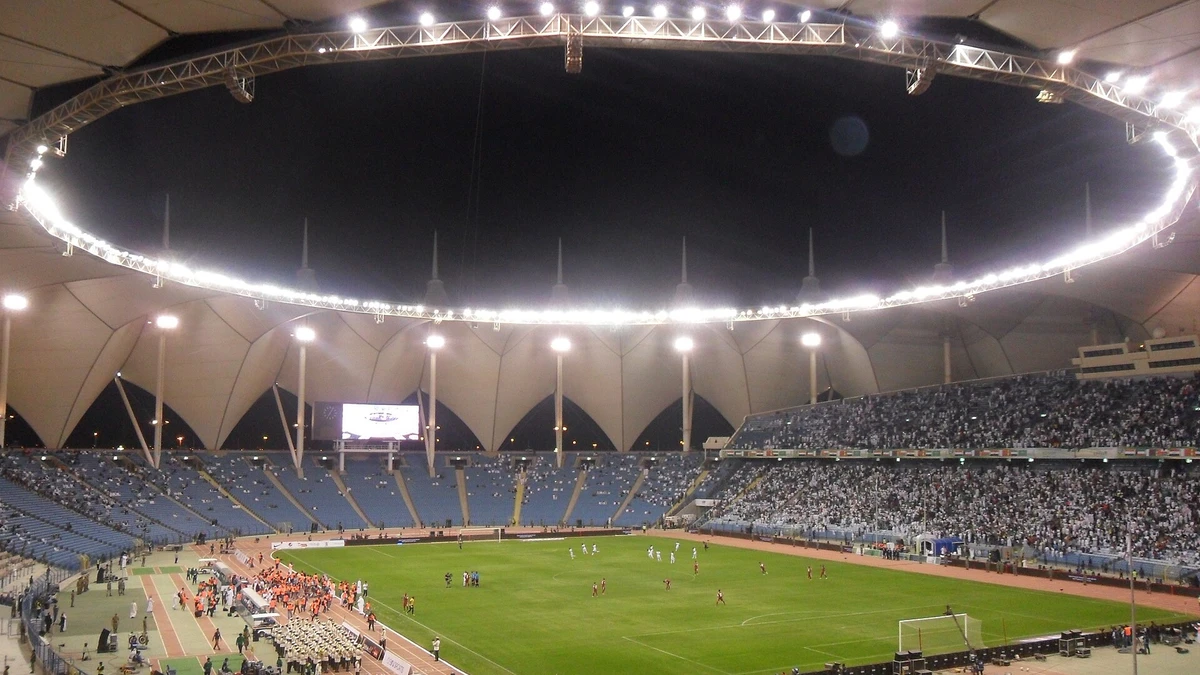
About Aramco Stadium
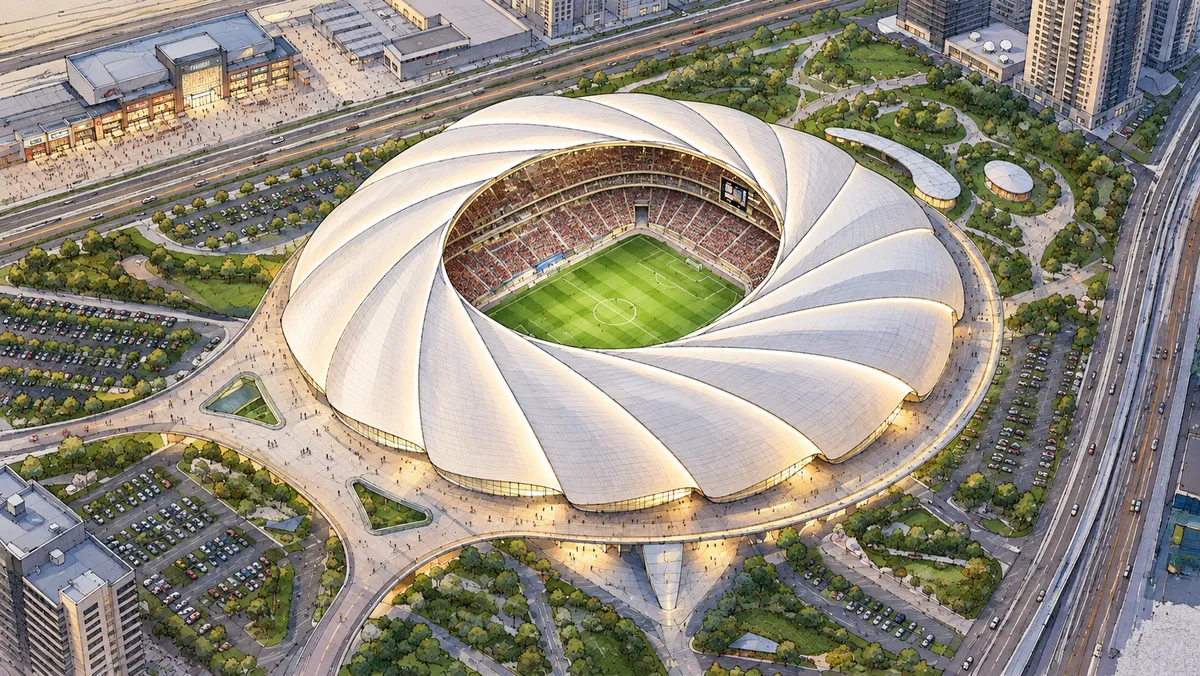
Off the Khobar coastline in summer, the Gulf turns on itself in slow spirals that people here call dawwam. Populous took that rotation, stretched it into an ellipse, and wrapped it in overlapping translucent sails that curve past one another like water folding over. The result now stands in Sports City, in the north of Al Khobar, at 2222 King Saud bin Abdulaziz Road. It has a capacity of 47,000 for football and a maximum of 55,000 for concerts. And, as of September 2026, not a single crowd.
That last part is the fact the rest of the page hangs on. Construction began on July 31, 2024. Saudi press reporting in August 2026 put construction completion in September, operational testing through the autumn, an official opening in November, and handover to the Asian Football Confederation in December, ahead of an Asian Cup that kicks off on January 7. Very little slack in that sequence.
The ownership is unusual enough to be worth stating plainly. ROSHN Group, the Public Investment Fund’s real-estate developer, owns the building. Saudi Aramco operates it under a 25-year concession, and Aramco also owns the club that will play in it. Al-Qadsiah, founded in Khobar on December 1, 1967, became an Aramco-owned company in the summer of 2023 when the Ministry of Sport privatized eight clubs at once, and won promotion to the Saudi Pro League the following May. The oil company, the developer, the landlord, the operator and the tenant are, in the end, two organizations.
No official Aramco statement has confirmed a cost. The reported figure is SAR 3.7 billion, about a billion US dollars. The site around the bowl runs to 800,000 square metres (8.6 million square feet) and takes in training fields, a park, a fan zone and 33 retail units. The pitch is 105 by 68 metres (344 by 223 feet) of hybrid grass. It will be a 2034 World Cup venue too, through the Round of 16.
Getting to Aramco Stadium
Public Transit
No metro. No tram, no commuter line, and a national rail network that stops at Dammam rather than Al Khobar. Nothing on rails reaches Sports City.
→ SAPTCO Eastern Region buses: The city network covers Dammam, Al Khobar, Dhahran and Qatif with 85 buses serving 212 stops, running 18 hours a day from 05:30 to 23:30. No published route reaches the stadium as of September 2026.
→ From central Al Khobar: About 9 kilometres (6 miles) north. Fifteen to twenty minutes by road outside event traffic.
→ From Dammam: Roughly half an hour, longer on a match night, and the two cities share one continuous urban sprawl rather than a gap between them.
Treat the bus as a way of crossing the metro area, not a way of reaching your seat. Riyadh has six metro lines; the Eastern Province, with a population the Saudi 2034 bid puts above 2.7 million across the Dammam, Khobar, Dhahran and Qatif cluster, has none. The bid book promises an “efficient multimodal transportation network” in development. Not yet, though. Not by January.
Driving + Parking
The stadium sits off King Saud bin Abdulaziz Road in north Al Khobar. GPS address: 2222 King Saud bin Abdulaziz Road, Sports City, Al Khobar 34225.
→ From Bahrain: The King Fahd Causeway lands you in Al Khobar directly, 25 kilometres (16 miles) of road plus a border crossing on an artificial island in the middle.
→ From Dhahran and Ithra: About 7 kilometres (4 miles). Closer in than central Al Khobar.
Around 9,000 parking spaces are laid out on the site, feeding 15 entry gates. For a Saudi Pro League crowd that is generous. Against a full Asian Cup house of 47,000 arriving inside the same hour, it is adequate rather than comfortable, and Sports City is served by one main road.
Rideshare
Uber and Careem both cover the Dammam metropolitan area, alongside metered taxis, and all of them reach Sports City without trouble. The trip in is the easy half.
Pro tip: Agree the return before you need it. A car park built for 9,000 vehicles emptying into a single arterial road is the part of the evening nobody plans for.
From the Airport
→ King Fahd International (DMM): About 55 kilometres (34 miles) by road, 40 to 50 minutes. SAPTCO runs an airport bus to Al Khobar in roughly 40 minutes, which gets you to the city rather than the stadium.
→ Bahrain International (BAH): Across the causeway. Under an hour of driving plus however long the border takes, and on a match night that second number is the one that matters.
Watching a Match at Aramco Stadium
The case for cooling this building was made in the stands of a different one. Through 2025 and 2026, Al-Qadsiah supporters at Prince Mohamed bin Fahd Stadium in Dammam were filmed being carried out of the stands after fainting in the humidity, with paramedics working the aisles. Khobar’s June daytime range runs from 36 to 50 degrees Celsius (97 to 122 Fahrenheit), and the Gulf adds the moisture. That is the problem the new bowl was built around.
The answer is under the seat rather than over it. Roughly 57,000 displacement air diffusers were installed across the stands, approximately one per seat, engineered to push cooled air upward at low velocity so the noise stays down and the energy draw stays low. They passed their HVAC commissioning tests during 2026. The roof, meanwhile, covers the stands, and the pitch is not enclosed: the grounds team runs grow-light rigs for the strips of turf the canopy shades, and the front rows of the lower tier will be the most exposed seats in the house on an afternoon kickoff. Sit high. Sit back.
The matchday culture arrived before the building did, and it is not subtle. Al-Qadsiah run pyrotechnic fire fountains when the players come out and again after every goal, a piece of theater the club has leaned on hard since promotion. They also fill their stands on purpose, routing tickets through Aramco employees, through schools, and through community programs, which is how a club that spent most of the 2010s in the second tier arrived at a home record worth talking about. Unbeaten at home in the league deep into the 2025-26 season. Two home draws in that run, against Damac and against Al-Hilal. Simone Inzaghi, whose Al-Hilal side was one of the two to take a point, described it as among the most difficult grounds his team played on that season.
The rivalry travels with them. The Eastern Derby against Al-Ettifaq, a fixture both clubs let slide during years spent in the lower divisions, came back to life on September 12, 2026 with a 3-3 draw at Prince Mohamed bin Fahd Stadium, the ground both clubs currently share. The first one played at Aramco Stadium will be the fixture to be at.
One honest caveat, because it is the thing nobody in the promotional material says out loud. The atmosphere described above was generated in a 26,000-seat ground that the club could reliably fill. Aramco Stadium is nearly twice that. A full house of 47,000 with fire fountains going off is one of the better nights in Asian football. A half-empty one is a very large air-conditioned room.
The 2027 Asian Cup at Aramco Stadium
Saudi Arabia hosts the AFC Asian Cup from January 7 to February 5, 2027, with 24 teams across eight stadiums. Five of those stadiums are in Riyadh. Two in Jeddah. Aramco Stadium is the eighth, and the Eastern Province’s entire allocation rides on it. The full venue list is in our AFC Asian Cup 2027 guide.
That concentration cuts both ways. It guarantees the venue a tournament profile that a new club ground would normally take a decade to earn, and it removes any margin for a delayed handover, which is why the December 2026 date matters more than the November opening does. Individual fixtures had not been published when this page was written. A tournament venue without a fixture list, less than four months from handover.
January is also, quietly, the best argument for the timing. Played in Saudi Arabia in midwinter, the tournament sidesteps the heat problem entirely, and the cooling under the seats becomes insurance rather than necessity. The 2034 World Cup still has no dates, and the heat is why.
Construction & Design
The project was conceived in May 2023, and the design was finished inside six months. That is a fast schedule for a 47,000-seat stadium, and it set the pattern for everything that followed. BESIX of Belgium and ALBAWANI of Saudi Arabia were engaged as a joint venture early in 2024, with the design already closed. Ground was broken on July 31, 2024. Fourteen months from first sketch to first excavator. The target was a building ready in 2026 for a tournament in January 2027.
Populous drew it, with the firm’s Jump Studios handling interiors and hospitality. Dar Al-Handasah delivered the detailed engineering design for the stadium and the surrounding masterplan, and Dar’s sister company Maffeis Engineering took on the roof and facade, which is where the whirlpool stops being a metaphor and becomes an engineering problem. The facade is a set of translucent sails, each one curved and lapping over the next, and the daylight in the concourses arrives through them. The bowl beneath it is a true ellipse, chosen to shrink the footprint and to help natural ventilation do some of the work the mechanical system would otherwise do alone.
The roof is the piece with the best paper trail. The original specification called for insulated sandwich panels; the team switched to standing-seam metal roofing, and published the reasoning. Standing seam can be roll-formed on site into sheets running up to 100 metres (328 feet), and cold-bent to a radius as tight as 4,000 millimetres (13 feet), which is what a non-linear elliptical geometry demands. Three separate roof build-ups were designed for different sections of the canopy, tuned to different acoustic and structural loads, landing between 20.69 and 24.81 kilograms per square metre. Thermal performance came in at U-values of 0.20 to 0.25 watts per square metre kelvin, acoustic performance at Rw 41 to 43 decibels, and the assemblies were tested watertight under simulated wind-driven rain at pressures above 1,200 pascals.
Then the cooling, which is displacement rather than overhead. Air enters beneath the seats and rises through the bowl at low velocity instead of being blown down at it from the roof, and both the noise and the plant come out smaller for it. The sustainability strategy, written by Dar, targets both LEED and Mostadam, Saudi Arabia’s own green building rating system, and Saudi reporting has put the Mostadam goal at Diamond. The pitch runs on smart irrigation, 95 percent natural grass with hybrid stitching.
Building it took a small town. Somewhere between 11,000 and 12,000 workers were on site through 2026, and the project logged more than 10 million safe working hours, which the contractors attribute partly to a smart safety command center running AI monitoring, 360-degree cameras, drone inspection and heat sensors. The strangest piece of it is a crane collision-prevention system in which the tower cranes and crawler cranes talk to each other and shut themselves down when they get too close, described by the team as a first for the region. A construction fire in January 2026 was put out by civil defense inside ten minutes, with no injuries and no structural damage, and the roof was reported installed that same month. Progress hit 81 percent in April. The stands were finished on July 23, 2026.
History of Aramco Stadium
The Dawasir tribe moved to Al Khobar in 1923, and into the early 1930s the place was still mainly a fishing hamlet. Oil is what turned it into a city. Khobar served as the port for Saudi Aramco’s oil exports, and the company compound at Dhahran sits next door, so the company’s fingerprints are on the whole Eastern Province. A stadium carrying its name is less a sponsorship than a statement of where it already stood. The other piece of infrastructure that shaped the place was never Aramco’s at all. The King Fahd Causeway, funded and owned jointly by the Saudi and Bahraini governments, opened on November 26, 1986 and put Manama within 25 kilometres (16 miles) of Al Khobar.
Al-Qadsiah is the other half of the story, and its recent history is compressed. Founded in Khobar on December 1, 1967, the club won the Crown Prince’s Cup in 1991-92 and then, in 1993-94, both the Saudi Federation Cup and the Asian Cup Winners’ Cup, still its high-water mark. Four second-tier titles followed across three decades, in 2001-02, 2008-09, 2014-15 and 2023-24. Another way of saying the club kept going down and kept coming back. The summer of 2023 changed the arithmetic when the Ministry of Sport converted eight clubs into companies and handed Al-Qadsiah to Saudi Aramco. Promotion arrived on May 6, 2024 with a 2-2 draw against Ohod. Brendan Rodgers was appointed head coach in 2025. From the second tier to Brendan Rodgers in a little over a year.
Through all of it the club has been a guest. Prince Mohamed bin Fahd Stadium in Dammam opened in 1973 and has housed Al-Qadsiah, Al-Ettifaq, Al-Nahda and the national team at various points across fifty years, a 26,000-seat municipal ground shared by everyone and owned by none of them. Aramco Stadium ends that arrangement. Al-Qadsiah become the anchor tenant of a building in Khobar itself.
Notable dates:
- May 2023: The project is conceived, and the design is completed within six months.
- July 31, 2024: Aramco and ROSHN announce the project and break ground, with BESIX and ALBAWANI already engaged as the contracting joint venture.
- December 26, 2025: The stadium’s visual identity is unveiled, a year before the building is due to open.
- April 2026: Construction passes 81 percent. Aramco Stadium Company is established the same month, with Matthew Kittle as chief executive.
- July 23, 2026: Installation of the stands is completed, with the roof already on.
- November 2026 (targeted): Official opening, with Saudi press reporting that the Saudi Super Cup is planned as the inaugural event, followed by handover to the AFC in December.
What happens after 2027 is the part worth watching. Saudi Arabia will build or rebuild fifteen stadiums for 2034, most of them in Riyadh and Jeddah, and the majority of them will spend the decade after the tournament looking for a reason to exist. Aramco Stadium has one already: a club with almost sixty years of identity behind it, a crowd that already fills a smaller ground, and an owner with an unusually direct interest in filling the seats. That is a better starting position than most of them will have.
Sources & Further Reading
- Aramco Stadium official site: aramcostadium.com. Address, capacity, masterplan, events and the operator’s own status updates.
- Populous project page: populous.com. The architect’s account of the dawwam concept, the elliptical bowl, the sail facade and the 47,000 and 55,000 configurations.
- Wikipedia entry on Aramco Stadium: en.wikipedia.org/wiki/Aramco_Stadium. Ownership, concession terms, cost, contractors and pitch dimensions.
- Structure Magazine on the roof system: structuremag.org. The standing-seam selection, cold-bending radii, build-up weights and test standards.
- Saudi Arabia 2034 bid site: saudi2034.com.sa. Al Khobar’s World Cup role, match rounds and proposed fan festival sites.
Quick Facts
Everything you need at a glance.
Stadium specs
- Capacity
- 47,000
- Opened
- 2026
- Cost
- SAR 3.7 billion (about $1 billion), reported
- Roof
- Canopy over the stands
- Surface
- Hybrid grass (95% natural)
- Tenants
- Al-Qadsiah (Saudi Pro League)
Construction & location
- Groundbreaking
- July 31, 2024
- Architects
- Populous, Jump Studios (interiors and hospitality)
- Engineering
- Maffeis Engineering (roof and facade); Dar Al-Handasah (detailed design)
- General contractor
- BESIX and ALBAWANI joint venture
- Address
- 2222 King Saud Bin Abdulaziz Road, Sports City, Al Khobar 34225, Saudi Arabia
- GPS
- 26.3650°N, 50.1811°E
Fun Facts
The cooling is not a vent behind you, it is a vent beneath you. The airflow and noise testing was signed off in 2026, on roughly 57,000 displacement diffusers that have still never had a crowd sitting over them.
The standing-seam roof sheets are roll-formed on site rather than trucked in, in lengths running up to 100 metres (328 feet), and can be cold-bent to a radius as tight as 4,000 millimetres (13 feet) to follow the ellipse.
The bowl seats 47,000 for football and stretches to a maximum of 55,000 for concerts, and the site around it runs to 800,000 square metres (8.6 million square feet) with 15 entry gates, 33 retail units and 30 private suites.
Stadium Location
Frequently Asked Questions
- Is Aramco Stadium open yet?
- Not as of September 2026, and this is the single thing worth checking before you plan a trip around it. Construction was reported at 81 percent in April 2026, the roof went on over the winter, and the stands were finished in July. Saudi press reporting in August 2026 put construction completion in September, operational and technical testing through the autumn, an official opening in November, and handover to the Asian Football Confederation in December. Those are targets, not guarantees, and a stadium racing a January tournament does not get to run late.
- Where is Al-Qadsiah playing until it opens?
- Prince Mohamed bin Fahd Stadium in Dammam, a 26,000-seat ground that opened in 1973 and is about half an hour up the road. They have made it work. Al-Qadsiah were still unbeaten at home in league play well into 2025-26, and Al-Hilal's Simone Inzaghi called it one of the hardest grounds his team visited that year.
- Is it really air conditioned?
- Yes, and the delivery method is the interesting part. Rather than blowing cold air down from above, the bowl uses displacement diffusers set under the seats, around 57,000 of them, pushing cool air up through the stands at low velocity and low noise. The reason is not luxury. Fans at the club's temporary ground in Dammam have been carried out of the stands with heat and humidity, on video, more than once.
- Where should I sit?
- High and back, if you have the choice, because that is where the canopy is. It shelters the stands rather than the pitch, so the front rows of the lower tier are the seats most exposed to sun and to weather blowing in off the Gulf. For an evening kickoff in January it will not matter. For an afternoon in June it will matter a great deal.
- What will the atmosphere be like?
- Loud, engineered, and worth arriving early for. Al-Qadsiah run pyrotechnic fire fountains when the teams come out and again after every goal, and the club fills its stands deliberately, distributing tickets through Aramco employees, schools and community programs. Whether 47,000 seats fill the same way 26,000 did is the open question, and it is a real one.
- Can I come over from Bahrain for a match?
- Yes, and plenty will. The King Fahd Causeway puts Manama about 25 kilometres (16 miles) away, and Al Khobar is the closest Saudi city to it. Build in the border crossing, which sits on an artificial island halfway across and backs up badly on event nights and weekends.
- What is the whirlpool the design keeps referring to?
- Dawwam, the spiral current that forms off the Khobar coastline in summer. Populous took the rotation of it and turned it into the building: an elliptical bowl, and a facade of overlapping translucent sails that curve past each other and let daylight through into the concourses. It is the rare stadium metaphor that actually shows up in the finished shape.
- Which 2027 Asian Cup matches will be played here?
- The individual fixtures had not been allocated when this page was written. What is settled is that the tournament runs from January 7 to February 5, 2027 across eight stadiums, and that Aramco Stadium is the only one of the eight outside Riyadh and Jeddah. That makes it the Eastern Province's entire share of the competition.
- What is its role in the 2034 World Cup?
- Saudi Arabia's bid book assigns it group stage matches plus Round of 32 and Round of 16 games, and lists two proposed FIFA Fan Festival sites nearby, King Abdullah Park and King Fahad Park. Its capacity, listed at 46,000 and over in the bid documents, keeps it below the quarter-final venues.
- How bad will parking and the exit be?
- There are around 9,000 spaces on site and 15 entry gates, which is a generous ratio by Saudi Pro League standards and a tight one for a full Asian Cup house. Sports City is served by King Saud bin Abdulaziz Road and little else. Park facing the exit, or wait twenty minutes and let the first wave clear.
Last updated: 2026-09-13