About Mercedes-Benz Stadium
The Atlanta Falcons had played at the Georgia Dome for 25 years when Arthur Blank, the Home Depot co-founder who bought the franchise in 2002, decided the building was finished. The Dome was one of the busier domed venues in the country. Two Super Bowls. An NCAA Final Four. Olympic gymnastics and handball for the 1996 Games. The annual Chick-fil-A Peach Bowl. None of that mattered by 2011, when Blank started publicly pushing for a replacement. His initial concept cost for the new venue was around $700 million. It did not stay there.
By 2012 the figure had grown to $947.7 million. By the May 2014 groundbreaking, it was higher again. By the August 26, 2017 opening, the final number was $1.6 billion, roughly $2.1 billion in 2025 dollars. The scope kept expanding during construction. A retractable roof that had been simpler in early renderings. Premium seating upgrades. The halo. The bronze falcon outside. Atlanta United FC, a new MLS franchise also owned by Blank, added as a second tenant halfway through design.
Mercedes-Benz Stadium sits immediately south of where the Georgia Dome used to stand, in the Vine City neighborhood west of downtown Atlanta. On November 20, 2017, less than three months after the new stadium opened, the Dome was imploded. For a short window, the two buildings stood side by side, roughly 90 metres (100 yards) apart. Old and new.
Design was led by 360 Architecture, a subsidiary of HOK, with tvsdesign, Goode Van Slyke, and Stanley Beaman & Sears as associated firms. BuroHappold Engineering handled structural engineering. The kinetic roof was developed with Hoberman Associates, who specialise in transformable structures. General contracting was split across a four-firm joint venture abbreviated as HHRM JV: Hunt Construction Group, Holder Construction, H. J. Russell & Co., and C. D. Moody Construction. The Georgia World Congress Center Authority, a state of Georgia agency, owns the building. Arthur Blank’s AMB Sports and Entertainment Group operates it.
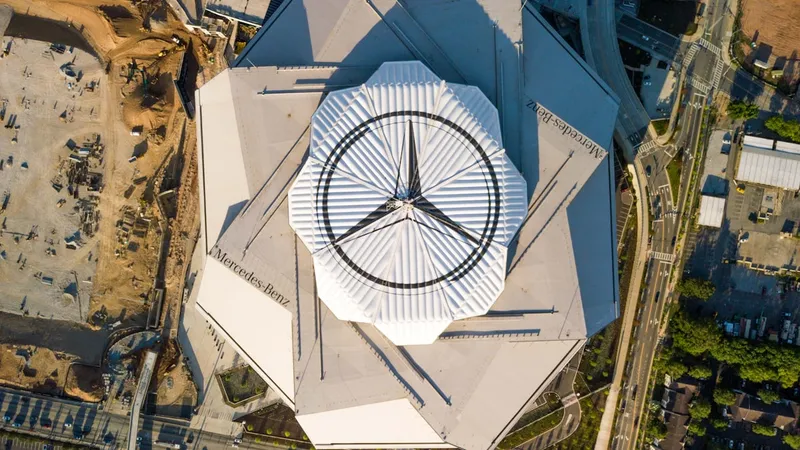
The defining architectural feature is the roof. Eight translucent triangular ETFE panels arranged in a pinwheel around a central oculus, sliding open and closed like the aperture of a camera. Inspired by the Roman Pantheon. A full open or close sequence takes 8-12 minutes. When the panels retract, the geometry produces an unmistakable silhouette that reads as wings folding inward. Atlanta summers routinely hit 32°C (89°F) with heavy humidity, and an open-air venue would be operationally painful most of the calendar. Close the panels, engage the HVAC, and the bowl stays comfortable.
Below the roof hangs the halo. A 360-degree LED video ring, 18 metres (58 feet) tall, stretching 335 metres (1,100 feet) around the interior circumference of the bowl, manufactured by Daktronics. Total display area around 62,350 square feet, plus more than 20,000 square feet of additional LED elsewhere. Largest LED video display at any sports venue on Earth when it opened. A 41-foot bronze falcon sculpture by Hungarian artist Gábor Miklós Szőke, weighing more than 73,000 pounds and with a 70-foot wingspan, sits outside the main entrance. Aggressively literal.
NFL capacity is 71,000, expandable to roughly 75,000 for Super Bowls. MLS configuration reduces the bowl to about 42,500 by curtaining the upper deck, although Atlanta United has regularly exceeded that number for high-demand matches. The 2018 MLS Cup Final drew 73,019 spectators, which is still the single-game MLS attendance record. The concession pricing model at opening was a quiet experiment. $2 hot dogs. $3 pizza slices. $5 domestic beers. $2 refillable sodas. Per-fan spending actually increased by 16% after the change, confirming what Blank had suspected. People buy more when they do not feel gouged. Cashless transactions were introduced in March 2019. The model has since been partially copied by other venues, though usually with higher prices.
Getting to Mercedes-Benz Stadium
Public Transit
MARTA is Atlanta’s rail and bus system, and it is the fastest way to reach the stadium on event days. Two rail stations serve the venue directly.
→ Vine City station (Blue/Green Line): The closer of the two. About a 5-minute walk to the stadium gates. Exit the station, head south on Northside Drive, and the building is immediately visible.
→ GWCC/CNN Center station (Blue/Green Line): Slightly further at a 10-minute walk, but it connects directly to the Georgia World Congress Center and CNN Center area. Convenient for fans coming from hotels in that district.
→ From downtown Atlanta: Peachtree Center and Five Points stations are already on MARTA. Ride the Blue or Green Line westbound to Vine City. 5-10 minutes from Five Points.
A one-way fare is $2.50. Buy a Breeze Card at any station. On major event days, MARTA runs extended hours and adds extra trains. The fastest way in and out of the stadium district, by a wide margin.
Driving + Parking
Highway access is straightforward. I-75, I-85, I-20 all converge around downtown, and the MLK Jr. Drive exit drops you within a few blocks of the gates. Atlanta traffic on event days is not straightforward. Budget accordingly. GPS: 1 AMB Drive NW, Atlanta, GA 30313.
→ From the north (Buckhead, Marietta): I-75 South to the Martin Luther King Jr. Drive exit (exit 248C). Right turn, follow signs to stadium parking.
→ From the east (Decatur, Stone Mountain): I-20 West to Northside Drive exit (exit 56B). North on Northside Drive.
→ From the south (airport area, Macon): I-75/I-85 North through downtown, then follow signs for I-85/I-75 North and take the MLK Jr. Drive exit.
Stadium-managed lots (Ruby, Sapphire, Emerald) sit closest to the gates, at $30-60 depending on the event. Pre-purchase through the Mercedes-Benz Stadium website or the ParkMobile app. Private lots further out, mostly along Northside Drive and Mitchell Street, often undercut stadium pricing. The trade-off is a longer walk. On a Falcons Sunday in January, that walk is unpleasant. On a World Cup afternoon in July, worse. Arrive 90 minutes early either way.
Rideshare
Uber and Lyft routes converge on the Northside Drive pickup zone. Drop-off before an event is usually fast. Pickup after is not. Expect 20-40 minutes of wait as thousands of people request rides in the same ten-minute window and the surge multiplier climbs. A ride from downtown Atlanta runs $8-15. From Buckhead, $15-25. An old trick: walk three or four blocks away from the stadium before you open the app. Wait times drop noticeably once you are outside the surge geofence.
From the Airport
→ Hartsfield-Jackson Atlanta International Airport (ATL): Around 16 kilometres (10 miles) south of the stadium. MARTA is the best option. Ride the Gold Line northbound from the Airport station to Five Points (about 15 minutes), then transfer to the Blue or Green Line westbound to Vine City (5 minutes). Total trip roughly 25 minutes, $2.50 fare. By car, take I-75/I-85 North and exit at MLK Jr. Drive. 15-30 minutes without traffic, double that on event days.
→ Hartsfield-Jackson by rideshare: $20-35 depending on traffic and surge pricing. 20-45 minutes.
→ Regional airports: DeKalb-Peachtree (PDK) is 15 miles northeast. Cobb County International (RYY) is 20 miles northwest. Both are largely private-use airports.
FIFA World Cup 2026 at Mercedes-Benz Stadium
Eight matches have been assigned to Mercedes-Benz Stadium. Five group stage games, one Round of 32 fixture, one Round of 16 fixture, and one semi-final. The first match is scheduled for June 15, 2026. The last, a semi-final, for July 15. Only one other venue, AT&T Stadium in Arlington, was trusted with a semi-final. Atlanta’s assignment reflects FIFA’s confidence in a climate-controlled venue with proven soccer operations.
Name change: Under FIFA’s corporate naming policy, the stadium will be temporarily renamed “Atlanta Stadium” in all broadcasts, signage, printed materials, and ticketing for the duration of the tournament. Corporate naming rights resume afterwards.
Climate control: Atlanta in June and July is hot and humid. Daytime highs regularly hit 32°C (89°F). Humidity above 70%. The retractable roof resolves this entirely. Close the eight ETFE panels, engage the HVAC system, and the interior temperature is decoupled from outside conditions. A genuine advantage over open-air venues in Dallas, Houston, or Kansas City.
Pitch conversion: The FieldTurf CORE synthetic surface will be removed and replaced with natural grass laid on modular trays, the same protocol used for 2024 Copa América matches at the venue. Atlanta United’s eight seasons of MLS play mean the operations team has unusually deep experience with soccer-specific configurations, sight lines, and pitch dimensions.
Fan atmosphere: Atlanta United has built one of the most electric soccer environments in North America. The supporters’ section at the south end is loud, well-organised, and passionate. The 2018 MLS Cup Final drew 73,019 fans. High-demand rivalry matches regularly pull more than 70,000. Expect fan festival zones in Centennial Olympic Park and throughout downtown Atlanta during the tournament. The city hosted soccer events during the 1996 Olympics and has infrastructure for handling international crowds. Among the 16 host venues, Mercedes-Benz ranks as our top US stadium for atmosphere: see the full World Cup 2026 stadium atmosphere ranking for the side-by-side comparison.
Construction & Design
Groundbreaking was on May 19, 2014. The site was an irregular parcel immediately south of the still-operational Georgia Dome, which continued hosting Falcons games throughout most of the construction period. Logistics were constrained accordingly. Cranes had to be sequenced around the old building. Utilities had to remain live until the very last moment before implosion. Design was led by 360 Architecture (a subsidiary of HOK since 2015), with tvsdesign, Goode Van Slyke, and Stanley Beaman & Sears contributing. Structural engineering was handled by BuroHappold Engineering, with Hoberman leading the kinetic roof system.
The cost grew throughout the project. A 2011 concept estimate of roughly $700 million. A 2012 revision to $947.7 million. A 2017 final of $1.6 billion, driven by scope expansion and specification upgrades that accumulated across three years of construction. Funding combined public and private sources. The Georgia World Congress Center Authority, a state of Georgia agency, retained ownership of the completed building. Around $200 million came from hotel-motel tax revenue. Another $200 million was raised through personal seat license sales to Falcons fans. More than $800 million was financed privately by Blank’s AMB Group, the Falcons, and NFL stadium-loan funds.
The defining technical challenge was the roof. Eight translucent triangular ETFE panels, slid on a steel track system engineered by Hoberman Associates, open and close in a pinwheel motion around a central oculus. A full open or close sequence runs 8-12 minutes. The original design had targeted faster operation, but the final engineering solution prioritised reliability and structural margin over speed, which is a standard trade-off in kinetic architecture. In the years after opening, the roof had a number of well-documented teething issues. By 2020 the mechanics had been fully debugged, and the roof now operates routinely on match days.
The exterior combines perforated metal panels and structural glass curtain walls. At night, internal lighting and the translucent roof make the bowl visible as a glowing volume from across downtown Atlanta, including from flights on final approach to Hartsfield-Jackson. More than 180 commissioned artworks are distributed throughout the building, most of them site-specific and many from Atlanta-based artists. The 41-foot bronze falcon sculpture by Gábor Miklós Szőke, with a 70-foot wingspan and weighing more than 73,000 pounds, sits outside the main entrance plaza.
Inside the bowl, the halo. A 360-degree Daktronics LED ring, 18 metres (58 feet) tall, stretching 335 metres (1,100 feet) around the interior circumference. Total display area around 62,350 square feet, plus more than 20,000 square feet of additional LED elsewhere in the venue. Largest LED video display at any sports venue on Earth when it opened. Suspended from the roof structure and visible from every seat.
Mercedes-Benz Stadium was the first professional sports stadium in North America to earn LEED Platinum certification. It was later the first stadium worldwide to earn TRUE Platinum certification for zero waste. The sustainability system includes 4,000 solar photovoltaic panels producing around 1.6 million kilowatt hours per year, enough to power nine Atlanta Falcons games, thirteen Atlanta United matches, or 160 Atlanta households annually. A 680,000-gallon underground cistern captures rainwater for landscape irrigation and cooling tower make-up. A separate 1.1-million-gallon stormwater vault handles run-off, making the total stormwater system 2.1 million gallons. Operational electrical use has been cut 29% against baseline. Water use 47%. More than 90% of waste generated at the venue is diverted from landfills. 250,000+ pounds of food have been donated to Second Helpings Atlanta, which translates into more than 208,000 meals for the community.
Capacity is 71,000 for NFL, expandable to around 75,000 for Super Bowls. 190 luxury suites. More than 7,500 club seats across four premium tiers. The MLS configuration reduces the bowl to 42,500 by curtaining the upper deck, though that curtain is routinely opened for high-demand Atlanta United matches. The Falcons and Atlanta United share a locker room corridor with separate visitor rooms at each end, which allows both franchises to operate on overlapping weekends without physically intersecting.
History of Mercedes-Benz Stadium
The Atlanta Falcons were founded as an NFL expansion franchise in 1966 and played at Atlanta-Fulton County Stadium (shared with the Braves) until 1992. The opening of the Georgia Dome that year coincided with the expansion of the Georgia World Congress Center district, which was already being built out in anticipation of the 1996 Summer Olympics. The Dome became a versatile venue. Super Bowl XXVIII in 1994. Super Bowl XXXIV in 2000. Gymnastics and handball at the 1996 Olympic Games. Two NCAA Final Fours. The annual Chick-fil-A Peach Bowl. By the early 2010s, however, it had started to lag in concession revenue, club-seat pricing, and broadcast infrastructure. Typical markers of an NFL venue approaching the end of its economic life.
Arthur Blank had bought the Falcons in 2002, a few years after co-founding The Home Depot and stepping down from its executive role. He wanted a replacement stadium. Public discussions began around 2010. The initial 2011 concept assumed a cost of around $700 million, which looked reasonable against NFL stadium builds of that era. By groundbreaking in 2014, the figure was $947.7 million. By completion in 2017, it was $1.6 billion, driven largely by roof engineering complexity, premium seating scope, and the inclusion of Atlanta United as a second tenant partway through the project.
Atlanta United FC began play in 2017 alongside the Falcons in the new building, which gave the stadium an unexpected second identity almost immediately. The team became a significant MLS success, drawing some of the largest crowds in the league’s history. MLS Cup 2018 was the high-water mark. On December 8, 2018, Atlanta United defeated the Portland Timbers 2-0 in front of 73,019 fans, which remains the largest crowd for any MLS match. The atmosphere that night is widely credited with establishing Atlanta’s reputation as a genuine soccer market, which proved important in FIFA’s later evaluation of the venue for the 2026 World Cup.
Notable events:
- Super Bowl LIII, February 3, 2019: The New England Patriots defeated the Los Angeles Rams 13-3 in the lowest-scoring Super Bowl in history. Not the most thrilling game ever played. The venue performed flawlessly at its first major test.
- College Football Playoff National Championship, January 8, 2018: Alabama defeated Georgia 26-23 in overtime on a Tua Tagovailoa touchdown pass to DeVonta Smith.
- MLS Cup 2018, December 8, 2018: Atlanta United defeated the Portland Timbers 2-0 in front of 73,019. The MLS single-game attendance record.
- College Football Playoff National Championship, January 20, 2025: Ohio State defeated Notre Dame 34-23 in the first year of the expanded 12-team playoff format.
- Peach Bowl, December 31, 2022: Record football attendance at the venue of 79,330.
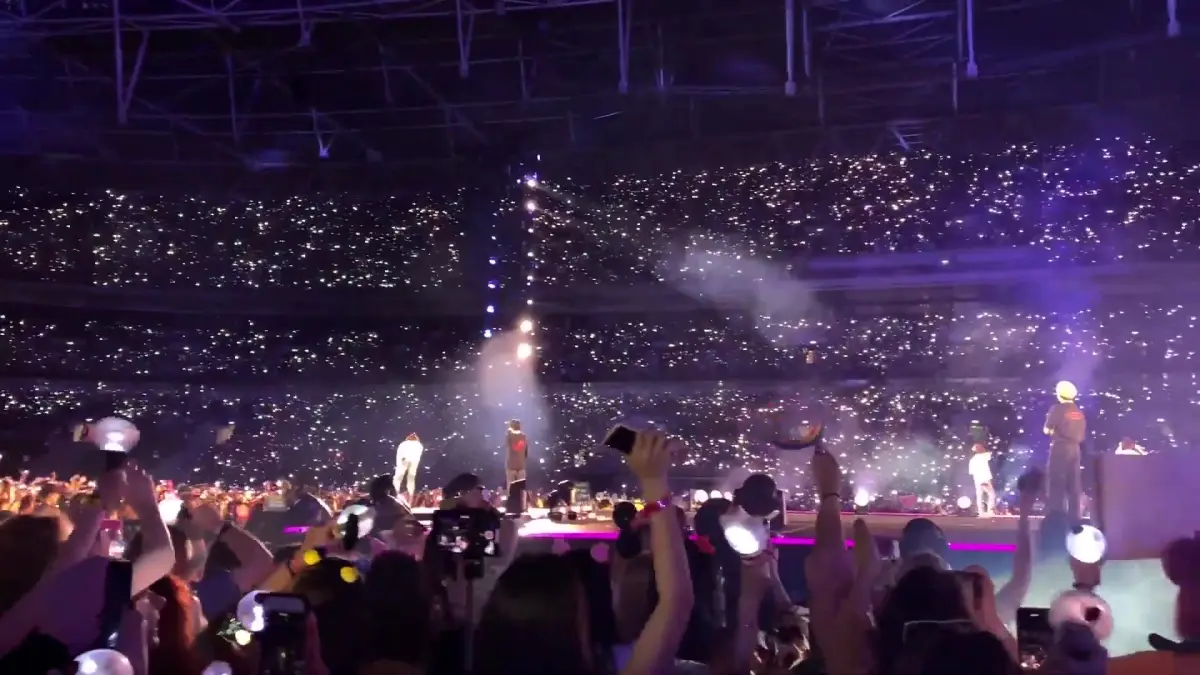
- Concert history: Garth Brooks on October 12, 2017, the venue’s first concert. Taylor Swift Reputation Tour on August 10-11, 2018, grossing $18.1 million. Beyoncé Renaissance Tour in August 2023 ($39.8 million gross). Beyoncé Cowboy Carter Tour in July 2025 ($55.4 million across four shows).
Mercedes-Benz Stadium is scheduled to host Super Bowl LXII in February 2028. The 2026 World Cup semi-final, however, will likely be its largest single-event global broadcast to date. The audience for that specific match is expected to exceed 1 billion viewers. Atlanta’s soccer culture, climate-controlled bowl, and proven event operations gave FIFA enough confidence to assign a semi-final to a stadium that will still be only 9 years old when the tournament begins. An unusually young venue for that role.
Sources & Further Reading
- Mercedes-Benz Stadium official site: mercedesbenzstadium.com. Capacity, operations, parking, and event calendars.
- Mercedes-Benz Stadium sustainability page: mercedesbenzstadium.com/sustainability. LEED Platinum, solar, water, and zero-waste program details.
- FIFA World Cup 2026 match schedule: fifa.com. Official match assignments and venue information.
- MARTA event-day service: itsmarta.com. Rail schedules and event-day service updates.
- Wikipedia entry on Mercedes-Benz Stadium: en.wikipedia.org/wiki/Mercedes-Benz_Stadium. Comprehensive reference with construction details, events, and attendance records.
- Wikipedia entry on the Georgia Dome (1992-2017): en.wikipedia.org/wiki/Georgia_Dome. Background on the predecessor venue.
- AMB Sports and Entertainment: amb-se.com. Ownership structure and operations for the Falcons and Atlanta United.
Quick Facts
Everything you need at a glance.
Stadium specs
- Capacity
- 71,000
- Opened
- 2017
- Cost
- $1.6 billion (~$2.1 billion today)
- Roof
- Retractable
- Surface
- FieldTurf (Natural Grass for FIFA)
- Tenants
- Atlanta Falcons (NFL), Atlanta United FC (MLS)
- WC 2026
- Semi-Final · 8 matches
- First WC match
- June 15, 2026
Construction & location
- Groundbreaking
- May 19, 2014
- Architects
- 360 Architecture (HOK), tvsdesign, Goode Van Slyke, Stanley Beaman & Sears
- Engineering
- BuroHappold Engineering / Hoberman
- General contractor
- HHRM Joint Venture (Hunt, Holder, H.J. Russell, C.D. Moody)
- Address
- 1 AMB Drive NW, Atlanta, GA 30313, USA
- GPS
- 33.7554°N, 84.4010°W
Photo Gallery
Fun Facts
Eight triangular ETFE panels form a retractable roof that opens like a camera aperture around a central oculus. Pantheon-inspired. A full open or close sequence runs 8-12 minutes.
The halo video board stretches 335 metres (1,100 feet) around the bowl interior, 18 metres (58 feet) tall, total display area around 62,350 square feet. The largest LED video display at any sports venue on Earth when it opened.
The first NFL stadium to earn LEED Platinum. 4,000 solar panels, a 680,000-gallon rainwater cistern, a 1.1-million-gallon stormwater vault. And a fan-first concession model that actually increased per-fan spending by 16%.
Stadium Location
Frequently Asked Questions
- What is the seating capacity of Mercedes-Benz Stadium?
- NFL capacity is 71,000, expandable to around 75,000 for Super Bowls and other marquee events. MLS configuration reduces the bowl to roughly 42,500 by curtaining the upper deck, although Atlanta United routinely exceeds that number. The 2018 MLS Cup Final drew 73,019 fans. Still the single-game MLS attendance record. For the 2026 World Cup, the soccer configuration will be set by FIFA's pitch and seating requirements.
- Where is Mercedes-Benz Stadium located?
- 1 AMB Drive NW, Atlanta, Georgia 30313. The venue sits in the Vine City neighborhood just west of downtown, next to Centennial Olympic Park and the Georgia World Congress Center. Around 16 kilometres (10 miles) north of Hartsfield-Jackson Atlanta International Airport.
- How many World Cup 2026 matches will Mercedes-Benz Stadium host?
- Eight matches, including five group stage games, one Round of 32 fixture, one Round of 16 fixture, and one semi-final. The first match at the venue is scheduled for June 15, 2026. The last, a semi-final, is scheduled for July 15, 2026. Under FIFA's branding policy, the stadium will be temporarily renamed 'Atlanta Stadium' for the tournament.
- Does Mercedes-Benz Stadium have a retractable roof?
- Yes. Eight triangular ETFE panels arranged in a pinwheel pattern around a central oculus open and close like the aperture of a camera. A full sequence takes roughly 8-12 minutes. Inspired by the Roman Pantheon. For World Cup matches during Atlanta's hot and humid summer, the roof can be closed and the HVAC system can provide full air conditioning.
- How do I get to Mercedes-Benz Stadium by public transit?
- MARTA is Atlanta's rail system. Two stations serve the stadium directly. Vine City station (Blue/Green Line) is about a 5-minute walk from the gates. GWCC/CNN Center station, also on the Blue/Green Line, is about 10 minutes. From Hartsfield-Jackson Airport, ride the MARTA Gold Line northbound to Five Points, then transfer to the Blue or Green Line westbound to Vine City. Total trip roughly 25 minutes.
- Is there parking at Mercedes-Benz Stadium?
- Several stadium-managed lots (Ruby, Sapphire, Emerald) and multiple private garages operate within walking distance. Stadium parking costs $30-60 depending on the event. Pre-purchase through the stadium website or ParkMobile app. Private lots along Northside Drive and Mitchell Street often undercut stadium pricing, with longer walks as the trade-off.
- What is the surface at Mercedes-Benz Stadium?
- FieldTurf CORE synthetic turf for NFL and MLS regular-season play. Natural grass was laid over the surface for 2024 Copa América matches, and the same modular tray system will be used to meet FIFA's natural-grass requirement for the 2026 World Cup.
- What teams play at Mercedes-Benz Stadium?
- The Atlanta Falcons (NFL) and Atlanta United FC (MLS), both owned by Arthur Blank's AMB Sports and Entertainment Group. Atlanta NWSL is scheduled to join as a third tenant in 2028. The stadium also hosts the annual Chick-fil-A Peach Bowl, the SEC Championship Game, the Celebration Bowl, and periodically the College Football Playoff National Championship.
- When was Mercedes-Benz Stadium built?
- Groundbreaking was on May 19, 2014. Opening was on August 26, 2017, roughly 39 months later. The adjacent Georgia Dome, which the new stadium replaced, was imploded on November 20, 2017, less than three months after the new building opened. For a short window, both structures stood side by side.
- Who designed and built Mercedes-Benz Stadium?
- Design was led by 360 Architecture (a subsidiary of HOK), with tvsdesign, Goode Van Slyke, and Stanley Beaman & Sears as associated firms. Structural engineering was performed by BuroHappold, with Hoberman handling the kinetic roof. General contracting was split across a four-firm joint venture known as HHRM JV (Hunt Construction, Holder Construction, H. J. Russell & Co., and C. D. Moody Construction). The halo video board was manufactured by Daktronics.
- How much did Mercedes-Benz Stadium cost to build?
- Around $1.6 billion at completion, roughly $2.1 billion in 2025 dollars. The initial 2011 concept figure was approximately $700 million. By 2012 it had grown to $947.7 million. Funding combined public sources (hotel-motel tax revenue, $200 million in personal seat license sales) and private investment led by Arthur Blank's AMB Group, the Falcons, and NFL stadium funds.
- What is the Halo Board at Mercedes-Benz Stadium?
- A 360-degree LED video ring manufactured by Daktronics, suspended around the interior of the bowl. It is 18 metres (58 feet) tall and 335 metres (1,100 feet) around. Total display area is roughly 62,350 square feet, with more than 20,000 square feet of additional LED elsewhere in the venue. Largest LED video display at any sports venue on Earth when it opened.
- Will Mercedes-Benz Stadium be renamed for the World Cup?
- Yes. Under FIFA's corporate naming policy, all venues are referred to by neutral geographic names during the tournament. Mercedes-Benz Stadium will be temporarily known as 'Atlanta Stadium' in all broadcasts, signage, printed materials, and ticketing. Corporate naming rights resume after the tournament ends.
- What was the Georgia Dome?
- The previous venue on the same site. Opened 1992, demolished November 20, 2017. The Dome hosted two Super Bowls (XXVIII in 1994, XXXIV in 2000), gymnastics and handball for the 1996 Atlanta Olympic Games, two NCAA Final Fours, and the Atlanta Falcons for 25 seasons. By the early 2010s, it had reached the end of its useful economic life. Arthur Blank pushed for a purpose-built replacement. Mercedes-Benz Stadium was built immediately south of it.
- Is Mercedes-Benz Stadium sustainable?
- Yes. It was the first professional sports stadium in North America to earn LEED Platinum certification, and it later became the first stadium worldwide to earn TRUE Platinum certification for zero waste. The operational system includes 4,000 solar panels (producing around 1.6 million kilowatt hours per year), a 680,000-gallon rainwater cistern, and a 1.1-million-gallon stormwater vault. The venue has cut electrical use by 29% and water use by 47% against baseline. More than 90% of all waste is diverted from landfills.
Last updated: 2026-04-17