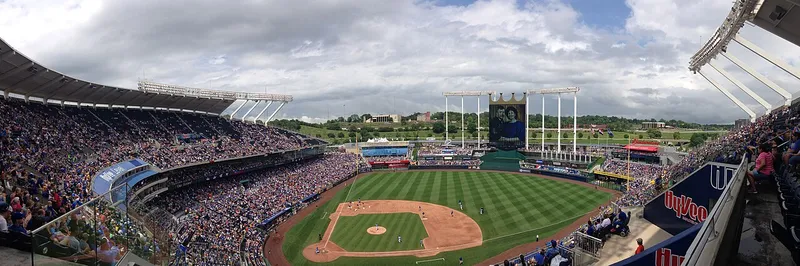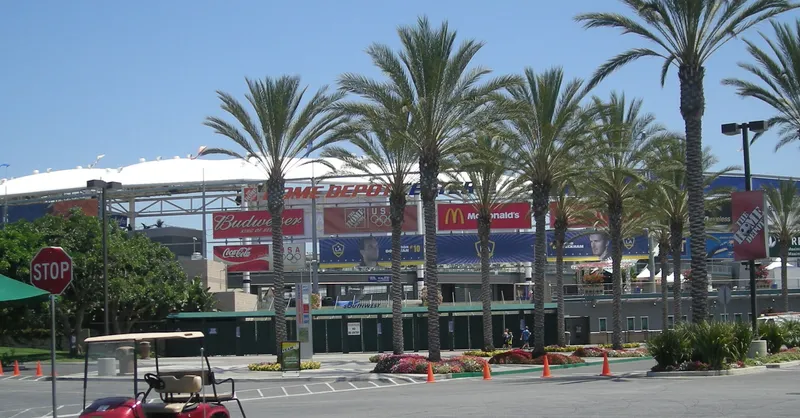
About Dignity Health Sports Park
On 125 acres at Cal State Dominguez Hills in Carson, California, 14 miles south of downtown Los Angeles, Dignity Health Sports Park holds 27,000, the second-largest soccer-specific stadium in the United States and the home fortress of the LA Galaxy, MLS’s most decorated franchise with six league titles.
The Galaxy moved here in 2003 after spending their first seven seasons at the Rose Bowl, a stadium that seats more than three times as many people. The difference was immediate. Immediate, and permanent. A purpose-built soccer venue with steep, intimate stands and every seat close to the pitch transformed the game-day experience. The soccer stadium did not open with soccer, as it happens. The first event on the site was a track and field invitational.
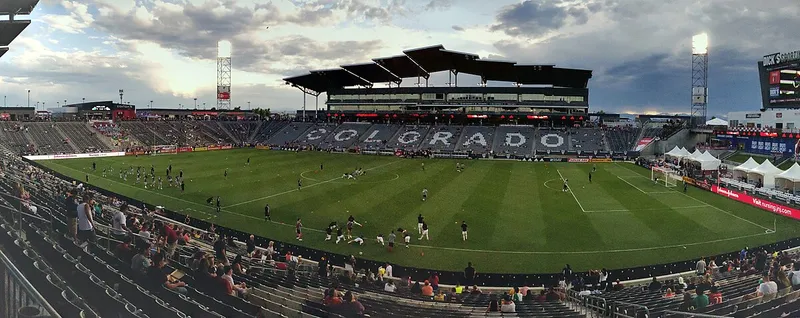
Designed by Rossetti Architects and developed by the Anschutz Entertainment Group, the $150 million complex is far more than a soccer stadium. The campus includes an 8,000-seat tennis stadium, a 2,000-seat track and field facility, and the 2,450-seat VELO Sports Center, which opened a year after the rest of the site and holds a 250-metre track laid in Siberian pine, the only cycling track of its kind in the country. The soccer stadium’s natural grass pitch sits in an open-air bowl under the Southern California sun, with clear sightlines from every angle.
This venue has hosted more MLS Cup Finals than any other stadium in history, seven and counting. Add the 2003 FIFA Women’s World Cup Final, Gold Cup matches, USMNT and USWNT friendlies, and its upcoming role in the 2028 Los Angeles Olympics, and Dignity Health Sports Park has a resume that punches well above its 27,000-seat capacity.
Getting to Dignity Health Sports Park
Public Transit
The LA Galaxy operates the Galaxy Express, a free shuttle service running for every MLS home match. It’s by far the easiest way to get here on public transit.
→ From the Metro J Line: Ride to Harbor Gateway Transit Center (731 W. 182nd St., Gardena). Free parking is available at the transit center. Galaxy Express shuttles depart every 10 minutes starting 90 minutes before kickoff.
→ From the Metro A Line: Ride to Del Amo Station (20220 Santa Fe Ave., Rancho Dominguez). Free parking here as well. Galaxy Express shuttles run on the same schedule.
LA Metro bus lines 51, 205 and 246 stop at Avalon Boulevard and 184th Street, a one-minute walk from the stadium entrance. However, the Galaxy Express is significantly more convenient on match days.
Driving + Parking
The stadium is at 18400 Avalon Boulevard in Carson. GPS users should search for “Dignity Health Sports Park, Carson, CA.”
→ From Downtown LA: Take I-110 South (Harbor Freeway) to the 190th Street exit. Head east to Avalon Boulevard, then south to the stadium. About 20-30 minutes without traffic.
→ From Long Beach: Take I-405 North to I-110 North, exit at Victoria Street, and head west to the campus. Approximately 15-20 minutes.
→ From the Westside (Santa Monica/LAX area): Take I-105 East to I-110 South, exit at 190th Street. About 30-40 minutes depending on traffic.
Standard parking is $30 per vehicle, with preferred parking at $40 and valet at $75. Multiple lots are accessed from Avalon Boulevard and Victoria Street. Pro tip: Use the free Galaxy Express shuttle parking at Harbor Gateway or Del Amo Station to skip the stadium lot entirely and save $30.
Rideshare
Uber and Lyft both serve the stadium with a designated pickup/drop-off area on Avalon Boulevard. A ride from downtown LA runs about $25-40 depending on demand. After matches, expect surge pricing and 15-25 minute waits as 27,000 fans stream toward the exits.
Pro tip: Walk toward Victoria Street or the campus perimeter for faster pickups and lower fares.
From the Airport
→ Los Angeles International (LAX): 14 miles west, approximately 20-35 minutes by car depending on traffic. Take I-105 East to I-110 South, exit at 190th Street. A rideshare from LAX costs $25-45.
→ Long Beach Airport (LGB): 11 miles southeast, about 20 minutes by car. Take I-405 North to I-110 North, exit at Victoria Street. A more convenient option for visitors coming from the south.
Watching a Match at Dignity Health Sports Park
Ask Galaxy supporters what to do with a first visit and almost nobody starts with the seats. They start with the parking lot. Tailgating is allowed in lots 10 through 13 and nowhere else, the lots open three hours before kickoff, and the two supporters’ groups set up across Lot 13: the Victoria Block in the northwest picnic space, the LA Riot Squad in the northeast. One rule catches people out every season. Alcohol in the tailgate areas is prohibited once the match kicks off, so the drinking really is a pre-match activity, not something you drift back out to.
The money-saving move is a shuttle. The Galaxy Express runs free from Harbor Gateway Transit Center and from Del Amo station, both of which have free parking of their own, going roughly every ten minutes from ninety minutes before kickoff. Stadium parking runs $30 standard, $40 preferred and $75 for valet, so the shuttle pays for itself immediately. The catch is on the way home: return service starts after the final whistle and runs for 45 minutes only. Stay for a long trophy presentation and you are finding your own way back to Gardena.
Inside, the bowl does what it was built to do. Two tiers, 27,000 seats, every one close to the pitch. The noise concentrates behind the goals, where the Angel City Brigade takes the north end around sections 121 and 122 and the LA Riot Squad holds the southeast corner near 137 and 138, and the decision most regulars actually agonize over is not sightline but sun. This is an open bowl in Southern California with no roof to speak of, so a summer afternoon kickoff is a commitment. Fans who have learned the hard way pick evening matches, or aim for the shade that arrives first on the 118 and 119 side.
Two practical things before the gate. The bag policy is a clear bag no larger than 12 by 6 by 12 inches, and while concessions are card-only, there are reverse ATMs inside that turn cash into a prepaid card, so arriving with notes is inconvenient rather than fatal. And on food, the item fans name without being asked is Cathy’s Cookies. The advice that comes attached is about the queue rather than the cookie: join it roughly 45 minutes before you actually want one. Elsewhere there are food trucks along the south end by the tennis arena, and the AFJA pupusa stand, whose proceeds go to youth soccer in El Salvador and Guatemala.
Construction & Design
A university campus in Carson was an unlikely place to solve American soccer’s biggest problem. Unlikely, and available. Rossetti Architects designed the stadium, John A. Martin and Associates engineered the structure, and PCL Construction built it on the grounds of Cal State Dominguez Hills, opening in June 2003 as the Home Depot Center. The whole project ran $150 million, privately financed by AEG rather than by the public, and its arrival gave the LA Galaxy and Major League Soccer somewhere of their own for the first time. Contemporary reporting watched that number climb: the Los Angeles Times had it at $130 million in 2002 and $140 million the following March before it settled at $150 million on completion. A frequently repeated figure of around $87 million for the soccer stadium alone is worth treating with more caution, since AEG only ever published the total.
What sets the site apart is that the stadium is only one piece of it. Not the point of it, either. The complex was conceived as a US Olympic training center, so alongside the soccer ground sit an 8,000-seat tennis stadium, the indoor VELO Sports Center velodrome, a full track-and-field facility sunk below grade, and a 40,000-square-foot rehabilitation center, a rare all-in-one cluster for four different sports on one campus. The soccer bowl itself is tight and steep, built to feel full and loud even at MLS crowd sizes.
The name has turned over with its sponsors: Home Depot Center from 2003, StubHub Center from 2013, and Dignity Health Sports Park since 2019. For three seasons the building also moonlighted as an NFL venue, hosting the Los Angeles Chargers from 2017 to 2019 while SoFi Stadium was under construction, which made its roughly 27,000 seats briefly the smallest home in the league by a wide margin.
The Galaxy Legacy
Dignity Health Sports Park is synonymous with MLS royalty. The LA Galaxy have won six MLS Cups, and this stadium has been the stage for the franchise’s greatest moments, from David Beckham’s debut in 2007 to Landon Donovan’s farewell in 2014 to the club’s dynasty years that defined American soccer’s growth.
The venue’s impact extends beyond the Galaxy. Well beyond it. As one of the first purpose-built soccer stadiums in MLS, it proved that American soccer could sustain its own venues rather than borrowing someone else’s. The model it pioneered, intimate, soccer-specific, with training facilities on the same campus, became the template that every subsequent MLS expansion club followed. The proof is in the fixture list: seven MLS Cup finals have been staged here, more than at any other ground in the league’s history. With the 2028 Olympics coming to this site (as Carson Stadium), the venue will add another chapter to an already extraordinary story. The Carson campus is unusual among the Games venues in carrying a whole cluster on its own, with the stadium, the tennis center, the velodrome and the hockey fields all in use; every site is mapped in our Los Angeles 2028 Olympics guide.
History of Dignity Health Sports Park
Nothing like it existed in American soccer when it was proposed. Not one purpose-built ground of any size. The 125-acre complex was developed by the Anschutz Entertainment Group and designed by Rossetti Architects, broke ground on February 26, 2002, and opened as the Home Depot Center on June 1, 2003. Fifteen months, start to finish. The opening event was the Home Depot Track and Field Invitational, which drew around 10,000 people to a site better known ever since for soccer. The Galaxy arrived six days later, beating the Colorado Rapids 2-0 on June 7.
Opening and First MLS Cup (2003): The stadium opened to immediate impact, hosting the MLS All-Star Game and MLS Cup in its inaugural year. The 2003 FIFA Women’s World Cup Final was played here too: Germany beat Sweden 2-1 in front of 26,137, Nia Kunzer settling it with a golden goal eight minutes into extra time.
The Beckham Era (2007-2012): David Beckham’s arrival at the Galaxy in July 2007 transformed the stadium into a global attraction. His presence brought unprecedented media attention and sold-out crowds that elevated the venue’s international profile.
StubHub Center Rebrand (2013): On June 1, 2013, the venue was renamed StubHub Center under a new naming rights deal, ending a decade as the Home Depot Center.
Dignity Health Naming (2019): California-based healthcare system Dignity Health took over naming rights on January 1, 2019, giving the stadium its current name.
MLS Cup Finals Record: The stadium has hosted MLS Cup in 2003, 2004, 2008, 2011, 2012, 2014, and 2024, seven finals and counting, more than any other venue in league history.
2028 Olympics (Upcoming): The complex will serve as Carson Stadium during the 2028 Los Angeles Olympics, hosting archery, rugby sevens, tennis, field hockey, and track cycling across its four separate competition venues.
From a Women’s World Cup Final to seven MLS Cup Finals to the upcoming Olympics, Dignity Health Sports Park has earned its place as one of the most consequential soccer venues in American history.
Sources & Further Reading
- Wikipedia entry on Dignity Health Sports Park: en.wikipedia.org/wiki/Dignity_Health_Sports_Park. The multi-sport complex, construction, and name history.
- John A. Martin & Associates, project page: johnmartin.com. The structural engineer’s account of the complex.
- LA Galaxy official stadium page: lagalaxy.com/stadium. The primary tenant’s stadium information.
- Dignity Health Sports Park official site: dignityhealthsportspark.com. Events, tickets, and visitor information.
Quick Facts
Everything you need at a glance.
Stadium specs
- Capacity
- 27,000
- Opened
- 2003
- Cost
- $150 million (2003, full complex, privately financed by AEG)
- Roof
- Open
- Surface
- Natural Grass
- Tenants
- LA Galaxy (MLS)
Construction & location
- Groundbreaking
- February 26, 2002 (opened June 1, 2003)
- Architects
- Rossetti Architects
- Engineering
- John A. Martin & Associates
- General contractor
- PCL Construction
- Address
- Dignity Health Sports Park, 18400 Avalon Boulevard, Carson, CA 90746
- GPS
- 33.8640°N, 118.2610°W
Photo Gallery
Fun Facts
Dignity Health Sports Park hosted the 2003 FIFA Women's World Cup Final, where Germany defeated Sweden 2-1, making it one of only a few MLS stadiums to host a World Cup final of any kind.
The $150 million complex houses not just the 27,000-seat soccer stadium but also an 8,000-seat tennis stadium, a 2,000-seat track and field facility, and the 2,450-seat VELO Sports Center velodrome.
The stadium has hosted 7 MLS Cup Finals (2003, 2004, 2008, 2011, 2012, 2014, 2024), more than any other venue in league history.
Stadium Location
Frequently Asked Questions
- What is the seating capacity of Dignity Health Sports Park?
- Dignity Health Sports Park has a seating capacity of 27,000 for soccer matches, making it the second-largest soccer-specific stadium in the United States after Geodis Park in Nashville. For concerts and special events, the capacity can be adjusted.
- Where is Dignity Health Sports Park located?
- Dignity Health Sports Park is located at 18400 Avalon Boulevard in Carson, California, on the campus of California State University, Dominguez Hills. It sits approximately 14 miles south of downtown Los Angeles.
- How do I get to Dignity Health Sports Park by public transit?
- The LA Galaxy operates the Galaxy Express, a free shuttle service for every MLS home match. Shuttles depart from Harbor Gateway Transit Center (accessible via Metro J Line) and Del Amo Station (accessible via Metro A Line). Shuttles run every 10 minutes starting 90 minutes before kickoff. LA Metro bus lines 51, 205 and 246 also stop near the stadium at Avalon and 184th Street.
- Is there parking at Dignity Health Sports Park?
- Yes. Standard parking costs $30 per vehicle, with preferred lots at $40 and valet parking at $75. The stadium complex has multiple lots accessed from Avalon Boulevard and Victoria Street. Alternatively, free parking is available at the Galaxy Express shuttle pickup locations.
- What was Dignity Health Sports Park previously called?
- The stadium has had three names: Home Depot Center (2003-2013), StubHub Center (2013-2018), and Dignity Health Sports Park (2019-present). Many fans still refer to it by its earlier names.
- When was Dignity Health Sports Park built?
- The complex opened on June 1, 2003, as the Home Depot Center, though not with soccer: the first event was the Home Depot Track and Field Invitational, which drew about 10,000 people. The Galaxy played their first match here six days later, beating the Colorado Rapids 2-0 on June 7. Designed by Rossetti Architects and developed by the Anschutz Entertainment Group, the 125-acre complex cost $150 million and was privately financed.
- What major events has Dignity Health Sports Park hosted?
- The stadium has hosted 7 MLS Cup Finals, the 2003 FIFA Women's World Cup Final, the 2003 MLS All-Star Game, multiple CONCACAF Gold Cup matches, USMNT and USWNT international friendlies, and will serve as a venue for the 2028 Los Angeles Olympics (archery, rugby, tennis, field hockey, and track cycling).
- Will Dignity Health Sports Park be used for the 2028 Olympics?
- Yes. During the 2028 Summer Olympics, the venue will be known as Carson Stadium and host archery, rugby sevens, tennis, field hockey, and track cycling events across its multiple facilities.
- What is the best way to get to Dignity Health Sports Park without paying for parking?
- Take the Galaxy Express. It is free, it runs from Harbor Gateway Transit Center and from Del Amo station, both of which have free parking of their own, and it goes roughly every ten minutes from ninety minutes before kickoff. Against $30 for standard stadium parking, it pays for itself on arrival. The thing to plan for is the return: service starts after the final whistle and runs for 45 minutes only, so a long post-match wander can leave you stranded.
- Can you tailgate at Dignity Health Sports Park?
- Yes, and it is the part supporters talk about first, but the rules are specific. Tailgating is allowed in lots 10, 11, 12 and 13 only, and those lots open three hours before kickoff. The Victoria Block sets up in the northwest picnic space across Lot 13 and the LA Riot Squad in the northeast. The rule that catches people out: consuming alcohol in the tailgate areas is prohibited after kickoff, so it is strictly a pre-match affair.
- Where should I sit at Dignity Health Sports Park?
- It is a two-tier bowl of 27,000 seats built tight to the touchline, so there is no poor view to speak of and the real decisions are atmosphere and sun. For noise, head behind a goal: the Angel City Brigade takes the north end around sections 121 and 122, the LA Riot Squad the southeast corner near 137 and 138. For an afternoon kickoff in summer, shade matters more than any of that, and it reaches the 118 and 119 side first.
- Is Dignity Health Sports Park cashless, and is there a bag policy?
- Yes to both. The venue is fully cashless, so bring a card or a phone wallet, and it enforces a clear bag policy. Checking the club's current bag dimensions before you travel saves an argument at the gate.
Last updated: 2026-08-17