About Audi Field
Buzzard Point spent a century as a working-class edge of southwest Washington: a power plant, a concrete batching plant, and fenced-off industrial lots at the point where the Anacostia meets the Potomac. D.C. United broke ground there on February 27, 2017, and eighteen months later the club had a home of its own for the first time in its history.
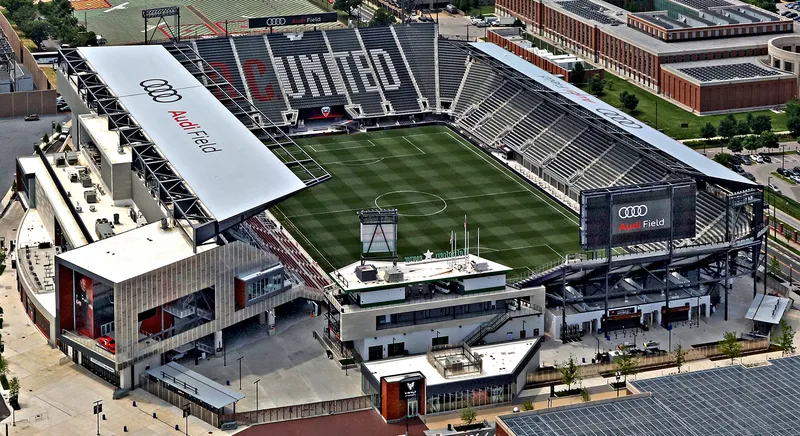
Audi Field opened for the 2018 season. The first match, on July 14, 2018, ended 3-1 over the Vancouver Whitecaps in front of a sellout crowd of 20,504. Designed by Populous with the local firm Marshall Moya Design, the 20,000-seat stadium traded the scale of RFK for the intimacy of a purpose-built soccer ground. The bowl is raked steeply, the roof canopies push sound back down onto the field, and on a full night the noise punches well above the listed capacity. A small stadium, loud in a way the old barn never was.
The 8.5-acre (3.4-hectare) plot is one of the tightest in MLS, which forced a vertical, wrapped-in design rather than the sprawling parking-lot venues common to American soccer. That constraint turned out to be a feature. The site is now the anchor of a fast-changing waterfront: Nationals Park sits half a mile north, The Wharf entertainment district is a short walk away, and Navy Yard supplies the bars and restaurants that carry the pregame crowd. Buzzard Point’s turn from industrial dead zone to sports district mirrors the broader revival of Washington’s southern waterfront.
The club owns the moment that put the place on the map. Less than a month after opening, Wayne Rooney chased down a would-be goal in stoppage time, tackled, and set up the winner against Orlando City. The stadium has since hosted CONCACAF Champions League nights, international friendlies, and U.S. national team fixtures, settling in as the capital’s premier soccer venue.
Getting to Audi Field
Public Transit
Audi Field is reachable on the Washington Metro, with Navy Yard–Ballpark station about a 10-minute walk from the gates.
→ Via Metro Green Line: Navy Yard–Ballpark station is the closest stop. Walk southwest along Potomac Avenue to the stadium. From Gallery Place–Chinatown, the ride takes about 10 minutes. Fare is $2.25 to $6.00 depending on distance and time.
→ Via DC Circulator: The Circulator’s Union Station–Navy Yard route serves stops on M Street SE, a 10-minute walk from the stadium. Fare is $1.00.
Metro is the best option for most fans. The walk from Navy Yard station is straightforward and well marked on match days. Afterward the station can jam up, so consider drifting toward The Wharf or the Navy Yard bars to let the first wave clear.
Driving + Parking
The stadium address is 100 Potomac Avenue SW, Washington, DC 20024. I-395 and South Capitol Street are the primary approaches.
→ From Northern Virginia (~8 mi): I-395 North to the Maine Avenue/Waterfront exit, then south on South Capitol Street to Potomac Avenue. About 15 to 25 minutes.
→ From Bethesda/Rockville (~15 mi): I-270 to I-495 to I-295 South to South Capitol Street. About 30 to 40 minutes.
→ From Baltimore (~40 mi): I-95 South to I-295 to South Capitol Street. About 45 to 60 minutes.
On-site parking is limited. Navy Yard garages run $15 to $30, with the Yards Garage and Half Street Garage the closest options. Metered street parking fills early. Metro is the smarter play, because driving in D.C. on a match day is an exercise in patience.
Rideshare
Uber and Lyft use designated zones on Potomac Avenue near the main entrance. From Dupont Circle or Adams Morgan, expect $10 to $15. From Georgetown, $12 to $18. Post-match surge is moderate, so a walk toward The Wharf for a drink often beats waiting in the queue.
From the Airport
→ Ronald Reagan National (DCA): 3 miles south, about 8 to 12 minutes by car. Metro Yellow/Blue lines connect DCA to L’Enfant Plaza, then transfer to the Green Line for Navy Yard–Ballpark station. Rideshare runs $8 to $12. One of the closest airport-to-stadium hops in MLS.
→ Dulles International (IAD): 28 miles west, about 40 to 55 minutes by car. The Silver Line Metro connects to the Green Line via L’Enfant Plaza. Rideshare runs $45 to $60.
Construction & Design
The site fought back before the first steel went up. Buzzard Point had carried a power plant and a concrete operation for decades, and the ground underneath was contaminated. Environmental remediation and unexpected site work drove the budget higher than the club first planned, pushing D.C. United’s stadium spend from an early figure near $150 million toward roughly $300 million by the time the doors opened.
Ground was broken on February 27, 2017, and the schedule was aggressive. Turner Construction Company ran the build as general contractor, delivering a full stadium in about seventeen months so the team could christen it mid-season rather than wait another year. Populous led the design, with the Washington firm Marshall Moya Design (also credited as Michael Marshall Design) serving as associate architect. The look leans into Buzzard Point’s industrial past: a contemporary industrial palette, exposed structure, and canopies that ring the open field. Inside sit 31 luxury suites and a bike valet built for 200 machines, a nod to a fan base that arrives on two wheels along the Anacostia Riverwalk Trail. The total built area comes to about 437,938 square feet (roughly 40,700 square meters) on a plot of just 8.5 acres.
The money came from two directions, which is worth being clear about. The District of Columbia capped its contribution near $150 million, spent on assembling the land and preparing the Buzzard Point site, including utility relocation and street work. D.C. United financed the stadium itself. Once every piece is counted, land, infrastructure, and construction, the total climbed well past $400 million, above the roughly $300 million the project was approved at in 2015, though exact figures vary by source. The District of Columbia owns the venue and D.C. United operates it.
Audi signed on early, with a naming-rights deal announced in February 2017 for a minimum of twelve years. Continental competitions bar sponsor names, so during CONCACAF matches the ground is called Washington, D.C. Stadium. The stadium is LEED Gold certified, with food-waste composting, recycling programs, stormwater drainage systems, waterless urinals, and an LED-powered pregame light show among the sustainability features Populous folded into the design.
History of Audi Field
For 21 seasons D.C. United called RFK Stadium home, and for a while they owned MLS. Four league titles landed in the RFK era: 1996, 1997, 1999, and 2004. But the venue aged badly, seats sat empty in a bowl built for football and baseball, and the club had no ground it could truly call its own. Audi Field was the answer.
The RFK goodbye was not a fairy tale. On October 22, 2017, in the final MLS match at the old stadium, D.C. United lost 2-1 to the New York Red Bulls before 41,418 fans. Paul Arriola scored for United, Luciano Acosta was sent off, and the Red Bulls turned it around late. An anticlimax, but the memories stretched back two decades: Jaime Moreno, the Screaming Eagles, and those four championships.
Audi Field arrived nine months later. The first match, on July 14, 2018, brought a 3-1 win over the Vancouver Whitecaps and a sellout of 20,504. Then came the moment that defined the new ground. On August 12, 2018, deep into stoppage time against Orlando City, Wayne Rooney raced back the length of the field to make a covering tackle, then delivered the cross for Luciano Acosta to head home. Acosta completed his first MLS hat trick, D.C. United won 3-2, and the play went global. Rooney had signed that summer, and that single sequence sold the project as well as any marketing could.
The stadium has never been a single-tenant building. The Washington Spirit of the NWSL, champions in 2021, have made Audi Field their exclusive home since 2023. The DC Defenders of the UFL play spring football there, and DC Power FC of the USL Super League joined the calendar in 2024. Meanwhile, the old landmark came down: RFK Stadium was demolished across 2023 and 2024 to clear its 190-acre campus for redevelopment.
Notable moments and events:
- The opener, July 14, 2018. D.C. United 3, Vancouver Whitecaps 1, sold out at 20,504, with Wayne Rooney coming off the bench to grab his first MLS assist.
- Rooney’s stoppage-time tackle-and-assist against Orlando City on August 12, 2018, capping Luciano Acosta’s hat trick in a 3-2 win. It remains one of the most replayed plays in league history.
- Washington Spirit home matches since 2023, adding an NWSL championship pedigree to the ground.
- CONCACAF Champions League nights, international friendlies, and U.S. national team fixtures, where the stadium plays under its competition name, Washington, D.C. Stadium.
From RFK’s muted farewell to Rooney’s sprint into club folklore, Audi Field is where D.C. United’s next chapter is being written. A 20,000-seat ground that bet intimacy and noise could stand in for scale and history, and mostly won.
Sources & Further Reading
- Populous project page: populous.com. The lead design firm’s overview of capacity, the 8.5-acre site, LEED Gold status, and sustainability features.
- Marshall Moya / Michael Marshall Design project page: michaelmarshalldesign.com. The associate architect’s account of its supporting role to Populous, the built area, and suite and bike-valet counts.
- D.C. United official site: dcunited.com. Club records covering Wayne Rooney’s tenure, the Audi Field opening, and the RFK era.
- Wikipedia entry on Audi Field: en.wikipedia.org. Comprehensive reference for cost, groundbreaking and opening dates, tenants, naming rights, and the first-match result.
Quick Facts
Everything you need at a glance.
Stadium specs
- Capacity
- 20,000
- Opened
- 2018
- Cost
- ~$300 million as planned (D.C. United ~$150M stadium + District ~$150M land/site prep); overruns pushed the total past $400 million
- Roof
- Open
- Surface
- Natural Grass (Bermuda)
- Tenants
- D.C. United (MLS), Washington Spirit (NWSL)
Construction & location
- Groundbreaking
- February 27, 2017
- Architects
- Populous (design architect), Marshall Moya Design (associate architect)
- General contractor
- Turner Construction Company
- Address
- 100 Potomac Avenue SW, Washington, DC 20024, USA
- GPS
- 38.8687°N, 77.0126°W
Photo Gallery
Fun Facts
Audi Field sits on an 8.5-acre plot at Buzzard Point, where the Anacostia and Potomac rivers meet, one of the tightest stadium sites in MLS. The land had held a power plant and a concrete batching operation, and cleaning up the contaminated ground added months and millions to the build.
D.C. United's last MLS match at RFK Stadium, on October 22, 2017, was a 2-1 loss to the New York Red Bulls in front of 41,418 fans. The result closed 21 seasons and four MLS Cup titles (1996, 1997, 1999, and 2004) at the aging venue.
On August 12, 2018, less than a month into Audi Field's life, Wayne Rooney sprinted 50 yards back to make a last-ditch tackle in the 96th minute, then swung in the cross for Luciano Acosta to head the winner. Acosta completed his first MLS hat trick and D.C. United beat Orlando City 3-2. The play is one of the most replayed moments in league history.
Stadium Location
Frequently Asked Questions
- What is the seating capacity of Audi Field?
- Audi Field holds 20,000 for D.C. United matches. The bowl was designed to be compact and steep, which keeps fans close to the pitch and traps noise. The inaugural game on July 14, 2018 drew a sellout of 20,504, a touch above the listed figure because standing areas count toward the total.
- Where is Audi Field located?
- Audi Field is at 100 Potomac Avenue SW, Washington, DC 20024. It sits at Buzzard Point in the southwest quadrant, where the Anacostia and Potomac rivers meet, about half a mile from Nationals Park and 2 miles from the National Mall.
- How do I get to Audi Field by public transit?
- The Washington Metro Green Line stops at Navy Yard–Ballpark station, roughly a 10-minute walk southwest along Potomac Avenue. The DC Circulator also serves M Street SE nearby. On match days the walk is well signed, and Metro is the recommended way in.
- Is there parking at Audi Field?
- On-site parking is limited. Surrounding Navy Yard garages and surface lots run $15 to $30 on match days, with the Yards Garage on 4th Street SE and the Half Street Garage among the closest. Metered street parking fills early. Take Metro if you can.
- Who designed and built Audi Field?
- Populous served as design architect, with the Washington firm Marshall Moya Design (also known as Michael Marshall Design) as associate architect. Turner Construction Company was the general contractor. The stadium was fast-tracked, breaking ground on February 27, 2017 and opening for matches in July 2018.
- How much did Audi Field cost?
- Audi Field was approved in 2015 as a roughly $300 million project, split about evenly: D.C. United funded the stadium (about $150 million) and the District of Columbia paid about $150 million to assemble and prepare the contaminated Buzzard Point site. Environmental remediation and overruns pushed the real total higher, past $400 million by some accounts.
- Why is Audi Field sometimes called Washington, D.C. Stadium?
- Audi took the naming rights in a deal announced in February 2017, running a minimum of twelve years. During CONCACAF and other continental competitions, sponsorship rules bar commercial venue names, so the ground is referred to as Washington, D.C. Stadium for those matches.
- Who plays at Audi Field besides D.C. United?
- The Washington Spirit of the NWSL, crowned league champions in 2021, have made Audi Field their exclusive home since 2023. The DC Defenders of the UFL (which launched as the XFL in 2020) and DC Power FC of the USL Super League (from 2024) also play there, giving the stadium a year-round schedule.
- Does Audi Field have a roof?
- No. Audi Field is open-air, with canopies over the seating bowl but no cover over the pitch. Summer matches in D.C. can be hot and humid, so plan for sun and heat during afternoon kickoffs.
- What happened to RFK Stadium?
- D.C. United played at RFK Stadium from 1996 to 2017, winning four MLS Cups (1996, 1997, 1999, and 2004) during that run. The aging venue was demolished in 2023 and 2024, and the 190-acre RFK campus is being redeveloped. The move to Audi Field gave the club a modern home and closed one of the storied eras in American soccer.
- How far is the airport from Audi Field?
- Ronald Reagan Washington National Airport (DCA) is about 3 miles south, roughly 8 to 12 minutes by car. Metro Yellow and Blue lines connect DCA to L'Enfant Plaza, where you transfer to the Green Line for Navy Yard station. Dulles International (IAD) is about 28 miles west, 40 to 55 minutes out. DCA is the most convenient.
Last updated: 2026-07-10