About Target Field
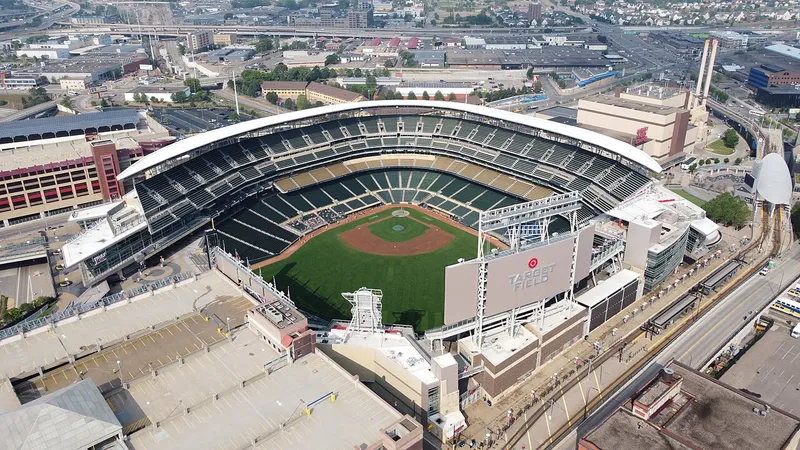
In the Warehouse District of downtown Minneapolis, an open-air ballpark brought the Twins back under the sky. Target Field seats 39,504, frames the downtown skyline beyond the outfield, and grows a living wall of more than 5,700 juniper plants as its batter’s eye. After 28 years indoors, Minnesota baseball came back outside.
Designed by Populous with HGA Architects, the ballpark opened on April 12, 2010, returning the Twins to outdoor baseball after 28 years in the enclosed Metrodome. It cost about $545 million, funded largely by a Hennepin County sales tax alongside a private contribution from the Twins, and rose on a tight downtown site next to what became Target Field Station, a purpose-built intermodal transit hub. The METRO Blue Line reaches it from MSP Airport in 30 minutes, one of the most accessible ballparks in the sport.
The park earned LEED Silver for its construction in 2010, then LEED Gold for operations in 2017, one of the greenest venues in the majors. Its rainwater recycling system has reused millions of gallons. The cantilevered canopy reaches 90 feet at each end of the upper deck, sheltering fans from rain and snow without blocking the skyline that defined the design from the start. And in 2019 came the batter’s eye: MLB’s first living wall, 2,280 square feet of more than 5,700 juniper plants. A backdrop that also happens to be alive.
The ballpark has hosted the 2014 All-Star Game, the 2022 NHL Winter Classic, and a string of ALDS series, though the Twins’ Octobers here were mostly misery. Eighteen straight postseason losses, a major-league record. The 2023 Wild Card sweep of the Blue Jays finally broke it, and gave Target Field its first winning October memory.
Getting to Target Field
Public Transit
Target Field has one of the best transit connections of any ballpark in America, the station is right at the gate.
→ Via METRO Blue Line: Target Field Station is directly adjacent to the ballpark. Trains run from MSP Airport and Mall of America. Fare is $2.00 flat.
→ Via METRO Green Line: Also stops at Target Field Station, connecting downtown St. Paul. Trains run every 10–15 minutes.
Approximately 2,500 free park-and-ride spaces are available at outlying Blue Line stations (28th Avenue, 30th Avenue, Fort Snelling). Take the train in and skip the $20 parking.
Driving + Parking
The ballpark address is 1 Twins Way, Minneapolis, MN 55403. I-394 and I-35W are the primary approaches.
→ From St. Paul (~10 mi): I-94 West to downtown Minneapolis. About 15 minutes.
→ From Duluth (~163 mi): I-35 South to I-35W South into downtown. About 3 hours 15 minutes.
→ From Rochester (~85 mi): US-52 North to I-494 West to I-35W North. About 1 hour 35 minutes.
The ABC Ramps and Hawthorne Ramp offer about 7,000 spaces at $20 on game days. Pre-pay through SpotHero for discounts. Street meters nearby charge $2.50/hour. Tailgating is not permitted in official stadium lots.
Rideshare
Uber and Lyft drop off on Twins Way between 7th and 10th Streets. Exit via Gate 29 (Right Field) for post-game pickup. From downtown Minneapolis, expect $8–$12. From MSP Airport, $13–$20. Post-game surge is common, walk a few blocks for a faster pickup.
From the Airport
→ Minneapolis-Saint Paul International (MSP): 9 miles south, about 16 minutes by car. The METRO Blue Line runs directly from Terminal 1 to Target Field Station in about 30 minutes for $2.00, one of the best airport-to-ballpark transit links in MLB. Rideshare runs $13–$20.
Construction & Design
The Twins spent 28 seasons under the Metrodome’s Teflon roof, and Target Field was the antidote. Baseball outdoors, in a city that hits -5°F in January. The site made that ambition harder: downtown Minneapolis had almost no free land, so Populous and the local firm HGA wedged the ballpark onto an 8-acre parcel hemmed in by highways, a parking ramp, and light-rail tracks, one of the smallest footprints in the majors. The tight fit is why the seats feel so close to the field.
Groundbreaking was set for August 2, 2007. The day before, the I-35W bridge over the Mississippi collapsed during rush hour and killed 13 people, and the ceremony was moved to August 30 out of respect for a grieving city. Construction ran about $545 million, most of it from a Hennepin County sales tax, and the park opened in April 2010.
The building is clad in Minnesota limestone, quarried near Mankato, and oriented so the downtown towers stand beyond the outfield. Overhead, a cantilevered canopy stretches 90 feet at each end of the upper deck to fend off rain and snow. The signatures kept coming: LEED Silver at the opening, Gold by 2017, and in 2019 a living wall of juniper as the batter’s eye. Seat for seat, it is one of the most-praised parks of the retro era, built on a footprint most architects would have called impossible.
History of Target Field
Target Field was built to bring the Twins back outdoors after 28 seasons in the Metrodome. The roughly $545 million project broke ground on August 30, 2007, delayed from the planned August 2 ceremony after the I-35W bridge collapsed the day before, killing 13 people and shaking the city.
First Game (April 12, 2010): The Twins defeated the Boston Red Sox 5-2 before a sellout crowd in the ballpark’s regular-season debut. The return to outdoor baseball, with the Minneapolis skyline framed beyond center field, was everything fans had waited three decades for.
2014 MLB All-Star Game (July 15, 2014): The American League defeated the National League 5-3. It was the third All-Star Game in Twin Cities history and the first at an outdoor venue in Minneapolis.
2022 NHL Winter Classic (January 1, 2022): The St. Louis Blues defeated the Minnesota Wild 6-4 before 38,619 fans, with Thomas Rhett performing in -5°F weather. Target Field proved it could handle January in Minnesota, and that the ballpark works for more than baseball.
2023 AL Wild Card Series (October 3–4, 2023): The Twins swept the Blue Jays in two games, snapping a record 18-game postseason losing streak dating back to 2004. The 38,518 fans at Game 2 witnessed the franchise’s first playoff victory in 19 years, Royce Lewis’s go-ahead home run sealing it in a 2-0 win that shook the Warehouse District.
Minnie and Paul: Beyond center field stands the ballpark’s signature, a giant illuminated sign of two ballplayers, one for Minneapolis and one for St. Paul, shaking hands across a stylized Mississippi River. The figures light up and animate after every Twins home run, a callback to a 1960s Twins logo that has become the emblem of the whole franchise. It is the first thing many fans look for, and the image that ends up on every highlight of a Minnesota home run. Around it, the park leans hard into local identity: Minnesota craft beer, regional food stands, and a Warehouse District setting that drops the downtown skyline directly behind the action. For a team that spent 28 seasons indoors, the whole point of the place is to feel unmistakably Minnesotan and unmistakably outdoors.
From the living wall to the skyline views to the light rail at the gate, Target Field is where Minnesota baseball came back outside, a ballpark that earned some of the sport’s top environmental marks and gave a franchise its identity back.
Sources & Further Reading
- Ballparks of Baseball, Target Field: ballparksofbaseball.com. Cost, dimensions, and the design team.
- Populous, Target Field: populous.com. Design, the compact footprint, and LEED certification.
- Wikipedia, Target Field: en.wikipedia.org/wiki/Target_Field. Capacity, construction history, and events.
Quick Facts
Everything you need at a glance.
Stadium specs
- Capacity
- 39,504
- Opened
- 2010
- Cost
- $545 million (2010) (~$800 million (2025 dollars) today)
- Roof
- Open
- Surface
- Natural Grass (Kentucky Bluegrass)
- Tenants
- Minnesota Twins (MLB)
Construction & location
- Groundbreaking
- August 30, 2007
- Architects
- Populous, HGA (Hammel, Green and Abrahamson)
- Address
- 1 Twins Way, Minneapolis, MN 55403, USA
- GPS
- 44.9817°N, 93.2776°W
Photo Gallery
Fun Facts
Target Field earned LEED Silver certification for its construction in 2010 and was upgraded to LEED Gold for operations in 2017, making it one of the greenest ballparks in the majors, with a rainwater recycling system that has captured and reused millions of gallons.
The batter's eye installed in 2019 is MLB's first 'living wall', a 2,280-square-foot display of 5,700-plus sea green juniper plants that doubles as a backdrop for hitters and one of the largest living walls in the continental United States.
The cantilevered canopy extends 90 feet at each end of the upper deck, sheltering fans from rain and snow without blocking the celebrated views of the Minneapolis skyline, the reason the Twins moved outdoors after 28 years in the enclosed Metrodome.
Stadium Location
Frequently Asked Questions
- What is the seating capacity of Target Field?
- Target Field seats 39,504 fans for MLB games. The ballpark opened in 2010 at a cost of about $545 million and was designed by Populous in association with HGA Architects. It replaced the Hubert H. Humphrey Metrodome, returning the Twins to outdoor baseball after 28 years.
- Where is Target Field located?
- Target Field is at 1 Twins Way in the Warehouse District of downtown Minneapolis, Minnesota 55403. It sits adjacent to Target Field Station, a purpose-built intermodal transit hub, about 5 blocks from Hennepin Avenue.
- How do I get to Target Field by public transit?
- Target Field Station is directly adjacent to the ballpark. Both the METRO Blue Line (from MSP Airport and Mall of America) and METRO Green Line (from downtown St. Paul) stop here. Flat fare is $2.00. Approximately 2,500 free park-and-ride spaces are available along the Blue Line at 28th Avenue, 30th Avenue, and Fort Snelling stations.
- Is there parking at Target Field?
- The ABC Ramps and Hawthorne Ramp offer approximately 7,000 parking spaces directly adjacent to the stadium. Game-day rates are about $20. Pre-paid parking is available through SpotHero at discounted rates. Street meters closest to the stadium charge $2.50/hour.
- Has Target Field hosted a World Series?
- No. Target Field has hosted ALDS playoff games in 2010, 2019, and 2020, plus an AL Wild Card Series in 2023 when the Twins snapped their record 18-game postseason losing streak by sweeping the Blue Jays. The Twins' last World Series championship was in 1991 at the Metrodome.
- Does Target Field have a roof?
- No. Target Field is an open-air ballpark with a cantilevered canopy that extends 90 feet over the upper deck for rain and sun protection. The playing field and most seating are open to the elements, the Twins specifically chose outdoor baseball to showcase the Minneapolis skyline.
- How far is the airport from Target Field?
- Minneapolis-Saint Paul International Airport (MSP) is 9 miles south, about 16 minutes by car. The METRO Blue Line runs directly from Terminal 1 to Target Field Station in approximately 30 minutes for $2.00, one of the best airport-to-ballpark transit connections in MLB. Rideshare runs $13-$20.
Last updated: 2026-07-10