About PayPal Park
PayPal Park occupies a stretch of Coleman Avenue in San Jose, wedged between downtown and the runways of Mineta San Jose International Airport, close enough that planes pass overhead during matches, a quirk that’s become part of the venue’s character. With 18,000 seats, it’s one of the smaller stadiums in MLS, but what it lacks in size it makes up for in atmosphere and design ingenuity.
The San Jose Earthquakes and Bay FC of the NWSL share the venue. 360 Architecture (now part of HOK) designed the roughly $100 million stadium, which was privately financed by the Earthquakes, a rarity in American professional sports. The club broke ground on October 21, 2012, in Guinness World Record fashion: 6,256 people swung shovels simultaneously, the largest groundbreaking ceremony in history.
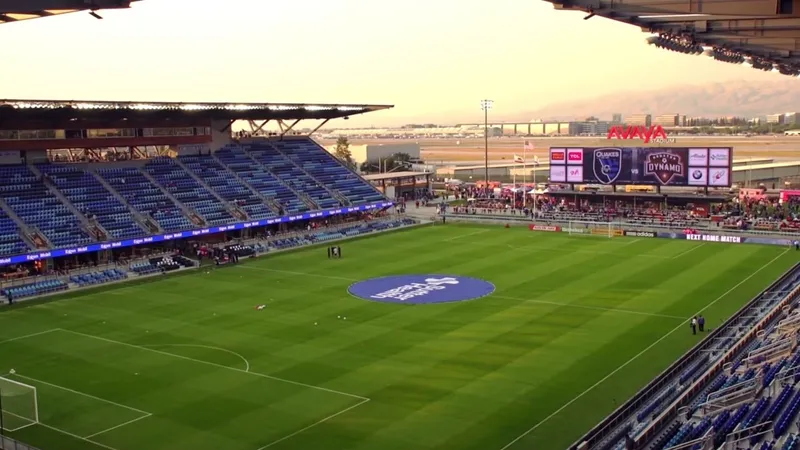
The signature feature is the Epicenter, a two-acre fan zone behind the northeast goal that houses what the club calls the largest outdoor bar in North America, set beneath a double-sided video scoreboard. It doubles as a supporters’ terrace and social hub, blending the European standing-section tradition with Silicon Valley’s outdoor culture. The bowl rakes steeply upward, among the steepest in MLS, creating a wall of noise that makes the compact venue feel much larger than its capacity suggests.
The pitch uses SISGrass hybrid technology, natural grass reinforced with synthetic fibers injected into the root zone, providing durability and consistency while maintaining the feel of real turf.
What the stadium has quietly become is one of the country’s primary homes for women’s soccer. Bay FC arrived in 2024 as the NWSL’s Bay Area expansion club, giving the ground top-flight men’s and women’s soccer year-round, and in November 2025 it staged the NWSL Championship, Gotham FC beating the Washington Spirit 1-0 before a full house. That reputation carries into the Olympics. Of the seven grounds staging football at the 2028 Games, PayPal Park is the only one where every scheduled match belongs to the women’s tournament.
Getting to PayPal Park
Public Transit
PayPal Park has excellent transit access for the Bay Area.
→ From downtown San Jose: Take VTA Light Rail (Mountain View–Winchester line) to the Earthquakes stadium station, adjacent to the venue. About 10 minutes from downtown.
→ From San Francisco: Take Caltrain to College Park station (about 70 minutes), then walk 10 minutes to the stadium. Or take Caltrain to San Jose Diridon and transfer to VTA Light Rail.
VTA bus routes 10 and 60 also serve Coleman Avenue with stops near the stadium entrance.
Driving + Parking
GPS address: 1123 Coleman Ave, San Jose, CA 95110.
→ From San Francisco (77 km): US-101 South to Coleman Avenue exit. The stadium is immediately visible. About 55-70 minutes depending on traffic.
→ From Oakland (60 km): I-880 South to I-280 South, exit at Bird Avenue/Coleman. About 45-60 minutes.
→ From Santa Cruz (50 km): CA-17 North to I-280 North, exit at Bird Avenue/Coleman. About 45 minutes.
On-site parking ranges from $20-40 on match days. Lot 1 is closest to the main gate. Advance online purchase through the Earthquakes or Bay FC websites is recommended. Street parking fills quickly in the surrounding neighborhood.
Rideshare
Uber and Lyft operate throughout the South Bay. Drop-off at the Coleman Avenue entrance. From downtown San Jose, expect $10-15; from San Francisco about $50-70. Post-match surge is moderate, the VTA Light Rail is a better bet for the return trip.
From the Airport
→ Mineta San Jose International Airport (SJC): Just 3 km away, about 5 minutes by car and one of the closest major airports to any MLS stadium. Uber/Lyft fare about $8-12. The VTA Airport Flyer bus connects to the light rail system.
→ San Francisco International Airport (SFO): 50 km north, about 45-60 minutes by car. Take US-101 South to Coleman Avenue. Uber/Lyft fare about $60-80.
Watching a Match at PayPal Park
Pick your seat by the sun, not the sightline. The bowl is small and steeply raked, so the views look after themselves. What varies is whether you spend ninety minutes squinting. Fans discuss it constantly, and the dividing line moves with the date and the kickoff time rather than sitting in one place. Mapping one March afternoon, a regular reckoned that by two o’clock the top 60 percent of sections 101 to 112 had moved into shade and the corner at 113 to 116 was already covered, while the sections opposite stayed in sun. Others who sit in the low 120s report shade for most of a game, so treat any fixed line with suspicion. Sections 106 to 109, shaded and near midfield, are the recommendation that recurs. One season-ticket holder in row 9 of the lower 100s says shade reaches them around two. Some fans check a sun-and-shade map before buying.
The counter-argument is money. The sunny side often costs half as much, and for a seven o’clock kickoff the calculation collapses entirely, because the sun has gone and the premium bought nothing. Visiting supporters are usually put in section 134.
Then there is the Epicenter, where the honest version of this stadium diverges from the brochure. The two-acre fan zone behind the northeast goal, with what the club calls the largest outdoor bar in North America, is the venue’s signature feature and the thing every write-up leads with. Not everyone is sold. In one thread on club traditions a fan wrote that the fan park and its bar “kills the atmosphere,” and another griped about the crowd that stays out on the grass after kickoff watching the screen instead of taking their seats. A minority view, not a consensus. But a real one, and worth knowing that the social hub and the noise sit in different parts of the ground. Worth knowing too that the grass and food-truck area is inside the gates: you need a match ticket to stand in it.
Where the noise comes from is the supporters’ end. The San Jose Ultras hold the south terrace and the Seismic Union the north, in the general-admission sections behind the goals. The call-and-response that draws the most participation is EARTH from the supporters, QUAKES from everyone else, though fans in that same thread were blunt that turnout for chants is patchy and that an older tradition of shouting each player’s surname during the starting-eleven announcement has faded. For Bay FC matches the drums belong to the Bridge Brigade, who play right through the ninety rather than in bursts. Some love it. Some find it relentless.
Two details worth the walk. Players cross a bridge over the concourse shortly before kickoff, and small groups gather beneath to watch them pass overhead, close enough that players sometimes wave back. And guest services hands out free foam earplugs, because the PA is loud enough that regulars ask for them.
Food is not the calling card, and fans name no signature dish. The one item that comes up is a baked potato truck in the fan-fest area, where the line moves fast. The fan fest also runs sign-making and temporary tattoos, and there are rally towels for anyone who completes a survey at the Sutter Health booth. One visitor describes a drumline playing outside before kickoff. Arrive an hour early for any of it. The tailgate lot is the cheaper option and easy to navigate, whether or not you intend to tailgate.
Construction & Design
360 Architecture, the Kansas City sports practice later absorbed into the global firm HOK, designed PayPal Park, with structural engineering by Magnusson Klemencic Associates and Devcon Construction as general contractor. The result is a compact, European-influenced horseshoe bowl of about 18,000 seats built for atmosphere over scale, wrapped by a partial canopy that shelters the stands while leaving the pitch open. It has some of the steepest-raked seating in Major League Soccer, a deliberate choice to pull spectators close to the field and channel crowd noise back onto it, with suites and club seats set unusually at field level rather than in an elevated ring. The seating bowl uses a steel frame with aluminum decking. Ground was broken on October 21, 2012, in a Guinness-record ceremony of 6,256 people, on a former industrial parcel immediately west of Mineta San Jose International Airport.
Behind the northeast goal sits the two-acre Epicenter fan zone, home to what the club and several outlets call the largest outdoor bar in North America, set beneath a double-sided video scoreboard so the social hub stays tied to the match. Terraced general-admission supporters’ sections sit behind both goals, home to the San Jose Ultras and the Seismic Union. The three-acre playing field, designed and built by Verde Design, was planted with a hybrid Bermuda grass chosen for drought and shade tolerance and precisely leveled in both directions; the surface is now a SISGrass hybrid, natural turf reinforced with stitched synthetic fibers.
The project’s defining fact is financial. The roughly $100 million cost was financed entirely by owners Lew Wolff and John Fisher with no public money from the City of San Jose, a rarity among major American sports venues. Sustainability measures include 882 solar panels over the VIP parking area, roughly 90 percent recycled steel in the structure, drought-tolerant landscaping, and reclaimed redwood salvaged from Moffett Field’s historic Hangar One used to panel the press box.
History of PayPal Park
The San Jose Earthquakes spent decades as nomads. After joining MLS in 1996, the club played at Spartan Stadium (San Jose State) before relocating to Houston in 2006, restarting as an expansion team in 2008, and bouncing to Buck Shaw Stadium at Santa Clara University. The quest for a permanent home was the franchise’s defining saga for nearly two decades.
The Coleman Avenue site, a former industrial lot near the airport, emerged as the chosen location in 2012 after years of failed proposals in downtown San Jose, Santa Clara, and Fremont. Unlike most MLS stadiums, the Earthquakes financed the roughly $100 million project privately, without major public subsidies, a bold bet by owner Lew Wolff that reflected both Silicon Valley’s wealth and the difficulty of securing public funding in the Bay Area. 360 Architecture (now part of HOK) designed the venue with an emphasis on atmosphere over capacity, and the Guinness-record groundbreaking on October 21, 2012, signaled the start of construction.
Key moments in the stadium’s history:
- October 21, 2012: Guinness World Record groundbreaking, 6,256 people break ground simultaneously.
- February 28, 2015: Stadium opens as Avaya Stadium with a preseason match. The first MLS game follows on March 22, 2015, Earthquakes defeat Chicago Fire 2-1.
- July 28, 2016: The MLS All-Star Game brings Arsenal to Coleman Avenue. The visitors win 2-1 in front of 18,000.
- 2020: Renamed Earthquakes Stadium after Avaya’s bankruptcy.
- 2021: PayPal acquires naming rights, becoming the stadium’s current identity.
- 2024: Bay FC (NWSL) begins play as the venue’s second primary tenant.
- November 19, 2025: The city clears the stadium for concerts, up to 15 events a year, opening a second life for a ground built strictly for soccer.
- November 22, 2025: The NWSL Championship comes to San Jose, Gotham FC beating the Washington Spirit 1-0.
- July 2028 (upcoming): Seven matches of the Olympic football tournament, all of them from the women’s competition: group-stage games on July 11, 14 and 17, then a women’s quarterfinal on July 21. Of the seven venues staging football at the Games, this is the only one with an all-women’s fixture list, the men’s group stages going to New York, Columbus, Nashville and St. Louis. For the duration of the Games the venue reverts to “San José Stadium”, since the IOC does not permit sponsor names. Every venue is mapped in our Los Angeles 2028 Olympics guide.
The airport is close enough that planes pass low overhead during evening matches, which fans long ago stopped treating as an intrusion. What has changed most since 2015 is who plays here. A ground built for a wandering MLS club now hosts an NWSL team, has staged a league final, and will spend July 2028 as an Olympic venue for the women’s tournament alone. After two decades without a home of their own, the Earthquakes built one that turned out to be useful to more than just themselves.
Sources & Further Reading
- Wikipedia entry on PayPal Park: en.wikipedia.org/wiki/PayPal_Park. Capacity, dates, cost, the naming history, architect, and features.
- San Jose Earthquakes official PayPal Park page: sjearthquakes.com. The Epicenter, the Scoreboard Bar, and fan amenities.
- MLSsoccer.com, “What will $100 million buy you?”: mlssoccer.com. The cost, the steel tonnage, and the design.
- Verde Design, Avaya Stadium playing field: verdedesigninc.com. The field designer on the hybrid grass and leveling.
- LA28 football tournament match dates: la28.org. The official round-by-round grid, published 16 March 2026, and the source for the seven-match all-women’s schedule.
Quick Facts
Everything you need at a glance.
Stadium specs
- Capacity
- 18,000
- Opened
- 2015
- Cost
- Around $100 million (2015), entirely privately financed by owners Lew Wolff and John Fisher
- Roof
- Open
- Surface
- Hybrid Grass (SISGrass)
- Tenants
- San Jose Earthquakes (MLS), Bay FC (NWSL)
Construction & location
- Groundbreaking
- October 21, 2012 (opened 2015)
- Architects
- 360 Architecture (now HOK)
- Engineering
- Magnusson Klemencic Associates
- General contractor
- Devcon Construction
- Address
- PayPal Park, 1123 Coleman Avenue, San Jose, CA 95110
- GPS
- 37.3508°N, 121.9244°W
Photo Gallery
Fun Facts
PayPal Park holds the Guinness World Record for the largest groundbreaking ceremony in history, 6,256 people swung shovels simultaneously on October 21, 2012.
The Epicenter, a two-acre fan zone behind the northeast goal, features what the club calls the largest outdoor bar in North America, set beneath a double-sided video scoreboard.
All seven Olympic matches scheduled at PayPal Park in 2028 come from the women's tournament, the only one of the seven venues with an all-women's fixture list.
Stadium Location
Frequently Asked Questions
- Where is PayPal Park located?
- At 1123 Coleman Avenue in San Jose, California, between downtown San Jose and the Mineta San Jose International Airport. It's in the Coleman-Taylor neighborhood just west of the Guadalupe River.
- What is the capacity of PayPal Park?
- 18,000 seats, making it one of the more intimate venues in MLS. The Epicenter fan zone behind the northeast goal adds a large standing social area with the club's largest-outdoor-bar-in-North-America claim.
- What teams play at PayPal Park?
- The San Jose Earthquakes (MLS) and Bay FC (NWSL). Bay FC became the second tenant in 2024 as the NWSL's San Francisco Bay Area expansion club.
- How do I get to PayPal Park by transit?
- VTA Light Rail's Mountain View–Winchester line has a station adjacent to the stadium. Caltrain stops at College Park station, a 10-minute walk. Both connect to the broader Bay Area transit network.
- Is there parking at PayPal Park?
- Yes. On-site lots range from $20-40 on match days. Advance online purchase is recommended. Lot 1 is closest to the main gate. The VTA Light Rail station makes transit a strong alternative.
- When did PayPal Park open?
- It opened on February 28, 2015 with a preseason match, and hosted its first MLS game on March 22, 2015, a 2-1 Earthquakes win over the Chicago Fire. The stadium was originally named Avaya Stadium, then Earthquakes Stadium in 2020, before PayPal acquired the naming rights in 2021.
- Is PayPal Park an Olympics venue?
- Yes, and with an unusual brief. It takes seven matches at the 2028 Los Angeles Games, every one of them from the women's tournament: group-stage games on July 11, 14 and 17, then a women's quarterfinal on July 21. Per LA28's published match-date grid it is the only one of the seven football venues with an all-women's schedule. The other six run across the country, from Etihad Park in New York to Snapdragon Stadium in San Diego, with the semifinals and both gold medal matches finishing at the Rose Bowl in Pasadena. During the Games the stadium is called San José Stadium, because the IOC does not allow sponsor names.
- Where should I sit at PayPal Park?
- For an afternoon kickoff, pick by sun rather than sightline, since the bowl is small and steeply raked enough that the views look after themselves. The recommendation that recurs is sections 106 to 109, shaded and near midfield, with the corner at 113 to 116 also covered. The line moves with the date and kickoff time, though, and fans in the low 120s report shade for most of a game, so check rather than assume. Visiting supporters usually get 134. For an evening match none of this matters, and the sunny side is often half the price.
- Is the Epicenter worth it?
- Depends what you came for. The two-acre fan zone behind the northeast goal holds what the club calls the largest outdoor bar in North America, and it is the stadium's signature feature. But it has its critics among regulars, who complain that people stay out on the grass watching the screen after kickoff instead of taking their seats. A minority view rather than a consensus. Note also that the grass and food-truck area is inside the gates, so you need a match ticket to stand in it. If you want noise, the supporters' end behind the goals is where it actually is.
- What surface does PayPal Park use?
- A SISGrass hybrid surface, natural grass reinforced with synthetic fibers injected into the root zone. This provides durability and consistency while maintaining the feel and playability of real grass.
Last updated: 2026-08-18