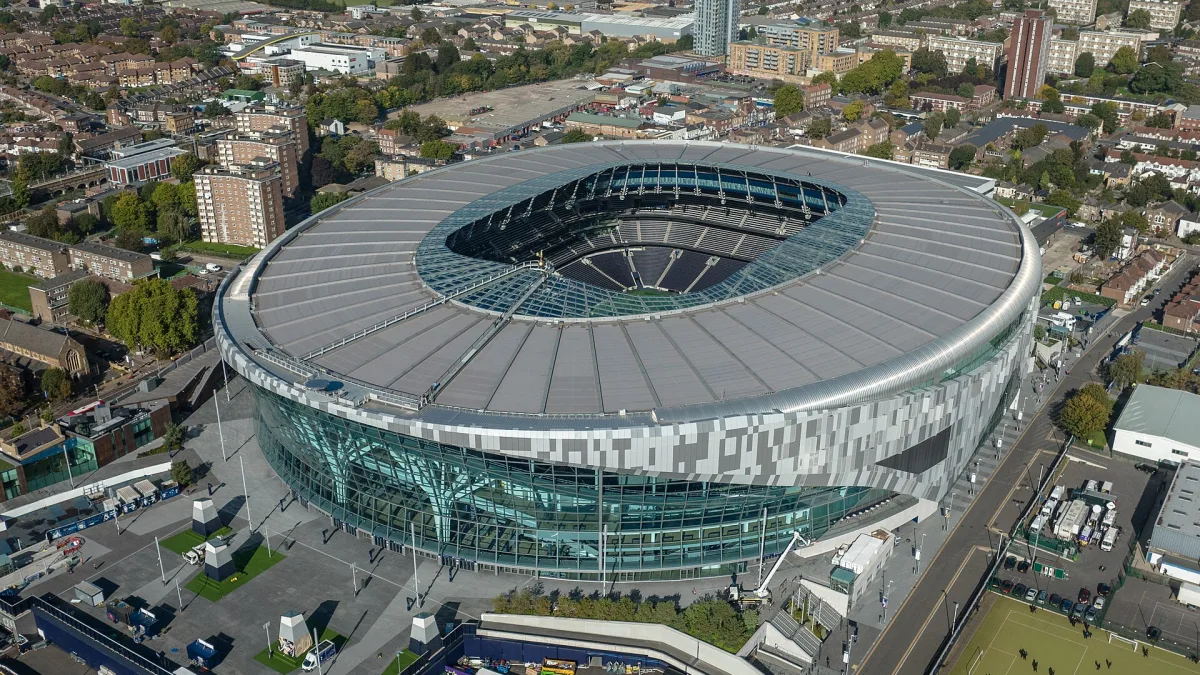
About Tottenham Hotspur Stadium
The cockerel went up before anyone else did. In November 2018 a 4.5-metre (15-foot) replica of the bronze bird that had perched over White Hart Lane since 1909 was craned onto the roof above the South Stand, and for another four and a half months it stood there over a building site nobody was allowed into. Tottenham Hotspur Stadium finally opened on 3 April 2019, roughly seven months later than the club had promised, after safety-critical electrical systems failed their sign-off and pushed the whole thing back into a second season of exile at Wembley.
It holds 62,850, the largest club ground in London and the third largest in England. The address is 782 High Road, N17, on the same stretch of Tottenham that Spurs have occupied since 1899, with the old pitch sitting partly under the new North Stand. Populous designed it, Mace built it, and the finished cost has never been published as a single audited number. Chairman Daniel Levy described it at the opening as being “of the order of £1 billion” against early estimates nearer £400 million; later reporting put it as high as £1.2 billion. Whichever figure you take, it was privately financed, and the club was still carrying £871 million of debt against it as of June 2025.
What makes the building unusual is not its size. It is that there are two pitches stacked on top of each other. The natural grass slides out in three pieces to reveal a synthetic surface underneath, purpose-built for the NFL, which has played here since October 2019 and now calls it the Home of the NFL in the UK under a deal running to the 2029-30 season. Boxing, rugby union, rugby league and up to thirty non-football events a year use the same trick. Beyoncé has performed here eleven times, more than any other artist.
The naming rights, incidentally, are still unsold. Seven years in, the place is simply called Tottenham Hotspur Stadium, and by now most people have stopped expecting that to change.
Getting to Tottenham Hotspur Stadium
Public Transit
Four stations serve the ground, and the club would very much prefer you used one of them.
→ White Hart Lane (Overground, Weaver line): The closest, about 400 metres (a quarter of a mile) from the turnstiles, five minutes on foot. Direct from Liverpool Street via Bruce Grove.
→ Seven Sisters (Victoria line): The easiest for a first visit. One line, northbound, then a straight walk up the High Road. Around 25 to 30 minutes, or take any bus whose number ends in a 9 from outside the station.
→ Northumberland Park (Greater Anglia): Direct from Liverpool Street, a little over 600 metres (0.4 miles) from the east side of the ground.
→ Tottenham Hale (Victoria line and national rail): Useful if you are arriving from Stansted or Cambridge, then a bus or a longer walk.
Free shuttle buses link the ground to Wood Green on the Piccadilly line and Alexandra Palace on Great Northern, running from three hours before kick-off to two hours after, pre-booked. Do not leave it late: the club warns against boarding within 50 minutes of kick-off. Local bus routes 149, 259, 279 and 349 normally run the High Road but are diverted east of the stadium at Lansdowne Road during matches.
Driving + Parking
Don’t. There is no general admission parking whatsoever. That is the transport strategy, not an accident of the site.
A large Controlled Parking Zone covers the surrounding streets, and road closures run in four staged phases: two hours out, then tightening through kick-off, then holding until an hour after the final whistle. Nothing without a permit gets in or out during that window, so a car parked inside the cordon is a car you are not collecting for a while. Accessible parking exists for Blue Badge holders registered with the club’s Disability Access Scheme, booked in advance, and even then the advice is to arrive early and expect to leave late.
Cycling is treated far more generously. Cycle Superhighway 1 starts on Church Road directly opposite the stadium and runs all the way to Liverpool Street, and there are 220 cycle parking spaces across two nearby sites.
Rideshare
Uber and Bolt both operate, but the road closures mean no drop-off anywhere near the gates. The club’s own guidance is to be set down at least a 15-minute walk away, roughly 800 metres (half a mile) out.
Pro tip: Set your pickup point south of the cordon toward Bruce Grove rather than fighting for a car on the High Road. The surge after a full house is real, and walking ten minutes will usually beat waiting twenty.
From the Airport
→ Stansted (STN): 38 km (23 miles). Stansted Express to Liverpool Street, then Greater Anglia straight to Northumberland Park. The cleanest run of the four.
→ Heathrow (LHR): 31 km (19 miles). Elizabeth line to Liverpool Street, then the Overground to White Hart Lane. Allow 75 minutes door to door.
→ Gatwick (LGW): 51 km (32 miles). Gatwick Express to Victoria, then the Victoria line north to Seven Sisters without changing again.
→ Luton (LTN): 37 km (23 miles). Thameslink to St Pancras, walk across to King’s Cross St Pancras, Victoria line to Seven Sisters.
Watching a Match at Tottenham Hotspur Stadium
Regulars converge on the same piece of advice: get to the station two hours before kick-off. Not the turnstiles, the station. That is the margin that turns a matchday into an afternoon rather than a scramble, and the walk north from Seven Sisters up the High Road, past the scarves multiplying at every junction, is the part season-ticket holders describe as the best bit of the whole thing.
The pubs are the other half of it. The Bricklayers and the Bill Nicholson, named for the manager who won the Double in 1961, get named most often. The No.8, formerly the Bell and Hare, sits on the corner opposite the club shop and runs a beer garden bigger than most car parks, with a DJ before the game and a live band after. The Beehive, further down the walk, takes away fans. The Antwerp Arms is community-owned and tiny. And the ritual mentioned more than any pub is Chick King, a family-run chicken shop that has been feeding matchgoers on the High Road since 1981, where the queue reaches the pavement and moves faster than it looks.
Inside, the food is a real cut above the football norm, and that is not a small thing to say about a stadium concourse. More than 60 food and drink outlets are spread through the building. The Marketplace in the South Stand is the destination: line-caught fish and chips at The Linesman, Korean fried chicken at Seoul Birdie developed with chef Judy Joo, stone-baked pizza, halal chicken, and a Bagel Bar carried over from White Hart Lane. Running the length of it is the Goal Line Bar, 65 metres of it, billed as the longest in Europe. The beer behind it is brewed on the premises: Beavertown’s microbrewery, the first inside any football stadium anywhere, pours One Of Our Own, a 4.9 percent golden ale that debuted against Liverpool on 11 January 2020.
One catch that surprises visitors from almost everywhere else. You cannot take that pint to your seat. English law bans alcohol in view of the pitch at a regulated match, and stewards stop you at the top of the steps. The concourse is where you drink, which is why the practiced move is to slip out around the 43rd minute rather than at the half-time whistle, when a thousand other people have the same idea.
The place to sit, if the choice is yours, is the South Stand. Seventeen and a half thousand seats in one unbroken tier, the largest single-tier stand in the country, modeled on Borussia Dortmund’s Yellow Wall and holding roughly 7,500 rail seats that convert to safe standing. On the fan forums one night gets named more than any other: 12 May 2022, the first full-capacity North London derby here, Spurs 3-0 Arsenal in front of 62,027 and a club-organized tifo, a night supporters describe as leaving them partially deaf. European evenings run it close. The honest counterweight is that supporters argue constantly about whether the building has ever matched the old Lane for noise, and a bad run of home results turns that argument up loud. It is a fair fight, and both sides are right some of the time.
Practical things nobody tells you: the stadium is entirely cashless, the first in England to be, while several pubs outside are still cash-only. Bags larger than A4 will not get past the airport-style scanners, though there is a paid bag drop outside the South Stand. And when the whistle goes, stay put for twenty minutes. Crowd control at the stations after a full house is a queue you can simply choose not to join.
Construction & Design
Two concrete columns are the reason the pitch splits into three. The design brief demanded a real grass surface for Premier League football sitting above a synthetic one for the NFL, which meant sliding 10,000 tonnes of turf, soil and steel out from under the South Stand, and the columns holding that stand up sat directly in the path. SCX Special Projects solved it by cutting the pitch lengthwise into three sections so the outer two could pass either side of the obstructions. Each section weighs more than 3,000 tonnes and rides on 33 steel trays, 99 across the three. The changeover takes about 25 minutes. When the grass comes back, the joints close onto three-ply rubber strips running beneath the turf, and the seams are invisible.
Parked outside, the grass does not die. Six trusses 70 metres long carry grow lights over the pitch and fold away under the North Stand when they are not needed, and with lighting, ventilation, dehumidification and irrigation the surface holds for around five days retracted. The synthetic Turf Nation surface underneath sits 1.6 metres (5 feet) below the grass, and it is not an afterthought: this was the first stadium anywhere outside North America purpose-built for American football.
The design team was Populous, led by Christopher Lee, with Buro Happold on shell, core and services, Schlaich Bergermann Partner on the roof and Mace as main contractor. The roof is a cable net held in tension by an elliptical compression ring 720 metres (2,362 feet) in circumference, clad in standing-seam aluminum with 810 curved eave cassettes tying it into the walls. Underneath it hang 324 floodlights arranged in 54 groups of six. The outer skin is where the building gets its restless, pixelated look: 4,801 perforated metal panels that open and close for ventilation and are lit from behind on match nights, 2,505 glass panels, and about 35,000 decorative tiles. Gross internal area comes to 119,945 square metres.
Inside, the priority was steepness and proximity. The bowl is raked to 35 degrees, the steepest UK stadium guidance permits, putting the front row between 4.9 and 7.9 metres (16 to 26 feet) from the touchline and stacking the upper tiers almost on top of the play. The corners are enclosed rather than open, which traps sound instead of letting it escape, and Populous worked with U2’s sound engineers on the acoustics, tuning reverberation times so that a chant starting in one block can be picked up across the bowl. The South Stand rises 34.1 metres (112 feet) in a single sweep. Whether all of that engineering reliably produces atmosphere is the one question the numbers cannot answer, and Spurs fans have been debating it since the doors opened.
The sustainability record is better than the marketing usually suggests, which is a rare direction for that sentence to run. The stadium runs on 100 percent renewable electricity with a zero waste-to-landfill policy, a reusable cup scheme and wooden cutlery, and the club topped the UN-backed Sport Positive Premier League sustainability table published by BBC Sport for four consecutive years. In September 2021 it hosted Game Zero against Chelsea, billed as the first net zero carbon football match at elite level, with squad travel emissions cut by more than 80 percent and plant-based meal sales up 94 percent on a baseline fixture. The club has committed to halving emissions by 2030 and reaching net zero by 2040.
History of Tottenham Hotspur Stadium
Spurs had been on this patch of Tottenham since 4 September 1899, when White Hart Lane opened. Archibald Leitch built most of what it became between 1909 and 1934, including the East Stand with the Shelf, a raised terrace that had no real equivalent anywhere in English football. By the 1930s the place could take nearly 80,000, and it recorded 75,038 for an FA Cup tie against Sunderland on 5 March 1938. All-seater conversion cut it to 36,284, and by the 2000s a top-six club playing in front of 36,000 was a structural problem rather than a nostalgic one.
The replacement took a decade to fight through. The Northumberland Development Project was announced in October 2008, approved by Haringey Council in September 2010, redesigned around the NFL in 2013 and reapproved in December 2015. Between those dates the club fought a compulsory purchase battle over the Archway Sheet Metal Works, a family business on the site, running through a planning inspector’s refusal in 2013, ministerial approval in July 2014, a suspected arson that destroyed the factory that November, and a High Court ruling in the club’s favor in February 2015. Spurs played their last match at the Lane on 14 May 2017, beating Manchester United 2-1, and Mace took possession the following day. It was gone by August.
Two seasons at Wembley followed, one more than planned. The new stadium had been due to open in September 2018; faulty wiring in the safety-critical systems delayed it, the club extended its Wembley tenancy, and the ground finally opened on 3 April 2019 with a 2-0 win over Crystal Palace in front of 59,215, Son Heung-min scoring the first competitive goal. Two test events had come first: an under-18 fixture against Southampton on 24 March that drew 28,987, and a legends match against Inter Forever on 30 March that drew 41,244.
Notable events:
- First NFL game (6 October 2019): The Oakland Raiders beat the Chicago Bears 24-21 in front of 60,463, with Josh Jacobs scoring the first touchdown on the purpose-built surface. The NFL attendance record here came four years later, 61,273 for Buffalo against Jacksonville on 8 October 2023.
- Anthony Joshua vs Oleksandr Usyk (25 September 2021): A crowd of 66,267 watched Usyk take Joshua’s heavyweight belts, a stadium record at the time. It was the first of a run of stadium boxing nights that now includes Fury vs Chisora III in 2022 and Eubank Jr vs Benn in April 2025, a boxing sell-out of 67,484.
- Record football crowd, 62,027 (12 May 2022): Spurs 3-0 Arsenal, the first full-capacity North London derby at the new ground, and the night supporters most often name as the loudest the building has produced.
- European Champions Cup final (May 2024): Toulouse beat Leinster in front of 61,531, part of a rugby residency that has also brought Saracens fixtures and a Rugby League Challenge Cup final.
- Beyoncé, Cowboy Carter Tour (June 2025): Six nights and 275,399 tickets, the biggest concert run the stadium has staged. The original planning consent allowed six concerts a year; that cap was lifted in 2023 to as many as 30 major non-football events.
Ahead lies UEFA Euro 2028, where the stadium is one of nine venues across the UK and Ireland and one of two in London alongside Wembley. Five matches are scheduled: group games on 12, 15, 18 and 21 June 2028, then a round of 16 tie on 26 June.
The building has done everything it was designed to do, and it generates a reported £344 million a year for the local economy. It has also done it while the team underneath churned through managers. That is the tension the place lives with, and it is not one the architects were ever going to solve.
Sources & Further Reading
- Tottenham Hotspur official site: tottenhamhotspur.com. Capacity, the South Stand, matchday travel and parking policy, food and drink outlets, the retractable pitch announcement, the club’s own match reports including the 66,267 attendance for Joshua v Usyk, and its sustainability reporting.
- Tottenham Hotspur Stadium events site: tottenhamhotspurstadium.com. Tours, the Dare Skywalk, F1 Drive, the NFL London Games and the concert calendar.
- Wikipedia entry on Tottenham Hotspur Stadium: en.wikipedia.org/wiki/Tottenham_Hotspur_Stadium. Construction timeline, dimensions, attendances and event history.
- Populous project page: populous.com. The architect’s own account of the bowl geometry, the acoustics work and the project team.
- Supporters’ guide to visiting Tottenham: reddit.com/r/coys. First-hand matchday advice on timing, pubs, food and getting away afterwards.
- Euro 2028 schedule for the venue: onefootball.com. The five allocated fixtures and their dates.
Quick Facts
Everything you need at a glance.
Stadium specs
- Capacity
- 62,850
- Opened
- 2019
- Cost
- Around £1 billion (club, 2019); later reports up to £1.2 billion
- Roof
- Fixed (cable net, compression ring)
- Surface
- Retractable GrassMaster hybrid grass
- Tenants
- Tottenham Hotspur (Premier League)
Construction & location
- Groundbreaking
- 2015 (basement and foundation work; wider site development from September 2012)
- Architects
- Populous (Christopher Lee, lead designer), Jump Studios (interiors)
- Engineering
- Buro Happold (shell, core and services); Schlaich Bergermann Partner (roof); SCX Special Projects (retractable pitch)
- General contractor
- Mace
- Address
- 782 High Road, Tottenham, London N17 0BX, England, UK
- GPS
- 51.6044°N, 0.0664°W
Photo Gallery
Fun Facts
The grass pitch splits into three lengthwise sections and slides out from under the South Stand because two structural columns sit in the way. Each section weighs more than 3,000 tonnes and is built from 33 steel trays, 99 trays in all. The whole surface changes over in about 25 minutes.
The Goal Line Bar in the South Stand runs 65 metres (213 feet), billed as the longest bar in Europe, and the stadium microbrewery behind it is rated at roughly a million pints a year, a first for any football ground.
The outer skin carries 4,801 perforated metal panels that open and close for ventilation, 2,505 glass panels and around 35,000 decorative tiles, all held inside a roof compression ring measuring 720 metres (2,362 feet) around.
Stadium Location
Frequently Asked Questions
- Which station should I use for Tottenham Hotspur Stadium, and how long is the walk?
- White Hart Lane on the Overground Weaver line is the closest, about five minutes on foot, and Northumberland Park on Greater Anglia is barely further. If you do not know London, Seven Sisters on the Victoria line is the easier call: one line, one direction, then a straight walk north up the High Road that takes 25 to 30 minutes. Buses whose numbers end in a 9 run that stretch if you would rather not walk it. Tottenham Hale is the fourth option, useful if you are coming in from Stansted or Cambridge.
- Can you park at Tottenham Hotspur Stadium?
- No. There is no general admission parking at all, and the club actively discourages driving. A large Controlled Parking Zone covers the surrounding streets, and staged road closures run from two hours before kick-off until an hour after the final whistle, so a car left inside the cordon stays there. Accessible parking exists for registered Blue Badge holders through the club's Disability Access Scheme, pre-booked only.
- Can you drink alcohol in your seat at Tottenham Hotspur Stadium?
- No, and this is English law rather than a club rule: alcohol cannot be consumed in view of the pitch at a regulated football match. Stewards will stop you carrying a pint out of the concourse into the bowl. Soft drinks and food are fine at your seat. Everywhere else inside the stadium, the bars are open and busy, and the regulars' advice is to slip out at around 43 minutes if you want a half-time drink without losing ten minutes of the second half to a queue.
- What is the food and drink like inside Tottenham Hotspur Stadium?
- Better than football normally manages, and there is a lot of it: more than 60 outlets across the stadium. The Marketplace on South Stand Level 1 is the destination, with The Linesman doing line-caught fish and chips, Seoul Birdie for Korean food developed with chef Judy Joo, Smashed Olive for stone-baked pizza, halal fried chicken at Chicken House, and a Bagel Bar carried over from White Hart Lane. The Goal Line Bar runs the length of it at 65 metres. Beer comes from the in-house Beavertown microbrewery, including One Of Our Own, a 4.9 percent golden ale brewed on site that first went on sale on 11 January 2020.
- Is Tottenham Hotspur Stadium cashless?
- Yes, completely, and it was the first stadium in England to go that way. Every till inside takes card or phone only. Worth knowing: several of the pubs and burger vans on the High Road outside still run cash-only bars on matchdays, so a few notes in your pocket will move you up a queue faster than a contactless card will.
- Where are the best seats at Tottenham Hotspur Stadium?
- The South Stand is the singing end, a single tier of 17,500 that is the largest of its kind in the country, and its lower blocks include around 7,500 rail seats convertible to safe standing. It is where the noise starts. The bowl is raked to 35 degrees, the steepest UK guidance allows, so the upper tiers feel steep and close rather than distant, and the front row sits between 4.9 and 7.9 metres (16 to 26 feet) from the touchline. The corners are closed rather than open, which is a large part of why the place holds sound.
- What is the bag policy at Tottenham Hotspur Stadium?
- Strict. Anything larger than A4 will not get through the gates, and every entrance uses airport-style scanners. There is a paid bag drop outside the South Stand if you turn up with luggage, but the simplest answer is to travel without a bag at all. Leave time for the scanners regardless, particularly for a European night.
- Why does Tottenham Hotspur Stadium have two pitches?
- So it can host the NFL without wrecking the grass. The natural GrassMaster surface is cut into three sections, 33 steel trays apiece, that slide out from under the South Stand in about 25 minutes, uncovering a synthetic surface 1.6 metres (5 feet) below for American football, concerts, boxing and rugby. The grass keeps growing while it is parked, under six 70-metre grow-light trusses that fold away under the North Stand, and it can survive around five days out there.
- What can you do at the stadium on a non-matchday?
- More than most grounds offer. Self-guided stadium tours run through the dressing rooms and tunnel, the Dare Skywalk walks a glass gantry over the roof, and a technical tour takes you underneath the retracting pitch itself. F1 Drive, an electric karting circuit built under the South Stand, opened in February 2024 and was the first of its kind inside a stadium. The Tottenham Experience on the High Road houses the club shop and archive. The venue reports close to two million visitors a year across all of it.
- How do you get away after the final whistle without queuing?
- Do not sprint for the station. Crowd control operates at every transport hub after a match, and the first twenty minutes are the worst of it. Fans who go every week either stay in their seat a while, or peel off to a pub on the High Road and let the surge clear before walking down. Buses 149, 259, 279 and 349 are diverted east of the ground at Lansdowne Road during matches and go back to their normal route afterwards.
- Which pubs near Tottenham Hotspur Stadium are worth it?
- The High Road is thick with them. The Bricklayers and the Bill Nicholson, named for the manager who won the Double in 1961, are the two most often named by regulars; the No.8, formerly the Bell and Hare, sits on the corner opposite the club shop and has an enormous beer garden. The Beehive is further down the walk up and takes away fans. The Antwerp Arms is community-owned and small. And the pre-match ritual that gets mentioned more than any pub is Chick King, a family-run chicken shop on the High Road serving matchgoers since 1981, with a queue out of the door that moves faster than it looks.
- What will Tottenham Hotspur Stadium host at Euro 2028?
- Five matches. Four group-stage games on 12, 15, 18 and 21 June 2028, then a round of 16 tie on 26 June. It is one of two London venues in the tournament alongside Wembley, which takes the final on 9 July, and one of nine grounds across the UK and Ireland. Teams and kick-off times follow the final draw in December 2027.
Last updated: 2026-08-30