About Estadio Hernando Siles
Estadio Hernando Siles is the most feared address in South American football, and it has almost nothing to do with the team that plays there. It is about the air. The stadium sits roughly 3,600 metres, about 11,800 feet, above sea level in the Miraflores district of La Paz, and at that altitude the game itself changes. Visiting players cannot breathe. The ball behaves strangely. And Bolivia, ordinarily one of the continent’s weaker sides, becomes a giant-killer.
The proof is in the results. Brazil suffered their first-ever World Cup qualifying defeat here. Argentina were beaten 6-1 on this pitch, their worst loss in some sixty years. When Messi came to play in 2013, he vomited at halftime. None of those things happen at sea level, and all of them happened because of where this stadium stands.
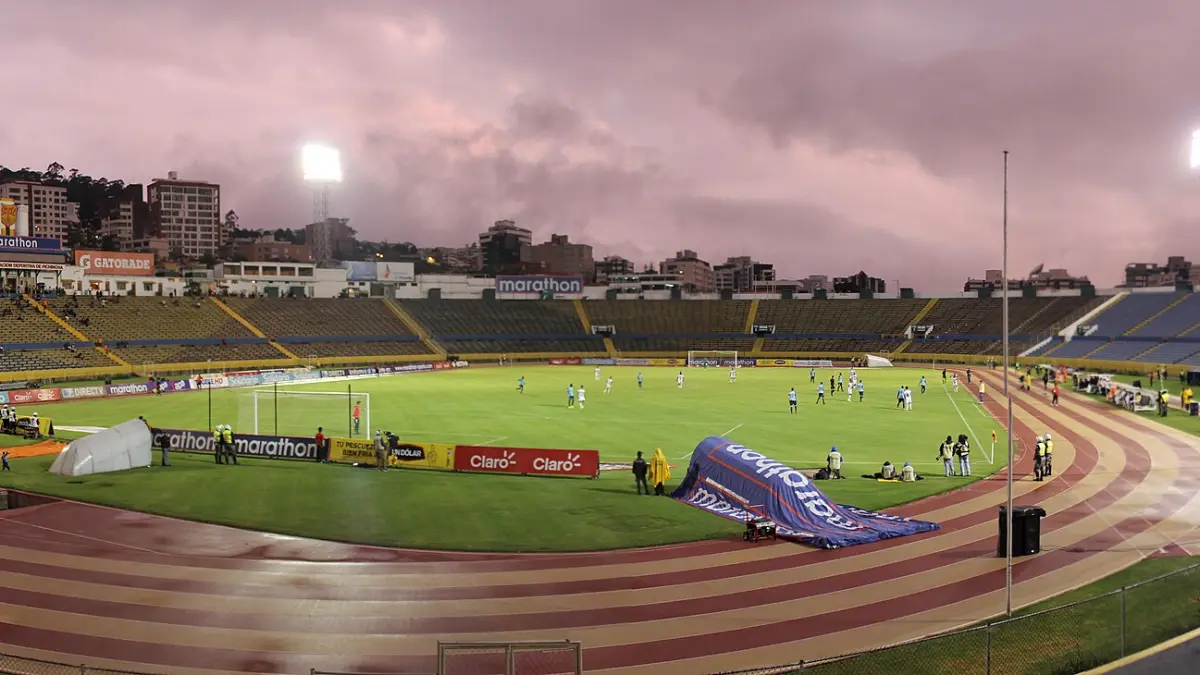
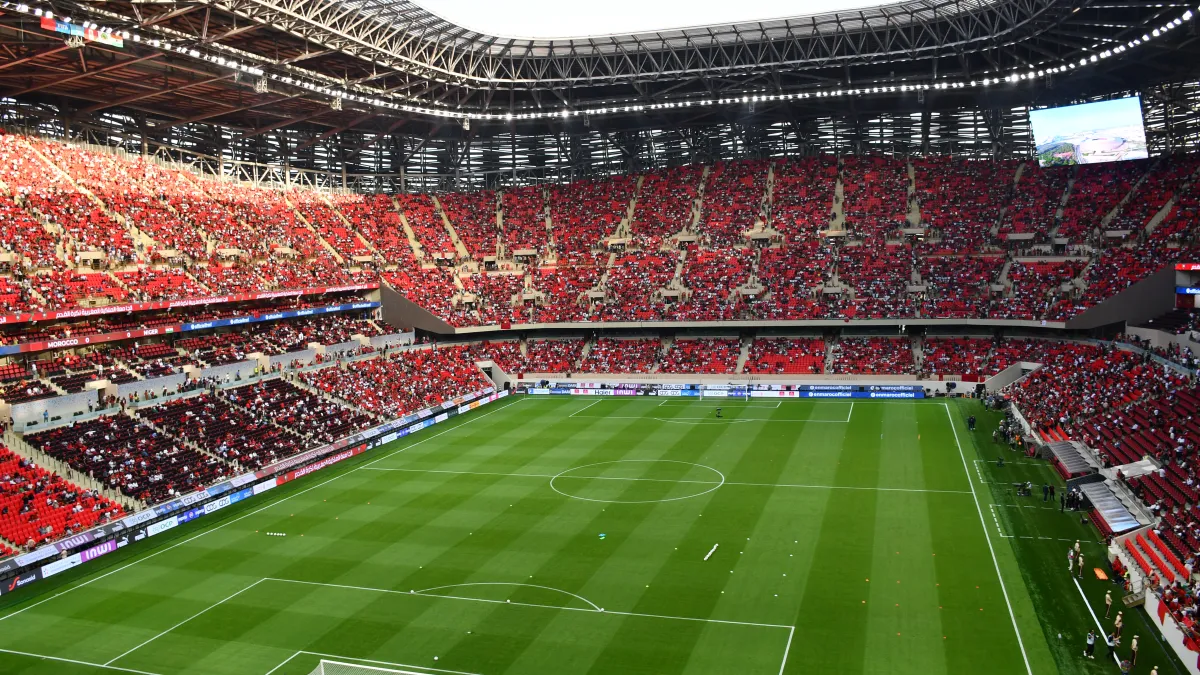
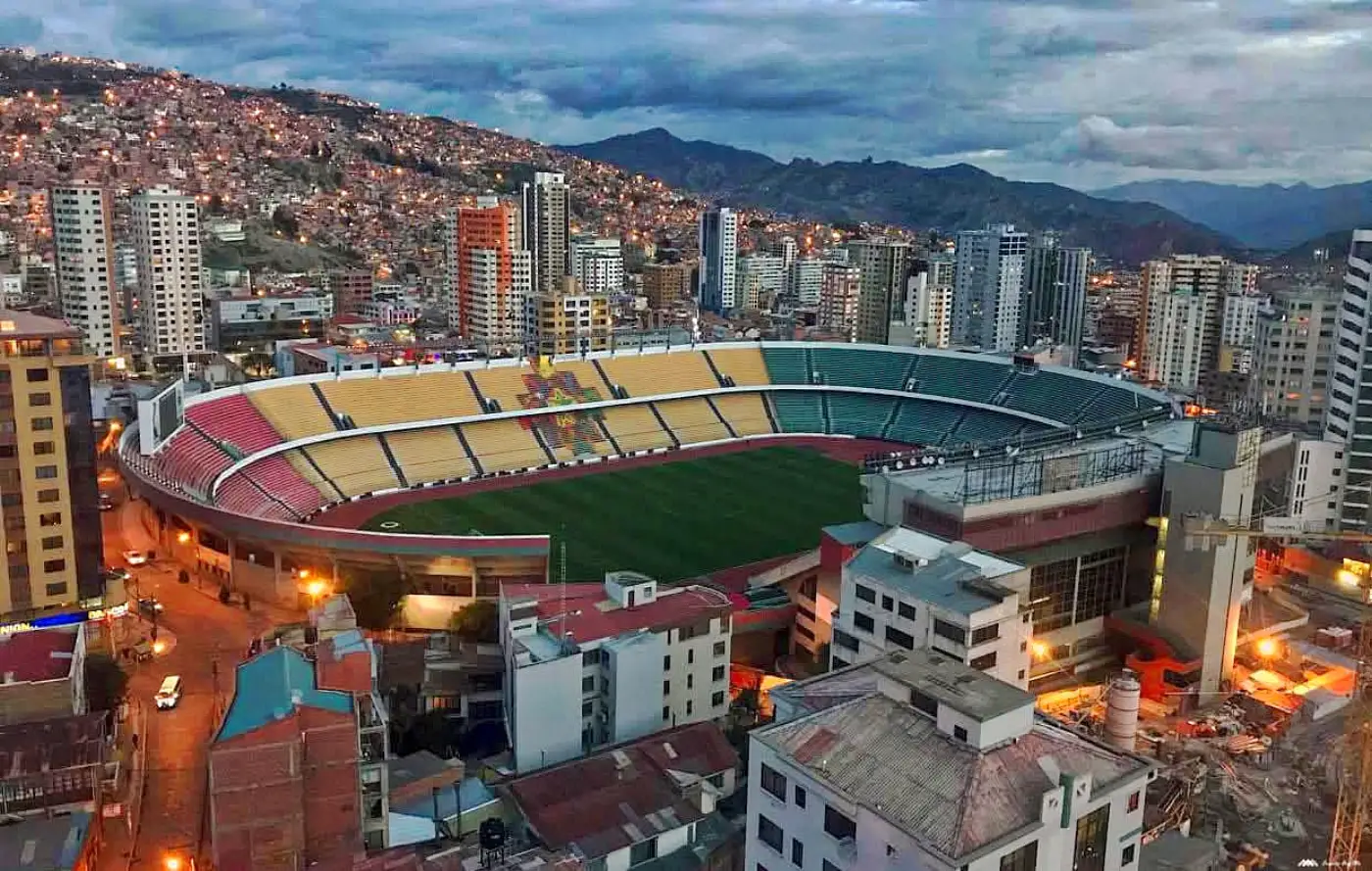
It holds about 41,143 spectators and is the shared home of La Paz’s two great rivals, Club Bolívar and The Strongest, as well as the fortress of the Bolivia national team. It is owned by the La Paz departmental government. The pitch is natural grass, the stands are open to the thin highland sky, and an athletics track rings the field.
Higher stadiums exist, including one in Peru that sits above 4,300 metres. But no ground has turned altitude into a legend the way this one has. This is the place that made FIFA try, and fail, to ban football for being too high.
Getting to Estadio Hernando Siles
Getting here means arriving in one of the highest cities on Earth, and the journey is part of the experience.
Public Transit
La Paz has one of the most spectacular public transit systems in the world, and it serves the stadium directly.
→ Via Mi Teleférico: The city’s cable car network, the world’s highest and longest, is the easy way across La Paz’s steep terrain. The Orange Line runs over the Miraflores district where the stadium stands. Stations connect the whole network, including a link up to El Alto and the airport.
→ Via minibus: The dense fleet of shared minibuses covers Miraflores and central La Paz cheaply, if chaotically.
The teleférico is worth riding for the views alone, a slow float over the canyon-city with the Andes behind it.
Driving + Parking
Miraflores is a central district, and the stadium sits on Avenida Saavedra. Driving in La Paz means steep, busy streets and thin air that affects engines as well as lungs.
→ From central La Paz: A short drive up into Miraflores, though traffic and gradients make a taxi or the teleférico simpler for most visitors.
→ From El Alto: A descent of some 500 vertical metres from the altiplano down into the La Paz bowl.
Street parking near the ground is limited on match days, when Bolívar, The Strongest or the national team draw a crowd.
Rideshare
Ride-hailing apps operate in La Paz alongside a huge fleet of street taxis. For visitors still adjusting to the altitude, a taxi door to door is often the most comfortable choice, and fares within the city are low. Coca tea, offered almost everywhere, is the local remedy for the soroche that catches new arrivals.
From the Airport
→ El Alto International (LPB): At about 4,058 metres, the highest international airport in the world. It sits on the altiplano above the city, so arriving passengers descend into La Paz. The teleférico and taxis connect it to Miraflores.
→ Acclimatize first: Because the airport is even higher than the stadium, many visitors feel the altitude the moment they land. Take it slowly for the first day.
Watching a Match at Estadio Hernando Siles
Going to a game here is not like going to a game anywhere else, and it starts before kickoff, with the air. Visitors are told to spend a day or two in La Paz acclimatizing first, because 3,600 metres works on the spectators too. Climb the steps to your seat too quickly and you will feel it. The players are not the only ones who arrive out of breath.
The reward is an atmosphere that regulars and first-timers both describe as overwhelming. The thin air is said to carry the sound further, and when the ground fills for a big match the noise seems to sit on top of you. The crowd is half the show. Fans sing, drum and stand for most of the ninety minutes, and the standing advice from people who have been is that the stands can be as good to watch as the pitch.
The match to catch is the clásico paceño, the La Paz derby between the two clubs who share the ground, Club Bolívar and The Strongest. Continental nights matter too. When a Brazilian or Argentine giant is drawn to play a Copa Libertadores tie up here, the altitude does half the home side’s work before a ball is kicked, and everyone in the stadium knows it.
A few pieces of local knowledge make the day easier. Tickets are cheap, often only a few dollars, and can usually be found on the street outside even for sold-out games, though the usual warning about fakes applies, so buy from a proper window where you can. Getting in is simple: the Mi Teleférico Orange line runs into Miraflores a short walk from the turnstiles, and floating in over the canyon-city is worth the ride on its own.
And one tip only the regulars will tell you. The hard plastic seats have a reputation for shedding tiny fiberglass splinters, so locals carry a scrap of styrofoam or a cushion to sit on. It sounds absurd until you are picking splinters off your jeans on the walk home. Whatever else you forget, bring something to sit on.
Construction & Design
Estadio Hernando Siles was built between 1927 and 1930 and inaugurated on January 16, 1930, with The Strongest beating Universitario in the opening match. It was the work of Emilio Villanueva, Bolivia’s foremost architect of the era, who drew on a neo-tiahuanacota style that looked back to the Andean stonework of Tiwanaku rather than to Europe. It was named for Hernando Siles Reyes, the Bolivian president who championed it, and its formal name remains Estadio Presidente Hernando Siles.
The stadium the world sees today is not the 1930 original. It was demolished and rebuilt in the mid-1970s, reopening on September 18, 1977 for the Bolivarian Games, an overhaul that roughly doubled its capacity and briefly saw it renamed the Estadio Olímpico. Later work converted it to an all-seater in 2007 and 2008, bringing the current figure to around 41,143, and the athletics track was renovated in 2018.
What no renovation can change is the thing that defines the place. At 3,600 metres, the stadium is a piece of engineering in the loosest sense: the real structure is the atmosphere around it. The pitch measures the standard 105 by 68 metres and the grass is real, kept alive at an altitude where visiting teams cannot be. The open bowl, the running track, the thin cold air, all of it frames a venue whose most important dimension is vertical and measured in metres above the sea.
History of Estadio Hernando Siles
Since it opened in 1930, Estadio Hernando Siles has been the home of Bolivian football, but its place in history was written by the visitors who came here and lost.
The most consequential night was July 25, 1993. Bolivia beat Brazil 2-0 in a World Cup qualifier, with late goals from Marco Etcheverry and William Ramallo, handing Brazil their first-ever defeat in World Cup qualifying. Brazil recovered to win the 1994 World Cup, but the aura of invincibility had been broken, and it was broken up here.
Sixteen years later came the result that still defines the fixture. On April 1, 2009, Bolivia demolished Argentina 6-1, with Joaquín Botero scoring a hat-trick. It was Argentina’s heaviest defeat in around six decades and the first loss of Diego Maradona’s reign as national coach. Much of the Argentine squad had flown in only hours before kickoff, a gamble against the altitude that failed completely.
Then, on March 27, 2013, the altitude produced its most-shared image. Argentina escaped with a 1-1 draw, but the story was Lionel Messi vomiting at halftime and Ángel Di María taking oxygen on the bench. It was the clearest picture anyone had of what this ground does to the best players in the world.
The stadium has hosted more than upsets. It staged the final of the 1997 Copa América, which Bolivia reached as hosts before losing 3-1 to Brazil. And it sat at the center of football’s altitude debate: when FIFA banned high-altitude qualifiers above 2,500 metres in 2007, La Paz was the target, and after protests from President Evo Morales and Maradona, FIFA first exempted this stadium and then dropped the ban altogether in 2008. The fortress had won again, this time in the committee room.
Bolivia have rarely been a force away from home. But here, in the thin air of Miraflores, they have beaten Brazil and Argentina and hosted a continental final, and that contrast is the whole story of the place. Take Bolivia down to sea level and they are ordinary. Bring the world’s best up to 3,600 metres and, for ninety minutes, the gap closes. The stadium does not just host the national team. It is the national team’s single greatest asset.
Sources & Further Reading
- Wikipedia, Hernando Siles Stadium: en.wikipedia.org. Capacity, dates, tenants, and the FIFA-exemption detail.
- Wikipedia (Spanish), Estadio Hernando Siles: es.wikipedia.org. The architect, the naming, and the renovation timeline.
- FIFA, historic firsts for Bolivia and Brazil: inside.fifa.com. The 1993 qualifier that ended Brazil’s unbeaten qualifying record.
- France 24, Argentina’s 6-1 loss to Bolivia: france24.com. Contemporary report on the 2009 result.
- Historia del Fútbol Boliviano: historiadelfutbolboliviano.com. Bolivian football history on the stadium’s construction and rebuilds.
Quick Facts
Everything you need at a glance.
Stadium specs
- Capacity
- 41,143
- Opened
- 1930
- Cost
- Not separately recorded
- Roof
- Open
- Surface
- Natural Grass
- Tenants
- Club Bolívar, The Strongest, Bolivia national team
Construction & location
- Groundbreaking
- 1927
- Architects
- Emilio Villanueva
- Engineering
- Not separately recorded
- General contractor
- Not separately recorded
- Address
- Avenida Saavedra, Miraflores, La Paz, Bolivia
- GPS
- 16.4994°S, 68.1228°W
Photo Gallery
Fun Facts
In a March 2013 World Cup qualifier here, the altitude did what it always does to visitors: Lionel Messi vomited at halftime and Ángel Di María needed an oxygen mask. Bolivia held Argentina to a 1-1 draw.
Brazil suffered their first-ever World Cup qualifying defeat at this ground, losing 2-0 to Bolivia on July 25, 1993. It made no difference to the eventual outcome: Brazil went on to win the 1994 World Cup a year later.
You arrive at the fortress by the world's highest cable car network. Mi Teleférico's Orange Line runs over the Miraflores district where the stadium stands, and the airport that feeds it sits even higher, on the altiplano above the city.
Stadium Location
Frequently Asked Questions
- How high is Estadio Hernando Siles?
- It sits roughly 3,600 metres (about 11,800 feet) above sea level in La Paz. Exact figures vary by source between about 3,577 and 3,637 metres, with 3,582 metres the most commonly cited, so it is best described as around 3,600 metres rather than a single precise number.
- Is Estadio Hernando Siles the highest stadium in the world?
- No, but it is the most famous high-altitude ground. Higher stadiums exist, including Estadio Daniel Alcides Carrión in Peru at about 4,338 metres, and Bolivia itself now plays some home matches even higher at El Alto (~4,150 metres). Hernando Siles is the historic altitude fortress, not the outright highest.
- What is the seating capacity of Estadio Hernando Siles?
- It holds about 41,143 spectators. For some international matches a reduced configuration of roughly 37,000 is used. The stadium opened with around 25,000 seats in 1930 and was enlarged in a 1970s rebuild before being converted to an all-seater in 2007 and 2008.
- Which teams play at Estadio Hernando Siles?
- It is the shared home of La Paz's two biggest clubs, Club Bolívar and The Strongest, and the primary home of the Bolivia national team for World Cup qualifiers. The venue is owned by the La Paz departmental government and operated by its sports service, SEDEDE.
- What are the most famous matches played at Estadio Hernando Siles?
- The altitude fortress has produced some of South American football's biggest upsets. Bolivia beat Brazil 2-0 here on July 25, 1993, Brazil's first-ever World Cup qualifying defeat. On April 1, 2009, Bolivia thrashed Argentina 6-1, Argentina's heaviest loss in around 60 years and Diego Maradona's first defeat as coach. In 2013 a 1-1 draw with Argentina became famous when Messi vomited at halftime and Di María used an oxygen mask. The ground also hosted the 1997 Copa América final.
- Did FIFA ever ban football at Estadio Hernando Siles?
- Yes. In May 2007 FIFA banned World Cup qualifiers above 2,500 metres, with La Paz the main target. After protests led by Bolivian president Evo Morales and Diego Maradona, FIFA raised the limit and then granted a special exemption for Estadio Hernando Siles so it could keep hosting qualifiers, before suspending the ban entirely in 2008.
- Who was Hernando Siles?
- Hernando Siles Reyes was the 31st President of Bolivia, in office from 1926 to 1930. He championed and inaugurated the stadium, which was named in his honor. Its formal name is Estadio Presidente Hernando Siles, and it was briefly known as the Estadio Olímpico around its 1977 reopening.
- How do you get to Estadio Hernando Siles?
- Fly into El Alto International Airport, the world's highest international airport at about 4,058 metres, which sits on the altiplano above the city. From there you descend into the La Paz bowl. The Mi Teleférico cable car network reaches the stadium's Miraflores district, and taxis and minibuses serve it directly. Give yourself time to acclimatize to the altitude before doing anything strenuous.
- Why is altitude such an advantage at Estadio Hernando Siles?
- At about 3,600 metres the air holds far less oxygen, so players who are not used to it fatigue and recover far more slowly, while the ball carries faster and farther through the thin air. Bolivian players who live at this altitude are unaffected, which is why the national team's home record here is so much stronger than its results at sea level.
- What is it like to attend a match at Estadio Hernando Siles?
- Intense, and not only because of the football. Spend a day or two acclimatizing first, because the altitude affects spectators too, and climbing the steps to your seat quickly will leave you short of breath. The atmosphere is described as overwhelming: the thin air seems to carry the crowd noise further, and fans sing, drum and stand for most of the match. The one to see is the clásico paceño, the La Paz derby between Club Bolívar and The Strongest.
- Should you bring anything to sit on at Estadio Hernando Siles?
- Regulars advise it. The hard plastic seats have a reputation for shedding tiny fiberglass splinters, so locals commonly bring a scrap of styrofoam or a cushion to sit on. It is the kind of local knowledge that makes the difference between a comfortable afternoon and picking splinters off your clothes afterward.
Last updated: 2026-07-17