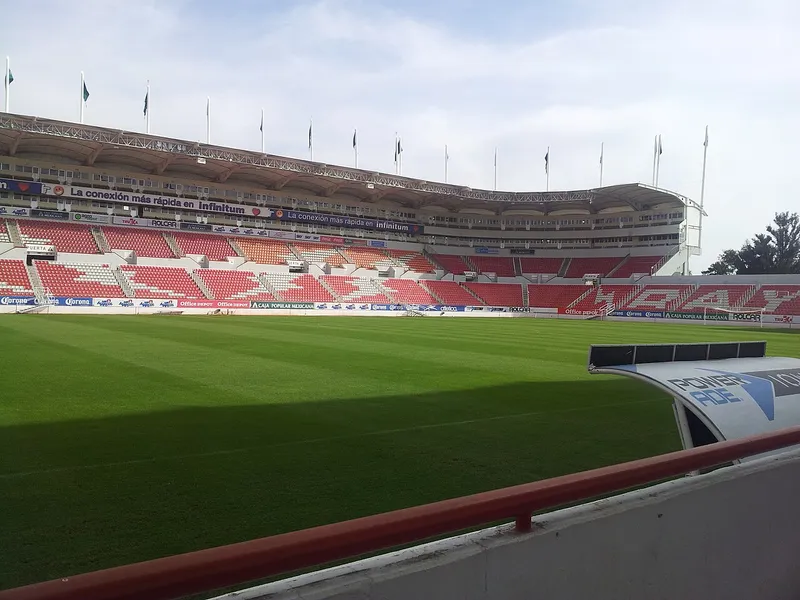
About Estadio Victoria
Club Necaxa arrived in Aguascalientes in the summer of 2003 with something almost no relocating club ever gets: a purpose-built stadium already finished, named, and waiting for them. The Estadio Victoria had gone up in roughly fourteen months on donated municipal land in the Colonia Héroes district, replacing a tired 8,000-seat municipal ground that was knocked down to make room. Capacity today is listed at 25,500.
Necaxa, nicknamed Los Rayos (The Lightning Bolts), are the sole tenant. Both the men’s and women’s sides play here. The club is one of Mexican football’s most decorated names, founded in 1923 in Mexico City, and the move to a mid-sized city 500 kilometers away was one of the more unusual franchise relocations in Liga MX history. The gamble was simple. Better to be the only major club in Aguascalientes than one of many fighting for oxygen in the capital.
The stadium’s most distinctive feature stays hidden until Necaxa find the net. Behind the south stand is a multimedia fountain that erupts on every home goal with choreographed water jets, colored light, and music. It is billed as one of the first built directly into a football venue, and whether or not the “world first” claim holds up, no other Liga MX ground celebrates quite like it.
Three of the four stands carry upper tiers and roof cover. The south stand, where the fountain sits, stays single-tiered and open to the sky. The playing field runs a standard 105 by 68 meters (344 by 223 feet), and there are eleven emergency exits threaded through the bowl. The 25-year naming-rights concession with Grupo Modelo, running 2003 to 2028, gives the stadium its name and ties it to Victoria, one of Mexico’s oldest beer brands, brewed since 1865.
Aguascalientes sits at roughly 1,888 meters (6,194 feet) above sea level on the central Mexican plateau, and the altitude gives visiting teams from lower elevations a nagging disadvantage in the closing minutes. The climate is dry and temperate. Summer daytime temperatures hover around 30°C (86°F) before dropping to pleasant evenings, which suits Liga MX’s usual 7 PM and 9 PM kickoffs. On clear days, the ridgeline of Cerro del Muerto, a mountain whose silhouette resembles a reclining human figure, is visible from the upper tiers of the east stand.
Getting to Estadio Victoria
Public Transit
Aguascalientes has no metro or rail system. City buses do the work, and there are a lot of them.
→ From the city center: Over a dozen CMOV bus routes serve the stadium area, including Ruta 16, 19, 23, 24, 25, 27, 43, 47, and 48. The nearest stop is “Catrina,” a 4-minute walk. Flat fare is approximately MXN $13.50.
→ From Central Camionera (bus terminal): Intercity buses connect Aguascalientes to Guadalajara, León, Zacatecas, and Mexico City via ETN, Primera Plus, and Ómnibus de México.
Last bus service near the stadium (Ruta 43) departs around 10:24 PM. Plan accordingly for evening matches, because a full 9 PM kickoff can run past the final departure.
Driving + Parking
GPS address: Colonia Héroes, Aguascalientes, Ags., Mexico.
→ From Guadalajara (220 km): North on Autopista 70D/45D. About 2 hours 30 minutes.
→ From León, Guanajuato (130 km): Northwest on Autopista 45D. About 1 hour 25 minutes.
→ From Zacatecas (121 km): South on Autopista 45D. About 1 hour 40 minutes.
Parking is limited. Small lots around the stadium fill quickly on match days at roughly MXN $50-100. Street parking in Colonia Héroes is the main overflow option. Rideshare is the smarter play here, given the congestion and the shortage of spaces.
Rideshare
Uber and DiDi both operate in Aguascalientes. A ride from the city center costs MXN $50-80, about 5-10 minutes. From the airport, expect MXN $145-200. Post-match congestion is real, so walk a block or two from the stadium for a quicker pickup.
From the Airport
→ Aguascalientes International Airport (AGU): 22 km south, about 25-30 minutes by car. Fixed-zone taxi fare is approximately MXN $300. Uber is available but can be tricky to hail at the airport because of local taxi restrictions. Domestic flights connect to Mexico City, Tijuana, and Monterrey, plus select US cities including Houston, Dallas, and Los Angeles.
Construction & Design
The build started in May 2002, and the clock is the part worth dwelling on. Roughly fourteen months later, on July 26, 2003, the Estadio Victoria opened its gates for a match. That is fast for a 25,500-seat football stadium. The municipality of Aguascalientes had donated the site, which held an outdated 8,000-seat municipal ground, and that older structure was demolished to clear the way. The land underneath belongs to the public. The stadium is owned by the municipality of Aguascalientes and operated by Club Necaxa as its tenant.
Some pieces of the story are not well documented, and it is better to say so than to pad the record. The exact construction cost was never published in a figure that survives a second look, so no number appears here. The design and engineering team behind the stadium is likewise thin in public sources. What is clear is the footprint. A standard 105 by 68 meter (344 by 223 foot) pitch, eleven emergency exits, and a three-sided upper deck with roof cover that leaves the south end open.
That open south end is the stadium’s calling card. Behind it sits the multimedia fountain, a bank of water jets choreographed to light and music that fires on every Necaxa goal. It reads as a gimmick on paper and works as a genuine spectacle in person, which is a rare combination. The stadium also anchors a larger public sports complex in the Héroes district that includes a baseball park, a gym, a basketball court, a velodrome, and a semi-Olympic pool, so match day here is one slice of a wider civic athletic zone rather than an isolated arena in a parking sea.
The name is a commercial arrangement rather than a civic one. Grupo Modelo holds a 25-year naming-rights concession, running from 2003 to roughly 2028, and attached its Victoria beer brand to the venue. Victoria is one of the oldest beer labels in Mexico, brewed since 1865, which makes the naming deal a small piece of national commercial history bolted onto a modern stadium. Locals mostly just call it “el Victoria.”
History of Estadio Victoria
Necaxa’s move to Aguascalientes in 2003 was a bet on identity. The club had been founded in Mexico City in 1923 and carried real history, including league titles and a fervent capital following, but ownership decided a purpose-built home in a mid-sized city offered a cleaner path than fighting for attention in Mexico City’s crowded market. The municipality donated the land, the old 8,000-seat ground came down, and fourteen months of construction produced the Estadio Victoria.
The opening stretch set the tone. On July 26, 2003, the inaugural match pitted Necaxa against Guadalajara, and the visitors won 1-0 on a penalty. Three days later came the game everyone still talks about. On July 29, 2003, Necaxa hosted Italian side AS Roma in a friendly that finished 1-1, and Paraguayan goalkeeper Rubén Ruiz Díaz, “La Bomba,” saved a penalty from Francesco Totti. Rodolfo Espinoza scored for Necaxa. Not a bad way to introduce a new stadium to the neighborhood.
The venue soon drew the national team. On June 27, 2004, Mexico thumped Dominica 8-0 here in a 2006 World Cup CONCACAF qualifier, the first senior international staged at the ground, in front of about 17,000 fans. The visitors had already lost the first leg 10-0, so the aggregate reached a lopsided 18-0. International football never became a fixture in Aguascalientes, but that night put the stadium on the map beyond Liga MX.
Necaxa’s own peaks came later, and unevenly. Early seasons in Aguascalientes drew sparse crowds as a city with no prior top-flight club warmed to a franchise transplanted from the capital. The club also bounced between divisions, dropping down and clawing back up, before a promotion returned it to Liga MX for the Apertura 2016. That first season back produced an unexpected run all the way to the semifinals. On December 1, 2016, Necaxa drew Club América 1-1 in the first leg, with Felipe Gallegos putting the home side ahead before William Da Silva equalized, though América took the return leg 2-0 and advanced 3-1 on aggregate.
The moment the city fully embraced the club arrived in the spring of 2018. On April 11, 2018, Necaxa beat Toluca 1-0 in the single-leg Copa MX final at a charged Estadio Victoria. The winning goal was scrappy and unforgettable: an 86th-minute own goal by Toluca defender Santiago García, who sliced a clearance past his own keeper Alfredo Talavera. Attendance was 19,223. It was Necaxa’s first trophy since arriving in Aguascalientes, and it turned a transplanted club into a local institution.
The ownership chapter that followed drew far more attention than any Necaxa result. In 2021, a US-led investment group headed by Al Tylis and Sam Porter bought into the club, bringing a roster of celebrity minority investors that read like a red-carpet guest list: actress Eva Longoria, former Arsenal and Germany star Mesut Özil, baseball’s Justin Verlander, model Kate Upton, and several NBA names among them. In 2023, Wrexham owners Ryan Reynolds and Rob McElhenney added stakes and brought their documentary-driven playbook south, spawning an FX docuseries about the club. To be clear about what changed hands, all of that investment went into Club Necaxa the team. The Estadio Victoria itself stayed publicly owned by the municipality.
Match day still runs on local energy rather than star power. Organized supporter groups such as Comando Rojiblanco fill an end with drums, songs, and red-and-white flags, and the fountain does the rest whenever Necaxa score. The Feria Nacional de San Marcos, held every April and May, pulls millions of visitors to Aguascalientes, and when Liga MX fixtures overlap with the fair, the stadium tends to fill with a mix of locals and out-of-towners folding a match into their feria trip. More than two decades in, the fountain, the beer-branded name, and the lightning-bolt crests in the stands add up to an identity that is entirely Aguascalientes, distinct from the club’s Mexico City roots.
Sources & Further Reading
- Club Necaxa official stadium page: necaxafutbol.com. Capacity, opening date, the 14-month build, and the south-stand fountain, straight from the club.
- Spanish Wikipedia entry on the stadium: es.wikipedia.org. Location, capacity, field dimensions, ownership, and naming-rights details.
- LJA Aguascalientes anniversary coverage: lja.mx. Local reporting on the stadium’s construction history, donated land, and inaugural matches.
- ESPN match record, Copa MX Clausura 2018 final: espn.com. Confirms the Necaxa 1-0 win over Toluca and the own-goal winner.
- ESPN coverage of the club’s US and celebrity ownership: espn.com. Background on the investor group behind Club Necaxa, the team, not the stadium.
Quick Facts
Everything you need at a glance.
Stadium specs
- Capacity
- 25,500
- Opened
- 2003
- Roof
- Open
- Surface
- Natural Grass
- Tenants
- Club Necaxa (Liga MX)
Location
- Groundbreaking
- May 2002
- Address
- Manuel Madrigal 101, Colonia Héroes, Aguascalientes, Aguascalientes 20190, Mexico
- GPS
- 21.8807°N, 102.2755°W
Photo Gallery
Fun Facts
Estadio Victoria was built in just 14 months (May 2002 to July 2003), replacing an 8,000-seat municipal stadium on donated public land, one of the fastest-built Liga MX venues of its era.
The stadium's name comes from a 25-year naming-rights concession (2003-2028) with Grupo Modelo for its Victoria beer brand, one of Mexico's oldest beer labels, brewed since 1865.
A dancing multimedia fountain behind the south stand erupts with water, light, and music every time Necaxa scores, billed as one of the first built directly into a football venue.
Stadium Location
Frequently Asked Questions
- What is the capacity of Estadio Victoria?
- Approximately 25,500 spectators, the figure listed by Club Necaxa and Spanish-language references. Three of the four stands carry upper tiers and roof cover; the south stand stays single-tiered and open.
- Who plays at Estadio Victoria?
- Club Necaxa ('Los Rayos') of Liga MX. The club has been the stadium's tenant since it opened in 2003, and both the men's and women's teams play here.
- When was Estadio Victoria built?
- Construction began in May 2002 and the stadium opened on July 26, 2003, a build of only about 14 months. It replaced an aging 8,000-seat municipal ground on the same site.
- Who owns Estadio Victoria?
- The stadium sits on public land in the Colonia Héroes sports area and is publicly owned by the municipality of Aguascalientes. Club Necaxa operates it as the tenant.
- Are Eva Longoria and Ryan Reynolds owners of the stadium?
- No. Those celebrity investors bought stakes in Club Necaxa, the team, not the stadium. A US-led group added star backers including Eva Longoria, Mesut Özil, and later Wrexham's Ryan Reynolds and Rob McElhenney. The Estadio Victoria itself remains publicly owned.
- How do I get to Estadio Victoria from the airport?
- Aguascalientes International Airport (AGU) is about 22 km south of the stadium, roughly 25-30 minutes by car. A fixed-zone taxi costs around MXN $300.
- Is there parking at Estadio Victoria?
- Parking is limited. Small lots surround the stadium but fill quickly on match days. Street parking in Colonia Héroes is the main overflow. Taking Uber or DiDi is the easier option.
- What is the fountain show at Estadio Victoria?
- A choreographed multimedia fountain behind the south stand that activates with water, light, and music whenever Necaxa scores. It is one of the stadium's signature quirks and part of the match-day experience.
- Does altitude affect matches at Estadio Victoria?
- Aguascalientes sits at about 1,888 meters (6,194 feet) above sea level. Visiting teams from lower elevations often feel the thinner air late in games, a modest but real home advantage.
- Why is it called Estadio Victoria?
- The name comes from a 25-year naming-rights concession with Grupo Modelo for its Victoria beer brand, running from 2003 to roughly 2028. Victoria is one of Mexico's oldest beer labels, brewed since 1865.
Last updated: 2026-07-10