About Kyle Field
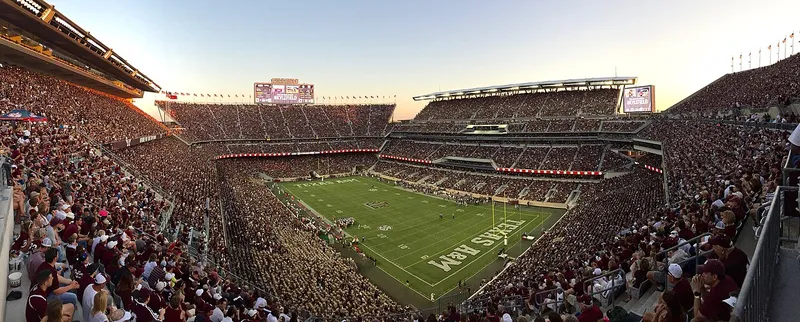
On the western edge of the Texas A&M campus in College Station, a small city 95 miles northwest of Houston, Kyle Field transforms into one of the largest gatherings in college football on Saturdays. With 102,733 seats, it is the biggest stadium in the SEC, the fourth-largest in the NCAA, and the single loudest place you will ever watch a football game.
The stadium is home to the Texas A&M Aggies, one of the most tradition-rich programs in college football. The 12th Man tradition, where the entire student section of roughly 37,000 stands for the full game, began in 1922 and defines every home match. That wall of maroon and white is visible from every seat and audible from blocks away.
The current Kyle Field is the product of a $485 million redevelopment completed in 2015. Populous designed the two-phase renovation, which demolished and rebuilt the east and west sides in 22 months without missing a single home game. The result is a modern colossus with a 163-foot-wide scoreboard, premium club spaces, and a natural Latitude 36 Bermudagrass playing surface.
Kyle Field has hosted far more than football. George Strait set the U.S. record for the largest single-day ticketed concert here in June 2024 with 110,905 fans. Mexico and Brazil played an international soccer friendly in front of 85,249 in June 2024. The stadium has also hosted multiple SEC Championship-caliber showdowns, including the return of the Texas A&M–Texas rivalry in 2024.
Getting to Kyle Field
Public Transit
College Station has no commuter rail or light rail. On gamedays, free shuttle services are your best option.
→ From Downtown Bryan: The City of Bryan runs free air-conditioned shuttles from Roy Kelly Parking Garage (200 E. 27th St.) to the Memorial Student Center, steps from Kyle Field. Runs 3 hours pre-game through 1 hour post-game.
→ From Campus Remote Lots: Texas A&M operates free shuttle loops from the Bush Library, Bonfire Memorial, and Agronomy Road lots. Shuttles begin 3 hours before kickoff and run continuously.
The City of College Station also offers free parking at City Hall with ground shuttles to campus. Real-time bus tracking is available through the “Destination Aggieland” app.
Driving + Parking
Kyle Field’s address is 198 Joe Routt Boulevard, College Station, TX 77843. TX-6 is the primary corridor from all directions.
→ From Houston (~95 mi): Take US-290 West to TX-6 North directly into College Station. Exit at University Drive. About 1 hour 45 minutes.
→ From Austin (~105 mi): Take US-290 East to TX-21 East, then merge onto TX-6 South into College Station. About 2 hours.
→ From Dallas (~180 mi): Take I-35 South to Hillsboro, then TX-6 South through Waco and Hearne into College Station. About 2 hours 45 minutes.
Pay-upon-arrival lots run $25 to $40 near the Bush Library and Bonfire Memorial areas, with free shuttle service included. Prepaid garage parking (West Campus, Southside, Central Campus garages) is available through Texas A&M Transportation Services. Tailgating starts at 7:00 AM, and Aggie Park directly east of Kyle Field is the most popular spot.
Rideshare
Uber and Lyft both operate in College Station. The designated pickup/drop-off zone is Lot 30E, with three additional curbside locations around the stadium. A ride within College Station runs $8 to $15. Expect surge pricing of 2 to 3x immediately post-game, so either leave early or wait 30 minutes for rates to settle.
From the Airport
→ Easterwood Airport (CLL): 3 miles from Kyle Field, about 8 minutes by car. Limited commercial flights via American Eagle to Dallas/Fort Worth. The most convenient but fewest options.
→ George Bush Intercontinental (IAH): 102 miles, about 1 hour 40 minutes. Best option for national and international arrivals with the widest flight selection.
→ Austin-Bergstrom (AUS): 102 miles, about 1 hour 50 minutes. Good for fans combining an Austin visit with the game.
Construction & Design
Kyle Field has been rebuilt so many times that almost nothing of the original survives. The first permanent concrete stadium opened on September 24, 1927, seating 32,890, on land Professor Edwin Jackson Kyle had developed two decades earlier. Over the next 85 years it grew piece by piece, deck by deck, until Texas A&M decided to stop patching and start over.
The $485 million redevelopment approved by the Board of Regents in May 2013 was one of the most ambitious projects in college football history. Populous designed it. Walter P Moore handled the structural engineering. Manhattan and Vaughn Construction built it as a joint venture, and they did the whole thing in two phases over 22 months without canceling a single home game, which for a 100,000-seat stadium is close to absurd.
Phase I, beginning after the 2013 season, demolished and rebuilt the first deck of the east side and added the new south end zone. Phase II, a year later, took down the entire west side, the last standing remnant of the 1927 structure, and rebuilt it from the ground up. The stadium reopened for the 2015 season against Ball State. On time. Under budget. Stadium projects almost never get to say both.
What you get now is 102,733 permanent seats wrapped tight around the field in a steep, enclosed bowl. The main scoreboard runs 163 feet wide. Two more video boards, each 54 feet across, sit in the corners. There are premium club levels, rebuilt concourses, and a press structure that towers over the west side. The playing surface is Latitude 36 Bermudagrass, laid in 2017, replacing the Tifway 419 grass that had been down since 1996 and the AstroTurf before that.
The design goal was loudness as much as capacity. The bowl is closed and steep on purpose. With the entire student section standing for the full game, the sound has nowhere to go but back down onto the field. That is not an accident of the engineering. It is the engineering.
History of Kyle Field
The story begins in 1904, when Professor Edwin Jackson Kyle spent $650 of his own money to purchase a grandstand from the Bryan fairgrounds. The Corps of Cadets named the site “Kyle Field” in 1906, and the first permanent concrete stadium opened on September 24, 1927, seating 32,890.
The 12th Man (1922): At the Dixie Classic in Dallas, coach Dana X. Bible called student E. King Gill from the press box to suit up for the injury-depleted Aggies. Gill stood ready on the sideline as A&M won 22-14. The tradition of the entire student body standing throughout every game was born.
Record Crowd (October 11, 2014): During renovation, a temporary-expanded Kyle Field held 110,633 for Texas A&M vs. No. 3 Ole Miss, the largest crowd in SEC history at the time and the biggest ever in Texas for a football game.
George Strait Concert (June 15, 2024): “The King at Kyle Field” drew 110,905 fans, setting the U.S. record for the largest single-day ticketed concert, surpassing the Grateful Dead’s 1977 mark.
International Soccer Debut (June 8, 2024): Mexico vs. Brazil drew 85,249 in a pre-Copa America friendly, the largest crowd to watch Mexico play in Texas.
Texas A&M–Texas Rivalry Returns (November 30, 2024): The Lone Star Showdown returned to Kyle Field as Texas joined the SEC, one of the most anticipated home games in decades.
Kyle Field is more than a stadium. It is the physical expression of Texas A&M’s identity. The 12th Man stands here, Reveille watches from the north end zone, and Midnight Yell Practice fills these seats at midnight on the eve of every home game. Few venues anywhere carry this kind of devotion.
Home of the 12th Man
Every school has fans. Texas A&M has a number. The 12th Man is the idea that organizes everything else at Kyle Field, and it traces to a single afternoon: January 2, 1922, at the Dixie Classic in Dallas, when injuries had cut the Aggie squad so thin that coach Dana X. Bible called a student down from the press box to suit up. His name was E. King Gill. He had left the football team for basketball, but he pulled on an injured player’s jersey and stood ready on the sideline for the rest of the game. He never entered. He didn’t need to. The point was that he was there, willing, in case the team ran out of men.
A century later, that is still the whole meaning. The entire student section, roughly 37,000 strong, stands for all four quarters of every home game, a standing body of reserves that never sits down, ready to be called. Texas A&M holds the trademark on the phrase, and the school bills Kyle Field as the Home of the 12th Man for a literal reason, not a marketing one. That wall of standing students is why opposing offenses burn timeouts they cannot afford, and why the noise here has a floor no empty seat can lower. It is not a slogan bolted onto the building. It is the reason the building sounds the way it does.
Sources & Further Reading
- Texas A&M Athletics official site: 12thman.com. Kyle Field capacity, gameday policies, parking, and ticketing.
- Kyle Field venue information: tamustadium.com. Address, seating map, and event details.
- Texas A&M Transportation Services: transport.tamu.edu. Gameday parking, shuttle routes, and accessible transit.
- Populous project page: populous.com. The architect’s overview of the 2013-2015 redevelopment.
- Wikipedia entry on Kyle Field: en.wikipedia.org/wiki/Kyle_Field. Construction history, capacity, and attendance records.
Quick Facts
Everything you need at a glance.
Stadium specs
- Capacity
- 102,733
- Opened
- 1927
- Cost
- $485 million (2013-2015 redevelopment)
- Roof
- Open
- Surface
- Natural Grass (Latitude 36 Bermudagrass)
- Tenants
- Texas A&M Aggies (NCAA/SEC)
Construction & location
- Groundbreaking
- 1927 (original stadium); redeveloped 2013-2015
- Architects
- Populous
- Engineering
- Walter P Moore
- General contractor
- Manhattan / Vaughn Construction (joint venture)
- Address
- 198 Joe Routt Boulevard, College Station, TX 77843, USA
- GPS
- 30.6099°N, 96.3405°W
Photo Gallery
Fun Facts
The 12th Man tradition dates to 1922, and Texas A&M's entire student section, roughly 37,000 strong, stands for the full game at every home match.
Kyle Field is the largest stadium in the SEC, the fourth-largest in the NCAA, and the biggest in Texas at 102,733 seats.
Every past Reveille mascot is buried at the north end of Kyle Field, facing the scoreboard so they can 'watch the Aggies score.'
Stadium Location
Frequently Asked Questions
- What is the seating capacity of Kyle Field?
- Kyle Field holds 102,733 fans, making it the largest stadium in the SEC, the fourth-largest in the NCAA, and the biggest in Texas.
- What is the 12th Man tradition at Texas A&M?
- The tradition began on January 2, 1922, when student E. King Gill left the stands to suit up for the injury-depleted Aggies. Today, the entire student section of roughly 37,000 stands for every home game to symbolize their readiness to support the team.
- How much does parking cost at Kyle Field?
- Pay-upon-arrival lots range from $25 to $40. Prepaid reserved garage parking is available through Texas A&M Transportation Services. Free parking with shuttle service is offered by the City of Bryan and City of College Station on gamedays.
- How do I get to Kyle Field without a car?
- The City of Bryan offers free gameday shuttles from Downtown Bryan. Texas A&M runs free campus shuttles from remote lots. Uber and Lyft both operate in College Station with a designated pickup/drop-off zone at Lot 30E. There is no rail service to College Station.
- When was Kyle Field renovated?
- The most recent major renovation was a $485 million redevelopment completed in two phases from November 2013 through August 2015. Designed by Populous, it was completed on time and under budget in 22 months without missing a single home game.
- What is the largest crowd ever at Kyle Field?
- The all-time record is 110,905 for the George Strait concert on June 15, 2024. The football record is 110,633 for the Texas A&M vs. Ole Miss game on October 11, 2014.
- Is Kyle Field a grass or turf field?
- Kyle Field has a natural grass surface, Latitude 36 Bermudagrass, installed in 2017. The field previously used Tifway 419 Bermudagrass (1996-2017) and AstroTurf (1970-1995).
- What is Kyle Field's bag policy?
- Kyle Field enforces a clear bag policy. Bags must be clear plastic, vinyl, or PVC and cannot exceed 12 by 6 by 12 inches. One clear bag plus one small clutch per person is permitted.
- Where is Kyle Field located?
- Kyle Field is at 198 Joe Routt Boulevard on the Texas A&M University campus in College Station, Texas 77843, about 95 miles northwest of Houston and 100 miles east of Austin.
- Who is Kyle Field named after?
- Kyle Field is named after Edwin Jackson Kyle, a Texas A&M horticulture professor who developed the athletic field in 1904, paying $650 of his own money for a grandstand from the Bryan fairgrounds. The Corps of Cadets named the site Kyle Field in 1906.
- What is Midnight Yell Practice at Kyle Field?
- Midnight Yell is a Texas A&M tradition held at Kyle Field at midnight before every home game. Tens of thousands of Aggies fill the stands to practice yells led by the Yell Leaders. It is free, open to the public, and one of the most distinctive traditions in college football.
- How far is Kyle Field from Houston?
- Kyle Field is about 95 miles northwest of Houston, roughly a 1 hour 45 minute drive via US-290 and TX-6. The nearest airport is Easterwood (CLL), 3 miles away with limited flights, while George Bush Intercontinental (IAH) is about 102 miles out with the widest flight selection.
- Does Kyle Field have a roof?
- No, Kyle Field is an open-air stadium with no roof. Early-season games in College Station can be hot and humid, often in the 90s, so bring sun protection, a hat, and water. Late-season night games can turn cool.
- Is there accessible seating at Kyle Field?
- Yes. Kyle Field offers ADA-accessible seating on every seating level, along with accessible parking and shuttle service through Texas A&M Transportation Services. Fans needing specific accessible seats should contact Texas A&M ticketing in advance.
Last updated: 2026-07-10