About Stadium 974
Most stadiums are built to last a century. Stadium 974 was built to come apart. Standing on the Doha waterfront a short hop from the airport, it is the strangest venue the World Cup has ever used: a 44,089-seat arena assembled from 974 recycled shipping containers and modular steel, designed from the first sketch to be unbolted, packed up, and moved on. No World Cup had ever staged matches in a building meant to disappear.
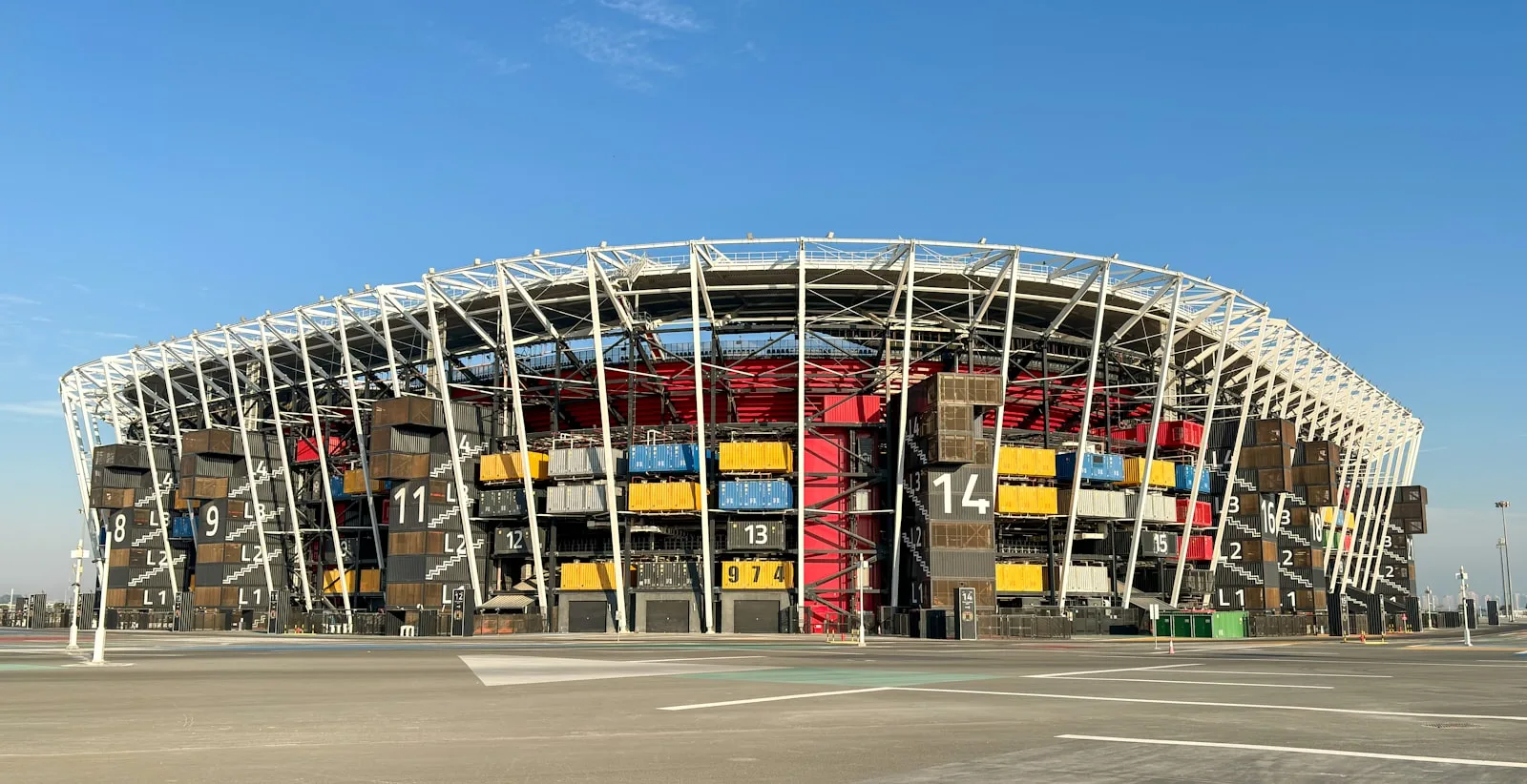
The name does double duty. The 974 containers stacked into the structure give it its number, and 974 also happens to be Qatar’s international dialing code, a quiet nod to the host nation and to the industrial, port-side history of the Ras Abu Aboud site. Officially it carries the name Ras Abu Aboud Stadium, but almost everyone calls it Stadium 974. The containers are not decoration. They are the building, fitted out off-site as concession stands, toilets, staircases, and offices, then craned into a steel skeleton like the world’s largest set of building blocks.
Spanish firm Fenwick Iribarren Architects, who also designed Qatar’s Education City Stadium, set the whole thing on a 450,000-square-metre waterfront plot beside the port, with the open end of the bowl framing the West Bay skyline across the bay. There is no roof and no enclosing facade, which was the point. The modular, open form was meant to catch the Gulf breeze and ventilate the stands naturally, well suited to a tournament played in the cooler weeks of November and December.
What makes Stadium 974 matter beyond its looks is the idea behind it. Every recent World Cup has left host cities wrestling with stadiums too big to fill once the circus leaves town. Qatar’s answer was a venue that could host seven matches and then vanish, its parts shipped off to build something else. Whether that promise is kept is still an open question, but the building itself remains the boldest experiment in the history of stadium design.
Getting to Stadium 974
Public Transit
The Doha Metro is the simplest way in. The Gold Line’s Ras Bu Abboud station is the closest stop, a short walk from the gates along the waterfront.
→ From central Doha: Pick up the Gold Line at Msheireb, the network’s main interchange, and ride a few stops east to Ras Bu Abboud. The trip takes about 10 minutes, then a 15 to 20 minute walk to the stadium.
→ From the airport: Take the Red Line from Hamad International and change to the Gold Line at the interchange, or simply grab a taxi, which is quicker given how close the stadium sits to arrivals.
On event days, shuttle buses run between the station and the stadium, and the metro keeps extended hours. As at every Qatar venue, trains fill fast after the final whistle, so it pays to set off a little early or wait for the first wave to clear.
Driving + Parking
The stadium is on the coast in Ras Abu Aboud, reached from the city along Al Matar Street and the airport road. GPS users can search “Stadium 974, Doha.”
→ From central Doha (~10 km): Head southeast toward the port and airport, about 15 minutes outside of peak traffic.
→ From West Bay (~12 km): Follow the Corniche and the coastal road south and east, roughly 20 minutes depending on traffic.
On-site parking is limited, so the easiest plan for a busy match is the park-and-ride at a metro station and the Gold Line in. Given the venue’s proximity to the airport and the port, traffic in the area can be heavy on event nights.
Rideshare
Uber, the Gulf-based Careem, and the metered Karwa taxis all serve the area. Because the stadium is so close to Hamad International, a rideshare straight from the airport is often the path of least resistance.
Pro tip: After a match, walk toward the Mina District or Box Park before opening the app. You will step out of the worst of the crowd and cut your wait.
From the Airport
→ Hamad International Airport (DOH): About 12 km (7 mi) away, a 15-minute drive, which makes Stadium 974 one of the most convenient venues in the country for fans landing in Doha.
→ Doha International Airport (DIA): The old airport handles little traffic now. Nearly all visitors arrive through Hamad International.
The 2022 World Cup at Stadium 974
Stadium 974 staged seven matches at Qatar 2022, then bowed out before the quarter-finals, exactly as its design intended.
The matches: Six group-stage games were played here, including Portugal’s opener and Brazil’s group fixtures, followed by a single Round of 16 tie in which Brazil dismantled South Korea 4-1 in one of the tournament’s most fluent performances. The Round of 16 was the venue’s final act.
The setting: With the bowl open to the Gulf and the Doha skyline glittering across the water, night matches at 974 had a backdrop no other stadium could offer. The colorful container facade, lit from within, became one of the signature images of the tournament alongside Lusail’s golden bowl.
The statement: Hosting World Cup matches in a demountable container stadium, and then walking away from it before the knockouts deepened, was the clearest expression of Qatar’s pitch that this tournament would not leave the usual graveyard of unused venues behind.
Construction & Design
Stadium 974 began as a question rather than a building: could you make a full World Cup venue that did not have to stand forever. Fenwick Iribarren Architects, the Spanish practice behind Education City Stadium, answered with a kit of parts. The core idea was to treat shipping containers, an object the port site had handled by the thousand, as ready-made rooms. Exactly 974 of them were repurposed, fitted out off-site as concessions, toilets, stairwells, retail units, and media offices, then lifted into place within a modular steel frame.
The engineering, led by Schlaich Bergermann Partner with HBK Contracting building it, was a study in doing more with less. Because so much of the structure arrived pre-assembled, the build needed fewer raw materials, generated less waste, and sat on a far smaller foundation than a conventional concrete bowl. By most reporting it was also the least expensive of the eight tournament venues, at a figure often put near $200 million, though Qatar never published an official cost. The steel frame and the containers bolt together, which means they can also be unbolted. Every connection was designed with disassembly in mind, so the stadium could one day be reduced to a stack of components and a clear plot of land.
The open form is doing quiet work too. With no roof and no solid outer wall, the design lets air move through the bowl, drawing on the breeze coming off the water. For a tournament played in the milder weeks of late autumn, that natural ventilation reduced the cooling burden that the fully enclosed Qatari stadiums had to carry.
The result is a stadium that reads as architecture and argument at once. The stacked, multicolored containers are honest about what the building is made of, and the whole thing is a rebuttal to decades of World Cup white elephants. It is also a genuine first: no previous World Cup had ever played a match in a structure built to be taken apart.
History of Stadium 974
Stadium 974 has one of the shortest histories of any World Cup venue, by design. Procurement for the project began in 2017, and the stadium rose on the Ras Abu Aboud waterfront over the following years as Qatar assembled the seven new venues it would need for 2022.
- Official opening (November 30, 2021): The stadium staged its first match, a 2021 FIFA Arab Cup group game in which the United Arab Emirates beat Syria 2-1, serving as a dress rehearsal a year before the World Cup.
- 2021 FIFA Arab Cup: Stadium 974 hosted several matches of the tournament, which doubled as a test event for Qatar’s organizers and a first look at the container stadium in action.
- 2022 World Cup (November–December 2022): The venue hosted seven matches, six in the group stage and a Round of 16 in which Brazil beat South Korea 4-1, then closed for the tournament.
- Still standing (2023–2025): Despite the demountable design and talk of relocating the stadium abroad, it remained in place on its original site, World Cup signage and all, and returned to use for events like the 2024 FIFA Intercontinental Cup and the 2025 FIFA Arab Cup. A mooted move to Maldonado, Uruguay lapsed when Uruguay’s 2030 World Cup bid fell short.
For now the container stadium endures, a landmark on the Doha waterfront and the most radical idea the World Cup has tried. Its real legacy will be written the day it either comes apart and travels, proving the concept, or quietly stays put, becoming the kind of permanent venue it was built not to be.
Sources & Further Reading
- Visit Qatar venue page: visitqatar.com. Official visitor information, the design story, and getting there.
- Fenwick Iribarren Architects: fenwickiribarren.com. The architects behind Stadium 974 and Education City Stadium.
- Wikipedia entry on Stadium 974: en.wikipedia.org/wiki/Stadium_974. Capacity, the container construction, contractors, the matches, and the dismantling question.
- Doha Metro (Qatar Rail): qr.com.qa. Gold Line routes, timings, and event-day service to Ras Bu Abboud.
Quick Facts
Everything you need at a glance.
Stadium specs
- Capacity
- 44,089
- Opened
- 2021
- Cost
- reported ~$200 million (the least expensive of the eight venues; never officially confirmed)
- Roof
- Open
- Surface
- Natural Grass
- Tenants
- No permanent tenant (2022 World Cup venue)
Construction & location
- Groundbreaking
- 2017
- Architects
- Fenwick Iribarren Architects
- Engineering
- Schlaich Bergermann Partner
- General contractor
- HBK Contracting Company
- Address
- Stadium 974, Ras Abu Aboud, Doha, Qatar
- GPS
- 25.2900°N, 51.5650°E
Photo Gallery
Fun Facts
Stadium 974 is named for the 974 recycled shipping containers used to build it, a number that also happens to be Qatar's international dialing code (+974).
It is the first fully demountable stadium in World Cup history, designed from the start to be taken apart completely and its parts reused, rather than left standing as a 'white elephant'.
The whole venue sits on a 450,000-square-metre (111-acre) waterfront site beside the port, with the Doha skyline rising straight across the bay from the open end of the bowl.
Stadium Location
Frequently Asked Questions
- What is the seating capacity of Stadium 974?
- Stadium 974 held 44,089 for the 2022 World Cup. Because the entire structure is modular and demountable, that capacity exists only while the stadium is assembled, and it was never meant to be a permanent figure.
- Why is it called Stadium 974?
- The name comes from the 974 recycled shipping containers used to build it. The number is also Qatar's international dialing code (+974), a nod to the country and to the site's industrial, port-side history. It is also known as Ras Abu Aboud Stadium.
- Where is Stadium 974 located?
- Stadium 974 is in the Ras Abu Aboud district of Doha, Qatar, about 10 km (6.2 mi) southeast of the city center on a 450,000-square-metre waterfront site beside the port, very close to Hamad International Airport.
- How was Stadium 974 built from shipping containers?
- Spanish firm Fenwick Iribarren Architects designed it as a kit of parts: 974 recycled shipping containers, fitted out off-site as concession stands, toilets, stairs, and offices, were craned into a modular steel frame like building blocks. The approach used less material, produced less waste, and needed a smaller foundation than a conventional stadium.
- How do I get to Stadium 974 by metro?
- Take the Doha Metro Gold Line to Ras Bu Abboud station, the closest stop. From there it is a walk of about 15 to 20 minutes along the waterfront, with event-day shuttle buses running for major matches.
- How many 2022 World Cup matches did Stadium 974 host?
- Stadium 974 hosted seven matches: six group-stage games and one Round of 16, in which Brazil beat South Korea 4-1. It staged no matches after the Round of 16, in keeping with its temporary, demountable design.
- Who designed and built Stadium 974?
- It was designed by Fenwick Iribarren Architects of Spain, engineered by Schlaich Bergermann Partner, and built by HBK Contracting Company. Fenwick Iribarren also designed Qatar's Education City Stadium.
- Does Stadium 974 have a roof?
- No, it is an open-air stadium. Its open, modular form and waterfront setting were designed to let sea breezes ventilate the bowl, which suited the cooler November and December tournament window.
- When was Stadium 974 built and opened?
- Procurement began in 2017, and the stadium officially opened on November 30, 2021, with a 2021 FIFA Arab Cup match in which the United Arab Emirates beat Syria 2-1, a year before the World Cup.
- Is Stadium 974 grass or turf?
- Natural grass. The pitch was grown and maintained to FIFA standards for the 2022 World Cup, the same as every other tournament venue.
- How far is Stadium 974 from Hamad International Airport?
- Very close. The stadium is about 12 km (7 mi) from Hamad International Airport, roughly a 15-minute drive, making it one of the most convenient World Cup venues for arriving fans.
- What was the plan for Stadium 974 after the World Cup?
- Stadium 974 was designed to be completely dismantled after the tournament and its parts reused, with ideas floated about relocating it abroad, including to Uruguay or to a developing football nation. It was meant to leave behind a clear waterfront site rather than an unused stadium.
- Has Stadium 974 been dismantled?
- No. Despite the demountable design, the stadium was still standing intact on its original site as of 2025, World Cup signage and all, and has hosted new events since the tournament, including the 2024 FIFA Intercontinental Cup and the 2025 FIFA Arab Cup. A tentative plan to relocate the containers to Maldonado, Uruguay lapsed after Uruguay's 2030 World Cup hosting bid fell short, and no new destination has been confirmed.
- What makes Stadium 974 unique?
- It is the first fully demountable stadium in World Cup history. Where other venues are built to endure, Stadium 974 was conceived as a temporary, reusable structure, a direct answer to the problem of host cities left with stadiums they cannot fill.
Last updated: 2026-07-10