About Camp Randall Stadium
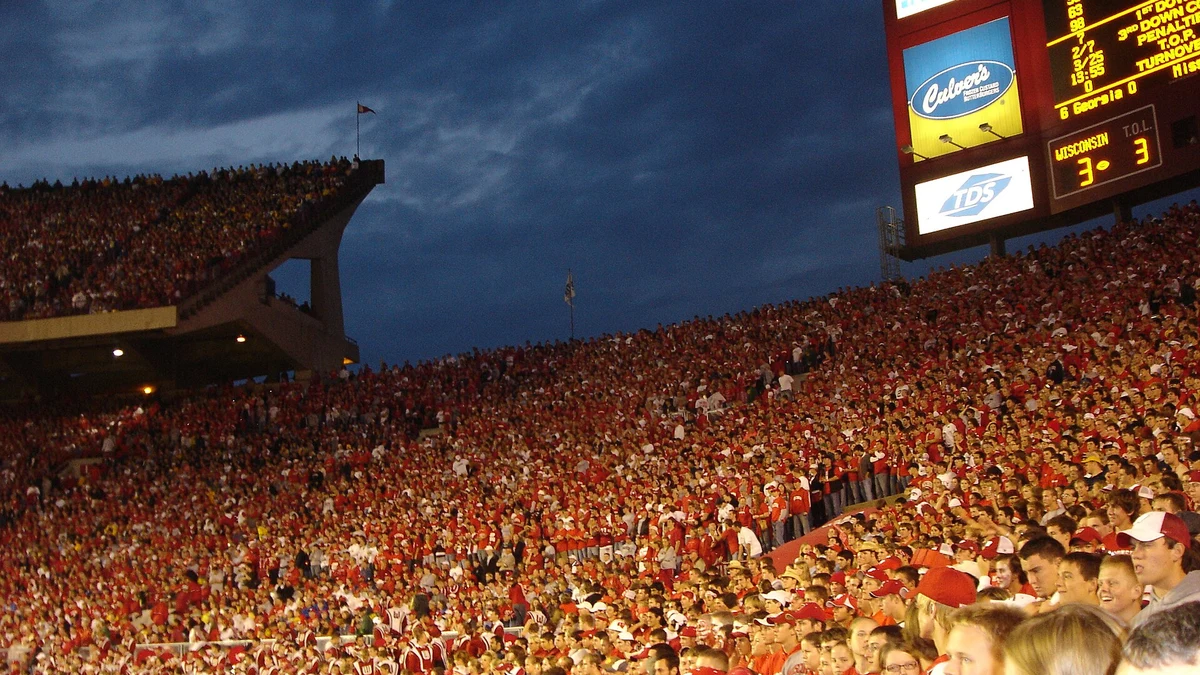
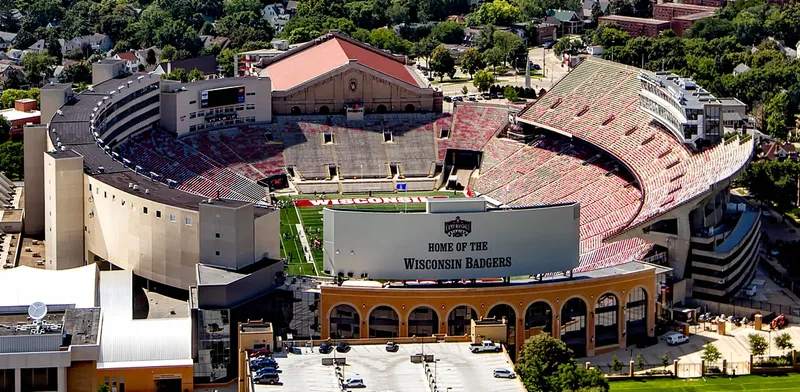
On the University of Wisconsin campus in Madison, the oldest stadium in the Big Ten occupies ground that trained soldiers before it ever hosted a game. Camp Randall seats 76,057, and between the third and fourth quarters some 76,000 of them jump in unison hard enough to register on a seismograph. The Badgers have played here since 1917, on a field that was a Civil War training camp first.
The stadium opened on November 3, 1917, with a 10-7 homecoming victory over Minnesota, designed by architect Arthur Peabody at a cost of just $15,000. It has been expanded repeatedly, from 10,000 seats through additions in 1921, 1951, 1958, 1966, and a major $109.5 million renovation from 2001 to 2005. The $77.6 million CR Future south end zone renovation in 2021-2022 replaced bleacher seating with premium sections, reducing capacity from 80,321 to the current 76,057. A $5.5 million heated-field project completed in 2024 installed 30 miles of underground tubing beneath the FieldTurf surface.
Jump Around defines the experience. Between the 3rd and 4th quarters, House of Pain’s “Jump Around” plays over the PA and the entire stadium jumps, students, alumni, opposing fans, everyone. The seismic readings are real. The tradition began informally in 1993 and was first played over the stadium PA on October 10, 1998, and it has become one of the most famous traditions in college football.
The Civil War origins give the stadium a weight that most college venues lack. Over 70,000 of Wisconsin’s 91,327 troops trained on this ground beginning in May 1861, and the site briefly held Confederate prisoners of war in April 1862. The land was transferred to the university in 1893, and football followed two years later.
Getting to Camp Randall Stadium
Public Transit
Madison doesn’t have rail transit, but bus service and game-day shuttles cover the stadium well.
→ Via Madison Metro Bus: Routes A, C, D, E, F, and O serve the stadium area. Real-time arrivals via the Madison Metro Transit Tracker.
→ Via Bucky Shuttle: Runs from Lot 60 (801 Walnut St), Lot 64 (606 Walnut St), and Lot 76 (2501 University Bay Dr) to Camp Randall. Cost: $10 per person round trip.
The Bucky Shuttle eliminates the parking headache entirely. It runs starting 2.5 hours before kickoff and for 1 hour after the game.
Driving + Parking
The stadium address is 1440 Monroe Street, Madison, WI 53711. I-94 is the primary approach from Milwaukee and Chicago.
→ From Milwaukee (~80 mi): I-94 West to Madison. About 1 hour 25 minutes.
→ From Chicago (~149 mi): I-90/I-39 North to Madison. About 2 hours 30 minutes.
→ From Minneapolis (~270 mi): I-94 East. About 4 hours.
Remote Lots 60 and 76 cost $5 (with $10 Bucky Shuttle). Closer Lots 46 and 67 cost $20. Tailgating is permitted in designated surface lots, charcoal grills are allowed but propane is prohibited. The free Badger Bash tailgate at Union South starts 2.5 hours before kickoff.
Rideshare
Uber and Lyft use the designated zone on N. Charter Street between Regent Street and Dayton Street. From downtown Madison hotels, expect $8–$12. From the airport, about $15–$20. Post-game congestion is heavy, consider walking to State Street for a faster pickup.
From the Airport
→ Dane County Regional Airport (MSN): Just 7 miles from Camp Randall, about 13 minutes by car. The closest airport with regional service. Rideshare runs $15–$20.
→ Milwaukee Mitchell International (MKE): 86 miles east, about 1 hour 35 minutes. A better option for national flights.
Construction & Design
The ground came with a history before the stadium did. In 1861 the state turned the land into Camp Randall, a Union Army training camp where more than 70,000 Wisconsin soldiers mustered, and which briefly held Confederate prisoners in 1862. The university took the site in 1893, football arrived, and in 1917 the architect Arthur Peabody drew up a concrete stadium for about $15,000. Ten thousand seats. Nobody imagined 80,000.
It grew in bursts across the century, in 1921, 1951, 1958, and 1966, each addition bolting more onto the bowl. The big modern rebuild came in 2001 to 2005, a $109.5 million project by Berners-Schober that gutted and rebuilt the stands, added luxury boxes, and lifted capacity to 80,321. Then, in 2021 and 2022, HOK led the $77.6 million CR Future project on the south end, which swapped old bleachers for premium seating and actually trimmed capacity to its current figure.
The field is FieldTurf, not grass, which matters in a state where football runs into December. In 2024 the school buried about 30 miles of tubing under the turf, a $5.5 million heated-field system that can hold the surface near 36 to 38°F to melt snow. A bet on landing College Football Playoff games in Wisconsin winters. The building keeps changing. The one thing that never does is the noise between the third and fourth quarters.
History of Camp Randall Stadium
Camp Randall’s history begins before football. The site was designated as a Union Army training camp in 1861, named after Governor Alexander Randall. Over 70,000 Wisconsin soldiers trained here, and the site briefly held Confederate prisoners. The land was transferred to the university in 1893.
First Game (November 3, 1917): Wisconsin defeated Minnesota 10-7 in the stadium’s homecoming debut. The original concrete structure held 10,000 fans, a modest beginning for a venue that would grow to 80,000+.
The Stampede (October 30, 1993): After a 13-10 victory over Michigan, the Badgers’ first win over the Wolverines since 1981, students in the general-admission section rushed toward the field. A crush against the field-level fence injured 73 people, 6 critically. The tragedy led to major safety changes: the fence was removed, a center aisle was added to the student section, and crowd management policies were overhauled across college football.
Jump Around Tradition (October 10, 1998): The song had been used informally by the swim team since 1993, but the first official PA play came at the Homecoming game against Purdue. It has been played between the 3rd and 4th quarters of every home game since, becoming one of the most famous traditions in college sports.
2005 Expansion: Luxury boxes pushed capacity to 80,321, completing the stadium’s transformation from a 10,000-seat concrete bowl to one of the largest venues in the Big Ten.
Heated Field (2024): A $5.5 million project installed 30 miles of tubing beneath the FieldTurf surface, warming the field to 36-38°F, built for December College Football Playoff games in Wisconsin weather.
The Fifth Quarter: Many fans stay in their seats long after the final whistle for one of college football’s great traditions, the Fifth Quarter, a roughly 20-minute postgame concert by the University of Wisconsin Marching Band. Under longtime director Michael Leckrone the band turned the ritual into an institution: polkas, “Varsity,” and “On, Wisconsin,” with the crowd swaying, hopping, and singing along whether the Badgers won or lost. Paired with Jump Around between the third and fourth quarters, it keeps Camp Randall loud and moving for long stretches when the ball isn’t even in play. Few stadiums ask their fans to stay after the game; here, leaving early means missing part of the show.
From Civil War training ground to Jump Around to 80,000 fans on a Saturday in October, Camp Randall Stadium is where Wisconsin football lives, the oldest stadium site in the Big Ten, where the history runs deeper than the sport itself.
Sources & Further Reading
- Wisconsin Athletics, Camp Randall Stadium: uwbadgers.com. Capacity, gameday, and facility information.
- UW Wisconsin 101, “A History of Camp Randall”: wi101.wisc.edu. The Civil War camp and site history.
- Wikipedia, Camp Randall Stadium: en.wikipedia.org/wiki/Camp_Randall_Stadium. Renovations, capacity, and traditions.
Quick Facts
Everything you need at a glance.
Stadium specs
- Capacity
- 76,057
- Opened
- 1917
- Cost
- $15,000 (1917); $109.5 million (2001-2005); $77.6 million (2021-2022 south end zone)
- Roof
- Open
- Surface
- Artificial Turf (FieldTurf Classic HD)
- Tenants
- Wisconsin Badgers (NCAA Big Ten)
Construction & location
- Architects
- Arthur Peabody (original, 1917), Berners-Schober (2001-2005), HOK (2021-2022 south end zone)
- Address
- 1440 Monroe Street, Madison, WI 53711, USA
- GPS
- 43.0700°N, 89.4126°W
Photo Gallery
Fun Facts
Between the 3rd and 4th quarters, the PA plays 'Jump Around' by House of Pain, the entire student section and much of the 80,000-seat stadium jumps in unison, generating measurable seismic readings. The tradition began informally in 1993 and was first played over the stadium PA on October 10, 1998.
Camp Randall was a Union Army training camp during the Civil War, over 70,000 of Wisconsin's 91,327 troops trained on the site beginning in May 1861, and it briefly served as a Confederate prisoner-of-war camp in April 1862.
In 2024, workers installed 30 miles of 5/8-inch flexible tubing beneath the FieldTurf surface as part of a $5.5 million heated-field project, allowing the field to be warmed to 36-38°F to melt snow and prevent ice, motivated by hopes of hosting College Football Playoff games in December.
Stadium Location
Frequently Asked Questions
- What is the seating capacity of Camp Randall Stadium?
- Camp Randall Stadium holds 76,057 fans after a 2022 south end zone renovation that replaced bleacher seating with premium sections. The peak capacity was 80,321 from 2005 to 2021. Opened in 1917 with 10,000 seats, it has been expanded numerous times, a $109.5 million renovation in 2001-2005 and the $77.6 million CR Future project in 2021-2022.
- Where is Camp Randall Stadium located?
- Camp Randall Stadium is at 1440 Monroe Street in Madison, Wisconsin 53711. It sits on the University of Wisconsin campus, about 1 mile west of the State Capitol and Capitol Square.
- What is Jump Around at Camp Randall Stadium?
- Between the 3rd and 4th quarters, the PA plays 'Jump Around' by House of Pain. The entire student section, and much of the 80,000-seat stadium, jumps in unison, generating measurable seismic readings. The tradition began informally in 1993 and was first played over the stadium PA on October 10, 1998.
- Why is it called Camp Randall?
- The site was a Union Army training camp during the Civil War, named after Wisconsin Governor Alexander Randall. Over 70,000 troops trained here beginning in May 1861. It briefly served as a Confederate prisoner-of-war camp in April 1862. The land was transferred to the University of Wisconsin in 1893.
- Is there parking at Camp Randall Stadium?
- University lots around the stadium range from $5 (remote Lots 60/76 with Bucky Shuttle) to $20 (closer Lots 46/67). The Bucky Shuttle costs $10 round trip per person. Some remote lots are free after 4:30 PM. Tailgating is permitted in designated surface lots with charcoal grills only, propane is prohibited.
- How do I get to Camp Randall Stadium?
- Madison Metro bus routes A, C, D, E, F, and O serve the stadium area. On game days, the Bucky Shuttle runs from Lots 60, 64, and 76 for $10 round trip. Rideshare pickup/drop-off is on N. Charter Street between Regent and Dayton streets. Dane County Regional Airport (MSN) is just 7 miles away.
- How far is the airport from Camp Randall Stadium?
- Dane County Regional Airport (MSN) is 7 miles from Camp Randall, about 13 minutes by car. Milwaukee Mitchell International (MKE) is 86 miles east, about 1 hour 35 minutes. Chicago O'Hare (ORD) is 150 miles southeast, about 2 hours 40 minutes.
- Is Camp Randall the oldest stadium in the Big Ten?
- Yes. Camp Randall Stadium opened in 1917, making it the oldest stadium in the Big Ten and one of the oldest in college football still in use. The site itself is older still: it served as a Union Army training camp during the Civil War, beginning in 1861.
Last updated: 2026-07-10