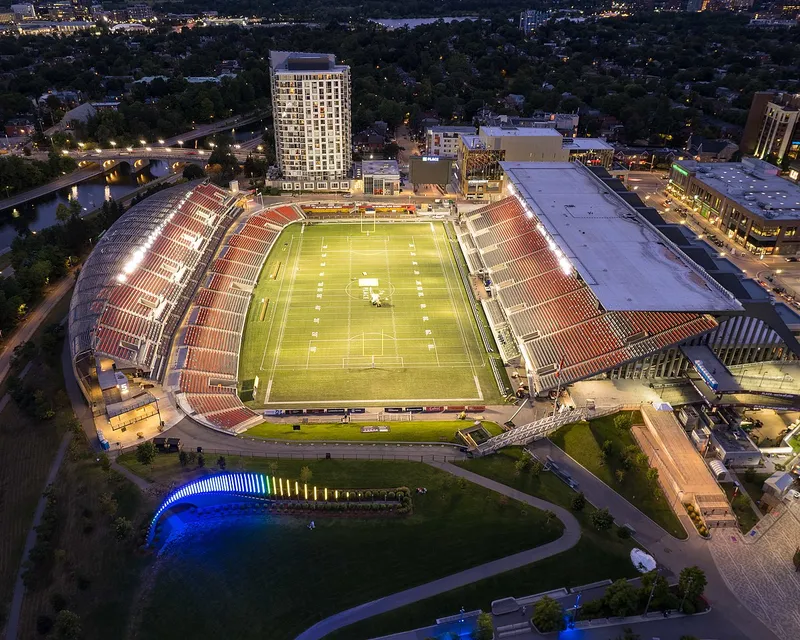
About TD Place Stadium
TD Place is the rare Canadian stadium you reach on foot. Tucked into Lansdowne Park on the edge of the Rideau Canal, a UNESCO World Heritage Site, it anchors Ottawa’s Glebe rather than hiding behind a suburban parking moat. With 24,000 permanent seats and the ability to expand beyond 36,000 for marquee events, it punches well above its weight in one of Canada’s most walkable urban settings.
The Ottawa Redblacks of the CFL and Atlético Ottawa of the Canadian Premier League share the venue, and the University of Ottawa Gee-Gees play their varsity football here too. On game days, the surrounding Lansdowne development, with shops, restaurants, and a Cineplex cinema, turns the area into a destination rather than just a stadium trip. The Rideau Canal runs parallel to the south stand, and in summer you can canoe past the stadium before kickoff.
TD Place has already hosted events that far exceed its nominal capacity. The 105th Grey Cup in 2017 drew nearly 36,000 fans in a snowstorm at -3°C. The 2015 FIFA Women’s World Cup brought 9 matches to Ottawa, including a quarterfinal. And the NHL 100 Classic in December 2017 saw the Senators blank the Canadiens 3-0 before 33,959 fans in an outdoor hockey game celebrating the league’s centennial.
Construction & Design
The 2014 rebuild had one job: make an old football ground feel new without pretending the history away. The stadium was the centerpiece of a $290.8 million redevelopment of Lansdowne Park, designed by CannonDesign, that reopened the site as a mixed-use district of shops, restaurants, a cinema, and housing wrapped around the field. The broader project, with its private retail and residential pieces, ran higher still. The City of Ottawa owns the complex, and the Ottawa Sports and Entertainment Group (OSEG) operates it.
The signature is the south stand’s cedar veil. Twelve kilometres of glue-laminated Alaskan Yellow Cedar, 750,000 individual parts, are compressed into a sculptural wall 154 metres wide and 25.5 metres high. It won a WoodWORKS! Wood Design Award and gives the stadium a look unlike anything else in Canadian football. Beautiful, and structurally show-off, in the best way.
The fixed bowl seats 24,000, expandable past 36,000 for a Grey Cup. The playing surface has been FieldTurf since 2001, and the current FieldTurf CORE was laid in 2020. The ground is not done changing, either. In November 2025, Ottawa City Council approved “Lansdowne 2.0,” a plan to demolish and rebuild the aging north-side stands after the 2027 CFL season, the next chapter for a site that has hosted sport since the 1870s.
Getting to TD Place Stadium
Public Transit
Your event ticket includes free OC Transpo and STO (Gatineau) transit, starting 3 hours before the event, during, and 3 hours after on all routes.
→ From downtown Ottawa: OC Transpo Routes 6 and 7 stop directly at Lansdowne, a 3-minute walk from the gates.
→ Via O-Train: Take the Confederation Line to uOttawa Station, then walk south about 7 minutes along the canal to Lansdowne Park.
Special direct shuttle routes run for Redblacks game days from across Ottawa and Gatineau, starting 2 hours before kickoff.
Driving + Parking
GPS address: 1015 Bank Street, Ottawa, ON K1S 3W7.
→ From Montreal (200 km): Autoroute 40 West to Highway 417 (The Queensway) into Ottawa. Exit at Bank Street south to Lansdowne. About 2 hours.
→ From Toronto (450 km): Highway 401 East to Highway 416 North, connecting to Highway 417 East into Ottawa. Exit at Bank Street. About 4.5-5 hours.
→ From Kingston (193 km): Highway 401 East to Highway 416 North to 417 East into Ottawa. About 1 hour 45 minutes.
The underground garage beneath Lansdowne holds 1,000+ vehicles, and club seat holders get priority access. Rate: about $0.60/hour (up to 5 hours). Carleton University lots (P5, P18) are about $10 after 5 PM. Street parking in The Glebe fills fast on event days.
Rideshare
Uber and taxis drop off at the corner of Exhibition Way and Paul Askin Way (near the Scholar’s entrance) for stadium events. From downtown Ottawa hotels, the ride is $8-15 CAD; from the airport about $20-30 CAD. Different drop-off points apply for Atlético Ottawa matches (Gate 4) versus Redblacks games.
From the Airport
→ Ottawa Macdonald-Cartier International Airport (YOW): 15 km south, about 20 minutes by car or Uber ($20-30 CAD). OC Transpo Route 97 also connects to downtown (~39 minutes, $3.25 CAD).
History of TD Place Stadium
This patch of ground has hosted organized sport since the 1870s, when the Lansdowne Park exposition grounds were used for lacrosse, rugby football, and equestrian events. The first permanent grandstand went up in 1908, and the Ottawa Rough Riders, one of Canada’s founding football franchises, played here from 1876 until folding in 1996.
The stadium carried several names through the decades. It was renamed Frank Clair Stadium in 1993 to honor the Rough Riders’ Hall of Fame coach, who won four Grey Cups. Ottawa hosted Grey Cup games here as early as 1925, seven in total, the most of any city outside Toronto. But by the 2000s, the aging venue and Ottawa’s turbulent CFL history (the Renegades folded in 2005) left the site in limbo.
Key moments in the stadium’s history:
- 1908: First permanent grandstand built on the north side of the field.
- 1993: Renamed Frank Clair Stadium.
- November 2011: South grandstand demolished to begin the $290.8 million Lansdowne redevelopment.
- January 7, 2014: Renamed TD Place under a 10-year naming-rights deal with Toronto-Dominion Bank.
- July 18, 2014: Ottawa Redblacks play their inaugural home game, and CFL football returns after an 8-year absence.
- June-July 2015: Hosts 9 FIFA Women’s World Cup matches, including a quarterfinal (renamed “Lansdowne Stadium” per FIFA policy).
- November 26, 2017 (105th Grey Cup): Toronto Argonauts defeat Calgary 27-24 before nearly 36,000 fans in heavy snowfall at -3°C, as part of Canada 150 celebrations.
- December 16, 2017 (NHL 100 Classic): Senators shut out the Canadiens 3-0 before 33,959 fans in an outdoor game marking the NHL’s centennial.
- November 2025: Ottawa City Council approves “Lansdowne 2.0,” a plan to rebuild the north-side stands after the 2027 CFL season.
For all its modern polish, the ground’s Grey Cup pedigree runs deep. The 92nd Grey Cup in 2004 drew a stadium-record 51,242 fans, the largest crowd the site has ever held. The venue has broadened beyond football, too: Atlético Ottawa joined the Canadian Premier League in 2020 and made TD Place a soccer ground as well, drawing strong Glebe crowds and turning summer evenings by the canal into match nights. Between the Redblacks, the soccer club, and the university team, the field rarely sits idle from spring through the first snow. That density of use is the point. Lansdowne was rebuilt not as an isolated bowl on a ring road but as a downtown block you can walk to, eat at, and stay near, a model other Canadian cities have studied since.
The cedar veil is more than decoration. It is the physical symbol of Ottawa’s renewed commitment to professional sport. After losing two CFL franchises in nine years, the Lansdowne rebuild was the city’s statement that it would not happen again. The Redblacks won the Grey Cup in 2016, just two years after their first game. This corner of Bank Street, next to the canal, is now one of the most active game-day neighborhoods in Canada.
Sources & Further Reading
- TD Place: tdplace.ca. Official venue: events, seating, and visitor information.
- Ottawa Redblacks: ottawaredblacks.com. Primary CFL tenant: game-day and ticket details.
- Canadian Football League: cfl.ca. Grey Cup history and records.
- TD Place Stadium on Wikipedia: en.wikipedia.org. Redevelopment, capacity, and event history.
Quick Facts
Everything you need at a glance.
Stadium specs
- Capacity
- 24,000
- Opened
- 1908
- Cost
- $290.8 million Lansdowne Park redevelopment (2014) (~$375 million (2025 dollars) today)
- Roof
- Open
- Surface
- FieldTurf CORE (Synthetic)
- Tenants
- Ottawa Redblacks (CFL), Atletico Ottawa (CPL)
Construction & location
- Groundbreaking
- November 2011 (redevelopment)
- Architects
- CannonDesign
- Address
- 1015 Bank Street, Ottawa, ON K1S 3W7, Canada
- GPS
- 45.3982°N, 75.6835°W
Photo Gallery
Fun Facts
The signature cedar veil wrapping TD Place's south stand contains over 750,000 individual parts and stretches 12 kilometres of glue-laminated Alaskan Yellow Cedar timber, all compressed into a structure 154 m wide and 25.5 m high.
TD Place's playing field has been in continuous use for over 150 years, dating to the 1870s, making it one of the longest-continuously-operated sports grounds in North America.
For the 2017 Grey Cup, the stadium expanded from 24,000 to nearly 36,000 seats, and the game was played in a snowstorm at -3°C, watched by 4.3 million television viewers.
Stadium Location
Frequently Asked Questions
- Where is TD Place Stadium located?
- At 1015 Bank Street in Ottawa, at Lansdowne Park on the southern edge of The Glebe neighborhood, right beside the Rideau Canal.
- What is the capacity of TD Place Stadium?
- The fixed capacity is 24,000 seats. For major events like Grey Cups and outdoor NHL games, the stadium can expand to approximately 36,000 with temporary seating.
- How do I get to TD Place by transit?
- Your event ticket includes free OC Transpo and STO (Gatineau) transit starting 3 hours before the event. Routes 6 and 7 stop at Lansdowne (3-minute walk). The uOttawa O-Train station is a 7-minute walk.
- Is there parking at TD Place?
- Yes. An underground garage beneath Lansdowne Park holds 1,000+ vehicles (club seat holders get priority). Street parking in The Glebe fills quickly. Nearby lots at Carleton University run about $10 after 5 PM.
- What teams play at TD Place?
- The Ottawa Redblacks (CFL) and Atletico Ottawa (Canadian Premier League soccer), plus the University of Ottawa Gee-Gees varsity football team. The adjacent TD Place Arena hosts the Ottawa 67's (OHL hockey) and Ottawa BlackJacks (CEBL basketball).
- When was TD Place Stadium built?
- The first permanent grandstand was built in 1908. The stadium was completely rebuilt as the centerpiece of a $290.8 million Lansdowne Park redevelopment, reopening as TD Place on July 18, 2014.
- Has TD Place hosted international events?
- Yes. It hosted 9 matches during the 2015 FIFA Women's World Cup (where FIFA renamed it 'Lansdowne Stadium'), including a quarterfinal, and the NHL 100 Classic outdoor hockey game in December 2017.
- What is the surface at TD Place?
- FieldTurf CORE, installed in 2020. The field has been a FieldTurf artificial surface since 2001, updated to the current CORE generation as part of the venue's ongoing upgrades.
Last updated: 2026-07-10