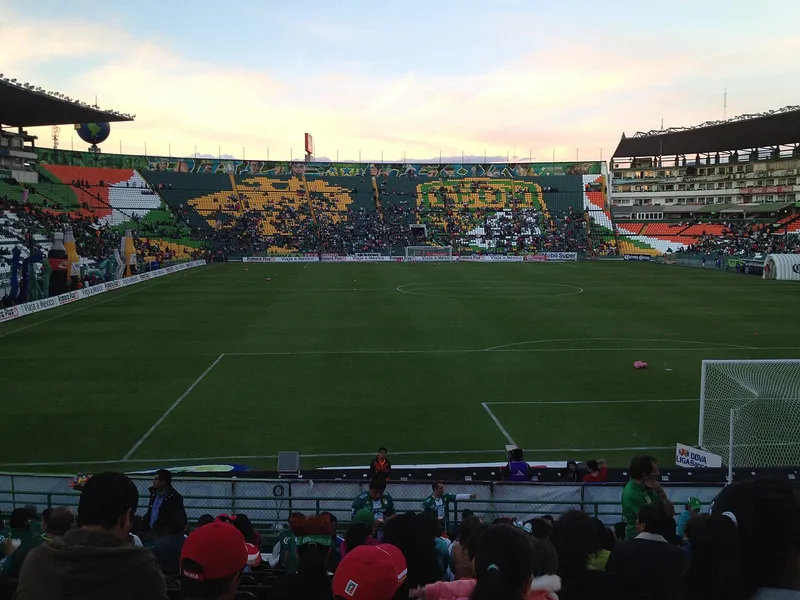
About Estadio León
On March 1, 1967, two foreign clubs, Santos of Brazil and River Plate of Argentina, walked out to open a new ground in León, and Santos won 2-1. Three years later the same field staged a World Cup quarterfinal that ended England’s reign as champions. Not a bad opening act for a stadium in Mexico’s shoe-making capital.
Estadio León, known to almost everyone as the “Nou Camp,” has been home to Club León since it opened. The nickname is borrowed, cheerfully, from FC Barcelona’s Camp Nou (Catalan for “new ground”), adopted by León supporters in the 1960s when the club’s ambitions ran high. It stuck. Nearly sixty years later, the name on the gate reads Estadio León, but the fans still call it the Nou Camp.
The headline number is a moving target. Wikipedia and most listings put capacity around 31,300; some Liga MX configurations and travel guides report closer to 27,400, and a renovation running through 2024 and 2025 keeps reshaping the bowl. In its early-1990s prime the ground squeezed in roughly 35,000. What is not in dispute: this is a mid-sized, steep, loud football stadium, and on a Fiera match night it feels smaller than its seat count because every row is full.
Then there is the World Cup pedigree. Eleven World Cup matches across two tournaments, 1970 and 1986, which puts León among Mexico’s most tournament-tested venues. The 1970 run included the quarterfinal on June 14, when West Germany came back from 2-0 down to beat defending champion England 3-2 in extra time, one of the most replayed comebacks the tournament has produced.
León is Mexico’s leather capital, a manufacturing city of roughly 1.7 million in the Bajío, the industrial belt of central Mexico. The stadium sits in a dense neighborhood off Boulevard Adolfo López Mateos, close enough to the shoe workshops that the two trades, leather and football, can feel like the same civic project. Club León is “La Fiera,” the Beast. Its supporters are among Liga MX’s most devoted, and they filled the place for the biggest night in club history in 2023.
Getting to Estadio León
Public Transit
León runs a Bus Rapid Transit system (SIT) but has no metro. The stadium is reachable by city bus routes along the main boulevards.
→ Via SIT Bus: Several routes pass near the stadium on Boulevard Adolfo López Mateos and surrounding streets. Ask for “Estadio León” or “Nou Camp.”
→ Via Intercity Bus: First-class buses from Mexico City (Terminal Norte) and Guadalajara reach León’s Central de Autobuses in 4-5 hours and 3 hours respectively. From the terminal, a rideshare to the stadium takes about 15 minutes.
Rideshare is the most practical option for visitors. Uber and DiDi both operate in León.
Driving + Parking
The stadium is in central León, reachable via the city’s main boulevards.
→ From Mexico City (~380 km): Highway 45D north through Querétaro and Irapuato. About 4 hours.
→ From Guadalajara (~170 km): Highway 45D east through Lagos de Moreno. About 2 hours 30 minutes.
→ From Guanajuato City (~56 km): Highway 45D west. About 45 minutes.
Street parking is available in the surrounding neighborhoods, but spaces fill quickly on match days. Several private lots operate near the stadium for 50-100 MXN ($3-$5 USD). Arrive early to secure a spot.
Rideshare
Uber and DiDi are widely available in León. From downtown (Centro Histórico), expect 60-100 MXN ($3-$5 USD) and about 15 minutes. From the bus terminal, 80-120 MXN. Post-match, walk a few blocks from the stadium before requesting your ride to avoid the crush.
From the Airport
→ Guanajuato International Airport (BJX): About 30 km (19 miles) west in Silao, roughly 25 minutes by car. Serves domestic flights plus connections to Dallas, Houston, Los Angeles, and Chicago. Rideshare runs 200-300 MXN ($10-$15 USD).
→ Mexico City International (MEX): About 400 km (249 miles) southeast, roughly 4 hours by car. Better served by domestic flights to BJX.
Construction & Design
Ground was broken in August 1965, and the stadium was substantially finished by late 1966, roughly seventeen months of work. The build is credited to the firm Constructora ARVA S.A. de C.V., though the design record from that era is thin, and no individual architect is consistently named. The reported cost was about 12.5 million in 1960s money (the sources give the figure with a dollar sign but do not specify pesos or dollars, so read it as an order of magnitude rather than an audited total). A single, uncomplicated concrete bowl. That was the brief, and León got it built fast.
Timing was everything. Mexico had been handed the 1968 Olympics and the 1970 World Cup, and León wanted in. The stadium opened on March 1, 1967, in time to host football at the 1968 Summer Olympics, then a full slate of 1970 World Cup fixtures. For those tournaments the ground held about 23,600, a number that grew over the following decades as the bowl was extended and reseated toward its early-1990s peak of roughly 35,000.
Ownership is where the modern story gets complicated. For most of its life the stadium was privately held, and a drawn-out legal dispute over that ownership boiled over in October 2020, when Club León was briefly locked out and had to play a match at Aguascalientes’ Estadio Victoria before returning. To settle it, Grupo Pachuca, the multi-club group that also runs C.F. Pachuca, bought the Nou Camp outright in July 2021 for a reported 410 million pesos. Club and home finally sat under one owner.
What comes next has been rewritten more than once. In June 2018 Grupo Pachuca announced an entirely new stadium, a 35,000-seat project pitched at a reported US$326 million, with HKS as architect and Manhattan Construction as builder, on land the Guanajuato state government bought for 280 million pesos. The pandemic, the ownership fight, and money all got in the way. In September 2023 the club scrapped the new build, returned the land to the state, and pivoted to a deep renovation of the existing ground instead. That work, announced in July 2024 around Club León’s 80th anniversary, has added Musco LED lighting rated at about 1,500 lux, a video screen roughly double the old one, and a rebuilt sound system, with expanded concourses, remodeled locker rooms, near-total roof coverage, and a new south-stand structure planned. All of it while the team keeps playing. The renovation, not the demolition, is the plan now.
History of Estadio León
The Nou Camp announced itself on the world stage almost immediately. Within eighteen months of opening it was staging Olympic football; within three years, World Cup football. For a stadium in a mid-sized industrial city, that is a fast climb.
1968 Summer Olympics (October 1968): León hosted matches in the Mexico City Olympic football tournament, its first taste of international competition, with the bowl seating roughly 23,600 at the time.
1970 FIFA World Cup: León hosted seven matches, all six of Group 4’s round-robin games plus the quarterfinal. That quarterfinal, on June 14, is the one people remember: England 2, West Germany 0, and then West Germany 3, England 2 after extra time, in front of about 23,357. Franz Beckenbauer, Uwe Seeler, and Gerd Müller turned it around, and the defending champions went home.
1983 FIFA World Youth Championship: The stadium staged matches at the youth World Cup, keeping León on the tournament map between the two senior editions.
1986 FIFA World Cup: With Mexico stepping in as host on short notice, León drew four matches, three Group C games (France, the Soviet Union, Hungary, and Canada all passed through) and one Round of 16 tie. That knockout match on June 15 was a classic: Belgium beat the Soviet Union 4-3 after extra time, watched by about 32,277, with Igor Belanov scoring a hat-trick in a losing cause. Across 1970 and 1986, that is eleven World Cup matches at one ground.
2023 CONCACAF Champions League: The biggest night in club history. León beat LAFC to win the CONCACAF Champions League, its first continental crown. The first leg at the Nou Camp finished 2-1 on May 31, and León then won 1-0 at BMO Stadium in Los Angeles on June 4, taking the tie 3-1 on aggregate. No away-goals math needed. León simply won both legs.
Grupo Pachuca era (2021 onward): The July 2021 stadium purchase folded the Nou Camp into one of Mexican football’s most powerful ownership groups, alongside C.F. Pachuca. It also set up the on-again, off-again saga of a new stadium that ended, for now, with a promise to modernize the old one instead.
From a 1970 quarterfinal that dethroned England to a 2023 continental title, the Nou Camp has packed a lot of history into a compact concrete bowl. La Fiera plays on, in the ground León has always simply called home.
Sources & Further Reading
- Estadio León overview and match record: en.wikipedia.org. Construction dates, capacity figures, and the full World Cup and Olympic history.
- 2023 CONCACAF Champions League title: concacaf.com. Match report confirming León’s first continental crown and the aggregate scoreline.
- New-stadium project and public funding: espndeportes.espn.com. Reporting on the cancelled Nuevo Estadio León and the state money involved.
- Stadium land returned to the state (2023): am.com.mx. Local reporting on the cancellation and the return of the land to Guanajuato.
Quick Facts
Everything you need at a glance.
Stadium specs
- Capacity
- 31,297
- Opened
- 1967
- Cost
- About 12.5 million (1960s; sources do not specify pesos or dollars)
- Roof
- Open
- Surface
- Natural Grass
- Tenants
- Club León (Liga MX)
Location
- Address
- Boulevard Adolfo López Mateos, Colonia La Martinica, 37500 León, Guanajuato, Mexico
- GPS
- 21.1156°N, 101.6578°W
Photo Gallery
Fun Facts
Estadio León hosted 11 FIFA World Cup matches across two tournaments, 7 in 1970 and 4 in 1986, including the 1970 quarterfinal where West Germany came back from 2-0 down to beat England 3-2 in extra time, ending the defending champions' reign.
The stadium is known to almost everyone as the 'Nou Camp,' a nickname borrowed from FC Barcelona's Camp Nou (Catalan for 'new ground') and adopted by León fans in the 1960s when the club's ambitions matched the name.
Club León won the 2023 CONCACAF Champions League, the club's first continental title, beating LAFC 3-1 on aggregate after winning both legs, which made Estadio León the home of Central and North America's champions.
Stadium Location
Frequently Asked Questions
- What is the seating capacity of Estadio León?
- It depends on who you ask, and the number is currently moving. Wikipedia and most listings put the capacity around 31,300 (31,297). Some Liga MX configurations and travel guides report closer to 27,400, and in its early-1990s prime the ground held roughly 35,000. A renovation running through 2024 and 2025 is reshaping the seating bowl, so the exact figure is in flux.
- Where is Estadio León located?
- The stadium is on Boulevard Adolfo López Mateos in the La Martinica neighborhood of León, Guanajuato, in central Mexico. That is roughly 380 km (236 miles) northwest of Mexico City and about 170 km east of Guadalajara, in the industrial Bajío region.
- Was Estadio León a World Cup venue?
- Yes, twice. It hosted 7 matches at the 1970 FIFA World Cup, all six Group 4 games plus the quarterfinal in which West Germany beat England 3-2 in extra time. It hosted 4 more at the 1986 FIFA World Cup, three Group C games and a Round of 16 tie. That is 11 World Cup matches in all. The stadium also staged football at the 1968 Summer Olympics.
- Why is Estadio León called Nou Camp?
- León fans adopted the nickname in the 1960s, borrowing it from FC Barcelona's Camp Nou, whose name is Catalan for 'new ground.' It reflected the ambitious identity the club cultivated in that era, and it stuck. Nearly sixty years on, the gate reads Estadio León but the crowd still says Nou Camp.
- Did Club León win a trophy at this stadium?
- The biggest one in club history. In 2023, León won the CONCACAF Champions League, its first continental title, beating LAFC 3-1 on aggregate. The first leg at the Nou Camp finished 2-1 on May 31, and León won the second leg 1-0 in Los Angeles on June 4. No away-goals math was needed, since León won both legs outright.
- Who owns Estadio León?
- Grupo Pachuca, the multi-club group that also runs C.F. Pachuca, owns the stadium. It bought the Nou Camp in July 2021 for a reported 410 million pesos, a purchase that settled a long-running ownership dispute and folded the ground and the club under one owner.
- Is Club León building a new stadium?
- Not anymore. Grupo Pachuca announced a 35,000-seat Nuevo Estadio León in 2018, but the pandemic, the ownership fight, and funding trouble stalled it. In September 2023 the club scrapped the project, returned the land to the Guanajuato state government, and chose to renovate the existing Nou Camp instead.
- Is the stadium being renovated?
- Yes. A modernization program announced in July 2024, timed to Club León's 80th anniversary, has added Musco LED lighting rated at about 1,500 lux, a video screen roughly double the size of the old one, and a rebuilt sound system. Wider concourses, remodeled locker rooms, near-total roof coverage, and a new south stand are planned, with the work done in stages so the team keeps playing.
- When did Estadio León open and who played first?
- The stadium opened on March 1, 1967, and the inaugural match was not a Mexican fixture at all. Santos of Brazil beat River Plate of Argentina 2-1. Construction had started in August 1965 and finished in late 1966, roughly seventeen months of work.
- How do I get to Estadio León from Guadalajara?
- Drive east via Highway 45D, about 170 km and 2 hours 30 minutes. First-class buses from Guadalajara's Central Camionera reach León's bus terminal in about 3 hours. From the terminal, a taxi or rideshare to the stadium takes around 15 minutes.
- How far is Estadio León from the airport?
- Guanajuato International Airport (BJX) in Silao sits about 30 km (19 miles) from the stadium, roughly 25 minutes by car. It handles domestic flights plus connections to cities such as Dallas, Houston, Los Angeles, and Chicago.
Last updated: 2026-07-10