About Imam Mohammed Ibn Saud University Stadium
On January 3, 2024, a Riyadh university signed its sports facilities over to the Ministry of Sport for ten years. Three years later the football ground at the center of that agreement hosts a knockout tie at the Asian Cup. That is the whole story of this place in two sentences, and it is a strange one.
The stadium sits inside the campus of Imam Mohammad Ibn Saud Islamic University, in the northern reaches of Riyadh, about 17 kilometres (10.5 miles) south of King Khalid International Airport. (The university transliterates the name Mohammad; the AFC’s tournament documents spell the stadium Mohammed. Both are in circulation, and both refer to the same place.) Before the works it held 8,500 people, with seating on one side and a running track wrapped around the pitch. A campus ground. The Ministry is taking it to more than 22,000, with stands on all four sides, and the Asian Football Confederation’s own tournament documentation lists it at 25,000 for January 2027.
The gap between 22,000 and 25,000 has never been reconciled in public. The builder quotes one number and the competition organizer quotes another, and both are current. Earlier reporting used 20,000 and 21,000, so anyone reading around this stadium will find four figures and no explanation. We use the AFC’s, because the AFC’s is the one that will be printed on the ticket.
Ownership stays with the university. Operation passed to the Ministry under the 2024 agreement, which covers the whole sports estate on the campus and runs for a decade. No resident club. Asharq Al-Awsat has reported the intended future uses as Saudi Pro League matches, lower-division football, age-group games, and a training base for national teams at the 2034 World Cup. None of that amounts to a tenant.
What makes it worth a visitor’s attention is the location. SABIC station on the Riyadh Metro is about 600 metres (0.4 miles) from the ground, and the same line runs uninterrupted to the airport terminals. Only Al-Shabab Stadium is in the same range among the city’s five Asian Cup venues; Kingdom Arena, King Saud University Stadium and King Fahd Sports City all sit roughly four to five kilometres (2.5 to 3 miles) from their nearest station. For a tournament spread across five grounds in a city built around the car, that is a real and measurable advantage, and it is the reason this unglamorous campus ground is probably the easiest of the five to attend. Every ground is mapped in our AFC Asian Cup 2027 guide.
Getting to Imam Mohammed Ibn Saud University Stadium
Public Transit
Riyadh opened its metro in phases, the first lines on December 1, 2024 and the last of the six by the following January, after more than a decade of construction. This ground is one of the few sporting venues in the city that actually benefited.
→ The nearest station: SABIC, about 600 metres (0.4 miles) from the ground. Line 4 (Yellow) and Line 6 (Purple) share the same trunk through here, so two lines serve one platform.
→ The backup: Uthman Bin Affan Road, one stop south, roughly 930 metres (0.6 miles) away and also on both lines. Worth knowing about before you need it.
→ The fare: A flat SAR 4 (about $1) buys two hours across metro and bus together, transfers included. First class is SAR 10. Passes run SAR 20 for three days, SAR 40 for seven, SAR 140 for thirty. Buy through the Darb app.
→ The hours: 05:30 to midnight Saturday through Thursday, 10:00 to midnight on Friday.
Eight to ten minutes on foot, and almost all of it inside the campus. It is worth stressing how unusual this is in Riyadh, where the standard advice for a football match is to drive and to leave early. Here the standard advice is to take the train.
Driving + Parking
The campus fronts Prince Mohammed bin Salman bin Abdulaziz Road in north Riyadh, and the stadium sits well inside the perimeter rather than on a public street.
→ From central Riyadh: North on King Fahd Road or Uthman Bin Affan Road, then into the university grounds. Twenty-five to forty minutes depending on the hour.
→ From the airport: South on Airport Road, about 17 kilometres (10.5 miles), twenty minutes when the road is clear.
Here is the honest position on parking: no matchday plan has been published. The campus has surface parking, because every Saudi university campus does, but a university campus is a gated site with its own rules, and the gate policy for a night when 25,000 people want in remains unpublished. Until the Ministry or the local organizing committee puts something out, treat driving as the uncertain option and the metro as the certain one. That is the reverse of the usual advice in this city.
Rideshare
Uber and Careem cover Riyadh, and either will reach the campus. Getting a car is the easy half. Telling the driver where to stop is the hard half, because a 25,000-seat event inside a university means the drop-off point will sit somewhere other than the pin your app defaults to.
Pro tip: Set your destination to SABIC station rather than the stadium. It is a fixed, named, unambiguous place that every driver in the city knows, it is a short walk from the ground, and it will not be sealed off by event stewarding.
From the Airport
→ King Khalid International (RUH): 17 kilometres (10.5 miles), twenty minutes by car. By metro, Line 4 runs from the terminal stations straight to SABIC with no change at all. The line is 29.6 kilometres (18.4 miles) end to end and has nine stations, so the ride is short by the standards of an airport transfer.
The airport has three metro stations on Line 4: one at Terminal 5, one shared by Terminals 3 and 4, and one shared by Terminals 1 and 2. That is the detail worth carrying with you, because it turns an airport transfer into a SAR 4 ticket.
Watching a Match at Imam Mohammed Ibn Saud University Stadium
Start with the limits of this section. Nobody has watched a competitive senior international at this ground, because it has never staged one and, as of September 2026, remains a building site. There is no matchday culture here to describe, no signature concession, no stand with a reputation. Anyone who tells you otherwise is inventing it.
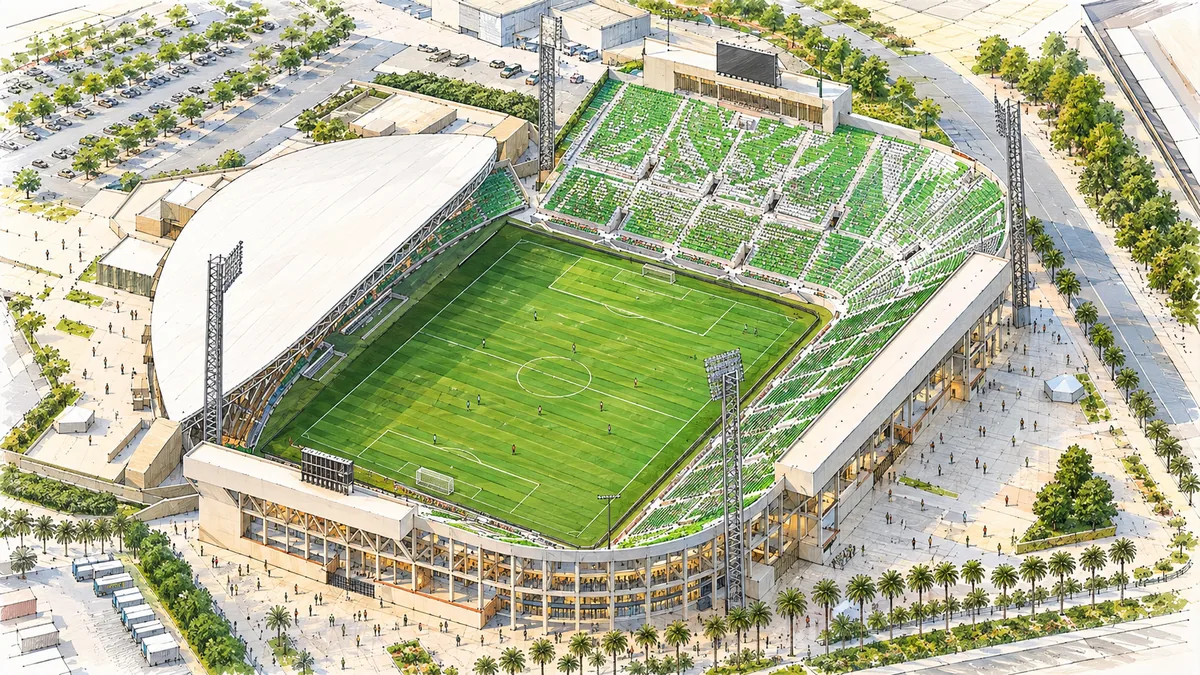
What can be described is the building people will walk into, because the Ministry has published its specification in some detail.
The seats are white and beige, arranged so the two colors run in undulating lines around the bowl rather than in the blocks most grounds use. Saudi outlets reporting from the site in May 2026 described the pattern as the stadium’s main visual signature, which tells you something about how plain the rest of it is. This is a functional bowl on a university campus, and the seat pattern is doing the aesthetic work on its own.
The hospitality is where the money went. Nine sky boxes hold 135 people between them, fifteen seats each, and two VIP lounges take 400 and 200. Set that against a total of roughly 22,000 to 25,000 and the premium proportion is small, which is normal for a ground built to satisfy a confederation’s minimum rather than to sell corporate packages.
The press facilities are disproportionate, and deliberately so. A media center for 500 people. A broadcast compound outside the stadium covering 3,500 square metres (37,700 square feet), about a third of a hectare of trucks and cabling for a ground that used to seat 8,500. Floodlighting at 2,500 lux, the level the AFC specifies so cameras can shoot at high frame rates. Everything in that list exists because of six matches in January 2027, not because of anything the stadium will do in February.
For a visitor, the practical read is this. Arrive by train, because you can. Expect a compact bowl with stands close to the pitch, since the running track that used to separate the two is gone. Expect a January evening in Riyadh, where the daily high averages 20.1 Celsius (68 Fahrenheit) and the overnight low averages 7.2 Celsius (45 Fahrenheit), so bring a layer. And expect a crowd that is new to the building, because everyone will be.
The 2027 Asian Cup at Imam Mohammed Ibn Saud University Stadium
Six matches, in a tournament running from January 7 to February 5, 2027 across Riyadh, Jeddah and Al Khobar. The AFC’s published match schedule gives this venue five group-stage games, on January 8, 11, 14, 17 and 20, followed by a Round of 16 tie on January 23 between the winner of Group D and a third-placed side from Group B, E or F. The group pairings were set by the final draw, held on May 9, 2026 at the At-Turaif world heritage site in Diriyah.
Six is the middle of the pack. King Fahd Sports City takes eight, including the opening match and the final, and King Abdullah Sports City in Jeddah takes eight as well. Aramco Stadium in Al Khobar takes seven. This ground is level with King Saud University Stadium and Kingdom Arena on six, ahead of Al-Shabab Stadium and Prince Abdullah Al-Faisal on five.
The interesting part is the Round of 16 draw position. Winning Group D routes a team here, to the smallest-but-one Riyadh venue, rather than to King Fahd. A group winner’s reward is a 25,000-seat campus ground with a metro station at the end of the path. There are worse deals.
Construction & Design
The first job was subtraction. Out came the running track, which had been holding the stands a long way back from the touchline and which had made the old ground an athletics facility with a football pitch inside it rather than a football ground. Then the single stand on the main side stopped being the only stand. The rebuild puts seating on all four sides, the change that takes the capacity from 8,500 to more than 22,000 and the reason a project of this size was needed at all. You cannot get to 22,000 by adding rows. You get there by building three new stands.
Nobody has put a name to the design. No architect of record, no structural engineer, no main contractor appears in the Ministry of Sport’s announcements, in the Saudi press coverage, or in the Arabic Wikipedia entry, and no budget has ever been published either. A design credit and a contractor name both circulate on Saudi enthusiast accounts. Neither is confirmed by a source we would stand behind, so neither gets a credit. That is unsatisfying, and it is also the accurate position.
The specification, by contrast, is unusually well documented, because the Ministry published it. Lighting renewed to 2,500 lux, the AFC’s broadcast standard. Behind that sits the media provision: press conference halls, a media center seating 500, and an outside broadcast compound of 3,500 square metres (37,700 square feet) parked beyond the bowl. Hospitality takes nine sky boxes carrying 135 seats between them and two VIP lounges at 400 and 200. New dressing rooms for players and match officials. What the people in the seats get is shorter: two large screens, and seating in white and beige laid out in undulating lines.
Read that list twice and the balance stands out. Broadcast and hospitality take most of the line items; the people in the seats take the least of it. That is what happens when a confederation hands a country eight venues and a deadline. The Ministry is building a place where football can be televised to AFC specification, and the watching experience comes along for the ride.
The timeline has moved. The agreement between the Ministry and the university was signed on January 3, 2024, allocating the university’s sports facilities to the Ministry for ten years and committing the Ministry to develop them. Work followed later that year. In November 2025 the Ministry’s announcement set full readiness for November 2026. In January 2026 the Saudi Press Agency reported more than 75 percent of the concrete structure complete, with the training pitches being prepared. By late May 2026, Saudi outlets reporting from the site said installation of the seats in the stands had begun, and put full fit-out at July 2026. That target came and went: the Minister of Sport was still touring preparations at the ground on August 10, 2026. The Arabic Wikipedia entry simply says the fourth quarter of 2026. Four sources, three dates, one tournament kicking off on January 7, 2027.
History of Imam Mohammed Ibn Saud University Stadium
Imam Mohammad Ibn Saud Islamic University began in 1950 as an Islamic seminary founded by Muhammad ibn Ibrahim ash-Sheikh, became the College of Sharia in 1953, and was reconstituted as a full university in 1974. The foundation stone of the current campus was laid on January 5, 1982. The campus opened in 1990. It now carries more than 60,000 students and around 4,000 faculty, along with fourteen colleges and a sports estate that includes the football ground, an athletics hall, an indoor sports hall, an Olympic-specification swimming pool and a fitness center.
For most of its life the football ground did what campus grounds do. Student football, faculty sport, the occasional friendly, 8,500 seats on one side and no attention from anywhere outside Riyadh. No source we could find records the year it opened, which is itself a fair measure of how little it mattered.
Notable events:
- February 1, 2023. The AFC confirmed Saudi Arabia as host of the 2027 Asian Cup, unopposed after the other bidders withdrew. Nothing about that announcement mentioned this stadium.
- January 3, 2024. The Ministry of Sport and the university signed the agreement that changed everything: the university’s sports facilities allocated to the Ministry for ten years, with the Ministry committing to develop them to modern engineering standards. Redevelopment work began later the same year.
- January 7, 2025. Saudi Arabia announced the tournament dates and the eight host venues. This ground made the list, one of five in Riyadh, alongside King Fahd Sports City, King Saud University Stadium, Kingdom Arena and Al-Shabab Stadium. Reporting at the time put the rebuilt capacity at 21,000.
- November 2, 2025. The Ministry of Sport published the development scope: 8,500 to more than 22,000 seats, 2,500 lux lighting, nine sky boxes, two VIP lounges, a 500-seat media center and a 3,500 square metre broadcast compound, with full readiness stated for November 2026.
- January 19, 2026. The Saudi Press Agency put the concrete structure at more than 75 percent complete, with the training pitches being prepared alongside it.
- May 9, 2026. The final draw at At-Turaif in Diriyah set the groups, and with them the five group fixtures this stadium would take.
- May 24, 2026. Saudi outlets reported from the site that seat installation had started, describing the white and beige undulating pattern that will define the finished bowl. Full fit-out was put at July 2026.
- August 10, 2026. The Minister of Sport toured the ground to review the latest preparations, with the July target already past and the work still going on.
What happens after January 2027 is the open question, and it is a bigger one than it looks. Riyadh will emerge from the tournament with five certified football venues. A 25,000-seat stadium on a university campus with a metro station outside is a useful asset in that context. It is also one whose calendar after the six matches exists only as a list of intentions.
Sources & Further Reading
- AFC Asian Cup Saudi Arabia 2027 match schedule: assets.the-afc.com. Capacities, match numbers, dates, the Round of 16 pairing.
- Al-Eqtisadiah: aleqt.com. The Ministry of Sport development scope and the November 2026 readiness date.
- Asharq Al-Awsat: aawsat.com. The January 2025 host-venue announcement and the planned post-tournament uses.
- Al-Slaati: slaati.com. The May 2026 site report and the seat pattern.
- Wikipedia entry on the stadium (Arabic): ar.wikipedia.org. Owner, capacity, surface, opening quarter.
- Wikipedia entry on Riyadh Metro Line 4: en.wikipedia.org/wiki/Line_4. Station order and the December 2024 opening.
Quick Facts
Everything you need at a glance.
Stadium specs
- Capacity
- 25,000
- Opened
- 2026
- Cost
- Not publicly disclosed
- Roof
- Not separately recorded
- Surface
- Natural grass
- Tenants
- No permanent club tenant
Construction & location
- Groundbreaking
- 2024 (redevelopment)
- Architects
- Not separately recorded
- Engineering
- Not separately recorded
- General contractor
- Not separately recorded
- Address
- Imam Mohammad Ibn Saud Islamic University campus, Prince Mohammed bin Salman bin Abdulaziz Road, Riyadh 13313, Saudi Arabia
- GPS
- 24.8063°N, 46.7035°E
Fun Facts
The rebuild takes the ground from 8,500 seats to more than 22,000, so the Ministry of Sport is adding more than half again as much seating as the old stadium ever had.
SABIC station on the Riyadh Metro is about 600 metres (0.4 miles) from the ground, and the same Line 4 train runs without a change to all three terminals at King Khalid International Airport.
The new floodlighting is specified at 2,500 lux, the broadcast level the Asian Football Confederation requires, on a pitch that until the 2024 works was still ringed by a running track.
Stadium Location
Frequently Asked Questions
- Is the stadium open yet?
- Not as of the most recent reporting we can verify. Work was still going on through 2026: the Saudi Press Agency reported more than 75 percent of the concrete work finished and the training pitches being laid, and in late May 2026 Saudi outlets reported that seat installation in the stands had only just started. The Ministry of Sport's stated date for full readiness is November 2026, and the Arabic Wikipedia entry gives the opening as the fourth quarter of 2026. Treat any date before that as a target rather than a fact.
- How do I get there on the metro?
- Easily, and that is the headline. SABIC station sits about 600 metres (0.4 miles) from the ground on Lines 4 and 6, an eight to ten minute walk. A flat SAR 4 covers two hours across metro and bus through the Darb app. Compare that with the rest of the Riyadh venues: Kingdom Arena is roughly 4 kilometres (2.5 miles) from its nearest station, King Saud University Stadium and King Fahd Sports City are both closer to 5 kilometres (3 miles). Only Al-Shabab Stadium, about a kilometre from Dr Sulaiman Al-Habib station, is in the same conversation. This ground has the shortest walk of the five.
- Can I get here straight from the airport?
- Yes, and it is the best argument for staying near the campus. Line 4 starts at King Khalid International Airport, calls at all three terminal stations, and reaches SABIC without a transfer. Nine stations, 29.6 kilometres (18.4 miles) of track, one train. Most visiting fans arriving for a group game will be able to go from baggage reclaim to their seat without touching a taxi.
- So how many people does it actually hold?
- Depends which document you read, and the spread here is wider than usual. The AFC's own published match schedule for the 2027 tournament lists the venue at 25,000, and the English Wikipedia venue table matches it. The Ministry of Sport, which is paying for the work, has consistently said the rebuild raises capacity to more than 22,000, and the Arabic Wikipedia infobox uses 22,000 flat. Earlier reporting from November 2024 said 20,000, and the January 2025 announcement coverage said 21,000. Read it this way: 25,000 is the competition figure, 22,000 is the builder's figure, and the earlier numbers are stale.
- What was here before the rebuild?
- A university athletics ground with a football pitch in the middle of it. Capacity was 8,500 by the Ministry's count, the seating was on the main side only, and the rest of the bowl was a running track and open ground. It was a campus facility rather than a match venue, and it is exactly the type of building the wave of Saudi ground upgrades that began in 2021 kept picking on.
- What does it host at the 2027 Asian Cup?
- Six matches. Five group-stage games, which the AFC's published schedule places on January 8, 11, 14, 17 and 20, then a Round of 16 tie on January 23 pairing the winner of Group D with a third-placed side from Group B, E or F. Six is the standard mid-size Riyadh allocation, level with King Saud University Stadium and Kingdom Arena, one more than Al-Shabab, two fewer than King Fahd Sports City.
- Who plays here after the tournament?
- Nobody permanent has been announced, and that is worth saying plainly rather than guessing. Asharq Al-Awsat reported the intended uses as Saudi Pro League fixtures, lower-division football, age-group matches and a training venue for teams at the 2034 World Cup. That is a rental calendar, not a tenancy. The Ministry of Sport holds the facility under a ten-year allocation agreement signed with the university on January 3, 2024, so the decision about a resident club sits with the Ministry.
- Does it have a roof?
- No published specification says. The Ministry's scope for the project runs through lighting, seating, dressing rooms, screens, sky boxes, hospitality and the broadcast compound and never mentions a canopy, and the Arabic Wikipedia infobox has no roof field at all. Renders circulating on Saudi social media show cover over the stands, but a render is not a source. January in Riyadh averages a daily high of 20.1 Celsius (68 Fahrenheit) anyway, so shade matters far less here than it would in June.
- What will the inside look like?
- Whiter than you expect. Saudi outlets reporting from the site in May 2026 described seats in white and beige, laid out so the two colors form undulating lines around the bowl rather than blocks. Above the seating there are nine sky boxes holding 135 people between them, two VIP lounges at 400 and 200 capacity, two large screens, and a media center for 500 with a 3,500 square metre (37,700 square foot) broadcast compound outside.
- Is there parking?
- The ground sits inside a working university campus, and no operator has published a matchday parking plan. Plan for the metro and plan for restrictions. A campus with more than 60,000 students has surface parking. It also has gates, and how those gates will be worked on an Asian Cup night is still an open question.
Last updated: 2026-09-17