About the LA Memorial Coliseum
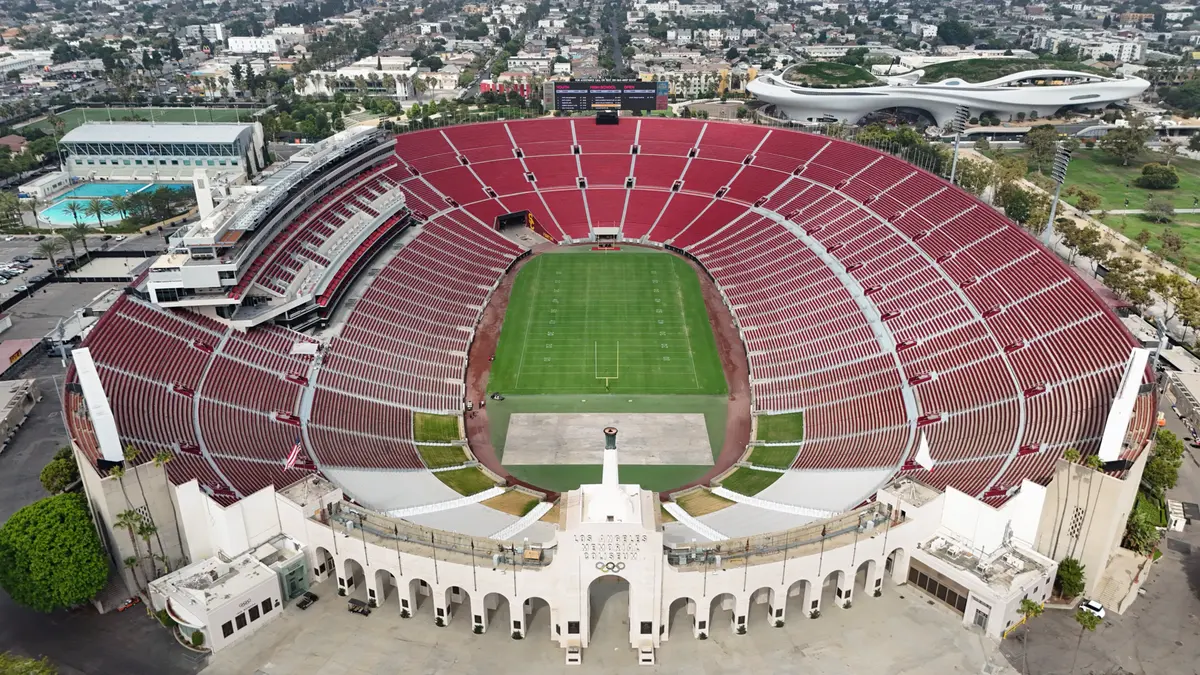
In Exposition Park on the edge of the USC campus, the Los Angeles Memorial Coliseum is the most historically significant stadium in America. Built in 1923 as a memorial to World War I veterans, it is the only venue on earth to have hosted two Olympic Games, two Super Bowls, a World Series, and a Papal Mass. When the 2028 Olympics arrive, it becomes the first stadium to have hosted the Summer Olympics three times. No other venue is close.
The Coliseum is home to the USC Trojans, one of college football’s most storied programs. On fall Saturdays, 77,500 fans fill the peristyle-crowned bowl while the Olympic cauldron flickers above the east colonnade. The stadium has also served as home to the LA Rams (most recently 2016-2019), the LA Dodgers during their first four seasons after moving from Brooklyn, and the LA Raiders from 1982 to 1994.
Designed by architects John and Donald Parkinson, the original Coliseum was built in just 16 months at a cost of $954,873 and opened on May 1, 1923. A $315 million renovation completed in 2019, funded entirely by USC, added 42 luxury suites, 1,100 club seats, loge boxes, a rooftop terrace, and new HD video boards while preserving the historic character that earned it National Historic Landmark status in 1984.
The Coliseum’s resume of events is unmatched. The 1932 and 1984 Olympics, Super Bowls I and VII, the 1959 World Series (Game 5 drew 92,706, still a record), JFK’s acceptance speech, Billy Graham’s record-setting 134,254 attendance, and NASCAR races built inside the stadium bowl. No other venue comes close.
Getting to the LA Memorial Coliseum
Public Transit
The Coliseum is one of the best transit-connected stadiums in the country, with a Metro station steps from the gates.
→ Via Metro E Line: Take the E Line to Expo Park/USC station, a 5-minute walk to the entrance gates. The E Line runs from East LA to Santa Monica, connecting at 7th St./Metro Center in Downtown LA. Fare: $1.75 per ride.
→ Via Metro J Line (Silver): Exit at 37th St./USC station along the I-110 ExpressLanes, then walk a few blocks via Flower Street.
→ Via Metrolink Regional Rail: Take any Metrolink line to LA Union Station, then transfer to the Metro E Line. Serves Los Angeles, Orange, Riverside, San Bernardino, and Ventura counties.
Enhanced Metro service runs 2–3 hours before kickoff and 1–2 hours post-game. Last E Line trains depart Expo Park around 11:50 PM eastbound and 12:10 AM westbound.
Driving + Parking
The Coliseum is at 3911 S. Figueroa Street, Los Angeles, CA 90037, just off the I-110 and I-10 freeways.
→ From Downtown LA (~4 mi): Head south on I-110 to the Exposition Blvd exit. Turn right on Exposition, then left on Figueroa. About 10–15 minutes without traffic.
→ From Anaheim / Orange County (~27 mi): Take I-5 North to CA-60 West, merge onto I-110 North. Exit at MLK Jr. Blvd or Exposition Blvd. About 35–45 minutes.
→ From Pasadena (~14 mi): Take I-110 South through Downtown LA. Exit at Exposition Blvd. About 18–30 minutes.
For USC games and major events, Exposition Park lots require permits bought in advance. Third-party lots are available via ParkWhiz or SpotHero. The Coliseum strongly encourages taking Metro to avoid LA traffic.
Rideshare
Uber and Lyft drop-off is available along Expo Park Drive from Figueroa Street. Post-event pickup is at Vermont Avenue between Exposition Blvd and Downey Way. Rideshare is held out of Exposition Park for a period after events while the crowd clears, so expect a wait and a walk to the pickup point.
From the Airport
→ Los Angeles International (LAX): 12 miles, about 20–30 minutes by car. Rideshare from LAX averages $25–$40. Public transit from LAX takes about 1 hour 20 minutes via Metro connections.
→ Hollywood Burbank (BUR): 18 miles, about 25–35 minutes. Good for Southwest Airlines and JetBlue travelers.
→ Long Beach (LGB): 22 miles, about 25–35 minutes. Budget-friendly option via JetBlue and Southwest.
→ Ontario International (ONT): 45 miles, about 45–60 minutes. Serves the Inland Empire and offers competitive fares.
Watching a Game at the Coliseum
Ask a regular where to sit and the first thing they will tell you is that the Coliseum does not really have sections. It has tunnels. Your ticket sends you to a numbered tunnel, and long-time season ticket holders give their seats the way you would give an address: Tunnel 8, Row 52. It trips up first-timers every year.
The second thing they will mention is the sun. This is an open bowl in Los Angeles, and an early-season afternoon kickoff is punishing on the exposed side. The stadium’s own A-to-Z guide carries an entry for sunscreen. Avoid the lowest rows for a different reason. Long-time season ticket holders warn that down there the camera crews and the team benches block the play.
Getting in is stricter than it looks. The Coliseum runs a clear-bag policy, meaning one clear bag no larger than 12 by 6 by 12 inches or a one-gallon zip bag, plus a clutch about the size of a hand. Pre-packaged snacks are allowed if they travel in a clear bag, and you can carry an empty non-metallic bottle. Cameras are fine. Tripods are not. The building is entirely cashless, so the cash in your pocket is dead weight.
Then there is the part no other stadium can offer. The Olympic cauldron above the peristyle is lit for the fourth quarter of every USC home game, and it burns again whenever the Games are being staged somewhere else in the world. Arrive early and you can stand under it in daylight, or take the historic tour, one of the few stadium tours where the building itself is the exhibit.
Construction & Design
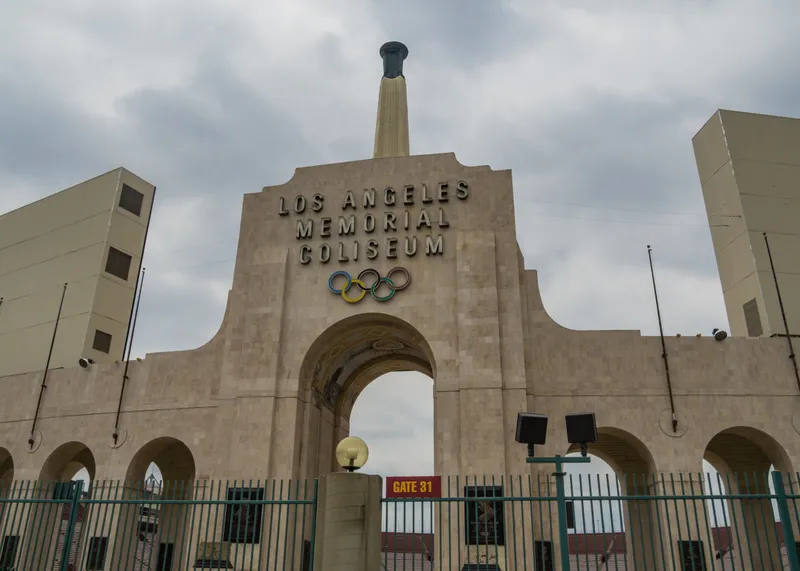
The Los Angeles Memorial Coliseum was built as a monument as much as a stadium, commissioned in 1921 as a memorial to the city’s veterans of the First World War. A monument first. The architects were the father-and-son firm of John and Donald Parkinson, who also gave Los Angeles Union Station and City Hall, and the builder was the Edwards, Wildey and Dixon Company. Ground broke in December 1921, the Coliseum opened on May 1, 1923, and the whole thing cost a little under $955,000. Its signature is the peristyle at the east end, a row of Roman-style arches crowned by the Olympic cauldron, which has become the most recognizable stadium facade in America.
That cauldron is there because of an unmatched Olympic record. The Coliseum hosted the Summer Games in 1932 and again in 1984, and it is confirmed to host them a third time in 2028, making it the first stadium to have hosted the Summer Olympics three times. Along the way it carried a capacity that peaked around 105,000 in 1939, and hosted two Super Bowls, the Rams, the Raiders, and USC football continuously since 1923. It was named a National Historic Landmark in 1984.
The building you see now is a careful modernization of that landmark. Not a replacement. A roughly $315 million renovation in 2018 and 2019, designed by DLR Group and built by a Hathaway Dinwiddie and AECOM Hunt team, rebuilt the seating bowl and added the Julia and George Argyros Plaza around the peristyle, trimming capacity from around 92,000 to 77,500 while adding modern premium areas. United Airlines took the naming rights to the field, but the master lease requires the Memorial Coliseum name to stay.
Legacy of the LA Memorial Coliseum
No stadium in America has hosted more historically significant events across more decades. The list runs well past sport: it is where JFK accepted the Democratic presidential nomination in 1960, where Martin Luther King Jr. spoke, where Pope John Paul II celebrated Mass before a packed Coliseum in 1987.
The Olympic thread runs through everything here. Three Games, ninety-six years apart. The 1932 Games brought the peristyle and Olympic cauldron. The 1984 Games brought a National Historic Landmark designation, awarded a day before the opening ceremony. The 2028 Games bring the athletics back, a share of the opening ceremony with SoFi Stadium, and both closing ceremonies, Olympic and Paralympic. Every venue is mapped in our Los Angeles 2028 Olympics guide.
That memorial status still has teeth. When United Airlines bought the naming rights, the plan was to call the whole venue United Airlines Memorial Coliseum. Veterans groups objected to a war memorial carrying a corporate name, and USC proposed a compromise: only the playing surface became United Airlines Field. The full agreed name is United Airlines Field at Los Angeles Memorial Coliseum. It remains the memorial it was built as in 1921, rededicated in 1968 to all United States veterans of the First World War.
Beyond the Olympics, the Coliseum keeps finding new uses. Not always predictable ones. NASCAR built a quarter-mile track inside the bowl for the Busch Light Clash in 2022, 2023, and 2024, the first NASCAR race inside a stadium since 1956. Inside the bowl. Properly. It remains a concert venue for the biggest acts in the world, from Metallica to Rammstein.
History of the LA Memorial Coliseum
Ground broke in December 1921 on what the city intended as a war memorial that happened to hold a hundred thousand people. Architects John and Donald Parkinson designed an elliptical bowl inspired by ancient Roman amphitheaters, built with reinforced concrete, roughly 316 metres (1,038 feet) long and 225 metres (738 feet) wide at its midpoint. The site did much of the work for them. The Coliseum went up on the sloped bank of an excavated sand and gravel pit, which is why the field sits 32 feet below the surrounding grade while the rim rises 106 feet above the turf. It was completed in just 16 months at a cost of $954,873 and opened on May 1, 1923.
1932 Summer Olympics (July 30 – August 14, 1932): The Coliseum was expanded to 101,574 seats. The peristyle colonnade and Olympic cauldron were added for these Games.
1959 World Series: The Dodgers hosted the White Sox at the Coliseum. Game 5 drew 92,706 fans. Still a World Series record and likely can never be broken in a modern baseball park.
Super Bowl I (January 15, 1967): Green Bay Packers defeated the Kansas City Chiefs 35-10 in the first AFL-NFL championship before 61,946 fans.
Super Bowl VII (January 14, 1973): Miami Dolphins beat Washington 14-7, completing the NFL’s only perfect season (17-0).
1984 Summer Olympics (July 28 – August 12, 1984): The Coliseum hosted its second Olympic Games. Designated a National Historic Landmark one day before the opening ceremony.
$315M Renovation (2018-2019): DLR Group led a two-year modernization funded by USC: all new seating, 42 luxury suites, club seats, loge boxes, a rooftop terrace, and HD jumbotrons, all while preserving the historic peristyle.
The Coliseum endures because it refuses to become a relic. Museums stand still. This one keeps booking events. A century after its opening, it remains LA’s grandest stage, and in 2028, the world will return here once more.
Sources & Further Reading
- National Historic Landmark nomination, National Park Service: npgallery.nps.gov. The primary record for the original 1923 dimensions and the landmark designation.
- Wikipedia entry on the Los Angeles Memorial Coliseum: en.wikipedia.org/wiki/Los_Angeles_Memorial_Coliseum. Construction, the three Olympics, and the 2019 renovation.
- USC Athletics, United Airlines Field at the Coliseum: usctrojans.com. The tenant’s facility page and history.
- CBS Los Angeles on the $315M renovation: cbsnews.com. Coverage of the 2019 rebuild.
- Los Angeles Memorial Coliseum official site: lacoliseum.com. Events, tickets, and visitor information.
Quick Facts
Everything you need at a glance.
Stadium specs
- Capacity
- 77,500
- Opened
- 1923
- Cost
- $954,873 (1923 original); 2018-2019 renovation around $315 million
- Roof
- Open
- Surface
- Natural Grass
- Tenants
- USC Trojans (NCAA/Big Ten)
Construction & location
- Groundbreaking
- December 21, 1921 (opened May 1, 1923)
- Architects
- John and Donald Parkinson
- Engineering
- Not separately recorded
- General contractor
- Edwards, Wildey & Dixon Company (original); Hathaway Dinwiddie / AECOM Hunt (2019 renovation)
- Address
- Los Angeles Memorial Coliseum, 3911 South Figueroa Street, Los Angeles, CA 90037
- GPS
- 34.0141°N, 118.2879°W
Photo Gallery
Fun Facts
When the 2028 Games arrive, the Coliseum becomes the first stadium to have hosted the Summer Olympics three times (1932, 1984, 2028).
The Olympic cauldron atop the peristyle is lit during the fourth quarter of every USC home game and on special occasions when Olympic Games are held elsewhere.
The all-time Coliseum attendance record is 134,254, set on September 8, 1963, for the final day of Reverend Billy Graham's crusade, not a sporting event.
Stadium Location
Frequently Asked Questions
- What is the seating capacity of the LA Memorial Coliseum?
- The current capacity is 77,500, which includes 42 luxury suites, 1,100 club seats, 24 loge boxes, and a 500-person rooftop terrace following the $315 million renovation completed in 2019.
- Is the LA Memorial Coliseum hosting the 2028 Olympics?
- Yes, and it becomes the first stadium to have hosted the Summer Olympics three times (1932, 1984, 2028). It stages the athletics, shares the opening ceremony with SoFi Stadium in a first for the Games, and hosts the closing ceremony on its own. It also closes the Paralympics on August 27, 2028.
- How do I get to the LA Coliseum by public transit?
- Take the Metro E Line to Expo Park/USC, less than a five-minute walk from the gates. Expo/Vermont also serves Exposition Park but sits farther west, roughly half a mile away. The E Line connects to Downtown LA at 7th St./Metro Center. A one-way TAP fare is $1.75, and Metro caps charges at $5 a day and $18 a week, so a match day plus sightseeing rarely costs more than the cap.
- How much does parking cost at the LA Coliseum?
- Prices vary by event and the Coliseum does not publish a standing rate, so buy in advance through the official parking links rather than turning up expecting a gate price. There are lots across Exposition Park, and USC campus parking is about a ten-minute walk. The venue itself urges guests to take the Metro instead.
- Who plays at the LA Memorial Coliseum?
- The USC Trojans football team (NCAA/Big Ten) is the primary tenant. The stadium has also hosted the LA Rams (most recently 2016-2019), NASCAR Busch Light Clash races, and major concerts.
- Why is the LA Coliseum a National Historic Landmark?
- The Coliseum was designated a National Historic Landmark on July 27, 1984, for its architectural significance (designed by John and Donald Parkinson in 1923), its role as a World War I memorial, and its unmatched history of hosting globally significant events.
- Is the Los Angeles Memorial Coliseum still home to the USC Trojans?
- Yes. The Coliseum has been the home field of the USC Trojans football team since 1923 and remains their home today, playing on United Airlines Field. Note that only the field carries the sponsor name: when a full rename to United Airlines Memorial Coliseum was floated, veterans groups objected to a war memorial being sold, and USC proposed naming just the playing surface instead. The stadium is still the Los Angeles Memorial Coliseum.
- Where are the best seats at the Coliseum, and what are the tunnels?
- The Coliseum sends you to a numbered tunnel rather than a lettered section, which is why Check your ticket for the tunnel number before you head over. Avoid the lowest rows if you want to follow the play, because camera crews and the team benches sit in front of them, and think about which side the sun is on for an afternoon kickoff in an open bowl.
- What can I bring into the LA Memorial Coliseum?
- One clear bag no larger than 12 by 6 by 12 inches, or a one-gallon clear zip bag, plus a small clutch about the size of a hand. Pre-packaged snacks are allowed if they are carried in a clear bag, and you can bring an empty non-metallic bottle to refill. Cameras are permitted but tripods, poles, and sticks are not. The venue is entirely cashless, so bring a card or your phone.
- Can I visit the Coliseum when there is no game on?
- Yes. The Coliseum runs historic tours of the peristyle, the Olympic cauldron and the field, which is unusual among American stadiums in that the building itself is the attraction rather than a trophy cabinet. Exposition Park around it also holds the California Science Center, the Natural History Museum, and the California African American Museum, all within a few minutes' walk.
Last updated: 2026-08-16