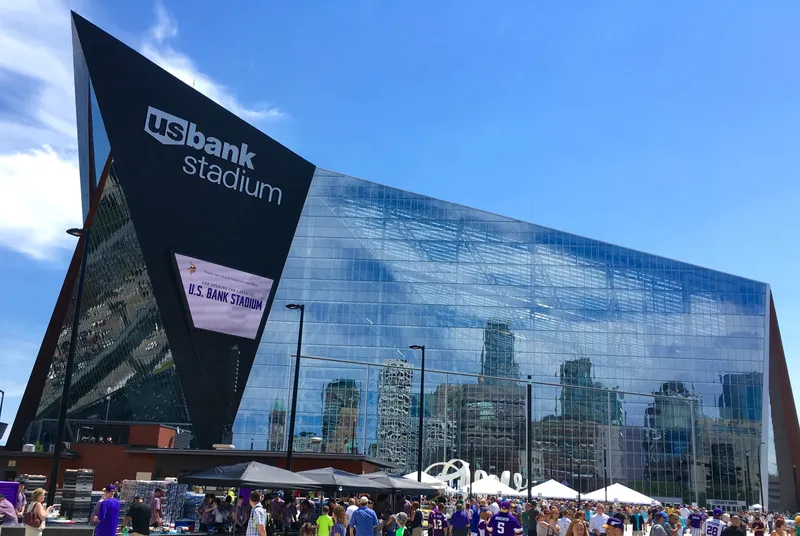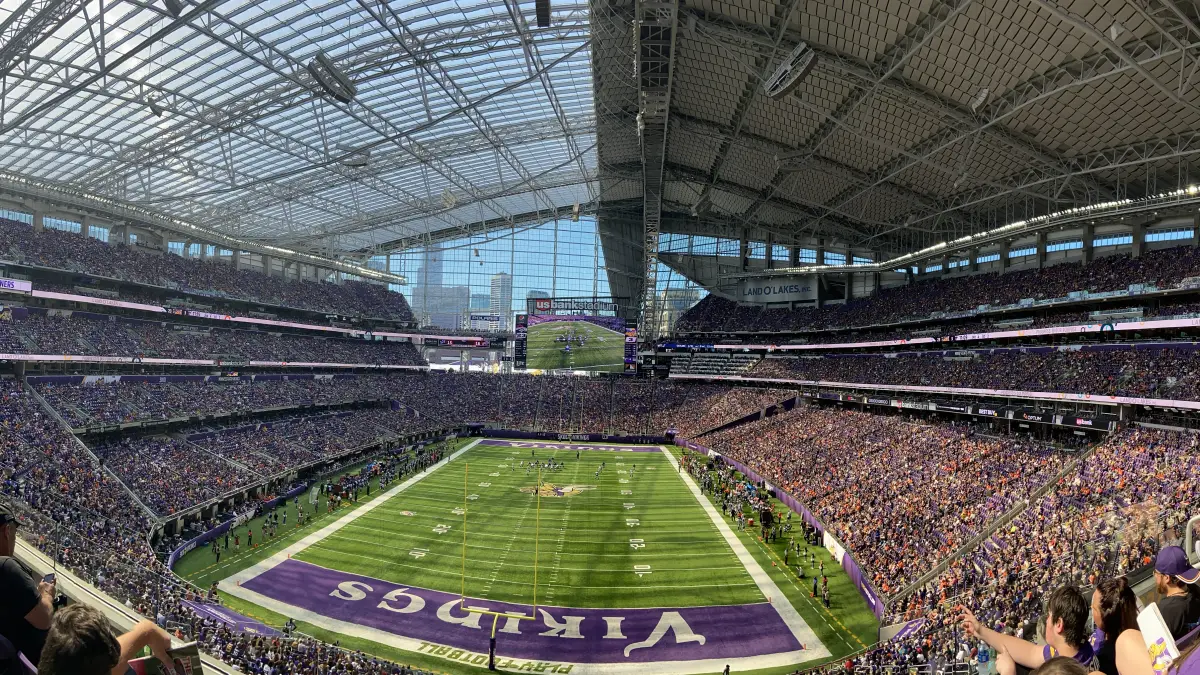
Stand inside U.S. Bank Stadium in Minneapolis on a January afternoon and something feels off. Outside it is below freezing. Inside, sunlight pours through a translucent roof onto 66,000 people in shirtsleeves, the downtown skyline glowing through a wall of angled glass. It is winter football with none of the winter. That contradiction, a stadium open to the light but sealed against the weather, is the future the entire league is building toward.
Right now, only 10 of the NFL’s 30 stadiums are covered. But look at what is going up. Nearly every new stadium under construction has a roof, and the lone open-air holdout is treated as an eccentric choice rather than the default. The open-air stadium, the thing football was played in for a century, is quietly becoming a relic. Here is why.
10 of 30: NFL stadiums that are currently covered, against nearly every new build now going up with a roof.
Three ways to cover a stadium
Before the why, the what, because “domed stadium” is a loose term that covers three genuinely different things. Getting them straight is the key to the whole trend.
| Type | How it works | Examples |
|---|---|---|
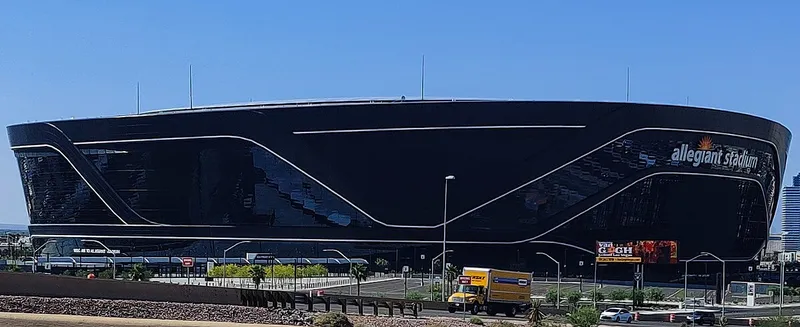
| Fixed dome | Permanent roof, never opens, climate-controlled | Allegiant, Caesars Superdome, Ford Field |
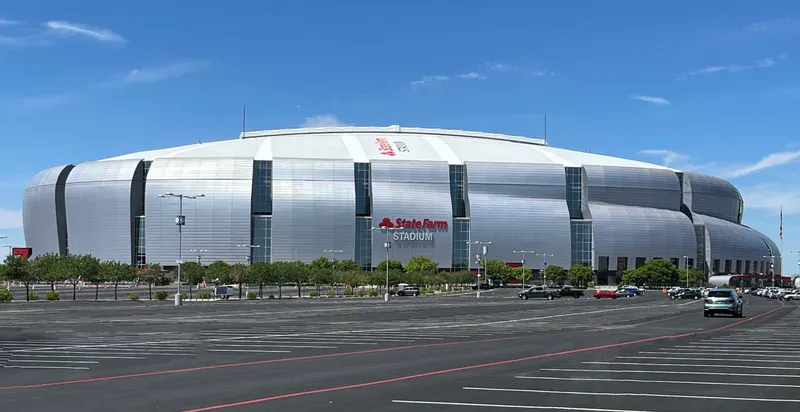
| Retractable roof | Panels open and close in minutes | Mercedes-Benz, AT&T, State Farm, NRG, Lucas Oil |
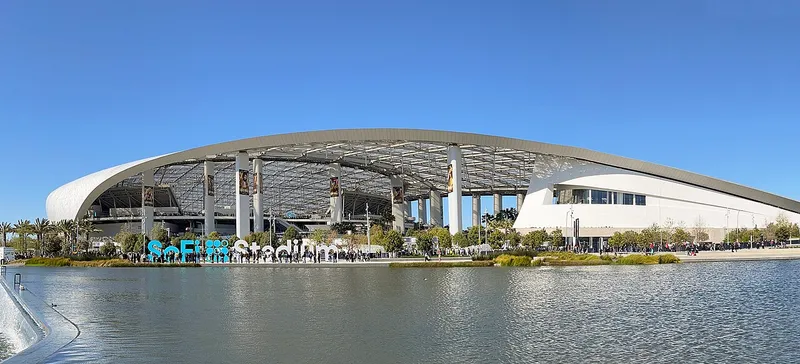
| Fixed canopy | Roof over the seats, field open to the sky | SoFi, Hard Rock |
A fixed dome is the simplest idea: a permanent roof, sealed for good, with the building’s climate fully under control. Allegiant Stadium in Las Vegas is a fixed dome, and so is the Caesars Superdome, which has stood in New Orleans since 1975.
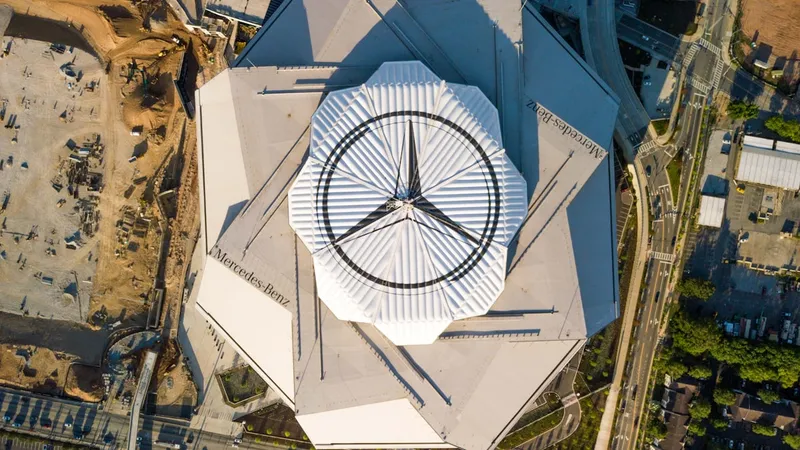
A retractable roof is the expensive, showy option: giant panels that slide open on a nice day and close against rain or heat, giving a team both an open-air stadium and an indoor one in the same building. Mercedes-Benz Stadium and AT&T Stadium are the marquee examples.
The third option, a fixed canopy, is the newest trick. The roof covers the fans but leaves a hole over the field, so the grass still gets sun and rain while the seats stay dry and shaded. SoFi Stadium works this way, with its vast translucent shell floating over open sides.
How many NFL stadiums actually have roofs
The precise count, as of the 2025 season, is 10 covered stadiums out of 30. Five are fixed domes and five have retractable roofs. The five retractable-roof teams are the Cowboys, Colts, Falcons, Texans, and Cardinals. The other 20 stadiums are open-air.
So at first glance, roofs are still the minority. Two out of three NFL teams play under open sky. But that snapshot is misleading, because it averages the old and the new. The 20 open-air stadiums include a lot of buildings from the 1990s and earlier. When you filter for what has actually been built recently, the picture flips hard.
The three most recently completed NFL stadiums, SoFi in Los Angeles, Allegiant in Las Vegas, and U.S. Bank Stadium in Minneapolis, are all covered. Not one open-air stadium has opened in that stretch. The roof is not the minority among new stadiums. It is close to unanimous.
Why everyone is suddenly building a roof
The reason is not comfort. It is money, and specifically the events a covered stadium can host that an open-air one cannot.
A roof turns a stadium from a football venue into a year-round events machine, and the crown jewels are the neutral-site mega-events that go looking for weatherproof buildings. Look at the Super Bowl rotation: the 2022 game was at SoFi, 2023 at State Farm Stadium, 2024 at Allegiant, and 2025 at the Superdome, four straight in covered venues. The upcoming slate keeps the pattern, with SoFi, Mercedes-Benz, Allegiant, and the Titans’ new domed stadium all on the calendar. The NFL prefers to put its championship where a blizzard cannot touch it.
It goes well beyond the Super Bowl. The College Football Playoff national championship keeps landing in domes and retractables like Mercedes-Benz, Lucas Oil, and NRG Stadium. The NCAA has staged its men’s Final Four exclusively in domed stadiums since 1997, because only a dome can seat 60,000-plus for basketball. And then there is the concert business, which has become one of the biggest reasons to build a roof at all. A weatherproof stadium can book multi-night concert runs with total confidence, which is exactly why enclosed Allegiant topped the concert-revenue charts, a link we trace in our look at how the biggest concerts took over the stadium.
Add it up and a roof pays for itself in bookings. The same building that hosts 10 football games can host Super Bowls, Final Fours, and a summer of stadium concerts, none of which a rainstorm can cancel. WrestleMania fills them too, and SoFi is routinely ranked the number one venue in the world for touring. Every one of those bookings is a date an open-air stadium either loses to weather risk or cannot compete for at all.
There is a bonus the owners rarely advertise: a roof makes a stadium louder. Crowd noise that would escape into the open sky instead bounces off a closed roof and back down onto the field, which is why domed stadiums post some of the highest decibel readings in sport. Detroit’s Ford Field, a fixed dome, hit 134.3 decibels during a 2024 playoff game, one of the loudest crowd readings ever recorded, a phenomenon we get into in our ranking of the loudest stadiums in the world. For a home team, the roof that pays the bills also weaponizes the crowd.
Four straight Super Bowls, from 2022 through 2025, were played in domed or retractable-roof stadiums.
The heat problem nobody can ignore
There is a second force pushing roofs, and it is getting more urgent every year: temperature. A roof is no longer just about keeping rain off a Super Bowl. It is about keeping people safe in the heat.
The most advanced covered stadiums are not just sheltered, they are air-conditioned on a massive scale. Mercedes-Benz Stadium runs a cooling plant around 8,600 tons and can hold its field near 68 degrees Fahrenheit with the roof shut. NRG Stadium in Houston operates one of the largest indoor cooling systems in the country, a necessity when the alternative is 94-degree heat at 80 percent humidity.
That capability is about to be tested on the world stage. When the 2026 World Cup arrives, three of its 16 venues, Mercedes-Benz in Atlanta, AT&T in Dallas, and NRG in Houston, are fully climate-controlled, and they are widely expected to keep their roofs closed for nearly every match. FIFA has mandated cooling and hydration breaks midway through each half at every venue regardless of roof, and player-union analysis flagged the highest heat risk at the open-air venues in Miami, Kansas City, and East Rutherford. In a tournament played in a North American summer, the covered stadiums are the safe ones, a dynamic we break down in our guide to the World Cup’s air-conditioned venues. Climate is turning the roof from a luxury into a health measure.
How a retractable roof actually works
The retractable roof is the most impressive piece of machinery in any stadium, and each one solves the same problem differently.
Mercedes-Benz Stadium has the showpiece. Its roof is not a single sliding panel but eight translucent triangular petals that retract in straight lines offset around a center point, so the whole thing opens like a camera aperture. It holds the Guinness World Record for the largest retractable roof of its kind, covering roughly 14.5 acres, and it opens in a little over eight minutes. AT&T Stadium takes the brute-force approach: two panels, each weighing about 1.6 million pounds, ride a rack-and-pinion system across 215 feet and open in around 12 minutes.
The wildest engineering, though, is at State Farm Stadium in Arizona, which solved a problem the others could not. Natural grass needs sunlight, but a closed roof blocks it. So the entire playing field sits in a tray of roughly 19 million pounds that rolls out of the building on rails to grow in the sun, then slides back inside for game day. It was the first system of its kind in North America, a stadium that opens its roof and moves its field.
~14.5 acres: the area covered by Mercedes-Benz Stadium’s roof, which holds the world record for the largest retractable roof of its kind.
None of this is cheap to run, either. A retractable roof is not just an upfront cost but a mechanical system that has to be maintained, inspected, and operated for decades, with motors and rails and millions of pounds of moving steel. It is one more reason the roof, in all its forms, keeps pushing the price of a modern stadium higher.
All that machinery is why a retractable roof is the single most expensive way to cover a stadium, a cost that flows straight into the price of the building, as we detail in the most expensive stadiums ever built.
The holdouts who refuse to cover up
Not everyone is buying in. A handful of teams treat the open sky as part of who they are, and they are digging in.
Lambeau Field in Green Bay is the patron saint of open-air football. Cold-weather home games are treated as a competitive weapon, the “frozen tundra” a genuine advantage, and the field is kept playable by about 34 miles of heating tubing buried under the grass rather than by any roof. Analysts increasingly wonder whether Lambeau will one day be the last open-air stadium standing.
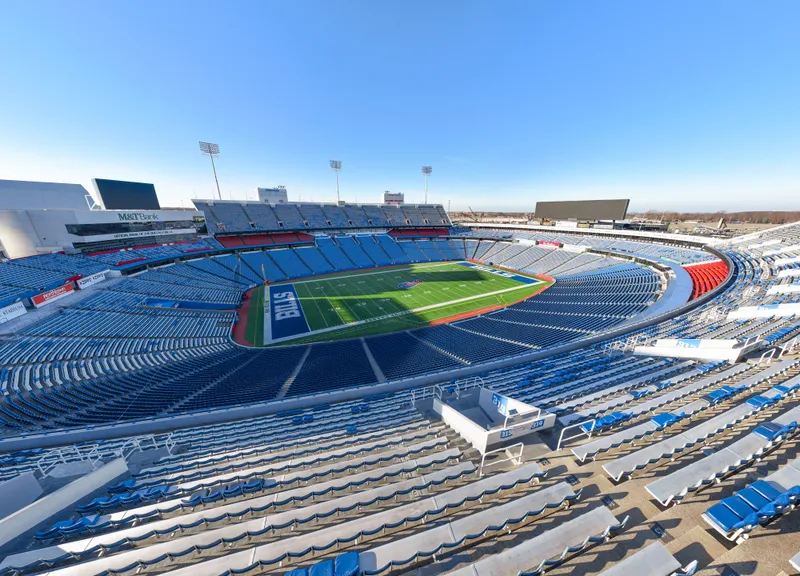
The most telling case is Buffalo. When the Bills built their new Highmark Stadium, opened in 2026, they chose to stay open-air on purpose. A fan survey showed most supporters wanted no roof at all, because cold, snowy, brutal weather is woven into the team’s identity and its home-field edge. The Bills compromised with a partial canopy over the stands to cut the wind and a heated field, but they left the bowl open to the sky. In a league racing to cover up, Buffalo spent about two billion dollars to build a stadium that still lets the snow in.
The holdouts have a point worth taking seriously, and it is not just nostalgia. Something is lost when the weather is engineered out of football. A snow game at Lambeau or a wind-whipped afternoon in the northeast is part of what makes the sport feel elemental, and no climate-controlled dome will ever reproduce it. Purists also argue that natural grass, which most domes struggle to grow without elaborate workarounds, plays truer and safer than the artificial turf that covered stadiums tend to install. The roof solves the business problem and creates an atmosphere one. Whether that trade is worth it depends on whether you think a stadium is a venue or a cathedral.
The covered future
Look at the drawing boards and the trend becomes a near-certainty. Almost every NFL stadium being planned or built is covered.
The Tennessee Titans’ new Nissan Stadium, due in 2027, is an enclosed dome with a translucent roof. The Cleveland Browns broke ground on a domed stadium in Brook Park, targeting 2029. The Washington Commanders unveiled renderings of a roofed stadium on the old RFK site. The Chicago Bears are now pursuing a fixed-roof stadium in the suburbs. Even the Jacksonville Jaguars, staying technically open-air, are adding a shade roof designed to drop interior temperatures by around 15 degrees. Of the major new builds in progress, Buffalo is the only one intentionally leaving the roof off.
The math is hard to argue with. A roof roughly doubles what a stadium can host, protects against a climate that is only getting more extreme, and turns a 10-day-a-year football venue into a 200-night entertainment building. The open-air stadium gave us a century of iconic football, from the frozen tundra to the wind tunnels of the northeast. But the buildings going up now have learned a different lesson: the surest way to fill a stadium is to make sure the weather can never empty it.
Sources
- List of indoor and outdoor NFL stadiums, Pro Football Network. The count of domed, retractable, and open-air stadiums.
- SoFi Stadium, Wikipedia and Allegiant Stadium, Wikipedia. Canopy and fixed-dome designs.
- Mercedes-Benz Stadium roof world record, Guinness World Records. The eight-petal aperture roof and its opening time.
- Cowboys Stadium retractable roof, Uni-Systems. The AT&T Stadium roof mechanics.
- State Farm Stadium, Wikipedia. The roll-out natural grass field.
- Super Bowl locations, Fox Sports. The run of Super Bowls in covered venues.
- World Cup 2026 stadium roofs and heat rules, The Football Faithful. Climate control and FIFA cooling breaks.
- Titans’ enclosed stadium on track for 2027, NFL.com and Browns break ground on domed stadium, NFL.com. The covered new-build wave.
- Highmark Stadium, Wikipedia and Lambeau Field, Wikipedia. The open-air holdouts.
Cost and capacity figures are reported inconsistently across sources and are given here at commonly cited values. Stadium classifications (dome, retractable, canopy) follow the most recent published descriptions; roof-opening times and cooling-system figures are drawn from the operators and engineering sources cited above and can vary by report.