Stand at field level in Arrowhead Stadium when 76,000 Kansas City fans are screaming, and a sound meter reads 142.2 decibels. That’s not a figure of speech. It’s the Guinness World Record, and it lands on the same scale as a jet engine at takeoff, the kind of noise that does permanent damage to your hearing if you sit in it unprotected.
Crowd noise is the one thing in sport that can’t be faked, bought, or coached. A billionaire owner can buy a superstar. He can’t buy a wall of sound that makes a visiting quarterback burn a timeout because his own linemen can’t hear the snap count. So which grounds are the loudest on Earth, and why do some buildings roar while others swallow the noise? Here’s the ranking, the record battle behind it, and the physics that separates a loud stadium from a quiet one.
142.2 decibels: the Guinness World Record for the loudest crowd roar at a sports stadium, set at Arrowhead in 2014.
The loudest stadiums in the world, ranked
Only a handful of stadiums have ever put a number on their noise, because a Guinness attempt needs certified equipment and an official adjudicator. These are the measured record-holders, the ones with a decibel reading on the board rather than just a reputation.
| Rank | Stadium | Team | Reading | When |
|---|---|---|---|---|
| 1 | Arrowhead Stadium | Kansas City Chiefs (NFL) | 142.2 dB | Sept 2014 |
| 2 | Lumen Field | Seattle Seahawks (NFL) | 137.6 dB | Dec 2013 |
| 3 | Ford Field | Detroit Lions (NFL) | 134.3 dB | Jan 2024 |
| 4 | Allen Fieldhouse | Kansas Jayhawks (NCAA) | 130.4 dB | Feb 2017 |
A quick word on how to read that table. Decibels are logarithmic, not linear, so the gaps are bigger than they look: every 10 decibels is roughly a doubling of perceived loudness. Arrowhead at 142.2 isn’t a little louder than Lumen at 137.6. It’s a different weather system. And the measured list is only half the story, because some of the most feared grounds in the world, from Tennessee to Dortmund, have never bothered with a certificate. More on them below.
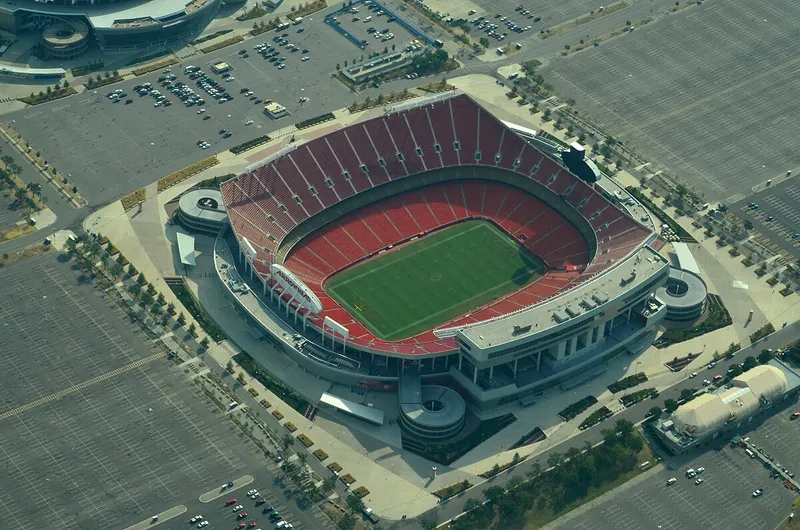
Arrowhead and the 142.2-decibel record
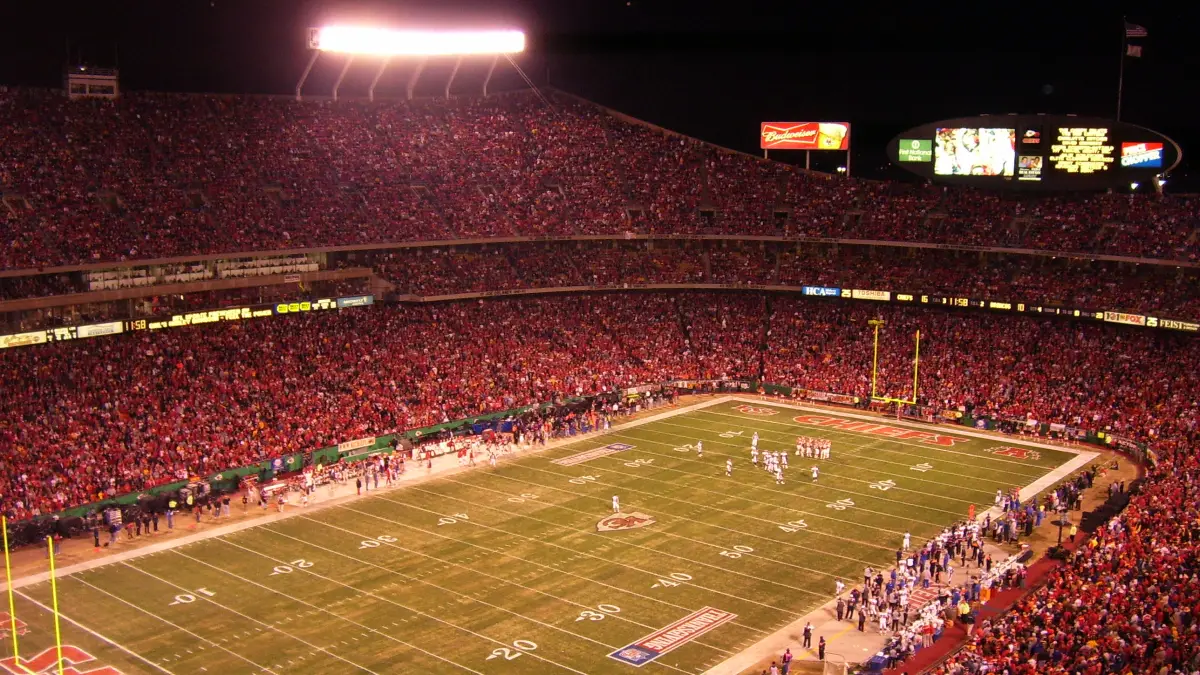
Arrowhead Stadium set the bar on September 29, 2014, during a Monday night game against the New England Patriots. With eight seconds left in the first quarter, the crowd hit 142.2 decibels, an official Guinness World Record, and the Chiefs went on to win 41-14. That number has stood ever since.
It’s loud for two reasons, and only one of them is the fans. Arrowhead is a steep, deep bowl that seats more than 76,000 people, and it was built without the open corners that let sound leak out of newer stadiums. The upper decks are cantilevered out over the lower bowl, and the roofline hangs over the seating, so noise that would otherwise rise and dissipate gets bounced straight back down onto the field. The players don’t just hear the crowd. They hear the crowd, and then they hear its echo.
The other reason is the crowd itself. Chiefs fans, “Chiefs Kingdom,” treat the noise as a job, and the franchise leans into it, piping the decibel count onto the video board so the stadium can watch itself get louder. Opposing offenses have to run a silent count, communicating with hand signals because spoken calls vanish. False-start penalties climb. It is, by any measure, the most weaponized home-field advantage in American football.
On a jet-engine scale: 142.2 decibels is roughly the noise of a jet at takeoff, well past the threshold where sustained exposure damages hearing.
The Seahawks started it, and the record went back and forth
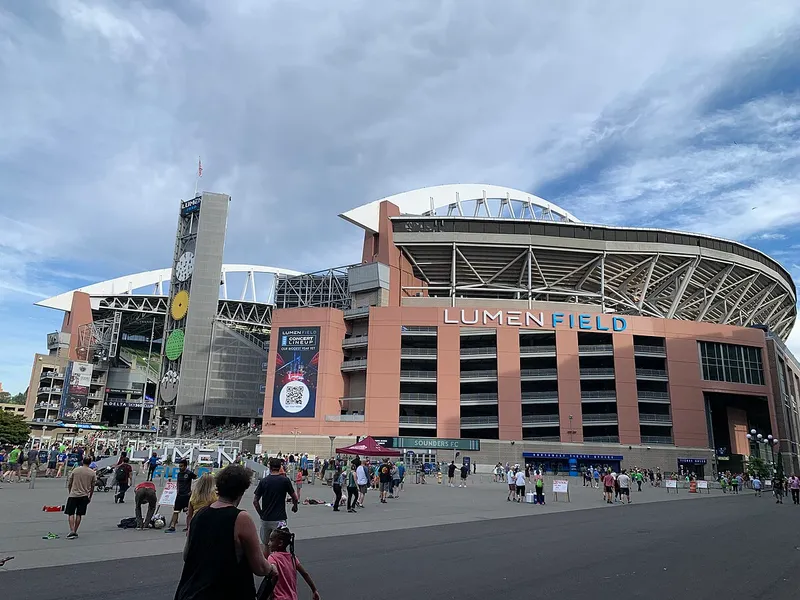
Before Kansas City, the loudest place in sport was Seattle. Fans at Lumen Field, then called CenturyLink Field, turned crowd noise into a civic identity, branding themselves the “12th Man” and treating decibel records as a competitive sport of their own.
In September 2013, Seattle fans hit 136.6 decibels against the San Francisco 49ers and took the world record. Three months later, in a December game against the New Orleans Saints, they broke their own mark and pushed it to 137.6. For most of a year, Seattle was the loudest place a football had ever been kicked. The stadium’s partial roof, which covers about 70 percent of the seats, does the same job Arrowhead’s does: it traps the sound and drives it back down.
Then Kansas City took it back, and the rivalry has simmered ever since, two fan bases that genuinely argue about who is louder. The honest answer is that Arrowhead holds the certified record at 142.2, and Seattle holds second place at 137.6, and both crowds are loud enough that the distinction only matters to them. Everyone else is playing for third.
The indoor kings: Ford Field and Allen Fieldhouse
Put a roof over the whole thing and the physics change again. A fully enclosed building doesn’t let any sound escape, which is why domes and arenas can rival open-air giants despite holding fewer people.
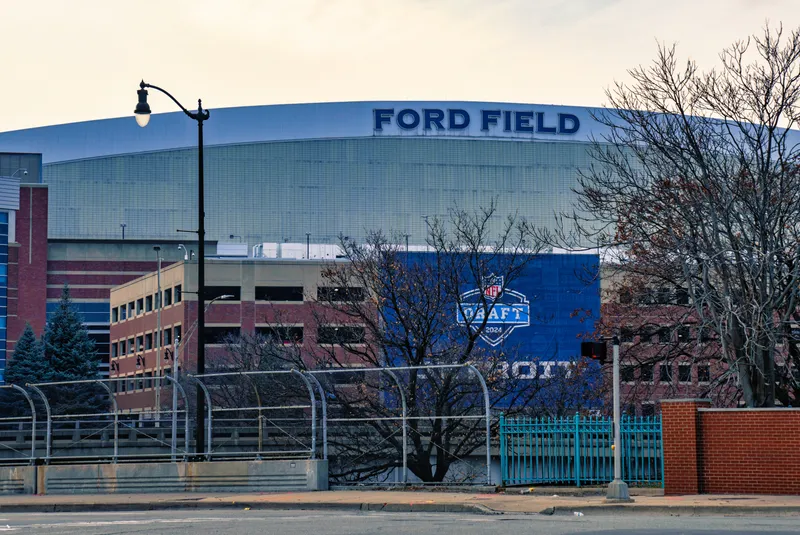
Ford Field, the Detroit Lions’ domed home, proved it during the 2024 NFL playoffs. In a wild-card win over the Los Angeles Rams, the first Lions home playoff game in three decades, the crowd hit 134.3 decibels, the third-loudest reading ever recorded at a stadium and a Ford Field record. A dome full of fans who had waited thirty years to make that noise turned out to be a genuinely dangerous acoustic environment.
College basketball does it in a smaller box. On February 13, 2017, University of Kansas fans at Allen Fieldhouse hit 130.4 decibels during a top-ten game against West Virginia, taking the Guinness record for the loudest indoor crowd roar. They beat a mark of 126.4 set just weeks earlier at Kentucky’s Rupp Arena. An arena that seats around 16,000 has no business being that loud, but a low roof, a tight footprint, and a student section that stands for two hours will do it.
130.4 decibels: the loudest indoor crowd roar recognized by Guinness, set by Kansas basketball fans at Allen Fieldhouse in 2017.
Loud without a record: the college and European cathedrals
Here’s the thing about the record book. It flatters the stadiums that hired an adjudicator and ignores some of the most frightening atmospheres on the planet, because they never bothered to measure.
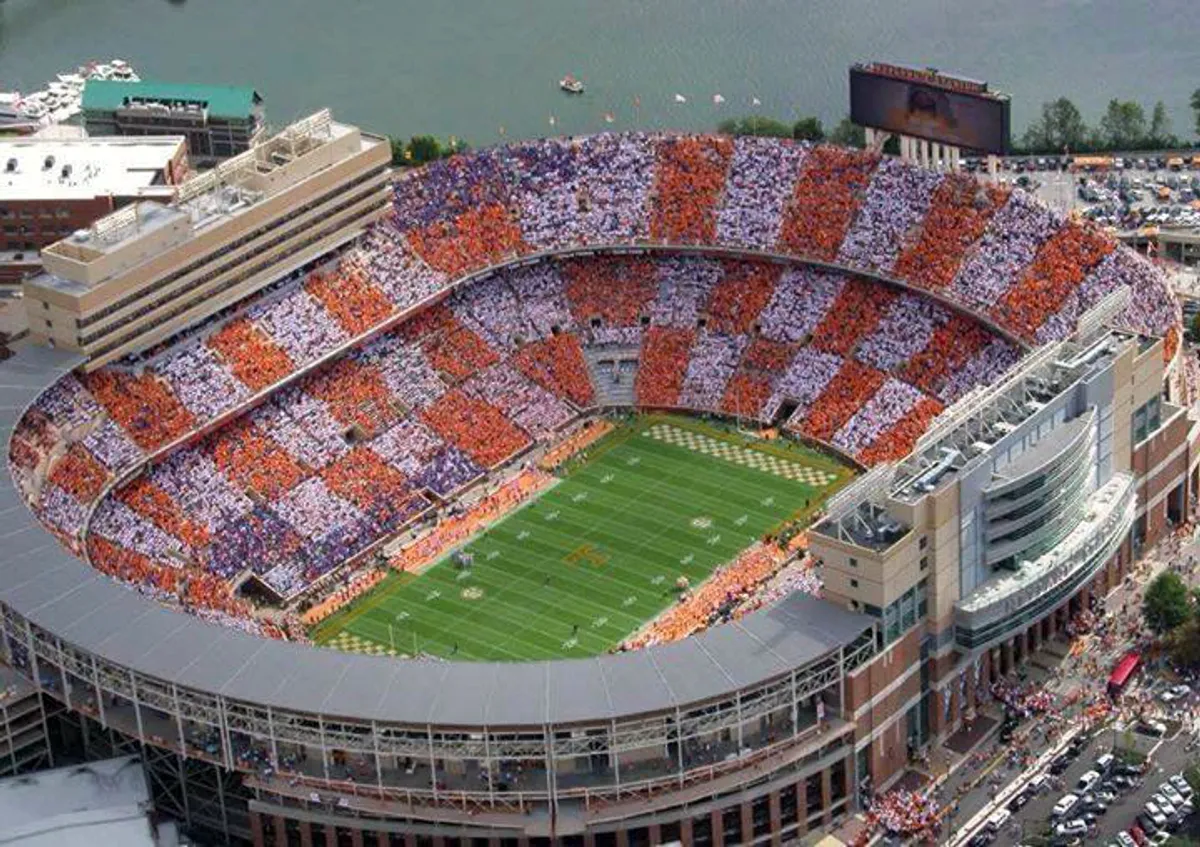
American college football is full of them. Neyland Stadium in Tennessee, a 100,000-seat monster on the banks of the river, is a byword for noise, and grounds like Death Valley at LSU and Kyle Field at Texas A&M, whose fans literally coined the term “12th Man,” trade the “loudest in the country” claim back and forth every autumn without a decibel meter in sight.
The most famous proof that a crowd can move the ground came at LSU. On October 8, 1988, Tiger Stadium erupted when the Tigers scored a last-minute touchdown to upset Auburn, and the roar was so violent that it registered as a small earthquake on a seismograph in the university’s geology building, around 1,000 feet away. Nobody was chasing a record. A machine built to measure the earth simply picked up the crowd instead. It has been the Earthquake Game ever since, and it did more for the stadium’s legend than any decibel meter could.
A seismograph recorded the crowd roar at LSU’s Tiger Stadium as a small earthquake in 1988, from around 1,000 feet away.
Europe’s version is different, and in some ways scarier, because it isn’t about a single roar, it’s about ninety minutes of unbroken sound. Borussia Dortmund’s Signal Iduna Park has the Südtribüne, the “Yellow Wall,” a single terraced stand that holds around 25,000 standing supporters and is widely called the most intimidating sight in club football. Turkish grounds in Istanbul, the sort of places where the home fans are already inside two hours before kickoff, have reduced visiting players to describing the noise as physical, a thing you feel in your chest rather than hear. None of them hold a Guinness plaque. All of them belong in any honest conversation about the loudest football on Earth.
What actually makes a stadium loud
Strip away the fan folklore and stadium noise comes down to three things: the crowd, the bowl, and the roof.
The crowd is the engine, and it’s not just about numbers. A packed 40,000-seat bowl with the fans stacked steeply over the field will beat a half-empty 90,000-seat oval every time, because proximity and density matter more than raw headcount. That’s why the loudest grounds tend to have steep lower bowls that put the front rows almost on the touchline.
The bowl is the amplifier. A fully enclosed ring of seating, with no open corners for the sound to escape through, keeps the noise circulating instead of bleeding out into the sky. Newer stadiums that were designed with open concourses and sightlines to the city skyline are often quieter for exactly that reason: they were built to feel airy, and airy is the enemy of loud.
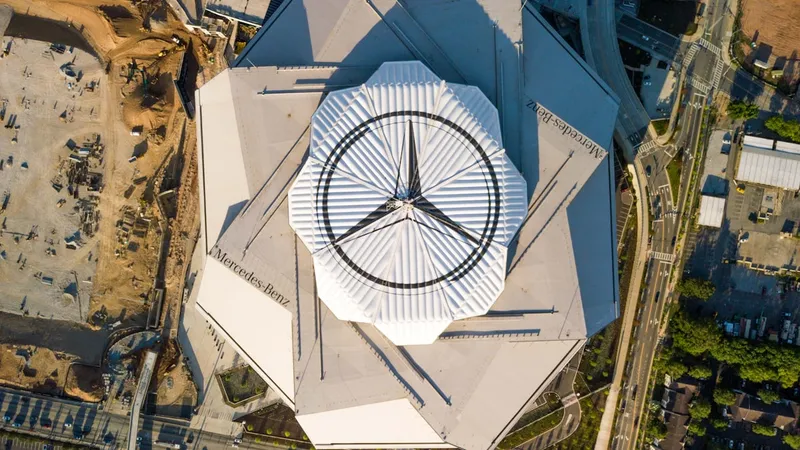
The roof is the multiplier. A canopy or a cantilevered overhang reflects rising sound back down onto the field, so players hear the crowd and its reflection at once. It’s why domes like Ford Field can match open giants, and why modern retractable-roof venues like Mercedes-Benz Stadium get dramatically louder with the roof shut. Close the lid and the same crowd doubles in effect. The physics don’t care how much the building cost.
Does the noise actually change the game?
It’s easy to treat crowd noise as pure spectacle, a number that flashes on the video board. On the field, it’s a tactical problem the visiting team has to solve.
In American football, an offense that can’t hear its own quarterback is forced into a silent count, snapping the ball on a visual signal instead of a spoken one. That slows the whole operation down and hands the defense a head start, which is why road teams at Arrowhead and Lumen Field pile up false-start penalties and burn timeouts they can’t spare. Coaches pump artificial crowd noise into practice all week just to prepare for one loud Sunday.
Football, the world’s game, feels it a different way. There’s no snap count to disrupt, but ninety minutes inside a wall of sound grinds on visiting players in a way that’s harder to put a number on and just as real. Home advantage is one of the most durable facts in the sport, and a hostile, deafening crowd is a big part of why. Players describe the noise as a physical thing, something that shrinks the pitch and makes the away goal feel a very long way off.
None of it guarantees a result. Loud teams still lose games they should win. But no manager alive would swap a screaming away trip for a silent one, and that trade nobody will make tells you exactly how much the noise is worth.
The World Cup will bring the noise to Arrowhead
For one summer in 2026, the loudest building in American sport gets handed to the loudest sport in the world. Arrowhead Stadium is a host venue for the 2026 World Cup, staging group matches and a quarterfinal, which means the record-holding bowl is about to be filled with the drums, flares, and ninety-minute songbooks of international football, not the silent counts of the NFL.
Fans have noticed. Ahead of the tournament, supporters of the Netherlands publicly set their sights on breaking Arrowhead’s decibel record during a World Cup match, turning a quiet piece of trivia into a genuine target. Whether a football crowd can top an NFL crowd is an open question, since the sound profiles are completely different, a constant hum versus a single explosive roar. But if any building on Earth is going to produce the loudest World Cup match ever measured, the smart money is on the one that already holds the record. For more on the grounds carrying the tournament’s atmosphere, see our ranking of the 2026 World Cup stadiums by atmosphere.
The number to beat is 142.2 decibels, and the Arrowhead video board will happily remind everyone of it. Kansas City has spent more than a decade as the loudest place in all of sport. Come the summer, it gets to defend that title against the loudest fans the rest of the planet can send.
Sources
- Guinness World Records: loudest crowd roar at a sports stadium. The Arrowhead 142.2-decibel record, 2014.
- TIME: how CenturyLink Field in Seattle broke the noise record. The Seahawks records and the acoustics behind them.
- Guinness World Records: Kansas fans set the indoor crowd-roar record. Allen Fieldhouse, 130.4 decibels, 2017.
- CBS Detroit: Ford Field sets a new decibel record in the Lions playoff win. Ford Field, 134.3 decibels, 2024.
- Sports Illustrated: which NFL stadium is the loudest?. The Arrowhead-Seattle record history.
- Hero photo: Arrowhead Stadium by Conman33, CC BY-SA 3.0.
Decibel readings are peak measurements taken under specific conditions and vary between attempts and equipment. Figures here reflect the officially recognized records and reported peaks; venues without a certified measurement are described by reputation, not ranked by number.