About Arrowhead Stadium
Lamar Hunt moved the Dallas Texans to Kansas City in 1963 and renamed them the Chiefs, bringing the American Football League to the Midwest. The team played its early seasons at Municipal Stadium, a shared facility with the Kansas City Athletics and later the Royals. By the mid-1960s, both franchises wanted out of the shared arrangement. In 1967, Jackson County voters approved a $102 million bond measure to fund a dual-stadium Truman Sports Complex, with Arrowhead for the Chiefs and Kauffman for the Royals built side by side. Groundbreaking followed on July 11, 1968. The opening match, four years later, was a Chiefs preseason win over the St. Louis Cardinals, 24-14, on August 12, 1972.
The architectural concept came from Denver architect Charles Deaton, who pitched Chiefs general manager Jack Steadman on a radical idea for the era. Rather than build one multipurpose stadium (the prevailing trend in the late 1960s), build two purpose-built venues on the same site, each optimised for its sport. Deaton’s initial plan even included a rolling roof shared between Arrowhead and Kauffman, which could slide on rails from one venue to the other. The rolling roof was cut to save costs. Both stadiums opened open-air, and both have stayed that way. For Arrowhead specifically, the decision had an unintended consequence that became the venue’s defining feature.
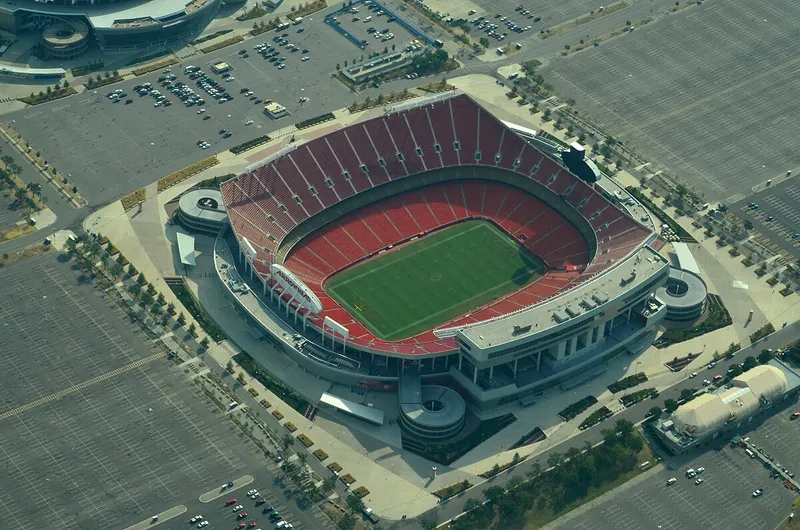
The Kansas City firm Kivett and Myers served as architect of record, implementing Deaton’s concept. Bob D. Campbell & Co. handled structural engineering. Construction was managed by a Sharp-Kidde-Webb joint venture. The playing field was sunk three stories below ground level. The seating bowl was raked at an aggressive angle for the era. The combination produced a natural amplifier. Sound funnels from the upper tiers downward and inward, trapping crowd noise in the bowl rather than dissipating it into the sky. An accidental acoustic effect at the time. A deliberate competitive advantage ever since.
On September 29, 2014, during a Monday Night Football game against the New England Patriots, Chiefs fans produced a crowd roar measured at 142.2 decibels. The Guinness World Record for the loudest crowd at an outdoor sports stadium. Louder than a jet engine at takeoff. The record had been set a year earlier at 137.5 dB, briefly lost to Seattle’s CenturyLink Field, and then reclaimed. The acoustic profile is effectively unrepeatable at newer venues, since modern accessibility codes require gentler seating rakes and wider concourse circulation than Arrowhead’s 1972 design allowed.
The stadium received a major renovation between 2007 and 2010, a $375 million project designed by Populous (the rebranded HOK Sport) that added premium seating, new video displays, a Chiefs Hall of Honor commemorating Lamar Hunt, and significant concourse upgrades. The bowl architecture was preserved entirely. Jackson County voters had passed a 2006 referendum to fund the renovation using a three-eighths-cent county sales tax extension. Capacity dropped marginally from the late-1990s peak of 79,451 to the current 76,416, largely to widen aisles and comply with updated fire and accessibility codes.
For the 2026 FIFA World Cup, Arrowhead has received another $50 million in targeted upgrades, focused on a new subsurface aeration and moisture management system beneath the natural NorthBridge Bermudagrass surface. Six matches have been assigned: four group stage games, one Round of 32 fixture, and one quarterfinal, with the first match on June 16, 2026. Under FIFA’s branding policy, the venue will be temporarily renamed “Kansas City Stadium” for the tournament. The Chiefs will continue as operators, but the atmosphere for international soccer will carry the same acoustic signature that has defined the venue for five decades of NFL play.
Getting to Arrowhead Stadium
Public Transit
Kansas City transit is limited. No subway, no light rail, and the RideKC streetcar does not extend to the Truman Sports Complex. Most fans drive. That said, a few options exist.
→ RideKC buses: Most routes are now fare-free. Route 47 Broadway connects downtown to the stadium area. On event days, Chiefs and RideKC partner on dedicated shuttle services from downtown locations.
→ Event-day shuttles for the 2026 World Cup: The local organising committee has announced expanded shuttle service from downtown Kansas City, the Power & Light District, and multiple transit hubs directly to the Truman Sports Complex. Details closer to the tournament.
Rideshare is the most flexible option if you are not driving. Transit works for regular Chiefs games if you are patient, but is not ideal for event-day crowds unfamiliar with the system.
Driving + Parking
Highway access is excellent. The Truman Sports Complex sits at the interchange of I-70 and I-435, the two main arteries for the Kansas City metro. GPS: 1 Arrowhead Drive, Kansas City, MO 64129.
→ From downtown Kansas City: I-70 East for around 13 kilometres (8 miles). Exit at Blue Ridge Cutoff, head south to Gates 2, 3, and 4. Without traffic, 15 minutes. Event day, 30-45 minutes.
→ From the east (via I-70): I-70 West to Blue Ridge Cutoff, south to Gates 2, 3, and 4. The primary approach, with the most parking lot access.
→ From the west (via I-70): I-70 East to the Manchester Exit, south on Manchester to Gate 5 or Raytown Road.
→ From the south (via I-435): I-435 North to the Raytown Road/Stadium Drive exit, enter through Gates 5 or 6.
→ From the north (via I-435): I-435 South to I-70 East, then Blue Ridge Cutoff south to Gates 2, 3, and 4.
Parking runs $35-60 across lots A through O. Red lots are the cheapest. Gold and Platinum lots (closer to the gates) cost more. Pre-purchase online, since cash is not accepted at the toll booths. Lots open early, since Chiefs tailgating is an institution. The real reason many fans arrive four or five hours before kickoff: the BBQ. Kansas City claims the title of American barbecue capital, and the Arrowhead parking lots on game day are arguably the most concentrated expression of that identity. Full smoker rigs. Competition-grade brisket. Burnt ends. Charcoal and propane grills are allowed, with footprint limited to 8 feet behind each parking space.
Rideshare
Uber and Lyft both operate designated pickup and drop-off zones near the stadium. A ride from downtown Kansas City runs $15-25 on a normal day, stretching to $40-60 each way with game-day surge. From Kansas City International Airport, rides typically cost $45-70. Post-event wait times run 20-40 minutes. Walking a few blocks away from the stadium to nearby roads can cut the wait noticeably.
From the Airport
→ Kansas City International Airport (MCI): Around 45 kilometres (28 miles) northwest of the stadium. Roughly 35-40 minutes by car without event traffic. Take I-29 South to I-435 East to I-70 East. Rideshare runs $45-70 depending on demand. No direct rail or express bus service. Fare-free RideKC buses reach the area but take significantly longer.
→ Charles B. Wheeler Downtown Airport (MKC): Around 19 kilometres (12 miles) west. Smaller airport, mostly private aviation and limited commercial service. 15-20 minutes by car.
FIFA World Cup 2026 at Arrowhead Stadium
Six matches have been assigned to Arrowhead Stadium: four group stage games, one Round of 32 fixture, and one quarterfinal. The first match at the venue is scheduled for June 16, 2026. Under FIFA’s branding policy, the stadium will be temporarily renamed “Kansas City Stadium” in all broadcasts, signage, printed materials, and ticketing. World Cup capacity will run roughly 3,400 seats below the regular Chiefs configuration to accommodate the wider FIFA pitch: see our journal article on why FIFA capacities differ from NFL capacities for the bowl-architecture breakdown.
Pitch upgrades: Approximately $50 million has been spent on venue-specific World Cup renovations, primarily on a new subsurface aeration and moisture management system beneath the natural grass surface. Arrowhead already plays on NorthBridge Bermudagrass year-round, which is a genuine operational advantage. Unlike several other 2026 venues that need to install temporary natural grass over synthetic turf, Arrowhead requires no surface swap.
Acoustic profile: The Guinness-record crowd noise is not just a Chiefs phenomenon. International soccer draws equally passionate crowds, and the bowl’s natural amplification will apply regardless of which national teams are playing. Early venue visits by FIFA technical inspectors specifically noted the acoustic environment as a differentiator.
Climate: Kansas City in June and July is hot and humid, with daytime highs around 30-33°C (86-91°F) and high humidity. Evening kickoffs are expected for most Arrowhead matches, which will help player comfort and European broadcast ratings. The stadium is fully open-air, with no canopy. Sunscreen and hydration remain essential for afternoon matches.
Fan Festival: The FIFA Fan Festival Kansas City will operate on the south lawn of the National World War I Museum & Memorial, a 10-minute drive from Arrowhead. Free admission, capacity for 25,000, giant screens for live match viewing, local food vendors (including BBQ), and entertainment stages. Expected to run for at least 18 days between June 11 and July 11, including every Arrowhead match day and every USMNT game day.
City presence: Kansas City is an unusual FIFA pick. Smaller metro than most host cities. No major Latin American population comparable to Miami, Los Angeles, or Houston. The assignment reflects FIFA’s confidence in the Chiefs organisation’s operational capacity, the acoustic uniqueness of the venue, and the city’s willingness to fund substantial infrastructure upgrades specifically for the tournament.
Construction & Design
The Truman Sports Complex was conceived in the mid-1960s as a response to a shared-venue problem. The Chiefs (then still the Dallas Texans, relocated in 1963) and the Kansas City Athletics were both playing at Municipal Stadium, a cramped shared facility that neither franchise wanted to keep using. Municipal had been the Athletics’ primary home since 1955. The Chiefs had been subletting since their arrival. After the Athletics moved to Oakland in 1968 and the Royals filled the baseball slot, Jackson County committed to building purpose-built replacements for both.
The 1967 bond measure raised $102 million for the dual-stadium project, approved by 60% of Jackson County voters. Groundbreaking was on July 11, 1968. The design concept came from Charles Deaton, a Denver architect Jack Steadman had befriended. Deaton proposed two separate stadiums, purpose-built for football and baseball, rather than the combined multipurpose bowl that was standard across American cities in the era. Kivett and Myers of Kansas City served as architects of record for both venues, implementing Deaton’s concept. Structural engineering on Arrowhead was handled by Bob D. Campbell & Co. General contracting was split between Sharp Brothers, Kidde Construction, and Webb Corporation in the Sharp-Kidde-Webb Joint Venture.
The original plan called for a rolling roof shared between Arrowhead and Kauffman, capable of sliding on rails from one venue to the other depending on which stadium was in use. The roof was cut during value engineering to reduce costs. Both stadiums opened open-air. For Kauffman, the result was a crisp outdoor baseball feel. For Arrowhead, the result was the acoustic environment that became the defining feature of the venue. With the field three stories below ground level and the upper deck sharply raked to maximise sightlines, sound concentrates in the bowl rather than dispersing upward. Crowd noise has nowhere to escape.
Arrowhead opened on August 12, 1972. The $43 million original cost worked out to approximately $331 million in 2025 dollars, unusually expensive for a 1970s NFL facility because of the shared-infrastructure investments with Kauffman. Capacity was initially listed at 78,097. It peaked at 79,451 during the late 1990s before a series of code-driven upgrades reduced it to the current 76,416. The largest crowd ever recorded was 82,094 on November 5, 1972, when Lamar Hunt christened the building and the Chiefs beat the Oakland Raiders 27-14. The capacity figure used for that game reflected temporary standing-room sections that were later removed.
The 2007-2010 renovation was a $375 million project, designed by Populous (the Kansas City firm that had recently rebranded from HOK Sport). The project kept the original bowl architecture intact and focused on revenue-generating additions: the Chiefs Hall of Honor (a tribute to Lamar Hunt and the franchise’s history), a horizon-level seating tier for luxury suite holders who preferred open-air seats, integrated Daktronics video displays in both end zones, approximately 1,625 feet of digital ribbon boards along the upper concourses, and significant concourse widening to improve fan flow. Funding came from a Jackson County sales tax extension approved in 2006, with Chiefs and Royals contributions proportionally allocated to each stadium.
More recent improvements have focused on the playing surface. NorthBridge Bermudagrass, a cold-tolerant hybrid variety, has been in place since 2013. The FIFA 2026 prep budget of approximately $50 million has been focused on a new subsurface aeration and moisture management system beneath the field, which is designed to maintain pitch firmness and drainage during summer match schedules. The NFL season runs through cold-weather conditions, but the World Cup will run through peak Midwest summer humidity, which is a different operational profile entirely.
History of Arrowhead Stadium
The Chiefs’ route to Arrowhead runs through Lamar Hunt’s broader gamble on American football. Hunt had tried to buy an NFL expansion team in the late 1950s and was told no, so his response was to launch a competing league. The American Football League started play in 1960 with Hunt’s own Dallas Texans as one of its founding franchises. The Texans won the 1962 AFL title but were sharing a crowded Dallas market with the NFL’s newly established Cowboys, which made both teams commercially miserable. Relocation became the least-bad option. Hunt moved the Texans to Kansas City in 1963, renamed them the Chiefs, and spent the next nine seasons at the shared Municipal Stadium while the Truman Sports Complex was being planned, funded, and built. The 1970 AFL-NFL merger, which Hunt himself had negotiated in secret back-channel meetings with Cowboys GM Tex Schramm, placed the Chiefs in the AFC West of the unified league. Hunt stayed on as principal owner until his death in December 2006. The family has kept control ever since, with his son Clark Hunt serving as current chairman and CEO.
Arrowhead’s opening preseason game, a 24-14 Chiefs win over the St. Louis Cardinals on August 12, 1972, introduced the venue to the public. The first regular-season game was a 20-10 Chiefs win over the Miami Dolphins on September 17, 1972. The all-time record crowd of 82,094 came on November 5, 1972 for Chiefs vs Raiders, the same day Hunt christened the building “Arrowhead Stadium.” That capacity figure included standing-room sections that were later removed during safety upgrades.
Notable events:
- January 1974: Hosted the NFL Pro Bowl. AFC defeated NFC 15-13.
- 1975: The Rolling Stones headlined one of the first major concerts at the venue.
- 1984: The Jacksons launched their Victory Tour at Arrowhead, with Michael Jackson headlining in front of massive crowds.
- 1996-2007: Kansas City Wizards (now Sporting Kansas City) used Arrowhead as their home venue before moving to the purpose-built Children’s Mercy Park in 2008.
- October 2013: Chiefs fans first set the Guinness World Record for loudest crowd at 137.5 dB, briefly before Seattle’s CenturyLink Field reclaimed it.
- September 29, 2014: Chiefs fans reclaimed the Guinness record at 142.2 dB during Monday Night Football vs the New England Patriots. The record has stood since.
- 2018-2022: The Chiefs hosted five consecutive AFC Championship Games, an NFL record, winning three on the way to Super Bowl appearances.
- March 2021: Naming rights partnership with GEHA (Government Employees Health Association) signed, making the stadium officially “GEHA Field at Arrowhead Stadium” through January 2031.
- July 8, 2023: Taylor Swift’s Eras Tour sold out the venue, with an estimated economic impact above $45 million for the Kansas City metro.
- September 18, 2023: Beyoncé’s Renaissance Tour ended its run at Arrowhead.
- April 13, 2024: Sporting KC vs Inter Miami, featuring Lionel Messi, drew 72,610 fans, the fourth-highest attended MLS event ever.
The combination of the Chiefs dynasty of the 2020s (three Super Bowl wins between 2019 and 2024), the Guinness acoustic record, and the annual five-hour tailgate culture has made Arrowhead one of the most recognised venues in American sports despite its relatively small-market location. The FIFA 2026 assignment brings Kansas City onto the global sports calendar in a way that Lamar Hunt would likely have found fitting, given his decades of work on American soccer’s development, including co-founding Major League Soccer in 1993 and the Kansas City Wizards franchise that played at Arrowhead for its first 12 seasons.
Sources & Further Reading
Starting with official references. The Chiefs operate a stadium-specific page at chiefs.com/stadium covering ticketing, premium seating, and event calendars. The Kansas City Sports Commission, which is coordinating the local organising committee effort for the 2026 World Cup, runs kc2026.com with tournament-specific visitor information, shuttle planning, and fan festival details.
For 2026 match schedules and venue assignments, the FIFA official page (fifa.com) remains the authoritative source.
Transit planning runs through two agencies. RideKC (ridekc.org) covers Kansas City’s fare-free bus network and streetcar, with event-day shuttle information posted closer to match dates. The KC2026 transportation plan adds dedicated World Cup service beyond regular RideKC operations.
Historical depth is best found on Wikipedia (en.wikipedia.org/wiki/Arrowhead_Stadium), which remains the most comprehensive single reference on the 1968 groundbreaking, the Hunt family’s original vision, and the venue’s subsequent renovations. The Truman Sports Complex page (en.wikipedia.org/wiki/Truman_Sports_Complex) covers the dual-stadium concept in additional detail, including Kauffman Stadium’s parallel construction and the originally planned rolling roof.
Quick Facts
Everything you need at a glance.
Stadium specs
- Capacity
- 76,416
- Opened
- 1972
- Cost
- $43 million (1972) + $375 million renovation (2007-2010) (~$331 million (1972 build in 2025 dollars) today)
- Roof
- Open Air
- Surface
- Natural Grass (NorthBridge Bermudagrass)
- Tenants
- Kansas City Chiefs (NFL)
- WC 2026
- Quarterfinal · 6 matches
- First WC match
- June 16, 2026
Construction & location
- Groundbreaking
- July 11, 1968
- Architects
- Kivett and Myers, Populous (2007-2010 renovation)
- Engineering
- Bob D. Campbell & Co. Structural Engineers
- General contractor
- Sharp-Kidde-Webb Joint Venture
- Address
- 1 Arrowhead Drive, Kansas City, MO 64129, USA
- GPS
- 39.0489°N, 94.4839°W
Photo Gallery
Fun Facts
Guinness World Record for the loudest crowd roar at an outdoor sports stadium. 142.2 decibels, set on September 29, 2014 during Monday Night Football against the New England Patriots. Louder than a jet engine at takeoff.
The playing field sits three stories below ground level. Combined with the steep seating tiers, this creates a natural amplifier that traps and focuses crowd noise onto the field. A design that cannot be replicated at modern venues due to current accessibility regulations.
The original 1967 concept included a shared rolling roof between Arrowhead and neighbouring Kauffman Stadium. It was cut to save costs. Both stadiums have been open-air ever since, which, for Arrowhead, turned out to help the acoustic profile considerably.
Stadium Location
Frequently Asked Questions
- What is the seating capacity of Arrowhead Stadium?
- Seating capacity is 76,416, which makes Arrowhead the fourth-largest NFL stadium and the largest sports venue in Missouri. The all-time record crowd of 82,094 was set on November 5, 1972 for Chiefs vs Raiders, when the venue's end zone configuration allowed higher standing-room totals. For the 2026 World Cup, end zone corner seating will be reduced to accommodate the wider FIFA pitch dimensions.
- Where is Arrowhead Stadium located?
- 1 Arrowhead Drive, Kansas City, Missouri 64129, within the Truman Sports Complex on the east side of Kansas City. Around 13 kilometres (8 miles) east of downtown, between I-70 to the north and I-435 to the south. Kauffman Stadium, home of the Kansas City Royals, sits directly adjacent to the north.
- What World Cup 2026 matches will be played at Arrowhead Stadium?
- Six matches, including four group stage games, one Round of 32 fixture, and one quarterfinal. First match is scheduled for June 16, 2026. Under FIFA's branding policy, the venue will be temporarily renamed 'Kansas City Stadium' in all broadcasts, signage, and printed materials throughout the tournament.
- How do I get to Arrowhead Stadium by public transit?
- Kansas City public transit is limited compared to larger US cities. There is no subway or light rail that reaches the stadium. Most RideKC bus routes are now fare-free, and Route 47 Broadway connects downtown to the stadium area on event days. For the 2026 World Cup, the local organising committee has announced expanded shuttle service from downtown Kansas City, the Power & Light District, and other transit hubs directly to the Truman Sports Complex.
- How much is parking at Arrowhead Stadium and can I tailgate?
- General parking runs $35-60 for NFL games across the various lots (A through O). Red lots are the cheapest. Gold and Platinum lots (closest to the gates) cost more. Pre-purchase is required; cash is not accepted at the toll booths. Tailgating is permitted in all lots. Charcoal and propane grills are allowed, with footprint limited to 8 feet behind the parking space. Arrowhead tailgating is a genuine Kansas City institution, and the BBQ scene in the lots ranks among the best in American sports.
- Is Arrowhead Stadium really the loudest stadium in the world?
- Yes, with a caveat. Arrowhead holds the Guinness World Record for the loudest crowd roar at an outdoor sports stadium. 142.2 decibels, set on September 29, 2014 during a Monday Night Football game against the New England Patriots. The stadium's design is the reason: the playing field sits three stories below ground level, and the steep seating tiers act as a natural amplifier. Chiefs fans first set the record at 137.5 dB in October 2013, briefly lost it to Seattle's CenturyLink Field, then reclaimed it in 2014. The outdoor-stadium qualifier matters. Indoor stadiums can technically reach higher decibel levels because enclosed spaces trap sound more efficiently.
- Why is it called GEHA Field at Arrowhead Stadium?
- In March 2021, the Chiefs announced a naming rights partnership with GEHA (Government Employees Health Association). The deal runs through January 2031, after which the name could change again. The 'Arrowhead Stadium' portion has been in place since Lamar Hunt christened it that way on November 5, 1972. Most fans and media still just say 'Arrowhead.'
- When was Arrowhead Stadium built?
- Groundbreaking was on July 11, 1968. Opening was on August 12, 1972, with the Chiefs defeating the St. Louis Cardinals 24-14 in a preseason game. The project was funded by a 1967 bond measure approved by Jackson County voters, which raised $102 million for the Truman Sports Complex housing Arrowhead and the Royals' Kauffman Stadium side by side. The original Arrowhead construction cost $43 million, approximately $331 million in 2025 dollars.
- Who designed and built Arrowhead Stadium?
- The architects of record were Kivett and Myers of Kansas City, who implemented a dual-stadium concept developed in collaboration with Denver architect Charles Deaton and Chiefs general manager Jack Steadman. Structural engineering was performed by Bob D. Campbell & Co. General contracting was executed by the Sharp-Kidde-Webb Joint Venture. The 2007-2010 renovation, which added premium seating, video boards, and the Chiefs Hall of Honor, was designed by Populous (the rebranded HOK Sport).
- How much did Arrowhead Stadium cost to build?
- Original 1972 construction cost $43 million, approximately $331 million in 2025 dollars. The 2007-2010 renovation added another $375 million (roughly $554 million in 2025 dollars), bringing lifetime investment to around $418 million nominal, well over $880 million adjusted. A further $50 million is being spent on 2025-2026 upgrades specifically to meet FIFA standards for the World Cup.
- Who owns Arrowhead Stadium?
- The stadium is owned by the Jackson County Sports Complex Authority, a public agency that also owns Kauffman Stadium. The Kansas City Chiefs operate the venue under a long-term lease that runs through 2030. This public-owner, private-operator structure is common in American sports, although the Hunt family's involvement in the original design, naming, and long-term stewardship has made the Chiefs' control of the venue unusually comprehensive.
- What is the surface at Arrowhead Stadium?
- NorthBridge Bermudagrass, installed in 2013 and used continuously since. The surface is re-sodded as needed between seasons. FIFA-specific upgrades completed in the 2025 offseason included a new subsurface aeration and moisture management system, to ensure the pitch meets the tournament's drainage and firmness standards. Natural grass is one of the operational advantages of hosting at Arrowhead. There is no need to install temporary grass over synthetic turf as required at several other 2026 venues.
- What is the best BBQ near Arrowhead Stadium?
- Kansas City claims the title of BBQ capital of America alongside Texas and Memphis. Joe's Kansas City Bar-B-Que (formerly Oklahoma Joe's) is the most famous and runs a gas-station location that routinely appears on national best-barbecue lists. Gates Bar-B-Q, known for its 'Hi, may I help you?' greeting, has multiple locations across the city. Jack Stack Barbecue runs an upscale BBQ experience. Q39 is a newer favourite. On game day, the best BBQ is often in the Arrowhead parking lot itself, where pitmasters who have been perfecting their craft for decades set up full smoker rigs, brisket, and burnt ends.
- Will Arrowhead Stadium be renamed for the World Cup?
- Yes. Under FIFA's corporate naming policy, all venues are referred to by neutral geographic names during the tournament. Arrowhead will be temporarily known as 'Kansas City Stadium' in broadcasts, signage, printed materials, and ticketing. Corporate naming rights resume after the tournament ends.
Last updated: 2026-04-17