About M&T Bank Stadium
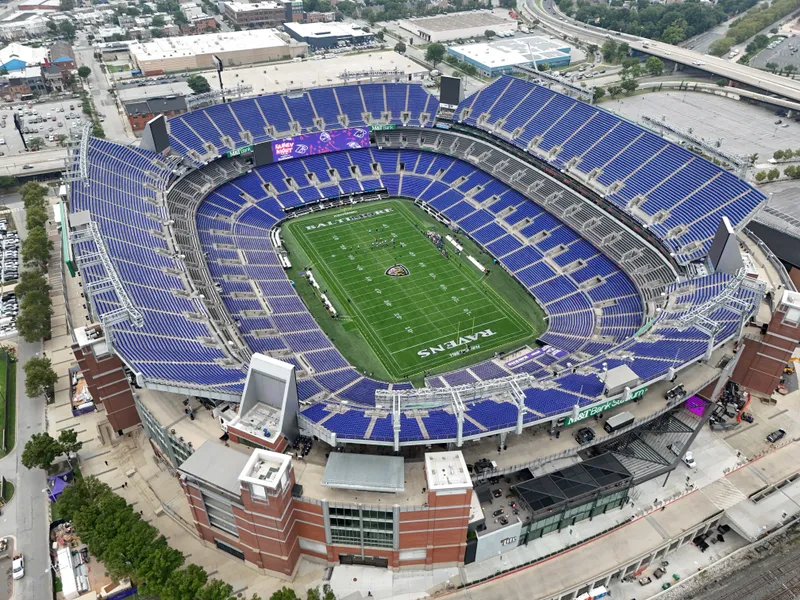
In the Camden Yards Sports Complex in downtown Baltimore stands a 70,257-seat open-air venue that has been home to the Baltimore Ravens since 1998, one of the most respected stadiums in the NFL. Adjacent to Oriole Park at Camden Yards, M&T Bank Stadium anchors one of America’s most acclaimed sports districts.
The Ravens have called this place home since their arrival from Cleveland in 1996, and the stadium has witnessed two Super Bowl championship teams (2000, 2012) and some of the most dominant defenses in NFL history. On fall Sundays, the purple-clad crowd and the Ray Lewis pregame dance tradition make M&T Bank Stadium one of the loudest and most intense environments in the league.
Designed by HOK Sport (now Populous), the same firm that designed neighboring Camden Yards, the $220 million stadium was completed in less than two years. At 1.6 million square feet, it stands 185 feet tall, 35 feet taller than Oriole Park next door. The stadium opened on natural grass on September 6, 1998, switched to an artificial surface from 2003 to 2015, and has been back on natural Bermuda grass since 2016.
In 2013, M&T Bank Stadium became the first existing outdoor pro sports facility in the United States to earn LEED Gold certification, a recognition of the Ravens’ commitment to sustainability. The stadium has hosted NCAA Lacrosse Championships, international soccer, major concerts, and served as a landmark in a city where sports and civic identity are deeply intertwined.
Getting to M&T Bank Stadium
Public Transit
M&T Bank Stadium is well served by Baltimore’s Light Rail system, with a station directly adjacent to the stadium.
→ Via Baltimore Light Rail: Take the Light Rail to Stadium/Federal Hill station, steps from the stadium gates. Lines run from Hunt Valley in the north and BWI Airport/Glen Burnie in the south through downtown. Fare: $2.
→ Via Charm City Circulator: The free Purple Route circulator bus connects Federal Hill, the Inner Harbor, and Penn Station, with stops near the stadium.
MTA adds extra Light Rail service before and after Ravens games. The Light Rail is the most convenient option, it connects directly to BWI Airport, Penn Station (Amtrak), and Park & Ride lots throughout the Baltimore metro.
Driving + Parking
The stadium address is 1101 Russell Street, Baltimore, MD 21230. I-95 and I-395 are the primary approaches.
→ From Washington, D.C. (~40 mi): I-95 North or Baltimore-Washington Parkway to I-395 into downtown. About 50 minutes.
→ From Philadelphia (~100 mi): I-95 South to I-395 exit. About 1 hour 45 minutes.
→ From Annapolis (~30 mi): I-97 North to I-695 to I-95 North. About 40 minutes.
Stadium lots open 4.5 hours before kickoff at $30–$50. The Camden Yards lots between the stadium and Oriole Park are the most popular and offer tailgating. Additional garages in Federal Hill and downtown run $20–$40. Pre-purchase through SpotHero or ParkWhiz.
Rideshare
Uber and Lyft have designated pickup and drop-off zones along Russell Street near the stadium. From Inner Harbor hotels, expect $6–$10. From BWI Airport, about $20–$30. Post-game surge pricing is moderate, walk toward Federal Hill or the Inner Harbor and wait 10–15 minutes for rates to settle.
From the Airport
→ Baltimore/Washington International (BWI): 7.3 miles south of the stadium, about 15–20 minutes by car. Major hub for Southwest Airlines. The Baltimore Light Rail connects BWI directly to Stadium station in about 25 minutes for $2. Rideshare runs $20–$30.
→ Reagan National (DCA): 37 miles south in Arlington, Virginia. About 50 minutes by car. Amtrak connects DCA to Baltimore Penn Station, then Light Rail to the stadium.
Construction & Design
The shared authorship with Oriole Park was deliberate. The Maryland Stadium Authority wanted its new football stadium to read as part of a single Camden Yards Sports Complex rather than a stand-alone arena, so it hired HOK Sport, the sports arm of Hellmuth, Obata & Kassabaum (since spun off as Populous), the same firm that had designed the ballpark next door. Structural engineering was led by Bliss & Nyitray, and construction was managed by a Whiting-Turner and Barton Malow joint venture. Ground was broken in July 1996 and the roughly $220 million stadium opened for its first NFL game on September 6, 1998, built in under two years.
The exterior consciously echoes Oriole Park and Baltimore’s industrial brick-and-steel vernacular. Brick arches at the base, dark Maryland-made brick and mortar, aluminum trim along the structural grid, and pewter-colored steel rakers support the upper decks, while large expanses of glass at the club lounges draw daylight in and frame views of downtown. The upper bowl is left open at each corner, a signature move that lightens the mass of the upper deck and opens sightlines to the city skyline. Inside, the seating bowl is finished in the Ravens’ signature purple, and the structure combines cast-in-place concrete columns and bents carrying precast concrete seating units with an upper deck framed on steel plate girders.
The stadium has been modernized in waves without altering its fundamental bowl or facade. A roughly $45 million program from 2013 to 2015 added stadium-wide Wi-Fi and LED displays. A three-year, roughly $120 million Ravens-funded renovation completed in July 2019, plus $24 million from the Maryland Stadium Authority, delivered two massive 4K RavensVision video boards in the end zones, encircling ribbon boards, new escalators and elevators to the upper deck, a new sound system, and a redesigned club level. In December 2023 the state and the Ravens announced a further multi-year renovation running through 2024 to 2026, deploying up to about $430 million of $600 million in authorized state funds. The venue was also the first existing outdoor pro-sports facility in the country to earn LEED Gold, in November 2013.
History of M&T Bank Stadium
M&T Bank Stadium was built to give the Ravens, who arrived from Cleveland in 1996, a permanent home in Baltimore. The $220 million project was designed by HOK Sport (now Populous) and funded through tax-exempt revenue bonds with debt service paid by Maryland lottery proceeds. Ground was broken in July 1996, and the stadium was completed in less than two years.
First Game (September 6, 1998): The Ravens hosted the Pittsburgh Steelers before a sellout crowd in the stadium’s NFL debut, a 20–13 Steelers win.
Super Bowl XXXV Season (2000): The Ravens’ defense, led by Super Bowl MVP Ray Lewis, delivered one of the greatest defensive seasons in NFL history. The stadium became a fortress, and the franchise had its first championship.
Super Bowl XLVII Season (2012): Ray Lewis announced his retirement, and the Ravens responded with a playoff run that ended in a 34–31 Super Bowl victory over the 49ers, the “Harbowl” coached by brothers John and Jim Harbaugh.
LEED Gold Certification (November 2013): M&T Bank Stadium became the first existing outdoor professional sports facility to earn LEED Gold status, recognizing energy efficiency improvements, waste reduction, and sustainable operations.
Lamar Jackson Era (2019–present): The unanimous 2019 MVP transformed the Ravens’ offense at M&T Bank Stadium, and his 2024 MVP season led Baltimore to the AFC Championship Game, returning the stadium to the center of the NFL’s biggest stage.
M&T Bank Stadium stands alongside Oriole Park at Camden Yards as the anchor of Baltimore’s sports identity, a stadium built in the shadow of a baseball cathedral that carved out its own fierce, purple-blooded legacy.
Sources & Further Reading
- Wikipedia entry on M&T Bank Stadium: en.wikipedia.org/wiki/M&T_Bank_Stadium. Construction, the surface history, naming changes, and renovations.
- Populous, M&T Bank Stadium project: populous.com. The architect’s account of the design and phased renovations.
- Stadiums of Pro Football, M&T Bank Stadium: stadiumsofprofootball.com. Construction, cost, and renovation history.
- Baltimore Ravens official stadium page: baltimoreravens.com. Events, parking, and gameday information.
Quick Facts
Everything you need at a glance.
Stadium specs
- Capacity
- 70,257
- Opened
- 1998
- Cost
- Around $220 million (1998); ~$144M renovations 2016-2019; further state-funded modernization ~$430M underway 2024-2026
- Roof
- Open
- Surface
- Natural Grass (Bermuda)
- Tenants
- Baltimore Ravens (NFL)
Construction & location
- Groundbreaking
- July 1996 (opened September 6, 1998)
- Architects
- HOK Sport (now Populous)
- Engineering
- Bliss & Nyitray
- General contractor
- Whiting-Turner / Barton Malow (joint venture)
- Address
- M&T Bank Stadium, 1101 Russell Street, Baltimore, MD 21230
- GPS
- 39.2780°N, 76.6227°W
Photo Gallery
Fun Facts
M&T Bank Stadium was the first existing outdoor professional sports facility in the United States to earn LEED Gold certification from the U.S. Green Building Council, awarded in November 2013.
The Johnny Unitas statue outside Gate A features the Hall of Fame quarterback's signature black high-top cleats, Ravens fans touch the left shoe for good luck before every home game.
HOK Sport (now Populous) designed both M&T Bank Stadium and neighboring Oriole Park at Camden Yards, making Baltimore's Camden Yards Sports Complex one of the most acclaimed stadium districts in America.
Stadium Location
Frequently Asked Questions
- What is the seating capacity of M&T Bank Stadium?
- M&T Bank Stadium seats 70,257 for NFL games. The stadium includes 124 luxury suites and 8,332 club seats. Capacity can be expanded for concerts and special events.
- Where is M&T Bank Stadium located?
- M&T Bank Stadium is at 1101 Russell Street in Baltimore, Maryland 21230. It sits adjacent to Oriole Park at Camden Yards in the Camden Yards Sports Complex, about 0.7 miles from the Inner Harbor.
- How do I get to M&T Bank Stadium by public transit?
- Take the Baltimore Light Rail to Stadium/Federal Hill station, it's directly adjacent to the stadium. Light Rail runs from Hunt Valley and BWI Airport through downtown. Fare is $2. The Charm City Circulator (free bus) also serves the area.
- Is there parking at M&T Bank Stadium?
- Stadium lots open 4.5 hours before kickoff at $30–$50. The Camden Yards lots between the stadium and Oriole Park are the most popular. Additional garages are available throughout downtown and Federal Hill. Pre-purchase through SpotHero for best rates.
- What was the stadium called before M&T Bank Stadium?
- The stadium opened as Ravens Stadium at Camden Yards in 1998, was renamed PSINet Stadium in 1999 after the internet company, briefly reverted to Ravens Stadium when PSINet went bankrupt in 2002, and became M&T Bank Stadium in 2003.
- What major events has M&T Bank Stadium hosted?
- The 2003 Army-Navy Game, NCAA Men's Lacrosse Championships (2010, 2011, 2014), 2013 and 2015 CONCACAF Gold Cup Quarterfinals, Beyoncé and Jay-Z's On the Run II Tour, and a 2012 Tottenham vs. Liverpool friendly.
- How far is the airport from M&T Bank Stadium?
- Baltimore/Washington International (BWI) is 7.3 miles south of the stadium, about 15–20 minutes by car. The Baltimore Light Rail connects BWI to the Stadium station directly. Rideshare from BWI runs $20–$30. Reagan National (DCA) is 37 miles away, about 50 minutes.
Last updated: 2026-07-04