About Coors Field
In Denver’s LoDo neighbourhood, a 50,144-seat ballpark stands roughly a mile above sea level, where the Colorado Rockies play baseball, baseballs fly farther than anywhere else in the major leagues, and the Rocky Mountains rise beyond the outfield on clear days. It is one of the most distinctive and dramatic settings in American sports.
The Rockies have called Coors Field home since 1995, after two seasons at Mile High Stadium. Built for $215 million and designed by HOK Sport (now Populous), the park was part of a wave of retro-style ballparks inspired by Camden Yards, but Coors Field’s defining feature isn’t its architecture. It’s the altitude. A mile above sea level, the thin air allows baseballs to travel approximately 9% farther than at sea level. Curveballs break less. Fly balls that die as warning-track outs in San Francisco become home runs in Denver. This is the most prolific hitting park in baseball history.
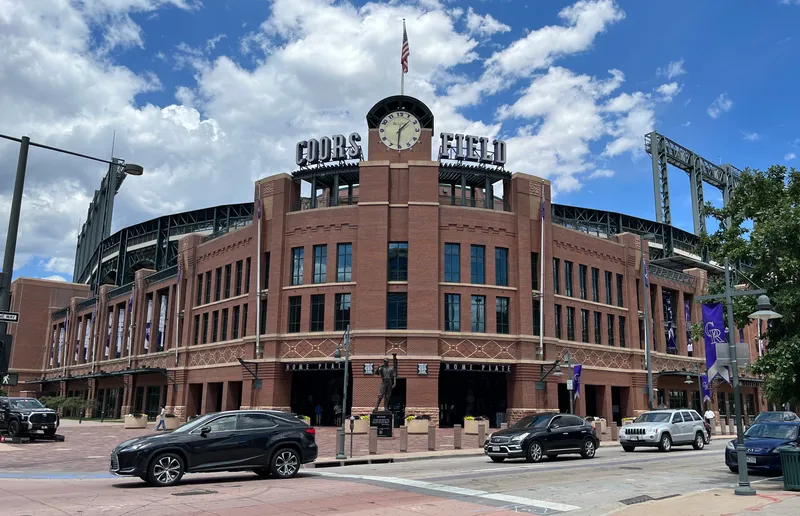
The red-brick facade integrates with the LoDo warehouse district, the Rockpile bleachers offer $4 tickets, and Row 20 of the upper deck is painted purple to mark the exact elevation of one mile. The Rockies introduced a humidor in 2002 to store baseballs at controlled temperature and humidity, reducing home runs by roughly 25% but not eliminating the Coors Effect entirely.
Coors Field didn’t just give Denver a ballpark, it catalysed the revitalization of LoDo. Before the park opened, Lower Downtown was largely abandoned warehouses. Today it’s one of the busiest neighbourhoods in the city, with Union Station, Larimer Square, and the RiNo Art District all within walking distance.
Getting to Coors Field
Public Transit
Coors Field sits in LoDo, served by RTD light rail, commuter rail, and bus. Union Station is the transit hub.
→ Via RTD Light Rail / Commuter Rail: Union Station, served by the A Line (DIA), B, C, E, and W lines, is a 15-minute walk northwest of the park along Wynkoop or Wazee streets. Fare is $3.00–$5.25 depending on zone.
→ Via 16th Street Mall Shuttle: The free MallRide shuttle runs along the 16th Street Mall. Exit at Market Street and walk four blocks north to the park.
The A Line from Denver International Airport to Union Station (37 minutes, $10.50) is one of the best airport-to-ballpark transit connections in baseball. Walk to the game straight from the train.
Driving + Parking
The ballpark address is 2001 Blake Street, Denver, CO 80205. I-25 to the Park Avenue/20th Street exit is the primary approach.
→ From Colorado Springs (~70 mi): I-25 North to the Park Avenue exit. About 1 hour 10 minutes.
→ From Boulder (~30 mi): US-36 East (Denver-Boulder Turnpike) to I-25 South to 20th Street. About 40 minutes.
→ From Fort Collins (~65 mi): I-25 South to the Park Avenue exit. About 1 hour.
Lot A on Wazee Street costs $20–$30. Surrounding LoDo garages run $15–$25. Street metered parking in LoDo and RiNo is available but competitive on game days. Many fans park at Union Station and walk, or take the light rail from suburban stations.
Rideshare
Uber and Lyft have designated zones on Park Avenue near the park’s north entrance. From downtown Denver hotels, expect $6–$10. From Cherry Creek, $12–$18. Post-game surge is moderate, walk to Union Station or Larimer Square and hail from there to avoid the crowds.
From the Airport
→ Denver International (DEN): 24 miles northeast of the ballpark, about 30–40 minutes by car. Major hub for United and Frontier with extensive domestic and international service. The RTD A Line commuter rail connects DIA to Union Station in 37 minutes for $10.50, walk 15 minutes to the park. Rideshare runs $35–$55.
Construction & Design
Coors Field was supposed to be smaller. When Denver won an expansion team in 1991, the plan was a 43,000-seat park, but the Rockies’ first two seasons at Mile High Stadium drew such enormous crowds, over 4.4 million in 1993, still an all-time record, that the design grew past 50,000 seats before it ever opened. HOK Sport, the firm behind Camden Yards, drew it in the retro-classic style sweeping baseball at the time: a red-brick facade, an asymmetric outfield, and hand-set touches, all stitched into LoDo’s old warehouse district. Ground broke in 1992, the park opened on April 26, 1995, and it cost about $215 million, most of it covered by a six-county sales tax.
Then the altitude took over the story. A mile up, the air is thin and dry, and baseballs fly. Coors Field became the highest-scoring park in the majors almost overnight, a place where routine fly balls carried over the fence and pitchers’ ERAs went to die. The Rockies fought back with engineering. In 2002 they installed a walk-in humidor that stores the game balls at 70 degrees and 50 percent humidity, adding just enough moisture to take some of the life out of them, and home runs dropped by roughly a quarter. The Coors Effect never fully went away.
The building wears its geography openly. A single row of purple seats rings the upper deck at exactly 5,280 feet, one mile up, and the outfield opens toward the Rocky Mountains on a clear evening. What Denver got was not just a ballpark but the lever that pried Lower Downtown out of decades of neglect and turned it into the busiest district in the city.
History of Coors Field
Coors Field was built to give the Colorado Rockies a permanent home after two record-breaking seasons at Mile High Stadium, where the expansion franchise drew over 4.4 million fans in 1993, the highest single-season attendance in MLB history. The $215 million project, designed by HOK Sport (now Populous), broke ground in 1993 on a former railroad site in LoDo.
First Game (April 26, 1995): The Rockies defeated the New York Mets 11–9 in a 14-inning marathon before 47,228 fans. The high-scoring game was a fitting debut for what would become baseball’s most prolific hitting park.
Hideo Nomo’s No-Hitter (September 17, 1996): Nomo threw a no-hitter for the Dodgers at Coors Field, considered one of the most remarkable pitching feats in modern baseball, given the park’s reputation as a hitters’ paradise. No pitcher has thrown a no-hitter at Coors Field since.
2007 Rocktober: The Rockies won 21 of their final 22 games to clinch a Wild Card spot, then swept the Diamondbacks and the Phillies to reach the World Series for the first and only time. They were swept by the Boston Red Sox in the Fall Classic, but the run remains one of the most electrifying stretches in baseball history. Coors Field was rocking.
The Humidor (2002): The Rockies began storing baseballs in a humidor at 70°F and 50% humidity before games, adding moisture that made the balls heavier and less lively. Home runs dropped approximately 25%. The innovation was controversial but effective, and MLB eventually adopted similar protocols league-wide.
All-Star Games (1998 and 2021): Coors Field has hosted the Midsummer Classic twice. The 1998 game was a fitting 13-8 shootout and drew a park-record crowd of 51,267; the 2021 All-Star Game was relocated to Denver on short notice and turned into a celebration of Colorado’s mountain-baseball experiment.
From the mile-high elevation to the purple row to Rocktober, Coors Field is one of baseball’s most distinctive venues, a place where the altitude, the setting, and the LoDo energy make every game feel a little different than anywhere else.
Sources & Further Reading
- Ballparks of Baseball, Coors Field: ballparksofbaseball.com. Capacity, cost, dimensions, and the humidor.
- Colorado Rockies official ballpark guide: mlb.com/rockies/ballpark. Tickets, the Rockpile, and visitor information.
- Denver Gazette, “Coors Field hosts Denver’s first MLB All-Star Game”: denvergazette.com. The 1998 All-Star Game.
- Wikipedia, Coors Field: en.wikipedia.org/wiki/Coors_Field. Construction, altitude effects, and event history.
Quick Facts
Everything you need at a glance.
Stadium specs
- Capacity
- 50,144
- Opened
- 1995
- Cost
- $215 million (1995) (~$440 million (2025 dollars) today)
- Roof
- Open
- Surface
- Natural Grass (Kentucky Bluegrass Blend)
- Tenants
- Colorado Rockies (MLB)
Construction & location
- Groundbreaking
- October 1992
- Architects
- HOK Sport (Populous)
- Address
- 2001 Blake Street, Denver, CO 80205, USA
- GPS
- 39.7562°N, 104.9949°W
Photo Gallery
Fun Facts
Coors Field is the highest ballpark in the major leagues, its playing field about 5,200 feet above sea level, where the thin air lets baseballs travel roughly 9% farther than at sea level, making it the most prolific home run park in MLB history and giving rise to the 'Coors Effect.'
The Rockies introduced a humidor in 2002 to store baseballs at 70°F and 50% humidity before games, reducing home runs by approximately 25%, one of the most significant rule-bending innovations in modern baseball, later adopted by other teams.
Row 20 of the upper deck is painted entirely purple to mark the elevation of exactly one mile (5,280 feet) above sea level, the only row of seats in any American stadium that denotes a specific geographic milestone.
Stadium Location
Frequently Asked Questions
- What is the seating capacity of Coors Field?
- Coors Field seats 50,144 for MLB games. The original capacity was 50,200 when it opened in 1995. The Rockpile section in center field offers $4 day-of-game tickets on a first-come basis, one of the best deals in baseball.
- Where is Coors Field located?
- Coors Field is at 2001 Blake Street in Denver, Colorado 80205. It sits in the LoDo (Lower Downtown) neighbourhood, adjacent to Union Station and the RiNo Art District, about six blocks from the 16th Street Mall.
- How do I get to Coors Field by public transit?
- RTD Light Rail lines A (to/from DIA), B, C, E, and W all stop at Union Station, a 15-minute walk from the ballpark. The free 16th Street Mall shuttle connects downtown to within a few blocks of the park. RTD bus routes 0, 6, and 44 also serve the area.
- Is there parking at Coors Field?
- Lot A on Wazee Street costs $20–$30. Surrounding LoDo garages and surface lots run $15–$25, with rates increasing closer to the park. Street metered parking is available in surrounding neighbourhoods but fills quickly. Walking from Union Station or the 16th Street Mall is the easiest option.
- What is the purple row at Coors Field?
- Row 20 of the upper deck is painted entirely purple to mark the elevation of exactly 5,280 feet (one mile) above sea level. The rest of the seats are green. It is the most photographed seating feature in any American ballpark.
- Why do so many home runs happen at Coors Field?
- At roughly 5,200 feet, the thin air provides less resistance, allowing baseballs to travel approximately 9% farther than at sea level. Curveballs and sliders also break less, benefiting hitters. The Rockies introduced a humidor in 2002 to store baseballs and reduce the effect, cutting home runs by roughly 25%.
- What is the Rockpile?
- The Rockpile is a 2,300-seat bleacher section in center field where the Rockies sell $4 day-of-game tickets on a first-come, first-served basis. It is one of the best deals in professional sports and a tradition dating to the park's opening in 1995.
- How far is the airport from Coors Field?
- Denver International Airport (DEN) is 24 miles northeast of the ballpark, about 30–40 minutes by car. The RTD A Line commuter rail connects DIA to Union Station in 37 minutes for $10.50, one of the best airport-to-ballpark transit connections in baseball. Rideshare runs $35–$55.
Last updated: 2026-07-10