About Petco Park
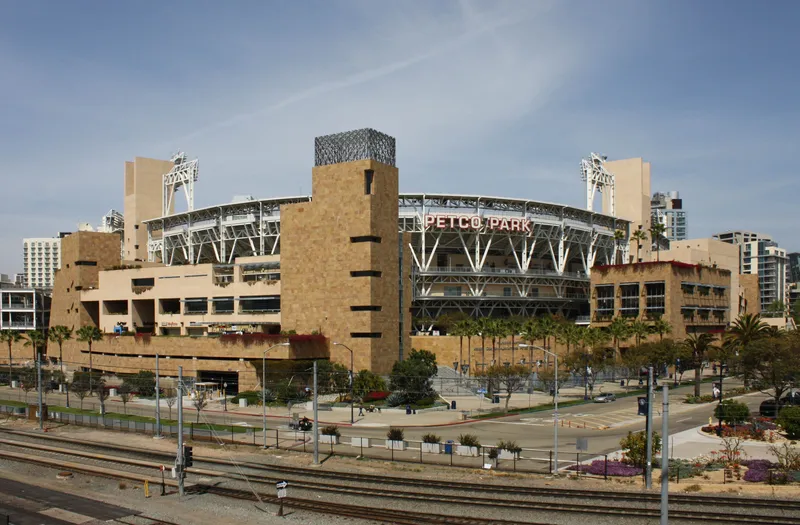
In San Diego’s East Village, a 39,860-seat ballpark hosts Padres baseball under some of the best weather in the sport, the 1909 Western Metal Supply Co. building anchoring left field and the downtown skyline rising beyond the outfield. It is one of the most beautiful ballparks in America, and it might have the best climate of any stadium in professional sports.
The Padres moved here in 2004 after 35 seasons at Qualcomm Stadium (then Jack Murphy Stadium). Built for $450 million and designed by Populous and Antoine Predock, Petco Park was the centrepiece of a massive redevelopment of San Diego’s East Village, a neighbourhood that was largely surface parking lots and abandoned warehouses before the ballpark arrived. The architects made a bold decision to incorporate the Western Metal Supply Co. building rather than demolish it, turning a century-old brick warehouse into the park’s most distinctive feature.
The Western Metal Supply Co. building serves as the left-field foul pole at 336 feet, with rooftop seating, luxury suites, and a team store. Beyond center field, Gallagher Square, a 2.8-acre grassy hillside, lets fans watch the game from a berm or enjoy the park as public green space on non-game days. A statue of Tony Gwynn, the greatest Padre, stands there as a permanent tribute to “Mr. Padre.”
Petco Park hosted the 2016 MLB All-Star Game, the 2006 World Baseball Classic championship, and served as a neutral site for the 2020 postseason bubble. The park’s combination of architecture, weather, and downtown setting makes it a destination that transcends the team, though the Padres’ emergence as contenders under Fernando Tatis Jr. and Manny Machado has made game-day energy something special.
Getting to Petco Park
Public Transit
Petco Park is one of the most transit-accessible ballparks in baseball. The MTS Trolley serves multiple stations within walking distance of the park.
→ Via MTS Trolley: The Blue, Orange, and Green lines stop at 12th & Imperial station, a 5-minute walk south of the park. The Green Line also stops at Gaslamp Quarter station, even closer to the main gates. Fare is $2.50 with a PRONTO card.
→ Via Bus: MTS bus routes 3, 11, and 901 serve stops near the park on Park Boulevard and Harbor Drive. The 992 airport shuttle connects SAN to downtown.
The trolley runs late on game nights and is by far the easiest way to reach and leave the park. Parking in the East Village is expensive and traffic post-game is slow, take the trolley.
Driving + Parking
The ballpark address is 100 Park Boulevard, San Diego, CA 92101. I-5 and I-15 are the primary approaches from north and south.
→ From Los Angeles (~120 mi): I-5 South to the 10th Avenue exit, east to Park Boulevard. About 2 hours without traffic.
→ From Orange County (~95 mi): I-5 South to the 6th Avenue exit. About 1 hour 30 minutes.
→ From Tijuana (~20 mi): I-5 North from the San Ysidro border crossing to the 10th Avenue exit. About 20–30 minutes plus border wait.
The Padres Parkade on 12th Avenue costs $30–$50. East Village garages run $20–$40. Street metered parking fills early. Many fans park in the Gaslamp Quarter or Little Italy and walk, the downtown grid makes it easy.
Rideshare
Uber and Lyft have designated zones on 14th Street near the park’s east entrance. From the Gaslamp Quarter, expect $6–$8. From Mission Beach, $12–$18. Post-game surge is moderate, walk to the Gaslamp and grab a ride there to avoid the crowds.
From the Airport
→ San Diego International (SAN): 4 miles northwest of the park, about 8–12 minutes by car. Major hub for Southwest Airlines with extensive domestic service. The 992 bus connects the airport to downtown for $2.50. Rideshare runs $10–$15. One of the shortest airport-to-ballpark trips in baseball.
Construction & Design
Petco Park was the anchor of a bet: that a ballpark could drag a derelict quarter of downtown San Diego into the twenty-first century. Voters approved it in 1998, ground broke in May 2000, and after a lawsuit-driven delay the park opened on April 8, 2004. Final cost ran about $450 million, a little more than half of it public money. Populous, then still HOK Sport, led the design, but the distinctive hand belongs to San Diego architect Antoine Predock, who wrapped the structure in sand-colored stucco and Indian sandstone meant to echo the region’s cliffs and the walls of Balboa Park. Thornton Tomasetti engineered it. A Clark Construction joint venture built it.
The signature move was preservation, not construction. The Western Metal Supply Co. building, a four-story brick warehouse from 1909, stood in what would become left field. Rather than level it, the architects turned its southeast corner into the left-field foul pole, 336 feet from home plate, and filled the rest with suites, a team store, and rooftop bleachers. It is the only foul pole in baseball with leasable office space behind it.
Beyond center field sits Gallagher Square, a 2.8-acre grass berm where fans watch for a few dollars and neighborhood kids play on days with no game. The whole thing reads less like a stadium dropped into a city than a city block that happens to contain a ballpark.
History of Petco Park
Petco Park was built to replace Qualcomm Stadium and catalyse the redevelopment of San Diego’s East Village. The $450 million project, designed by Populous and Antoine Predock, broke ground in 2000 after a contentious public vote. The architects studied the neighbourhood’s industrial heritage and made the Western Metal Supply Co. building the centrepiece of the design, a decision that defined the park’s identity.
First Game (April 8, 2004): The Padres lost to the San Francisco Giants 4–3 in 10 innings before a sellout crowd. The park was an instant sensation, praised for its sightlines, the Western Metal building, and the Gaslamp Quarter location.
2006 World Baseball Classic (March 2006): Japan defeated Cuba 10–6 in the inaugural WBC Championship at Petco Park, bringing international baseball to San Diego on one of the sport’s biggest stages.
2016 MLB All-Star Game (July 12, 2016): The American League defeated the National League 4–2 in a game that showcased Petco Park’s stunning setting, the San Diego skyline, the Western Metal building lit up at night, and the best weather of any All-Star Game in years.
2022 NLCS: The Padres reached the National League Championship Series for the first time since 1998, defeating the rival Dodgers in the Division Series before falling to the Phillies. Petco Park was electric, the loudest the building had ever been.
Tony Gwynn Tribute: The statue of Tony Gwynn in Gallagher Square was unveiled in 2007 and has become one of the most visited landmarks in the park. Gwynn, who spent his entire 20-year career with the Padres and hit .338 lifetime, is the soul of this franchise. He passed away in 2014, but his presence, from the statue to the retired number to the street named after him, permeates every corner of Petco Park.
From the preserved warehouse in left field to the grassy berm in center, Petco Park transformed downtown San Diego and gave the Padres a home that ranks among the finest in baseball, a place where the architecture, the weather, and the energy of the Gaslamp Quarter create a game-day experience unlike any other.
Sources & Further Reading
- Ballparks of Baseball, Petco Park: ballparksofbaseball.com. Capacity, cost, dimensions, and construction history.
- San Diego Padres official ballpark pages: mlb.com/padres/ballpark. Tickets, seating, and visitor information.
- Clark Construction, Petco Park project: clarkconstruction.com. The general contractor’s build record.
- Wikipedia, Petco Park: en.wikipedia.org/wiki/Petco_Park. Timeline, naming rights, and event history.
Quick Facts
Everything you need at a glance.
Stadium specs
- Capacity
- 39,860
- Opened
- 2004
- Cost
- $450 million (~$740 million (2025 dollars) today)
- Roof
- Open
- Surface
- Natural Grass (Bermuda/Ryegrass)
- Tenants
- San Diego Padres (MLB)
Construction & location
- Groundbreaking
- May 2000
- Architects
- Populous (HOK Sport), Antoine Predock
- Engineering
- Thornton Tomasetti
- General contractor
- Clark Construction / Nielsen Dillingham / Barnhart (JV)
- Address
- 100 Park Boulevard, San Diego, CA 92101, USA
- GPS
- 32.7075°N, 117.1575°W
Photo Gallery
Fun Facts
Petco Park incorporates the 1909 Western Metal Supply Co. building as its left-field structure, the four-story brick warehouse serves as the left-field foul pole at 336 feet, with rooftop seating, luxury suites, and a team store built into what was nearly demolished before preservationists intervened.
Gallagher Square (formerly Park at the Park) is a 2.8-acre grassy hillside beyond center field where fans can watch the game for free from an elevated berm, one of the only ballparks in America where you can see the action without a ticket.
Petco Park sits just 4 miles from the Mexican border, making it the closest MLB stadium to an international boundary, and its San Diego location gives it some of the best weather in baseball, with an average game-time temperature of 72°F and almost no rain delays.
Stadium Location
Frequently Asked Questions
- Which seats at Petco Park are in the shade?
- The third-base side, and you can work it out yourself once you know two things. The batter at Petco faces due north, which is unusual in baseball, so the afternoon sun comes from behind the third-base grandstand. And Petco numbers its sections outward from home plate rather than around the bowl, which means every even-numbered section is on the third-base and left-field side. Even equals shade. The shade itself falls from the deck above you, so the higher your row, the sooner it reaches you: in the lower bowl you want to be back far enough to sit under the Toyota Terrace overhang, and in the 200 level you want to be under the upper deck. Sources disagree on the exact row where the line falls, so treat any single row number you read online with suspicion and buy a few rows deeper than you think you need.
- Why are Petco Park's section numbers odd on one side and even on the other?
- Because the sections count outward from home plate in both directions instead of running sequentially around the ballpark. Odd numbers run up the first-base side and into right field. Even numbers run up the third-base side and into left field. Almost nobody tells you this, and it is the single most useful fact for buying a ticket here, because it turns the sun question, the shade question and the which-side-am-I-on question into one rule you can apply from your phone in about four seconds.
- Which Petco Park seats stay in the sun all game?
- The odd-numbered sections, which is to say the first-base line and right field, plus the upper right-field sections and the open lawn of Gallagher Square. Fans routinely report the sun straight in their eyes well into the evening on that side. There is also a trap that catches people who assume height means cover: the front rows of the upper deck are among the most exposed seats in the building, because there is no deck above you to cast a shadow. Up high is not the same as under something.
- Do you need a special ticket to go up on the Western Metal Supply Co. building?
- No, and this is the best-kept secret at Petco Park. The rooftop deck and the Budweiser Loft inside the 1909 warehouse are open to any ticket holder, not just suite holders, whenever they are not booked by a private group. You can buy the cheapest ticket in the ballpark and go stand on the roof of a landmarked brick warehouse with a drink. The only truly exclusive spaces in the building are the Foul Pole Suite and the Entertainment Suite, which are group rentals with minimum party sizes.
- Is the Western Metal building really the foul pole?
- Yes, literally. The southeast corner of the warehouse is the left-field foul pole, 336 feet from home plate, marked with a strip of bright yellow angle iron running up the brickwork. The building came first and the ballpark was drawn around it: architect Joe Spear has said that they built from the corner of the building and worked backwards. The whole park is rotated the way it is, and the batter faces north, because of a warehouse that was nearly demolished.
- Are the Rail seats on the Western Metal building worth it?
- Buy them for the experience, not the sightline. The Rail is a row of swivel chairs cantilevered off the building down the left-field line, and you are effectively sitting inside the foul pole looking straight down the line, which is a poor angle for following play on the right side of the field. What you get instead is room to stand, a drink rail, people to talk to, and the story. If you want to actually watch a pitcher work, sit somewhere else and visit the building between innings, which the ballpark lets you do.
- Is Petco Park still a pitcher's park?
- Yes, but not in the way the reputation suggests, and this is where most write-ups are a decade out of date. Petco still suppresses scoring hard, grading among the most run-suppressing parks in baseball. But home runs are close to neutral now. What Petco kills is everything short of a home run: it has been the only park in the majors posting badly suppressed factors for both doubles and triples, because the outfield is big enough to swallow balls in the gaps. So the balls that die at Petco are not the ones you would guess. They are the doubles.
- Why did the Padres move Petco Park's fences in?
- Because the ballpark was too good at killing offense and the club said so out loud. For the 2013 season the Padres brought right and right-center in by about 11 feet, lowered the wall on that side, pulled the deepest part of left-center in, and moved the visiting bullpen off the field. Executive chairman Ron Fowler's stated goal was to stop Petco being the most extreme run-suppressing ballpark in the majors, adding that it would still be a pitcher's park but no longer the outlier. Note that the 2015 work, which put in a new video board and table seating beneath it, was a separate project and changed no dimensions.
- Can you actually watch the game from Gallagher Square?
- Partly, and you should know that before you buy. The 2.8-acre lawn beyond center field, renovated for $20 million and reopened in 2024, gives you portions of the field, the skyline, and a very large video board. It is a place to hang out, not a vantage point, and a fan who buys a lawn ticket expecting to follow the game pitch by pitch will be disappointed. What it is good for is a cheap ticket, a blanket, and kids: there is a playground built around a 35-foot steel-and-wood bat, a wiffle-ball field where children can run the bases, a dog park and pickleball courts. Bring a blanket or a cushion; rigid folding chairs are not allowed. And any ticket in the ballpark lets you walk out to the lawn and back to your seat.
- Are there obstructed-view seats at Petco Park?
- Barely, and that is the honest answer. Petco was built in 2004 with a cantilevered upper deck, so there are no support columns standing in the seating bowl, which is the thing that ruins sightlines in older ballparks. Across the whole venue, fan-submitted reports flag only a scattered handful of individual seats, mostly for a railing, a set of stairs or a blocked corner of a scoreboard rather than a blocked view of the field. The real bad seat at Petco is not obstructed. It is sunbaked, and it is on the odd-numbered side.
Last updated: 2026-07-14