About Neyland Stadium
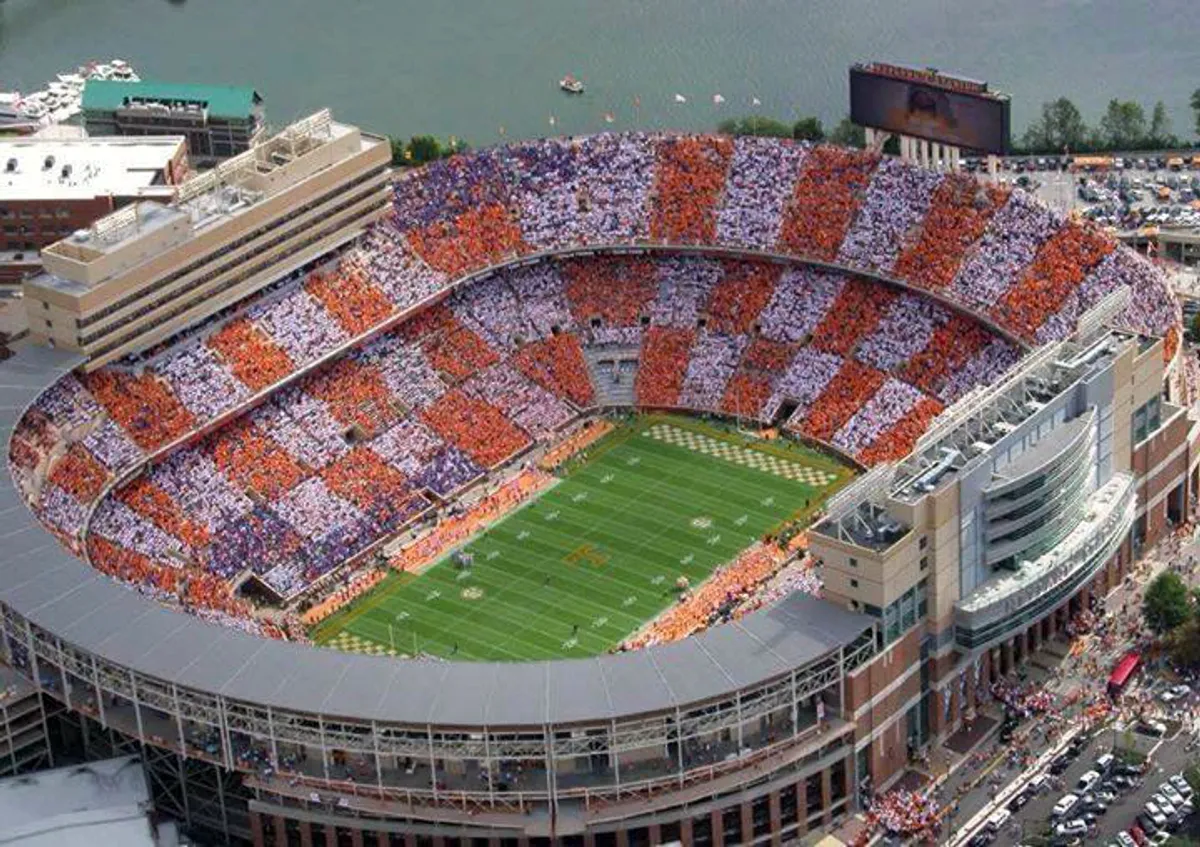
On the banks of the Tennessee River in Knoxville, wedged between campus and the water, Neyland Stadium enjoys a setting unlike any other in college football. With 101,915 seats, it is the sixth-largest stadium in the United States and one of the oldest. The first game was played here in 1921, when a single grandstand held 3,200 fans.
The stadium is home to the Tennessee Volunteers, and everything about it is built around tradition. Running Through the T, the Vol Navy, Checker Neyland, Rocky Top blaring from the speakers. Game day in Knoxville is a sensory overload that starts on the river and doesn’t stop until well after the final whistle. In November 2023, the crowd hit 137 decibels, setting a college football noise record.
The original Shields-Watkins Field was funded by a single donation of $42,000 in 1921. Over the next century, 16 expansions transformed a modest grandstand into a 101,915-seat colossus. The field was renamed Neyland Stadium in 1962 after General Robert Neyland, who coached Tennessee from 1926 to 1952 and compiled a 173-31-12 record across three stints interrupted by military service. The natural grass (Tifway Bermuda) is re-sodded annually.
Neyland has witnessed some of the most dramatic moments in SEC history. The 2022 upset of No. 3 Alabama, Tennessee 52 to Alabama 49, ended a 15-game losing streak and sent fans storming the field. They tore down the goalposts and threw them into the Tennessee River. The SEC fined Tennessee $100,000. Nobody in Knoxville cared.
Getting to Neyland Stadium
Public Transit
KAT (Knoxville Area Transit) operates game day shuttles that are the easiest way in without a car.
→ From Market Square (downtown): Take the KAT Market Square Shuttle from Krutch Park to Walters Life Sciences Building. $10 round trip, cashless only via the Transit app. Runs every 15 minutes starting 3 hours before kickoff.
→ From Civic Coliseum (park-and-ride): Park at Garage A or B ($25 per vehicle, includes shuttle) and ride to campus. A good option if you’re driving in from out of town.
Regular KAT bus routes 11, 12, and 15 stop at Cumberland and James Agee, two blocks from the stadium. A $2 day pass covers unlimited rides.
Driving + Parking
Neyland Stadium is on the UT campus, south of downtown Knoxville. GPS: “1235 Phillip Fulmer Way, Knoxville, TN 37916.”
→ From Nashville (~180 mi): I-40 East, about 2.5 hours. The most common route for SEC visitors.
→ From Chattanooga (~112 mi): I-75 North, about 1 hour 45 minutes.
→ From Asheville, NC (~108 mi): I-40 West through the Smoky Mountains, about 2 hours 10 minutes.
Blackstock Lot is the closest public option at $30 per car ($60 for RVs). The Civic Coliseum park-and-ride is $25 per vehicle with shuttle included. All lots open at 7:00 AM. The Fort Sanders neighborhood and Neyland Drive along the river are the prime tailgating spots. Arrive early to claim your territory.
Rideshare
Uber and Lyft operate in Knoxville. Drop-off is at Claxton Education Building on Volunteer Boulevard. Post-game pickup is at “The Hill” off Circle Drive near Cumberland Avenue. Wait times can be long. Police limit how many cars enter at once.
Pro tip: Walk north to Cumberland Avenue or east to Gay Street before requesting a ride. The congestion around the stadium is brutal after the game.
From the Airport
→ McGhee Tyson Airport (TYS): 13 miles south, about 18 minutes by car (30-45 minutes on game days). Served by Allegiant, American, Delta, Frontier, and United. The only nearby commercial airport.
Traditions of Neyland Stadium
Neyland Stadium’s identity is built on three traditions that make it unlike any other venue in college football. Running Through the T began on September 18, 1965. The Pride of the Southland Marching Band forms a giant “T” on the field, and players charge through the opening as 100,000 fans reach a crescendo. It’s considered one of the greatest player entrances in the sport.
The Vol Navy is a flotilla of 200-400 boats that dock along the Tennessee River on game days. “Sailgating” started in 1962 when broadcaster George Mooney, fed up with traffic, tied his boat to a tree on the riverbank. Today, the Vol Navy Boater’s Association organizes the flotilla, with boats decked in orange flags, live music, and Cajun-level food spreads lining the water.
Checker Neyland turns 101,915 fans into a human checkerboard. Inspired by a viral photoshopped image in September 2014, fans wear alternating orange and white by section. The first Checker Neyland game was October 4, 2014. Tennessee lost 10-9 to Florida, but the visual tradition stuck.
Construction & Design
Neyland Stadium is less a building than a hundred-year accumulation. It started in 1921 as Shields-Watkins Field, a single concrete grandstand seating 3,200, paid for by a $42,000 gift from Knoxville banker Colonel W.S. Shields and named partly for his wife, Alice Watkins-Shields. Ground was broken on March 21 that year. The first game came six months later. Almost nothing of that original structure survives in the bowl you see today.
What followed was sixteen separate expansions spread across the next century. Decks and grandstands went up in 1926 and 1929, the sides were enclosed through the 1930s and 1940s, upper decks arrived in the 1960s and 1970s, the north end was closed in 1980, and skyboxes were stacked on through the 1980s and 1990s. By the early 2000s the stadium had grown beyond 100,000 seats, the largest in the South. Every one of those projects bolted onto the last, which is why Neyland for decades felt like a venue assembled from spare parts rather than designed as one.
The first real attempt to fix that ran from 2004 to 2010. Knoxville firm McCarty Holsaple McCarty led a $136.4 million modernization in three phases: $26 million in 2006, $27.4 million in 2008, and an $83 million final push in 2010 that rebuilt the lower west stands, widened concourses, and added premium seating. It made the place more livable. It did not finish the job.
The current overhaul is the most ambitious yet. After a 2016 feasibility study with the architecture firm Populous, the university approved a master plan in 2017 carrying a $340 million price tag, with The Christman Company as construction manager. The work, underway since 2018, has rebuilt the lower bowl, widened the concourses again, added clubs and premium areas, and reshaped the south end, the “riverfront” side that gives arriving fans their first view of the stadium from the water.
Capacity now sits at 101,915, down from the early-2000s peak because modern seats are wider and the aisles have to be bigger. That is the trade every old stadium makes now: fewer bodies, more comfort. Neyland gave up a few thousand seats to stop feeling like it was built in fragments, which after a century of bolting on decks is probably the right call.
History of Neyland Stadium
The stadium began as Shields-Watkins Field, funded by a $42,000 donation from Colonel W.S. Shields in 1921. Students and faculty helped finish construction when funding ran out. The first game, Tennessee 27 and Emory & Henry 0, was played before 3,200 fans on September 24, 1921.
- First Game (September 24, 1921): Tennessee defeats Emory & Henry 27-0 in the stadium’s inaugural game. Capacity: 3,200.
- First Night Game (September 16, 1972): No. 7 Tennessee defeats No. 6 Penn State 28-21 under the lights for the first time.
- The Alabama Breakthrough (October 16, 1982): Tennessee 35, No. 2 Alabama 28. Johnny Majors snaps an 11-game losing streak to Bear Bryant.
- Pandemonium Reigns (September 19, 1998): No. 6 Tennessee beats No. 2 Florida 20-17 in overtime. Goalposts come down. Tennessee goes on to win the national championship.
- Record Attendance (September 18, 2004): 109,061 fans watch Tennessee defeat Florida 30-28.
- The Alabama Upset (October 15, 2022): No. 6 Tennessee 52, No. 3 Alabama 49. Chase McGrath’s 40-yard field goal ends a 15-game losing streak. Fans storm the field, tear down the goalposts, and throw them into the Tennessee River.
Sources & Further Reading
- Tennessee Athletics official site: utsports.com. Capacity, gameday policies, parking, ticketing, and renovation announcements.
- Neyland Stadium rules and policies: knoxvillestadium.com. Bag policy, prohibited items, and entry information.
- The Christman Company project page: christmanco.com. Construction manager’s overview of the current renovations.
- Football Stadium Digest: footballstadiumdigest.com. Coverage of the master plan and budget revisions.
- Wikipedia entry on Neyland Stadium: en.wikipedia.org/wiki/Neyland_Stadium. Construction history, expansions, capacity, and attendance records.
Quick Facts
Everything you need at a glance.
Stadium specs
- Capacity
- 101,915
- Opened
- 1921
- Cost
- $42,000 (1921 original); $136.4 million (2004-2010 program); $340 million (2017 approved master plan)
- Roof
- Open
- Surface
- Natural Grass
- Tenants
- Tennessee Volunteers (SEC)
Construction & location
- Groundbreaking
- March 21, 1921 (original); rebuilt across 16 expansions through 2025
- Architects
- McCarty Holsaple McCarty, Populous
- General contractor
- The Christman Company (2018-2025 renovations)
- Address
- 1235 Phillip Fulmer Way, Knoxville, TN 37916, USA
- GPS
- 35.9550°N, 83.9250°W
Photo Gallery
Fun Facts
Between 200 and 400 boats dock along the Tennessee River on game days for 'sailgating'. The Vol Navy tradition started in 1962 when a broadcaster boated to the game to avoid traffic.
Checker Neyland, where 101,915 fans wear alternating orange and white by section, started on October 4, 2014, after a viral photoshopped image inspired the idea.
After the 2022 upset of No. 3 Alabama, fans tore down the goalposts and threw them into the Tennessee River. The SEC fined Tennessee $100,000.
Stadium Location
Frequently Asked Questions
- What is the seating capacity of Neyland Stadium?
- Neyland Stadium holds 101,915 fans, making it the 6th largest stadium in the United States and 8th largest in the world. The record attendance was 109,061 on September 18, 2004.
- Who is Neyland Stadium named after?
- General Robert Neyland, who coached Tennessee football from 1926 to 1952 across three stints and compiled a 173-31-12 record. The stadium was renamed in his honor in 1962.
- What is the Vol Navy?
- The Vol Navy is a game-day tradition where 200-400 boats dock along the Tennessee River adjacent to Neyland Stadium for 'sailgating.' It started in 1962 when broadcaster George Mooney boated to games to avoid traffic.
- What is Checker Neyland?
- Checker Neyland is when fans wear alternating orange and white by stadium section, creating a checkerboard effect across all 101,915 seats. The tradition began October 4, 2014, and has become a signature visual of Tennessee home games.
- Where do you park for Neyland Stadium?
- Options include campus lots like Blackstock ($30/car), the Civic Coliseum park-and-ride ($25/vehicle including shuttle), and various private lots. All lots open at 7:00 AM. Season parking requires a minimum $100 donation to the Football Priority Fund.
- How do you get to Neyland Stadium without a car?
- KAT runs game-day shuttles from Market Square for $10 round trip. Regular bus routes 11, 12, and 15 stop two blocks from the stadium ($2 day pass). Rideshare drop-off is at Claxton Education Building on Volunteer Boulevard.
- What is Running Through the T?
- Before every home game, the Pride of the Southland Marching Band forms a giant 'T' on the field. Players and coaches run through the opening as 100,000+ fans roar. The tradition began September 18, 1965.
- How loud does Neyland Stadium get?
- Neyland Stadium set a college football noise record of 137 decibels during a 2023 game against Georgia. For context, that exceeds the pain threshold and rivals a jet engine at close range.
- When was Neyland Stadium built and renovated?
- The original Shields-Watkins Field opened September 24, 1921, seating 3,200. Sixteen expansions followed over the next century. A $136.4 million program rebuilt the concourses and skyboxes between 2004 and 2010, and a master plan first approved at $340 million in 2017 has been transforming the south 'riverfront' end and lower bowl since 2018.
- Where is Neyland Stadium located?
- Neyland Stadium is at 1235 Phillip Fulmer Way on the University of Tennessee campus in Knoxville, right on the bank of the Tennessee River. Downtown Knoxville and Market Square are about a mile north.
- Is Neyland Stadium grass or turf?
- Natural grass, re-sodded annually. Tennessee played on artificial turf from 1968 to 1993, then returned to grass in 1994 and has kept it ever since.
- Does Neyland Stadium have a roof?
- No. Neyland is fully open-air. Early-season games in Knoxville can be hot and humid, while November night games on the river turn cold fast, so check the forecast and dress for it.
- What is Neyland Stadium's bag policy?
- Neyland enforces a clear bag policy. Bags must be clear plastic, vinyl, or PVC and no larger than 12 by 6 by 12 inches, or a one-gallon clear resealable bag. One small clutch up to 4.5 by 6.5 inches is also allowed per person.
- Is there accessible seating at Neyland Stadium?
- Yes. Neyland offers ADA-accessible seating and companion seats throughout the stadium, plus accessible parking in designated lots. Fans needing specific accommodations should contact Tennessee ticketing in advance to arrange seats.
Last updated: 2026-07-10