About Lambeau Field
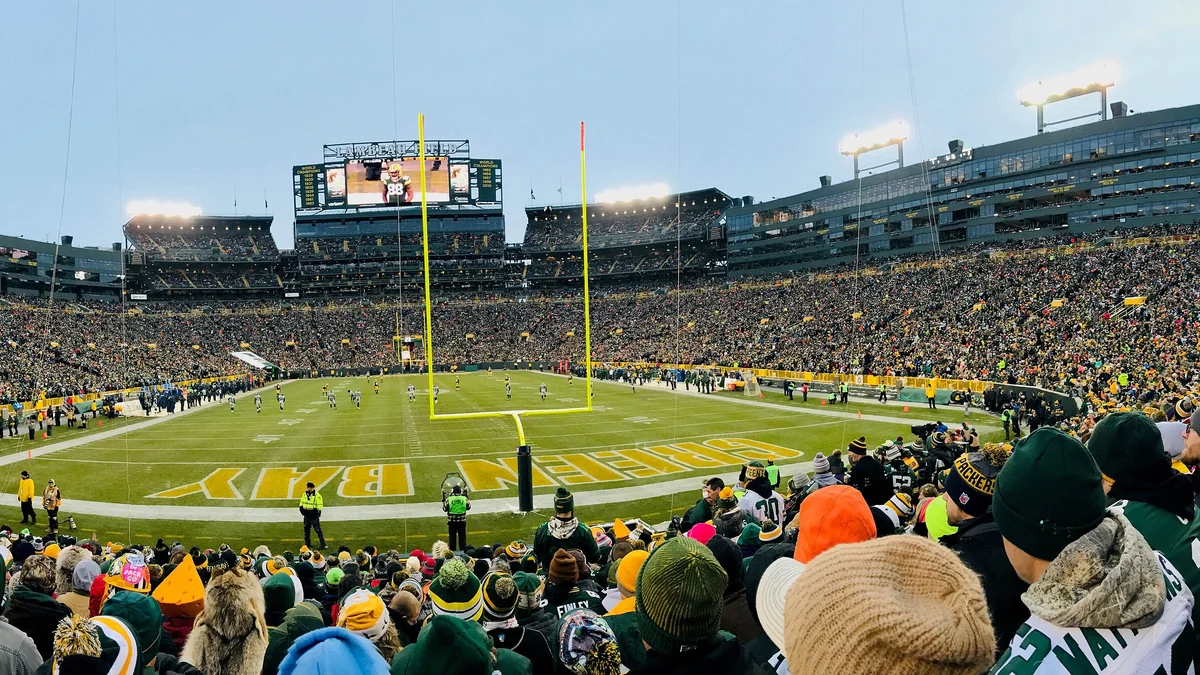
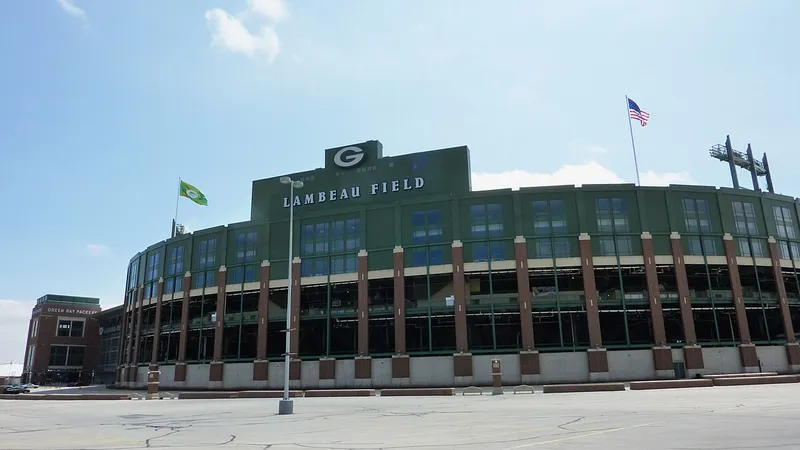
No ground in professional football carries more weight than the plot at 1265 Lombardi Avenue in Green Bay, Wisconsin. Lambeau Field is the oldest continuously occupied stadium in the NFL, and arguably its most hallowed. With 81,441 seats, it’s the second-largest in the league and the spiritual home of a franchise that has been here since 1919.
What makes Lambeau unique is its context. Green Bay has a population of roughly 107,000, by far the smallest market in major North American professional sports. The Packers are the only community-owned, non-profit franchise in the United States, with over 360,000 shareholders ensuring the team can never be moved. Every home game has been sold out since 1960. The waiting list passed 155,000 names in early 2026. The stadium has no corporate naming rights and never will, it’s simply Lambeau Field, named after the man who started it all.
The stadium was built in 1957 at a cost of $960,000, designed by Green Bay firm Somerville, Inc. It has been massively expanded since, from 32,150 seats to 81,441 through a $295 million redevelopment finished in 2003 and a second program begun in 2011 that the club puts at $286.5 million. The playing surface is SISGrass, a hybrid of 95% natural grass reinforced with synthetic fibers. Beneath the turf lies 34 miles of radiant heating pipe fed by 12 boilers producing 48 million BTUs, keeping the “Frozen Tundra” playable even in the depths of a Wisconsin winter.
Lambeau has hosted the Ice Bowl (1967), the 2025 NFL Draft, a Manchester City vs. Bayern Munich friendly before 78,128 fans (2022), NFC Championship Games, and major concerts from Paul McCartney to Billy Joel. Luke Combs played two nights in May 2026 and set the stadium concert record on the second of them.
Getting to Lambeau Field
Public Transit
Green Bay is a small city with limited but functional transit. Green Bay Metro bus routes 9 and 12 serve stops near the stadium. On game days, Lamers Express offers shuttle service from multiple pickup locations around the area, the most reliable transit option for visitors without a car.
Driving + Parking
Driving is how the vast majority of fans reach Lambeau Field. GPS: “1265 Lombardi Avenue, Green Bay, WI 54304.”
→ From Milwaukee (120 mi, ~2 hours): I-41 North to Green Bay, exit onto WI-172 West, then Oneida Street north to the stadium.
→ From Chicago (210 mi, ~3.5 hours): I-94 West to I-43 North through Milwaukee, continue to Green Bay, exit onto WI-172 West.
→ From Minneapolis (280 mi, ~4.5 hours): I-94 East to US-29 East, then I-41 South to WI-172 East, exit at Oneida Street.
The lots ringing the stadium are sold out to season parking pass holders, so plan on one of four routes instead. A limited number of individual passes for Lot 15 in Titletown go on sale online, digital only, with no tailgating permitted. Nearby lots run by PMI take reservations for single games. Private owners along the approach streets sell spaces for cash at whatever the day will bear. And many of the residential streets within walking distance are free. Accessible parking is $50 in Lots 4 and 7, first come, first served. The club’s own lots are cashless, as is everything else it runs.
Tailgating is permitted in all stadium lots except Titletown. Setup must stay within a 9x6 foot space behind your vehicle. Charcoal and propane grills are allowed; wood fires and turkey fryers are not.
Rideshare
Uber is the official rideshare partner. The designated pickup/drop-off zone is at the Bellin Health-Titletown lot behind Lodge Kohler. Green Bay’s small size keeps costs reasonable, $10-15 from the airport, $8-12 from downtown hotels. On game days, expect surge pricing after the final whistle.
From the Airport
→ Green Bay-Austin Straubel (GRB): Just 4 miles south, about 10 minutes by car, one of the shortest airport-to-stadium distances in the NFL. Airlines include American, Delta, and United.
→ Appleton International (ATW): 30 miles south, about 35 minutes. A viable alternative with additional flight options.
→ Milwaukee Mitchell (MKE): 120 miles south, about 2 hours via I-41. The nearest major hub with the most flight options.
Where to Sit, and What You Are Sitting On
Settle this before you buy a ticket: most of Lambeau Field is a bench.
Sections 100 to 138 and 300 to 354, most of the bowl, are bleacher seating with no backs. You get a seat number on a metal bench, and the company of whoever sits on either side of you. The Packers will rent you a seat back at the main gates for $10, and on a December afternoon that ten dollars is the difference between watching a game and enduring one. One exception is worth knowing: the south end built in the 2010s has real seats, its ticket sections end in the letter “s”, and those holders can walk straight past the rental line.
The bench is not an oversight. It is the building.
City Stadium opened with wooden bleachers and kept them for twelve seasons, so the Ice Bowl crowd watched Bart Starr’s sneak from planks. Aluminum arrived before the 1969 season, bolted onto the same brackets that had held the wood, and the changeover ran roughly $350,000, more than a third of what the whole stadium had cost to build twelve years earlier. Sit down today and you are sitting on a decision made in 1969.
The things nobody warns you about
Water. Two drinking fountains sit inside the Atrium, and the outdoor concourses have none at all. If you want tap water once you are in the bowl, the bar at the Verizon Loft on level 3 and the Bar and Grill at section 354 will give you some, and that is the whole list.
Cash. There is no such thing here anymore. Lambeau is cashless on game days and every other day, checks included. Free cash-to-card stations will load anything from $5 to $500 onto a card if you turn up with bills.
Beer. Alcohol is two per person per transaction, and sales stop at the end of the third quarter. Plan the fourth accordingly.
Arrival. Gates open two hours before kickoff, and bags have to be clear and no bigger than 12 by 6 by 12 inches.
Quiet. Section Yellow, at section 112, is a sober section that opens two hours before kickoff and runs to the final whistle. Barely advertised, and more useful than it sounds.
Who is actually selling you the bratwurst
Someone’s neighbor, usually. More than 90 schools, social service agencies and community groups staff the concession stands at every home game, raising an average of $140,000 per game for their own causes, keeping a share of what they sell and all of the tips. It is the most Green Bay thing about the building, and it is worth a little patience at halftime: the person working the till is a parent or a teacher on a fundraising shift, not a career cashier.
What to order: the Meat Packing Company, which exists only here, does giant bratwursts and cheese curds. Brew Pub Pizza is the official pizza of the Green Bay Packers, a sentence that tells you something about this franchise. The Miller Lite Endzone Market and Bar sits behind section 100 on the north side and holds nearly 400 people, which on a January afternoon is the most valuable real estate in Wisconsin.
Construction & Design
Lambeau was a first. When it opened on September 29, 1957, City Stadium was widely billed as the first built specifically for an NFL franchise, at a point when the rest of the league rented its ballparks from baseball clubs. A $960,000 bowl designed by the local firm Somerville, Inc., led by owner and architect John E. Somerville, with Richard Gustafson planning the sightlines after studying the stadium at his alma mater, Michigan, and built by Geo. M. Hougard and Sons. Vice President Richard Nixon sat in the crowd, as did NFL commissioner Bert Bell. For a franchise founded in 1919 in a town of barely 100,000, a permanent purpose-built home was a statement that the Packers were not going anywhere.
The bowl grew by filling itself in. It opened at about 32,000 seats, then climbed through a run of expansions: 38,669 in 1961, 42,327 in 1963, 50,852 in 1965, and 56,263 in 1970 once the end zones were fully enclosed. The shape you see now was set early. What came later was mostly stacked on top.
The modern stadium is really two big projects. The 2001-2003 redevelopment, a $295 million job by Ellerbe Becket with Turner Construction building it, wrapped the bowl in the five-story Atrium, added club seats and suites, and pushed capacity to 72,515 without ever disturbing the natural grass field. A decade later the 2013 south end zone expansion closed the last open end, adding roughly 7,000 theater-style seats with backs and a 70-by-220-foot scoreboard, the end zone work costing about $130 million, reaching today’s 81,441.
Then there is the field itself, the part the cold made famous. Under the grass runs a heating system of antifreeze-filled pipe, which replaced the original electric coils in 1997 and was torn out and rebuilt in 2007 alongside an entirely new drainage system, with grow lights wheeled out in late autumn to keep the turf alive through a Wisconsin winter. The surface is Kentucky bluegrass stitched through with synthetic fiber for grip, a hybrid that has been rebuilt twice since. It is an enormous amount of engineering aimed at one stubborn goal: keeping a grass field playable in a place where playing on grass should be impossible.
That stubbornness is the point. Seventy seasons in, it has never carried a corporate name. It is simply Lambeau Field, and it intends to stay that way.
History of Lambeau Field
The story begins with Earl “Curly” Lambeau, who co-founded the Green Bay Packers in 1919 at age 21 with $500 from his employer, the Indian Packing Company, the origin of the team’s name. He led the Packers to six NFL championships as player-coach before his death in 1965.
The Packers needed a new home by the mid-1950s. New City Stadium opened on September 29, 1957, with a 21-17 victory over the Bears before a capacity crowd of 32,150. After Lambeau’s death in 1965, the city council renamed it Lambeau Field in his honor.
On December 31, 1967, Lambeau hosted the most legendary game in NFL history. The Ice Bowl, the NFL Championship between the Packers and Dallas Cowboys, was played in -13°F temperatures with -48°F wind chills. The field’s heating coils failed, turning the surface to ice. Bart Starr’s quarterback sneak with 16 seconds left won it 21-17. NFL Films narrator John Facenda immortalized the phrase “the frozen tundra of Lambeau Field” and the nickname stuck forever.
Notable events:
- December 26, 1993: LeRoy Butler performs the first Lambeau Leap against the Raiders.
- 2001-2003 ($295M renovation): Added upper decks, the five-story Atrium, Hall of Fame, and 1919 Kitchen & Tap. Capacity grew to 72,515.
- 2011-2013 ($130M end zone projects): Closed the open south end, added roughly 7,000 seats and a 70x220 ft. HD scoreboard. Capacity reached 81,441.
- 2017: Titletown District opens, a 34-acre development with Lodge Kohler hotel, Hinterland Brewery, and a public park.
- July 2022: First-ever soccer match, Manchester City 1, Bayern Munich 0 before 78,128 fans.
- 2023 ($140.5M Atrium renovation): The club rebuilt the Atrium concourse, the final phase of the work begun in 2011 and, at $286.5 million across the whole program, all of it privately financed.
- April 2025: Lambeau hosts the NFL Draft for the first time.
- May 2026: Luke Combs plays two nights, the first time the stadium hosted back-to-back shows by the same artist in one weekend. Saturday drew 51,981, the largest crowd for a single artist in the stadium’s history, and the weekend totaled 92,540.
Lambeau Field is more than a stadium, it’s a civic institution. The smallest city in major professional sports has built one of its largest, loudest, and most beloved venues. The Frozen Tundra endures.
Sources & Further Reading
- Green Bay Packers, the club’s own record: Mark Murphy on capacity, the 2003 redevelopment, the 2011 end zones and the 2023 Atrium. Second in the league at 81,441 in the president’s own words; 32,150 at opening and 72,515 after 2003 against 60,890 before; $130 million for the end zones, $140.5 million for the Atrium, roughly 7,000 seats, and $286.5 million since 2011.
- Cliff Christl, Packers team historian: the 70th season and twelve years of wooden bleachers. The $960,000 bond issue of 1957, the $295 million 2001-03 job, and the 1969 aluminum swap at $350,000.
- Lambeau Field gameday guidance: packers.com. Bleacher sections, the $10 seat-back rental, the cashless rule, Section Yellow, bag sizes and tailgating.
- Somerville, Inc., the stadium’s original architect: somervilleinc.com. Owner John E. Somerville chose the sloping site; Richard Gustafson planned the sightlines.
- Elkus Manfredi Architects, Lambeau Field expansion and renovations: elkus-manfredi.com. The design team’s own account of the south end zone.
- Fox 11 on the field heating: fox11online.com. The club’s facilities director on the 34 miles of tubing, 5 more under the track, and the twelve boilers of which three serve the field.
- Spectrum News 1, reporting from behind the concession counter: spectrumnews1.com. The 90-plus community groups, the $140,000 a game, and what the volunteers keep.
- NBC 26 on the 2026 season: nbc26.com. The 155,000-name waiting list.
Quick Facts
Everything you need at a glance.
Stadium specs
- Capacity
- 81,441
- Opened
- 1957
- Cost
- $960,000 (1957); $295M (2001-03); $130M (2011-13); $140.5M (2023)
- Roof
- Open Air
- Surface
- Natural Grass (SISGrass Hybrid)
- Tenants
- Green Bay Packers (NFL)
Construction & location
- Groundbreaking
- October 11, 1956
- Architects
- Somerville, Inc. (original, 1957, under John E. Somerville, with Richard Gustafson on sightlines), Ellerbe Becket (2001-2003 redevelopment), Elkus Manfredi Architects (south end zone expansion)
- Engineering
- Not separately recorded
- General contractor
- Geo. M. Hougard & Sons (original); Turner Construction (2001-2003)
- Address
- Lambeau Field, 1265 Lombardi Avenue, Green Bay, WI 54304
- GPS
- 44.5013°N, 88.0624°W
Photo Gallery
Fun Facts
Lambeau Field has been sold out on a season-ticket basis since 1960, every single home game for over 65 years. The waiting list passed 155,000 names by early 2026. Two fans whose numbers finally came up in 2022 had waited 47 and 49 years, the second of them put on the list at the age of two. The Packers publish no average wait, but the arithmetic behind it is public enough: a renewal rate above 99% leaves only about 70 to 100 names a year reaching the front.
Beneath the 'Frozen Tundra' lies one of the most advanced field-heating systems in sports: 34 miles of PEX radiant heating pipe, plus another 5 miles under the surrounding track. The stadium runs twelve boilers at 4 million BTUs apiece, but only three of them serve the field; the other nine heat the stairs, the plazas, the upper deck and the atrium. The system was installed in the late 1990s specifically to prevent a repeat of the 1967 Ice Bowl, when the field's original electric heating coils failed catastrophically.
Green Bay (population ~107,000) is the smallest market in all four major North American professional sports leagues, and the Packers are the only community-owned, non-profit major league franchise in the United States, with more than 539,000 shares held by over 360,000 shareholders. No single shareholder may hold more than 200,000 shares, ensuring the team can never be relocated by an individual owner.
Stadium Location
Frequently Asked Questions
- What is the seating capacity of Lambeau Field?
- Lambeau Field has a seating capacity of 81,441, making it the second-largest stadium in the NFL. When it opened in 1957 the original capacity was just 32,150. Through expansions including the $295 million 2001-2003 renovation and the roughly $130 million end zone projects completed for 2013, capacity has grown to its current size.
- How do I get tickets to a Packers game at Lambeau Field?
- Not easily, and not at face value. Every home game has been sold out since 1960 and the waiting list passed 155,000 names in early 2026, so the practical route is resale. For reference, the Packers' own 2026 face prices run from $143 a game in the south end zone 700 Level to $218 between the 20-yard lines, which tells you how far above that the resale market is asking. Buy through the club's official ticket exchange where you can; it is the one channel that cannot sell you a seat that does not exist.
- Can I tour Lambeau Field and visit the Packers Hall of Fame?
- Yes. The Packers Hall of Fame and Stadium Tours operate year-round inside the Lambeau Field Atrium. Stadium tours take you through the players' tunnel onto the field, through the press box, and into a private suite. Adult tickets are approximately $21. Tours are not available on home game days.
- What is the parking and tailgating situation at Lambeau Field?
- The lots around the stadium are sold out to season parking pass holders. Your options are a pre-purchased digital pass for Lot 15 in Titletown (no tailgating there), a reserved space in a nearby PMI-run lot, a private lot on one of the approach streets for cash, or free street parking in the residential blocks within walking distance. Accessible parking is $50 in Lots 4 and 7. Tailgating in the stadium lots has to fit the 9 by 6 foot space directly behind your vehicle and ends at kickoff. Charcoal and propane grills are allowed; recreational wood fires and turkey fryers are not.
- What is the Lambeau Leap?
- The Packers' iconic touchdown celebration where a player jumps into the south end zone stands to celebrate with fans. It originated on December 26, 1993, when safety LeRoy Butler scored against the Raiders and spontaneously leaped into the bleachers. Robert Brooks popularized it further, and it remains one of the most beloved celebrations in NFL history.
- Why is Lambeau Field called the 'Frozen Tundra'?
- The nickname originated from the 1967 Ice Bowl, the NFL Championship Game played at -13 degrees F with -48 degree F wind chills. NFL Films narrator John Facenda used the phrase 'the frozen tundra of Lambeau Field' in the highlight film, and it stuck permanently. Green Bay averages 19 nights per year at or below 0 degrees F.
- Does Lambeau Field have a roof?
- No. Lambeau Field is a fully open-air stadium with no roof or retractable cover. This is central to its identity as the Frozen Tundra. December and January games regularly feature sub-zero temperatures, snow, and wind. Dress in layers with thermal base layers, insulated boots, and hand warmers for late-season games.
- Who designed and built Lambeau Field?
- The original 1957 stadium was designed by the Green Bay firm Somerville, Inc. and built by Geo. M. Hougard & Sons for $960,000. The 2001-2003 redevelopment that added the Atrium was designed by Ellerbe Becket, with Turner Construction managing the build.
- When was Lambeau Field built, and how old is it?
- Ground was broken on October 11, 1956, and the stadium opened on September 29, 1957, as City Stadium, with a 21-17 win over the Bears. It was widely billed as the first stadium built specifically for an NFL franchise, and it is the longest continuously occupied stadium in the NFL. The case Green Bay voters actually approved in the April 1956 referendum was broader than the Packers: the Press-Gazette argued it under the headline 'New Stadium Needed for High Schools as Well as Packers.'
- Does Lambeau Field have real seats, or bleachers?
- Mostly bleachers, and this surprises people every week. Sections 100 to 138 and 300 to 354 are bench seating with no backs, which is most of the bowl. The Packers rent seat backs at the main gates for $10 and they are worth every cent after November. The south end is the exception: its ticket sections end in the letter 's' and come with actual seats, so those holders can skip the rental line.
- What should I eat at Lambeau Field, and who runs the stands?
- Volunteers run them, which takes some explaining. More than 90 schools, charities and community groups staff the concessions at every home game, raising an average of $140,000 a game for their own causes and keeping all of the tips. As for what to order: the Meat Packing Company exists only at Lambeau and does giant bratwursts and cheese curds, and Brew Pub Pizza holds the title of official pizza of the Green Bay Packers.
- Is Lambeau Field cashless, and what can I bring in?
- Cashless throughout, on game days and every other day, and it does not take checks either. Free cash-to-card stations will convert $5 to $500 if you arrive with bills. Bags must be clear and no larger than 12 by 6 by 12 inches, plus a one-gallon clear freezer bag if you want one. Two other things worth knowing: the drinking fountains are inside the Atrium and the outdoor concourses have none, and beer sales stop at the end of the third quarter.
- What major renovations has Lambeau Field had?
- Two big ones. The 2001-2003 redevelopment cost $295 million and added the five-story Atrium, the Hall of Fame, club seats, and suites, lifting capacity to 72,515. The 2013 south end zone project added about 7,000 theater-style seats with backs and a giant scoreboard as part of roughly $130 million of end zone work, reaching today's 81,441.
Last updated: 2026-10-29