About Plaza de Toros México
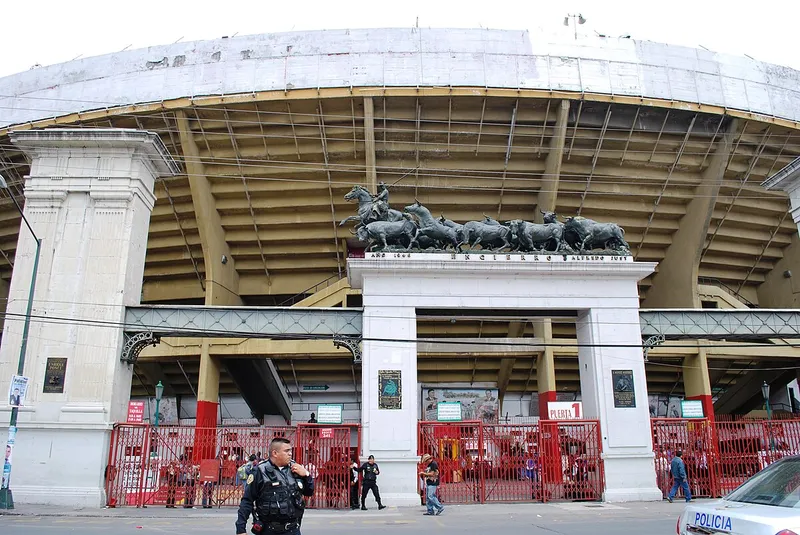
Neguib Simón spent nearly his entire fortune digging a hole in the ground. That hole, sunk 20 meters (66 feet) below the streets of Mexico City’s Nochebuena neighborhood, opened in February 1946 as the Plaza de Toros México. Eight decades later it is still the largest bullring ever built, with 41,262 official seats and room for more than 50,000 when the standing rails fill.
For most of its life this was the cathedral of Mexican bullfighting. The Temporada Grande season ran roughly October through March, pulling the world’s leading matadors and tens of thousands of aficionados into the concrete bowl every Sunday. That era effectively ended in March 2025, when Mexico City’s Congress voted 61 to 1 to ban violent bullfighting. The venue has spent the years since reinventing itself as one of Latin America’s busiest concert arenas.
The nickname is simply “La México,” and locals use it without irony. No other bullring comes close on size. Madrid’s Las Ventas, the spiritual home of the sport in Spain, seats around 23,800, barely more than half. The number is the whole point. Simón wanted the biggest, and he got it, even if the ambition ruined him financially before the wider sports city he imagined could be finished.
What makes the place work now is the same thing that made it work for bulls. The ring sits far below grade, so the seating wraps down into the earth rather than climbing into the sky, and sound collects at the bottom instead of leaking out. Roger Federer and Alexander Zverev played an exhibition here in November 2019 in front of 42,517 people, still the world attendance record for a tennis match. Julio César Chávez fought his final bout with Frankie Randall in the ring in 2004. Vicente Fernández recorded a defining live album here. Bulls or not, the bowl fills.
Getting to Plaza de Toros México
Public Transit
The easiest option is Metrobús Línea 1, which runs the full length of Avenida Insurgentes Sur. Get off at the Ciudad de los Deportes stop. The venue is a 5-minute walk from there.
→ From Centro Histórico: Take Metro Line 7 south to San Antonio station (10-minute walk to the plaza). Alternatively, board Metrobús Línea 1 at Insurgentes and ride south to Ciudad de los Deportes.
→ From Polanco / Chapultepec: Take Metro Line 1 to Tacubaya, transfer to Line 7 south, and exit at San Antonio.
Multiple bus routes also serve the area along Insurgentes Sur, including lines 1, 13-A, 106, and 200.
Driving + Parking
GPS address: Augusto Rodín 241, Ciudad de los Deportes, Benito Juárez, CDMX 03710.
→ From Zócalo / Centro Histórico (11 km): Head south on Eje Central to Av. Chapultepec, then take Insurgentes Sur south to Ciudad de los Deportes. Allow 25-40 minutes depending on traffic.
→ From Coyoacán (7 km): Head north on Insurgentes Sur. The complex appears on your left just past Parque Hundido. About 15-25 minutes.
Reserve parking in advance through Seeker Parking (plazadetoros.seekerparking.mx). Expect 180 to 250 pesos per event. Street parking is available but fills quickly. Arrive at least 45 minutes before showtime.
Rideshare
Uber and DiDi both operate here, with standard pickup and drop-off on Calle Augusto Rodín. A ride from Centro Histórico runs 80 to 150 pesos; from the airport, expect 200 to 400 pesos. DiDi typically undercuts Uber by 15 to 30 percent in Mexico City. Post-event surge pricing can double the fare, so build in a buffer.
From the Airport
→ Aeropuerto Internacional Benito Juárez (MEX): 14 km east, 20-40 minutes by car. Take Circuito Interior west to Viaducto Miguel Alemán, then connect to Insurgentes Sur south.
→ Aeropuerto Internacional Felipe Ángeles (NLU): 55 km north, 45-70 minutes by car. AIFA serves budget carriers, so take the Mexibús or a rideshare into the city.
Beyond Bullfighting
For 79 years, La México was the most important bullfighting venue on earth. That chapter narrowed sharply in March 2025, when Mexico City’s Congress passed a law banning violent bullfighting by a vote of 61 to 1. The legislation prohibits killing the bull and using sharp instruments that could wound it; horns must be padded, and the animals are returned to their ranches once the event ends. Supporters call the model “bullfighting without violence.” Aficionados call it the end of the sport in the capital. Both are, in their own way, correct.
The legal fight had been building for years. In June 2022, a judge ordered an indefinite suspension of taurine events on animal-welfare grounds. Mexico’s Supreme Court reversed that ruling in late 2023, which reopened the ring for a final traditional season. During the 2024 season, roughly nine days between January and March, 54 bulls were killed inside La México. The 2025 law closed the door that the courts had briefly reopened.
Here is the twist nobody planned. The venue is thriving in its second act. The same sunken bowl that concentrated the roar of a corrida turns out to be a superb concert hall, and promoters have noticed. Regional Mexican and norteño headliners, rock acts, and electronic DJs now fill the calendar, with recent bookings including Ramón Ayala, Edén Muñoz, and the Belgian duo Dimitri Vegas & Like Mike. A venue that was built to watch men fight bulls has become, almost by accident, one of the best places in Mexico City to hear music.
Construction & Design
The engineering came before the sport. Neguib Simón Jalife, a Yucatecan entrepreneur of Lebanese descent, wanted to build a Ciudad de los Deportes, a full sports city of stadiums, courts, pools, and pavilions on the edge of 1940s Mexico City. He hired civil engineer Modesto C. Rolland, already known for the Estadio Xalapeño, to design the centerpiece. Only the bullring and the adjacent football stadium were ever finished. Simón poured his fortune into the two structures and ran out of money before the rest could rise.
Construction began on December 1, 1944. Rolland’s defining decision was to dig rather than build up: the ring floor sits about 20 meters (66 feet) below the surrounding streets, carved down into the earth like a Roman amphitheater turned inside out. The playing surface is a sand ring 43 meters (141 feet) across. The whole thing is a single monolithic pour of reinforced concrete, which is why it has aged the way it has. The final cost came to roughly 660,000 pesos, a third over the 500,000-peso capital that Simón’s company, El Toreo, S.A., had raised to fund it.
Then came the stress test, which reads more like folklore than engineering, except that it happened. Once the concrete had cured, about a thousand workers spread 120,000 sandbags across every section of seating, 50 kilograms each, roughly 6,000 metric tonnes in total. Fifteen bags per square meter, which the engineers reckoned at about two and a half times the load of a packed house. The sandbags sat there for ten days. Nothing cracked. The structure has stood through the major earthquakes that have rattled Mexico City in the decades since, and the reputation for solidity traces directly back to Rolland’s monolithic design and that patient, absurd, decade-defining load test.
History of Plaza de Toros México
The plaza replaced a smaller predecessor. By the 1940s, El Toreo de la Condesa could no longer hold the crowds that Mexico City bullfighting was drawing, and Simón’s project answered the demand with brute scale. When La México opened on February 5, 1946, close to 41,000 people filled it for the inaugural corrida, and the venue immediately claimed the title it has never surrendered: the largest bullring in the world.
For the second half of the twentieth century, the ring defined the sport in Mexico. Generations of matadors, Mexican and Spanish, measured their careers by whether they had triumphed at La México. But the venue was never only about bulls. It hosted political rallies, religious gatherings, and, increasingly, sport and spectacle of every other kind.
Notable moments in the venue’s history:
- Inaugural corrida (February 5, 1946): Roughly 41,000 spectators packed the grand opening, establishing La México as the largest bullring ever built.
- Vicente Fernández, Independence Day 1984: The ranchera icon recorded his live album Un Mexicano en La México before a crowd estimated above 50,000, one of the defining performances of his career.
- Julio César Chávez vs. Frankie Randall (May 22, 2004): The Mexican boxing legend fought his third and final bout with Randall inside the ring.
- Red Bull X-Fighters: For several seasons in the 2000s and 2010s, the freestyle motocross series used the bullring as a stop on its world tour, packing dirt jumps into the sand.
- Federer vs. Zverev (November 23, 2019): The exhibition tennis match drew 42,517 spectators, a certified world attendance record for the sport, set inside a bullring converted to a hard court.
- Bullfighting ban (March 2025): Mexico City’s Congress voted 61 to 1 to prohibit violent bullfighting, ending traditional corridas in the capital.
The monolithic concrete that Rolland poured in the mid-1940s is still doing its job. What was built as a temple to bullfighting now amplifies norteño, rock, and pop instead of the charge of the bull, and the sunken bowl that funneled the roar of a corrida funnels the roar of a crowd all the same. It is a strange kind of survival, but it is survival.
Sources & Further Reading
- Wikipedia entry on Plaza de Toros México: en.wikipedia.org. Capacity, opening date, engineer, and venue history in English.
- Spanish Wikipedia on the Plaza Monumental de México: es.wikipedia.org. The construction cost of 660,000 pesos, the El Toreo, S.A. financing, depth, and ring dimensions.
- Mexico City bans violent bullfighting (March 2025): npr.org. The 61-to-1 vote, the killing prohibition, padded horns, and the legal background.
- Federer and Zverev break the tennis attendance record: espn.com. The 42,517 crowd and match details from November 2019.
Quick Facts
Everything you need at a glance.
Stadium specs
- Capacity
- 41,262
- Opened
- 1946
- Cost
- 660,000 pesos (1946)
- Roof
- Open
- Surface
- Sand
- Tenants
- Independent Venue (Bullfighting, Concerts)
Location
- Groundbreaking
- December 1, 1944
- Address
- Augusto Rodín 241, Ciudad de los Deportes, Benito Juárez, 03710 Ciudad de México, Mexico
- GPS
- 19.3830°N, 99.1801°W
Photo Gallery
Fun Facts
Plaza de Toros México is the largest bullring ever built, with 41,262 official seats and room for more than 50,000 at peak events like Vicente Fernández's 1984 concert.
The arena floor sits 20 meters (66 feet) below street level, and before it opened, roughly a thousand workers stress-tested the concrete with 120,000 sandbags weighing about 6,000 metric tonnes.
In November 2019, 42,517 fans packed the bullring to watch Roger Federer face Alexander Zverev, setting the all-time world record for attendance at a tennis match.
Stadium Location
Frequently Asked Questions
- What is the capacity of Plaza de Toros México?
- The official seating capacity is 41,262, which makes it the largest bullring ever built. Standing room and event configurations have pushed the crowd past 50,000 at concerts and boxing nights.
- Is bullfighting still held at Plaza de Toros México?
- Not in its traditional form. In March 2025, Mexico City's Congress voted 61 to 1 to ban violent bullfighting, prohibiting the killing of bulls and the use of sharp instruments. Events must now use padded horns, and the bulls are returned to their ranches alive. The venue has leaned into concerts in the meantime.
- Is Plaza de Toros México really the largest bullring in the world?
- Yes. With 41,262 seats it is the largest bullring ever constructed, ahead of Spain's Las Ventas in Madrid, which holds roughly 23,800. The nickname 'La México' has stuck for eight decades.
- When did Plaza de Toros México open?
- It opened on February 5, 1946, with an inaugural corrida that drew close to 41,000 spectators. The February anniversary was, for decades, marked by a Corrida de Aniversario.
- Who designed and built Plaza de Toros México?
- Civil engineer Modesto C. Rolland directed the design and construction, working for Yucatecan entrepreneur Neguib Simón Jalife. Simón conceived it as the centerpiece of a Ciudad de los Deportes, a sprawling sports campus. Construction began on December 1, 1944.
- Why is the arena floor below street level?
- Rolland sank the ring about 20 meters (66 feet) below the surrounding streets, which let him seat more than 40,000 people without building a towering exterior. The result is a natural concrete bowl that funnels sound downward, a big reason the venue works so well for concerts today.
- What events are held at Plaza de Toros México now?
- Concerts, mostly. The sunken bowl has become one of Mexico City's in-demand music venues, hosting regional Mexican, norteño, rock, and electronic acts. Recent bookings have included Ramón Ayala, Edén Muñoz, and Dimitri Vegas & Like Mike. The venue has also staged boxing, freestyle motocross, and a record-setting tennis exhibition.
- What is the tennis attendance record set here?
- On November 23, 2019, an exhibition between Roger Federer and Alexander Zverev drew 42,517 spectators inside the bullring, the largest crowd ever to watch a tennis match. Federer won the exhibition, billed as 'The Greatest Match.'
- How do I get to Plaza de Toros México by metro?
- The nearest station is San Antonio on Metro Line 7, about a 10-minute walk. Metrobús Línea 1 along Avenida Insurgentes Sur is often faster: get off at the Ciudad de los Deportes stop, roughly a 5-minute walk from the entrance.
- Where can I park at Plaza de Toros México?
- Event parking can be reserved in advance through Seeker Parking at plazadetoros.seekerparking.mx, typically 180 to 250 pesos per event. Street parking exists on surrounding blocks but fills fast. Arrive 45 to 60 minutes early.
Last updated: 2026-07-10