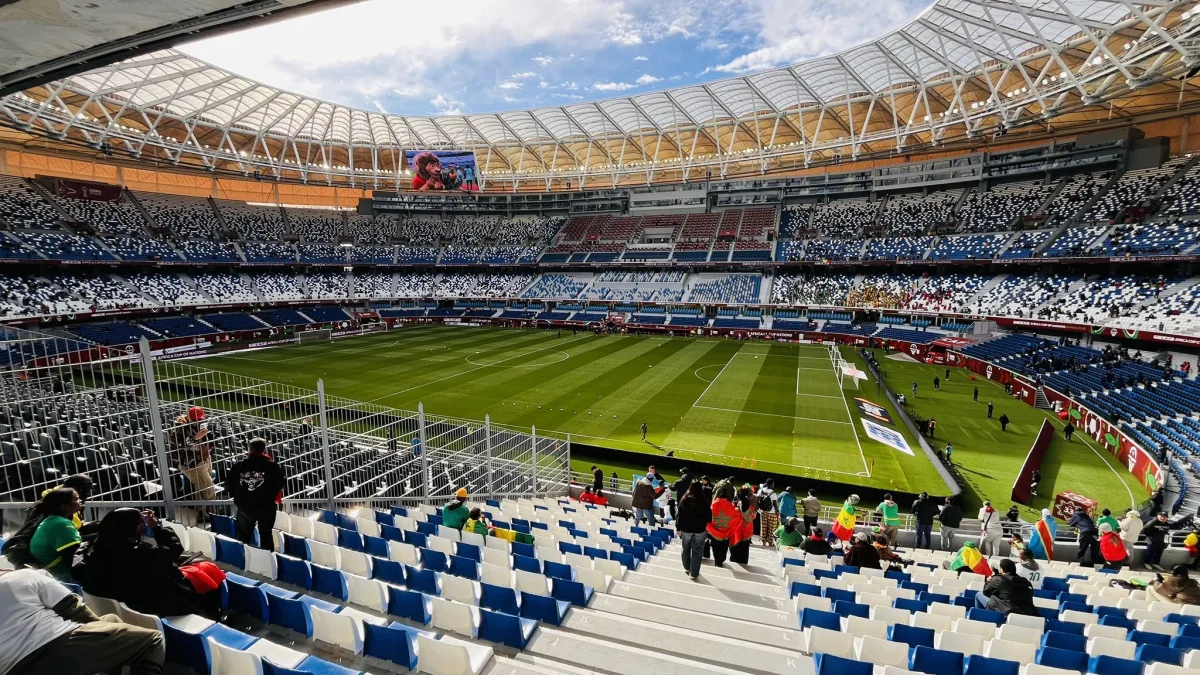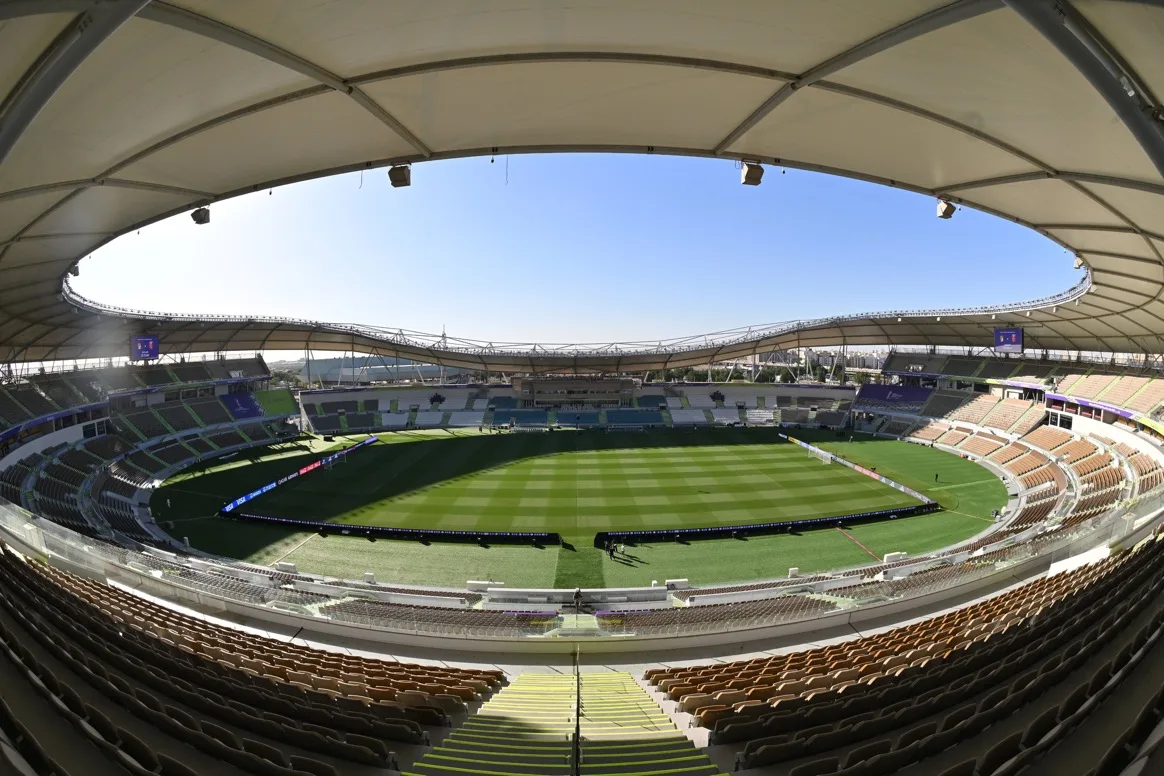
About Prince Abdullah Al-Faisal Sports City Stadium
Two of the oldest football clubs in Saudi Arabia have been walking into this address since the 1970s, and both of them now have a bigger one. That tension runs through everything about the ground. It stands in Al Waziriyah in southern Jeddah, hemmed in by the Jeddah to Makkah expressway on its eastern side and by Stadium Street on its southern one, with King Abdulaziz University to the north and the industrial city beyond. The sports city around it covers roughly 340,000 square metres (3.7 million square feet) and holds an Olympic pool, covered halls for handball, basketball, volleyball, judo and karate, a youth hostel and a mosque. The stadium itself seats 27,000. A municipal complex, in other words, with a football ground inside it.
It opened in the 1970s as the Youth Welfare Stadium in Jeddah, a name it carried until 2001, when it was renamed for Prince Abdullah Al-Faisal Al Saud, the first man to run sport in the kingdom as a portfolio. On November 19, 2023 the Ministry of Sport went a step further and reclassified three grounds as sports cities. That is how a football ground ends up with a six-word name. The short form is what the sources run with. Saudipedia files it as Prince Abdullah Al-Faisal Stadium.
The opening year itself is disputed. Saudipedia dates the inauguration to 1393 in the Hijri calendar, 1973, which is the only account that carries both calendars and the only one where the two halves agree. Saudi press reports put it at 1976, when the ground is described as opening under the Youth Welfare name, and other accounts say 1970. No ministry document naming a date has been published. This page uses 1973 and says so rather than picking one quietly.
Al-Ittihad, founded in 1927 and one of three Saudi clubs never relegated, and Al-Ahli, founded in 1937, both list it as a home ground. So does Jeddah Club, from the second tier. All three list King Abdullah Sports City first, 36 kilometres (22 miles) north and 62,345 seats, and this one second. A ground used for selected matches.
Then there is the gap in the middle of its life. The stadium hosted its last match in November 2012 and its next in October 2021, nine years of a redevelopment that was supposed to take a fraction of that. It came back at 27,000 rather than the 34,000 originally approved, with the athletics track still in place and a canopy over the stands that had once fallen down during installation. In January 2027 it hosts five matches of the AFC Asian Cup. Every venue is mapped in our AFC Asian Cup 2027 guide.
Getting to Prince Abdullah Al-Faisal Sports City Stadium
Public Transit
Jeddah has no metro. The project stalled last decade and came back to life in January 2026 with a design tender for a 35-kilometre (22-mile) Blue Line joining the airport to the Haramain station, spoken about as a 2034 World Cup deliverable. Nobody is riding it to the Asian Cup.
→ City buses: Jeddah Transport Company and SAPTCO run 76 buses over six main lines and 72 stations, 05:30 to 22:30 daily, on a smart card. The expanded network of 14 routes reaches King Abdulaziz University and the industrial city, the two landmarks the stadium sits between.
→ Haramain High Speed Railway: The Jeddah station at Al Sulimaniyah is about 15 kilometres (9 miles) north. Nothing connects it to the ground.
→ From Makkah: 60 kilometres (37 miles) east down the expressway that runs along the stadium’s own boundary. Of Jeddah’s two Asian Cup grounds this is the nearer one to the holy city, by about 19 kilometres (12 miles).
The buses will get you across Jeddah. They will not get you to your seat, and that last leg is a taxi.
Driving + Parking
The address is Prince Abdullah Al-Faisal Sports City, Stadium Street, Al Waziriyah. The expressway on the eastern boundary is the fast way in and the obvious way out. After a full house, that is exactly the problem.
→ Parking: The redevelopment added 122,000 square metres (1.3 million square feet) of parking outside the gates, along with 15 entrances. On a typical league night this is absurdly generous. On an Asian Cup night, clearing it afterward is what takes the whole evening.
→ From central Jeddah and Al-Balad: About 8 kilometres (5 miles) north-west of the ground, 20 minutes clear, longer with a crowd moving.
Park facing out. It is the oldest advice in this business and it has never once been wrong.
Rideshare
Uber and Careem both cover Jeddah properly, and Al Waziriyah is an easy pin to drop. Coming back is where it gets expensive, because drivers do not queue at a stadium for a fare that might not come.
Pro tip: Get a local SIM before matchday. An app you cannot load is the same as no ride at all.
From the Airport
→ King Abdulaziz International (JED): About 28 kilometres (17 miles) north, 30 to 45 minutes by road depending on the hour. The airport sits at the opposite end of the city from the stadium. At King Abdullah Sports City the arrangement is the reverse.
→ Onward to the other Jeddah venue: 36 kilometres (22 miles) separate the two Asian Cup grounds in this city. Do not assume a same-day double-header is a walk.
Watching a Match at Prince Abdullah Al-Faisal
The number that tells you most about this stadium is an attendance figure, and there are four of them. On December 15, 2023 it staged its first FIFA Club World Cup match, Leon against Urawa Red Diamonds, and 2,525 people came. A week later, on December 22, the third-place match between Urawa and Al Ahly drew 10,290. In April 2025 the AFC Champions League Elite finals arrived: Yokohama F. Marinos against Al-Nassr pulled 12,003, with Cristiano Ronaldo, Sadio Mane and Jhon Duran all scoring, and the following night Kawasaki Frontale against Al-Sadd drew 2,873. Twenty-seven thousand seats. Never more than 12,003 of them used.
That is not a criticism of the ground so much as a description of its job. Jeddah’s big nights happen 36 kilometres north at the 62,345-seat King Abdullah Sports City, and Al-Faisal takes the fixtures that do not need the room. Jeddah supporters argue about the two grounds online, and the comparison does not often come out in this one’s favor.
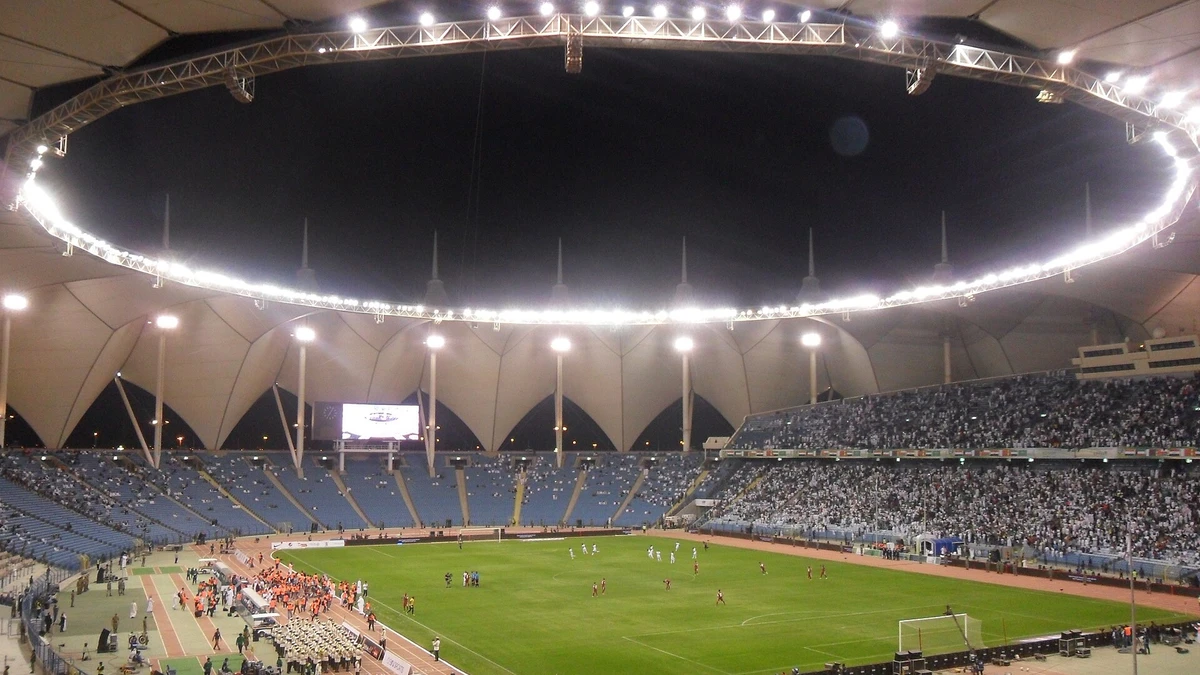
Where to sit is simple here, because the bowl is not symmetrical. The west stand is fully seated and carries the enclosed royal box and the media tribune in its central section. The east stand is the arch, terraced, curving along the running track. That track is the thing to understand before you buy. This is a 1970s sports city, not a purpose-built football ground, and the athletics oval still separates the lowest rows from the touchline. The 2023 refurbishment covered the surround with artificial grass, so it photographs as green now. It is still a running track underneath, and it still puts a track’s width between you and the touchline.
The redevelopment did fix the parts of a matchday that people actually complain about. The ground went from 4 concession points to 15, from 40 toilets to 370, and from 40 ticket windows to 120, alongside 72 seats set aside for spectators with disabilities. Entry has gone digital too. The April 2026 readiness report for the Champions League Elite knockout round listed smart crowd-management and identification technology at the gates, and the Ahlan app pulling ticketing, match information, transport and stadium entry into one place.
January is the right month to be here. Jeddah averages a high of 28.8C (83.8F) in January against 39.4C (102.9F) in July, and the city record is 52C (125.6F). The Asian Cup is a winter tournament for a reason, and an evening kickoff in the middle of it will be about as comfortable as football on the Red Sea coast ever gets.
The 2027 Asian Cup at Prince Abdullah Al-Faisal
Five matches, and an unusually scattered five. Japan against Indonesia goes first on January 11, then China against Syria on January 14, Uzbekistan against Bahrain on January 18, Vietnam against Yemen on January 20, and a Round of 16 tie on January 24. One group game apiece from Groups B, C, E and F, rather than a block of one group parked in one city.
The knockout tie is the neat part. It pairs the runners-up of Group B and Group F, which are the two groups whose matches here were Uzbekistan against Bahrain and Japan against Indonesia. Two of those four teams could plausibly come back to the same stadium, six days later for the Group B pair and thirteen for Japan or Indonesia. A short round trip either way, by tournament standards.
Five ties it with Al-Shabab Stadium in Riyadh for the smallest allocation of the eight. Three Riyadh grounds take six each, Aramco Stadium in Al Khobar takes seven, and the two biggest venues in the tournament, King Fahd and King Abdullah Sports City, take eight apiece. The AFC’s venue table lists it at 26,000 for the tournament rather than the 27,000 the stadium publishes, which is ordinary for a competition configuration and worth knowing when you are reading a seat map.
Construction & Design
King Abdullah bin Abdulaziz sat in the royal box for the King’s Cup final between Al-Ahli and Al-Nassr on May 18, 2012, and approved a rebuild on his way out. The proposal put to him was an expansion to around 34,000 seats, budgeted at SAR 90 million including the external parking. It was, by every account of what happened next, a serious underestimate of what was underneath the terraces. Reporting during the works put the figure at SAR 180 million and later at SAR 200 million as the scope grew.
The original ground was a 1970s Youth Welfare build and its structure had aged accordingly. Alrabiah Consulting Engineers were appointed by the General Presidency for Youth Welfare to work out how bad it was, a job their own project record describes as visual inspection of the reinforced concrete frames, site sampling and material testing, detailed structural analysis, cost-effective remedial solutions, and a tender package for the remedial works. Engineering designs then changed at infrastructure level, which is the polite phrase for starting again below ground.
Sources disagree on what the finished roof covers. Saudipedia’s stadium entry describes the stands as fully unroofed, while Makkah newspaper’s reopening inventory lists German-supplied canopies among the imported components, Sport KSA reported the canopy structures installed on every side of the ground, and a FIFA photograph taken in December 2023 shows a continuous white canopy ringing the stands. This page follows the photograph and the reporting.
Then, on July 30, 2013, part of the new canopy fell. Prince Nawaf bin Faisal, then running Youth Welfare, described it as human error, a failure of coordination between the man operating the crane holding the canopy and the engineer responsible, which threw the balance out. Nobody was hurt. He pointed out that it happened during working hours with no crowd in the building, which is true and was not much comfort. Financial claims between the contractor and the authority did the rest. The site sat.
Work accelerated after Prince Abdulaziz bin Turki Al-Faisal visited the engineering team in early January 2019. The ground reopened on October 1, 2021, and the numbers it came back with are worth laying out, because they are the building. Capacity 27,000 including the royal box, with 72 seats for spectators with disabilities. Four dressing rooms. Fifteen entrances and 81 electronic gates. Forty-eight broadcast cabins at six cameras each, six commentary positions, four analysis studios, two media centers and a press conference hall seating 250. And 122,000 square metres of parking. Saudi coverage at the reopening described the specification as matching Arsenal’s Emirates Stadium, with an American design, German canopies, French and Italian lighting, and Greek concrete.
A lighter pass followed in 2023: the seat colors were unified across the bowl, modern gates went in, and the area around the pitch was covered with artificial grass. That is how a 1970s athletics oval gets quietly dressed as a football surround. The pitch itself is natural grass. In April 2026 the Saudi Press Agency reported both Jeddah grounds ready for the Champions League Elite knockout matches, with pitch surfaces, players’ facilities, media areas, fan zones and broadcast systems signed off.
History of Prince Abdullah Al-Faisal Sports City Stadium
In February 1989 the best under-20 teams on the planet came to Jeddah, and this was where the biggest of them played. The FIFA World Youth Championship gave the stadium all six Group C matches, which meant Brazil, East Germany, the United States and Mali, and then kept coming back. It was listed at 35,000 seats that month. The crowds went past it.
Notable events:
- 1989 FIFA World Youth Championship (February 1989): Eight matches, including Brazil beating Argentina 1-0 in the quarter-final in front of 35,000 on February 25. Three days later Nigeria beat the United States 2-1 after extra time in the semi-final, with 40,000 recorded in a 35,000-seat ground.
- Asian finals, repeatedly (1985 to 2005): Al-Ahli met Daewoo of South Korea in the 1985 Asian Club Championship final here. Al-Ittihad played the second leg of the 1999 Asian Super Cup against Jubilo Iwata, the first leg of the 2004 AFC Champions League final against Seongnam, and the second leg of the 2005 final against Al Ain. Al-Shabab won the 2001 Asian Cup Winners Cup final against Dalian Shide on the same pitch.
- The Arab club circuit (1989 to 2005): Arab Cup Winners Cup finals in 1989 and 1992, Arab Club Champions Cup finals in 1998 and 2000, the 2002 unified Arab championship final between Al-Ahli and Club Africain, and the second leg of the 2005 Arab Champions League final. Add the 1999 Gulf Club Championship and the football tournament of the 2005 Islamic Solidarity Games.
- Closed (November 2012 to October 2021): Nine years dark. The capacity had already been cut to 20,000 in 2009 by removing standing areas; the rebuild eventually returned it at 27,000. It reopened with the Jeddah derby, Al-Ittihad against Al-Ahli, on October 1, 2021.
- 2023 FIFA Club World Cup (December 2023): Two matches, Leon against Urawa Red Diamonds on December 15 and the third-place match between Urawa and Al Ahly on December 22, refereed by Tori Penso of the United States.
- 2025 AFC Champions League Elite finals (April 2025): Two quarter-finals in two nights, Al-Nassr beating Yokohama F. Marinos 4-1 and Kawasaki Frontale beating Al-Sadd 3-2 after extra time.
The Saudi national team has played here around 36 times across friendlies, World Cup qualifying for 1978, 1990, 1998 and 2002, and Asian Cup qualifying. That is the record of a ground that was, for about three decades, simply where Jeddah played football. The 62,345-seat stadium up the coast changed that in 2014, and the nine-year closure finished the job.
What it has now is a second act as a tournament venue, which suits it. A 27,000-seat ground with a proper history is exactly what a 24-team competition needs for a Tuesday night group game, and in January 2027 it will get five of them.
Sources & Further Reading
- Saudipedia (Saudi Press Agency): saudipedia.com. Site area, capacity, natural grass pitch, naming history and the 2021 facility inventory.
- Wikipedia entry on the stadium: en.wikipedia.org/wiki/Prince_Abdullah_Al-Faisal_Sports_City_Stadium. Stand layout, the 2009 capacity cut, the 2023 refurbishment and tenancy dates.
- Arab News: arabnews.com. The reopening report from September 2021, with the before-and-after facility counts.
- Makkah newspaper: makkahnewspaper.com. The most detailed Arabic account of what the redevelopment actually delivered, down to the concession stands.
- Emarat Al Youm: emaratalyoum.com. Contemporary report on the July 2013 canopy collapse, quoting Prince Nawaf bin Faisal.
Quick Facts
Everything you need at a glance.
Stadium specs
- Capacity
- 27,000
- Opened
- 1973
- Cost
- SAR 90 million approved in 2012, reported at SAR 180 to 200 million
- Roof
- Canopy over the stands
- Surface
- Natural grass
- Tenants
- Al-Ittihad (Saudi Pro League), Al-Ahli (Saudi Pro League), Jeddah Club (Saudi First Division)
Construction & location
- Groundbreaking
- Not separately recorded
- Architects
- Not separately recorded
- Engineering
- Alrabiah Consulting Engineers (redevelopment investigation and remedial design)
- General contractor
- Not separately recorded
- Address
- Prince Abdullah Al-Faisal Sports City, Stadium Street, Al Waziriyah District, Jeddah, Saudi Arabia
- GPS
- 21.4466°N, 39.2517°E
Fun Facts
The 1989 FIFA World Youth Championship semi-final between Nigeria and the United States drew 40,000 people into a stadium then listed at 35,000. The same bowl now holds 27,000.
The nine-year redevelopment multiplied the plumbing: 370 toilets where there had been 40, 120 ticket windows where there had been 40, and 15 concession stands where there had been 4.
Its first FIFA Club World Cup match, Leon against Urawa Red Diamonds on December 15, 2023, was watched by 2,525 people in 27,000 seats.
Stadium Location
Frequently Asked Questions
- Will the stadium actually be full when I get there?
- Probably not, and this is the honest headline about the place. Four recent international fixtures here drew 2,525, 10,290, 12,003 and 2,873 against 27,000 seats. The Asian Cup will be different, because a tournament sells its own tickets. A midweek league night is a different animal, and you will have room to stretch out.
- Where should I sit?
- The west side. It is the fully seated stand, and it holds the royal box and the media tribune. The east stand is the terraced arch that curves along the running track, which puts you further back from the touchline than the seat map suggests.
- Is there a running track between the seats and the pitch?
- Yes. This is a 1970s sports city rather than a purpose-built football ground, and the athletics oval is still there. The 2023 refurbishment covered the surround with artificial grass, so it now reads as green rather than as a track, but the distance it creates has not gone anywhere.
- Which 2027 Asian Cup matches are here?
- Five. Japan against Indonesia on January 11, China against Syria on January 14, Uzbekistan against Bahrain on January 18, Vietnam against Yemen on January 20, and a Round of 16 tie on January 24 between the runners-up of Groups B and F. One game from each of four different groups, then a knockout between two of them.
- Why do I keep seeing different capacity figures?
- Because two figures circulate. The stadium's own published figure since the 2021 reopening is 27,000, and that is the number Saudipedia and the Saudi press use. The AFC's tournament table for 2027 lists it at 26,000. Tournament configurations routinely come in under the everyday number, so treat 27,000 as the ground and 26,000 as the competition.
- How do I get there without a car?
- A taxi, or Uber or Careem. Jeddah has no metro, the city bus network runs 05:30 to 22:30 and serves the university and the industrial city on either side of the ground rather than the gates, and the Haramain railway station is 15 kilometres (9 miles) away with nothing connecting it. Book the ride home before the final whistle.
- How hot will it be?
- In January, pleasant. Jeddah averages a high of 28.8C (83.8F) and a low of 18.8C (65.8F) in January at around 60 percent humidity, which is why the Asian Cup is a winter tournament. In July the average high is 39.4C (102.9F), and the record for the city is 52C (125.6F). Season matters more here than kickoff time.
- Why was the stadium closed for so long?
- A redevelopment approved in 2012 ran into a decaying 1970s structure underneath it. Part of the canopy came down during installation in July 2013, the design had to be reworked at foundation level, and financial claims between the contractor and the sports authority stalled the site. The last match before the shutdown was in November 2012. The next one was in October 2021.
- Is this Al-Ittihad's and Al-Ahli's main ground?
- No, and that is worth knowing before you buy. Both clubs list King Abdullah Sports City, the 62,345-seat stadium about 36 kilometres (22 miles) north, as their primary home, with this one used for selected matches. Jeddah Club does the same. Check which ground your fixture is actually at.
- What is there to eat and drink inside?
- Fifteen concession points, which sounds modest until you learn the pre-renovation ground had four. Saudi stadium catering runs to grills, shawarma, fried chicken, coffee and soft drinks, and no alcohol is sold anywhere in the country. The 2021 works also took the ground from 40 toilets to 370, which regulars noticed more than the food.
- Is the pitch real grass?
- Yes. Saudipedia and both Wikipedia entries record a natural grass pitch, laid new to FIFA and AFC specification during the redevelopment. The artificial turf people mention is the surround, laid over the athletics track area in 2023, not the playing surface.
Last updated: 2026-09-14