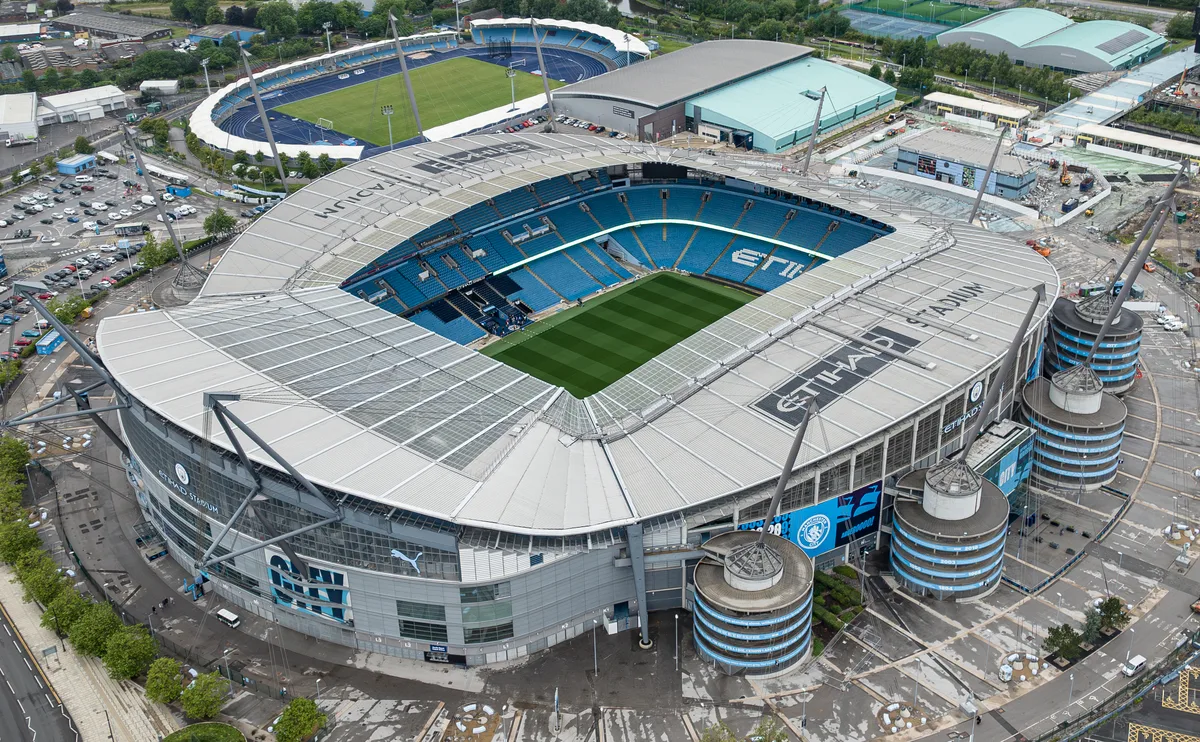
About Etihad Stadium
Manchester spent thirteen years trying to build this stadium for something other than football. Two Olympic bids failed, the Millennium Commission said no, and a plan to make the site England’s national stadium lost the money to Wembley. What finally landed was the 2002 Commonwealth Games, and what got built on the old Bradford Colliery land 2.5 kilometres (1.6 miles) east of the city center was an athletics arena with a running track and a horseshoe of stands. Manchester City moved in a year later, after the track came out and the floor was dug six metres deeper. The place is still legally called the City of Manchester Stadium. Almost nobody calls it that.
The capacity question needs four answers. For domestic football the Premier League listed 61,038 for 2026/27, and that is the figure used throughout this page. The planning consent for the rebuilt North Stand set a net capacity of 61,474, allowing for seats taken out of sale to keep home and away supporters apart. Concerts are listed at 60,000 and the Commonwealth Games ran at 41,000. Nobody at the club has ever published one tidy number, and the two football figures sit 436 seats apart. The attendance record is 60,645, set against Bournemouth on 23 August 2026.
Manchester City Council owns the ground and always has. City hold it on a 250-year fully repairing lease, which puts every operating and maintenance cost on the club and explains why the 2011 naming rights deal with Etihad Airways had to clear the council before anyone could sign it. The football has been productive to the point of absurdity: unbeaten in all nineteen home league games in 2011/12, and a run of twenty consecutive home wins completed here in March 2012. But this has never been only a football ground. A UEFA Cup final, England internationals, rugby league’s Magic Weekend, a Rugby World Cup pool match, the biggest British boxing crowd since the war, Oasis and Take That, and now five matches at Euro 2028. The Desso GrassMaster pitch, 105 by 68 metres (115 by 74 yards) over under-soil heating, won the Premier League’s best-surface award in 2010/11.
Getting to Etihad Stadium
Public Transit
The tram answers almost every question here. Etihad Campus opened in February 2013 at the north end of the ground on Metrolink’s East Manchester Line, reaching 98 other stops across Greater Manchester, with trams every six minutes Monday to Saturday and every seven and a half on a Sunday.
→ From the city center: Board at Piccadilly Gardens or in the Piccadilly station undercroft. Ten to fifteen minutes. Etihad Campus is in Zone 2 and an adult return is £3.50.
→ Walking from Piccadilly: The Citylink route runs through Ancoats, New Islington and Holt Town, about 30 minutes, lit and signposted, with live music and face painters before the bigger games.
→ By train: Ashburys is the nearest heavy-rail station, five minutes out of Piccadilly, then a 20-minute walk. Hardly anyone uses it.
→ By bus: Routes 53, 188, 216, 217 and 231 serve the ground, and Stagecoach runs a match special from Piccadilly at £1.80 for adults and 90p for children each way.
One thing to plan for. Velopark and Holt Town, the stops either side of Etihad Campus, shut for at least an hour after events, so the whole tram-going crowd funnels into one stop. Walking back toward Ancoats until the queue thins is what the weekly regulars do.
Driving + Parking
About 2,000 spaces sit on the campus and another 8,000 in surrounding businesses and schools, but the on-site lots are pre-book only and read your number plate on the way in.
→ From the motorway: The M60 rings the city and feeds the A6010, Alan Turing Way, which runs north to south straight through the SportCity complex past the ground. M6 and M56 from the south, M62 from east or west.
→ The car parks: Blue at M11 3DU, Orange at M11 4TA, Green at M11 3FY, Vermillion at M40 8AD. All open three hours before kickoff, with accessible bays in Orange and Blue.
Parking costs £14 for a solo driver and £12 if there are two or more of you, a structure designed to make you fill the car. A residents-only scheme covers roughly a mile around the ground, so leaving the car in a terraced side street is a ticket. Metrolink’s park and ride at Ashton Moss and Ashton West is free.
Rideshare
Uber, Bolt and Free Now all operate in Manchester and all reach the campus easily on a normal day. Matchday is different: Ashton New Road and Alan Turing Way carry the whole crowd, and a car aiming for the gates joins the same jam as everyone else.
Pro tip: Meet your driver back toward Ancoats or Holt Town. The fifteen minutes spent walking are fifteen you would otherwise spend stationary on Ashton New Road, and the fare comes down for the same trip.
From the Airport
→ Manchester Airport (MAN): The station sits under the terminals, 9.75 miles (15.7 km) south of Piccadilly on a branch of the Styal line. Train into Piccadilly and tram out, or take the Metrolink Airport line to Victoria and pick up the East Manchester Line there.
→ Liverpool John Lennon (LPL): The alternative if the fare works out better, with coach and rail connections into Manchester and then the tram from Piccadilly.
Watching a Match at Etihad Stadium
Start with the geometry, because it decides everything else. The bowl was dug into the ground rather than raised out of it, so the front rows sit right on the touchline and six metres (20 feet) below the street outside. Arup’s brief was to put every seat within 100 metres (330 feet) of the center spot, and the finished bowl holds to it. Three tiers run down either side and behind the south goal, two at the north end. The second tier along either side is the cleanest angle in the ground.
Away supporters go behind one goal in the South Stand, over three tiers, usually around 3,000 and double that for a cup tie. That matters more than it sounds, because the South Stand is also where City’s loudest support has always sat. The two groups trade songs across a line of stewards, and City forums have argued for years about moving the away end upstairs, one faction pointing out that the noise only exists because the visitors start it. The complaint you hear most from City’s own regulars is that you get looks for standing up and singing anywhere except the South Stand and the East Stand blocks beside it. Rivals have called the place the Emptihad for a decade, which stings mostly because a version of it is true.
The May 2026 North Stand is the club’s answer. It runs as two tiers rather than three, with no hospitality band cutting across, so the upper run climbs unbroken from pitch level to the roof, and a minimum of 3,000 rail seats give it a standing section with a designated singing area. Fans at the first test event were fond of it and honest about it: watching television from the top of the stairs, said one. A static drone view, said another. It is a long walk up.
Food is a real strength, which is not something you can say about most English grounds. The concourses run burgers in beef, cheese, vegan and gluten-free versions, hot dogs, pies and loaded fries in Korean barbecue, piri piri and hot chilli, plus a junior meal deal. A hot dog and chips came to about £10 in 2025. Asahi is the club’s beer partner and pints have been reported around £4, cheap for this division.
Outside is harder if you are not a City fan. Mary D’s, the big place beside the ground with its own City disco, is emphatically not for visitors. The Townley on Albert Street is the one that will have you, provided the colors stay at the hotel; the Grove Inn and the Corner Shop are the other names that come up. Most away fans skip the question entirely, drink in the city center and tram out. Locals will tell you the real find on the walk in is Tony’s chippy. Since September 2026 Medlock Square has added three sit-down options at the ground itself, no reservation needed: Blend, Little Beast and Three Rivers in the Medlock Hotel.
One free ritual is worth arriving early for. The team coach pulls in at the Colin Bell entrance and a crowd gathers to meet it; the gates open two hours out and the warm-up starts an hour before kickoff, watchable from the pitchside barriers. Take a lap while you wait. Kompany and Silva went up in 2021, Agüero mid-celebration in 2022, Bell, Lee and Summerbee together in 2023.
Euro 2028 at Etihad Stadium
UEFA will not call it the Etihad. Sponsor names are stripped out for its tournaments, so the venue appears on every Euro 2028 document as Manchester City Stadium, exactly as it did at the 2015 Rugby World Cup.
Matches: Five. Four group games on 10, 13, 16 and 20 June 2028, then a round-of-16 tie on 25 June, which is more than Birmingham or Newcastle draw and the same as most of the field outside London.
The tournament: Nine venues across eight cities in England, Scotland, Wales and the Republic of Ireland, opening at the National Stadium of Wales on 9 June 2028 and finishing at Wembley on 9 July.
What it means here: Very little construction, for once. The £300 million North Stand program was built to football deadlines, so the ground UEFA inspects in 2028 is the one City play in now.
Construction & Design
Tony Blair laid the foundation stone in December 1999 and the diggers arrived the following month, but Arup had been drawing this building in one form or another since 1992. The firm helped choose the Eastlands site, drew an 80,000-seat Olympic stadium for the 1996 bid, redrew it for the 2000 bid and again as a Millennium Stadium proposal, then shrank it into a Commonwealth Games venue that could be converted for football afterward. That last constraint is the whole design. Laing Construction built it for about £112 million, of which Sport England found £77 million and Manchester City Council the rest, with Watson Steel on the steelwork and KSS fitting out the interiors.
The two-stage trick is the interesting part. Only three sides of the permanent bowl went up for the Games, with a temporary stand across the north end and a track around the pitch, but the mast and cable system holding the roof was built in full at the first attempt, standing over a stadium not yet finished underneath it. Afterward the track was lifted and relaid at other athletics venues, the floor came down six metres, roughly 90,000 cubic metres of earth went out, and a new lower tier dropped into the space. The conversion cost the council £22 million and Manchester City £20 million on top. It also settled the building’s future for good: unlike the Stade de France, whose lower tier retracts, nothing here goes back.
The roof geometry is a toroid laid over a circular plan, a surface rising and falling in one continuous wave that covers every seat without a column in the way. Twelve cigar-shaped tubular steel masts carry it, eight of them standing on the spiral entry ramps, and 76 spiral strand forestay cables fan out in groups of five or seven, each holding up an individual rafter. Just above the roof surface, four more spiral strand cables gather every forestay end into what Arup calls a grounded tension ring. Prestress for the catenary and the cable net comes from four corner ties anchored to the ground, and pairs of back-stays, each a group of Macalloy high-tensile steel rods, tie every mast top back down. The rafters cantilever as much as 14 metres inward past the last cable. Martin Spring, writing in Building in 2002, called it structural gymnastics of the most exhilarating kind, and it took a Structural Special Award from the Institution of Structural Engineers in 2003 and an RIBA Inclusive Design Award in 2004.
The rest of the building runs to small oddities, the first two of them keeping the grass alive. A ten-metre band of translucent polycarbonate runs around the roof’s inner edge so sunlight reaches the pitch, and the four corners carry no seating at all, just perforated walls with adjustable louvers that open to ventilate the turf. Under the west stand sits a basement holding the dressing rooms, a kitchen that can feed 6,000 people on a matchday, and a police cell. Elsewhere: 226 wheelchair spaces across every price band, and 218 floodlights of 2,000 watts each.
Expansion has come in two rounds. Populous added a third tier to the South Stand and three pitchside rows in 2014/15, built by Laing O’Rourke, taking the ground to roughly 55,000. Then in July 2023 came the £300 million North Stand program, Populous again, with John Sisk & Son as main contractor and a 400-room hotel, an office block, a museum, a club shop and a covered City Square for 3,000 people going up alongside. The second tier at the north end gained 7,900 seats and a Skybar. It passed its checks in May 2026 and opened for the last home match of the season against Aston Villa, and on 22 May the club announced the stand would carry Pep Guardiola’s name, the manager’s departure after ten years having landed in the same week.
History of Etihad Stadium
The stadium exists because Manchester kept losing. A 1996 Olympic bid built around an 80,000-seat stadium on greenfield land west of the city went to Atlanta. A 2000 bid, moved onto the brownfield wreckage of Bradford Colliery to chase regeneration funding, went to Sydney. The same scheme was offered to the Millennium Commission and rejected, then lost a 1996 competition to become England’s national stadium, the money going to Wembley. Only the 2002 Commonwealth Games said yes.
Sport England, funding most of it, had one condition: no white elephant. The council had to commit to converting the venue into a football ground afterward. There was a version where £50 million more bought 65,000 seats and movable seating that could do both codes, but the council did not have it and Manchester City were lukewarm. Arup, asked for a view, pointed at the Stadio delle Alpi and Munich’s Olympiastadion, both abandoned by their football tenants inside forty years. The track went. Jonathan Edwards and Sebastian Coe said Britain had lost its last chance at a major athletics venue, and for a decade they were right.
Notable events:
- 25 July 2002: The Commonwealth Games opening ceremony, Queen Elizabeth II declaring the Games open from a message carried in an electronic baton. Sixteen Games records fell over the following ten days. With 72 nations and 3,679 athletes it is still the largest Commonwealth Games staged anywhere, and the first multi-sport event to award full medals in events for elite athletes with a disability.
- 10 August 2003: City beat Barcelona 2-1 in the first football match here, Nicolas Anelka scoring the stadium’s first goal. Trevor Sinclair got the first competitive one four days later, and Portsmouth’s Yakubu the first league goal on 23 August.
- 14 May 2008: Zenit Saint Petersburg beat Rangers 2-0 in the UEFA Cup final in front of 43,878, still the record for a match here not involving City. An estimated 130,000 Rangers supporters traveled against an allocation of 13,000, and the night ended in disorder in the city center.
- 24 May 2008: Ricky Hatton, from Stockport, beat Juan Lazcano in front of 56,337. Nearly two decades on, still the biggest crowd at a British boxing event since the Second World War.
- May 2012 and May 2014: Rugby league’s Magic Weekend set attendance records here twice, 63,716 across the weekend in 2012 and 64,552 in 2014, before the South Stand work sent it to Newcastle.
- 24 May 2026: Pep Guardiola’s final home match drew 60,332, City’s biggest home crowd in 54 years, with parts of the rebuilt North Stand still to open. That record lasted three months, until 60,645 came for Bournemouth on 23 August 2026.
The name has moved around as much as the seating. The council christened it the City of Manchester Stadium before a brick was laid; supporters called it Eastlands, after the colliery, and plenty still do. In February 2004 a fan vote renamed the West Stand after Colin Bell, a vote nearly canceled when the club suspected rival supporters were stacking it to produce a stand called The Bell End. Then in October 2010 City renegotiated the lease, taking the naming rights in exchange for a fixed annual payment to the council, where before they had handed over half the gate receipts on any crowd above 35,000. Etihad Airways signed in July 2011.
That deal was worth £200 million and bought a campus, not a sign. The City Football Academy opened next door in December 2014 with a 7,000-seat Academy Stadium and fifteen pitches, linked to the ground by a footbridge over Alan Turing Way, and Co-op Live, a 23,500-capacity arena part-owned by City’s parent group, followed in May 2024. Concerts on the pitch go back to the Red Hot Chili Peppers in 2004, with Oasis setting the 60,000 record in 2005. For a stadium built as somebody else’s consolation prize, it has done rather well.
Sources & Further Reading
- Manchester City official site: mancity.com. Matchday travel, parking prices, North Stand ticketing and rail seating, and the Medlock Square openings.
- Wikipedia entry on the Etihad Stadium: en.wikipedia.org/wiki/Etihad_Stadium. Capacity by configuration, naming history, attendance records and the full event list.
- Arup project and journal archive: arup.com. The engineer’s own account of the toroidal roof, the mast and cable-net structure and the two-stage conversion.
- Premier League club guide: premierleague.com. Official travel, bus routes, parking and accessibility guidance for visiting supporters.
- UEFA Euro 2028 fixtures by venue: uefa.com. The confirmed match list for the Manchester venue.
Quick Facts
Everything you need at a glance.
Stadium specs
- Capacity
- 61,038
- Opened
- 2002
- Cost
- £112 million (2000-02); £300 million (2023-26 North Stand)
- Roof
- Cable-stayed toroidal, all seats covered
- Surface
- Hybrid grass (Desso GrassMaster)
- Tenants
- Manchester City (Premier League)
Construction & location
- Groundbreaking
- December 12, 1999
- Architects
- Arup (2000-02 stadium and 2002-03 football conversion), KSS Design Group (interior fit-out), Populous (2014-15 South Stand and 2023-26 North Stand expansions)
- Engineering
- Arup
- General contractor
- Laing Construction (original build and conversion); Laing O'Rourke (2014-15); John Sisk & Son (2023-26)
- Steel supplier
- Watson Steel
- Address
- Etihad Stadium, Ashton New Road, Etihad Campus, Manchester M11 3FF, England
- GPS
- 53.4831°N, 2.2004°W
Photo Gallery
Fun Facts
The pitch sits six metres (20 feet) below the ground outside. After the 2002 Commonwealth Games the running track was lifted and the floor of the bowl was dug out to make room for an entire extra tier, and Arup puts the earth removed at 90,000 cubic metres.
The roof hangs off twelve cigar-shaped steel masts and 76 spiral strand cables, arranged in fans of five or seven per mast. Eight of the masts stand on top of the spiral entry ramps. The roof plate itself is a separate structure that leans on the concrete bowl.
Ricky Hatton beat Juan Lazcano here on 24 May 2008 in front of 56,337 people, which remains the largest crowd at a British boxing event since the Second World War.
Stadium Location
Frequently Asked Questions
- Where are the best seats at the Etihad Stadium, and where do away fans sit?
- Low and toward the corners on either side, if you want noise. The South Stand is where City's loudest support has always gathered, and it is also where visiting fans are put, in three tiers behind the goal, so the two ends of the argument sit within earshot of each other. The Colin Bell Stand on the west side is the formal one, with the tunnel and the boxes. The East Stand blocks nearest the away section carry the rest of the singing. Since May 2026 the rebuilt North Stand has added a designated singing area with at least 3,000 rail seats, which is the first serious attempt to move the noise off one side of the ground.
- Is the atmosphere at the Etihad any good?
- Honestly, it divides even City's own supporters, and they will tell you so at length. Rival fans have called it the Emptihad for years. Regulars complain that you get dirty looks for standing up and singing anywhere except the South Stand and the East Stand blocks next to the away fans. The counter-argument is that the noise is real when the game gives it something, and that the roof and the steep sides throw it back down at the pitch. The 2026 North Stand, with rail seating and a singing section, is the club's answer. Go to a night game rather than a lunchtime kickoff and you will hear the difference.
- What is the new North Stand like?
- The newest thing at the ground, and the only part of it carrying a manager's name. The 2023-26 rebuild put 7,900 seats into the second tier at the north end, and on 22 May 2026 the club announced the whole stand would be called the Pep Guardiola Stand. Behind it are two bars, Cross Bar for about 300 people and City Hall for about 500, with a Skybar at the top. What it is actually like to sit in is covered in the matchday section further up this page.
- Which Etihad capacity figure is right: 61,038 or 61,474?
- Both of them, because they measure different things, and the club has never published one final number. 61,038 is the domestic football capacity the Premier League listed for 2026/27, and it is the figure this page uses. 61,474 is the net capacity in the planning consent for the North Stand redevelopment, which allows for the seats taken out of sale to keep home and away supporters apart. Two more numbers get quoted alongside them: concerts run at 60,000, and the Commonwealth Games configuration was 41,000.
- How do I get to the Etihad Stadium, and how bad is getting away?
- Take the tram. Etihad Campus sits at the north end of the ground on the East Manchester Line, trams run every six minutes on a Saturday, and the ride from the city center is 10 to 15 minutes. An adult return is £3.50. The alternative is the Citylink walking route from Piccadilly, about 30 minutes through Ancoats and New Islington and lit the whole way. Afterward, know this: Velopark and Holt Town, the stops either side of Etihad Campus, close for at least an hour after events. So the queue funnels into one stop. Walking back toward Ancoats until the crowd thins is the local move.
- Is there parking at the Etihad Stadium?
- Yes, and you have to book it. There are around 2,000 spaces on site and another 8,000 in the streets and business parks around it, but the on-site lots are pre-book only and read your plate on the way in. The club charges £14 for a solo driver and £12 for two or more, which is a deliberate nudge toward filling cars. Lots open three hours before kickoff. A residents-only scheme covers roughly a mile around the ground, so the old trick of parking in a side street and walking does not work here. There is a park and ride at Co-op Academy Belle Vue, and free Metrolink park and ride at Ashton Moss and Ashton West.
- What is the food and drink like at the Etihad?
- Better than the league average and priced accordingly. The concourses sell burgers in several versions including vegan and gluten-free, hot dogs, pies and loaded fries in Korean barbecue, piri piri and hot chilli, plus a junior meal deal for kids. A hot dog and chips ran to about £10 in 2025. Asahi is the club's beer partner and pints have been reported around £4, which for a Premier League ground is cheap. From September 2026 the new Medlock Square outside the ground added three more options: Blend for coffee and wine, Little Beast for British produce, and Three Rivers in the Medlock Hotel.
- Where can away fans get a drink near the Etihad?
- Not easily, if it has to be near the ground. Most of the pubs inside the walking radius are City locals, and the few that will take visiting supporters are named in the matchday section above. The tram settles it: ten to fifteen minutes from the city center, where no doorman is counting colors.
- Why is the Etihad pitch below ground level?
- Because the stadium was built for athletics and had to be rebuilt around a football pitch. Arup designed it in two stages: the Commonwealth Games version had a running track and a horseshoe of stands, and the football version was made by lifting the track, digging the floor of the bowl down six metres (20 feet) and dropping an entire lower tier into the hole that was left. Around 90,000 cubic metres of earth came out. The upside is that the front rows are extremely close to the touchline. The oddity is that from those rows the pitch looks flat, because you are looking across it rather than down at it.
- What is Euro 2028 doing at the Etihad Stadium?
- Five matches, and a different name. UEFA lists the venue as Manchester City Stadium, because sponsor names are stripped out for its tournaments, the same reason the ground was called Manchester City Stadium at the 2015 Rugby World Cup. The schedule gives Manchester four group games, on 10, 13, 16 and 20 June 2028, and a round-of-16 tie on 25 June. The tournament runs across nine venues in eight cities in England, Scotland, Wales and the Republic of Ireland, opening in Cardiff on 9 June and finishing at Wembley on 9 July.
- Who owns the Etihad Stadium, and why is it called that?
- Manchester City Council owns it. The club leases it, on a 250-year fully repairing lease, meaning City carry every operating and maintenance cost. That is why the naming rights deal in 2011 had to be agreed with the council: they were selling the name of a building the public owns. Etihad Airways signed a ten-year agreement in July 2011 that covered the shirt, the stadium and the whole surrounding campus. The formal name is still City of Manchester Stadium, and older Mancunians still say Eastlands, after the derelict colliery land the thing was built on.
- Can you see the players arrive at the Etihad?
- You can, and it is the free bit of the matchday most visitors miss. The team coach pulls in at the Colin Bell entrance on the west side, and supporters gather there to meet it, so arriving two hours before kickoff gets you a look. The gates open two hours before the game and the players come out to warm up about an hour before, when you can walk down to the pitchside barriers. Outside, the campus has collected a set of statues worth a lap: Vincent Kompany and David Silva from 2021, Sergio Agüero mid-celebration from 2022, and Colin Bell, Francis Lee and Mike Summerbee together from 2023.
Last updated: 2026-09-03