About Al-Shabab Club Stadium
For thirty-five years this was simply where Al-Shabab trained. The ground opened in 1984 inside the club’s own complex in Al Sahafa, in the north of Riyadh, and it took the name of Prince Khalid bin Sultan bin Abdulaziz, the club’s honorary president. Training sessions and friendlies. That was the job. The first team, one of the most decorated in Saudi football with six league titles and an Asian Cup Winners’ Cup, played its competitive football elsewhere, mostly at Prince Faisal bin Fahd Stadium in Al-Malaz and at King Fahd International. A strange arrangement, and a common one in Saudi football. The first competitive fixture at this address was a King Cup tie against Al-Sahel on January 2, 2019. The club was seventy-two years old by then.
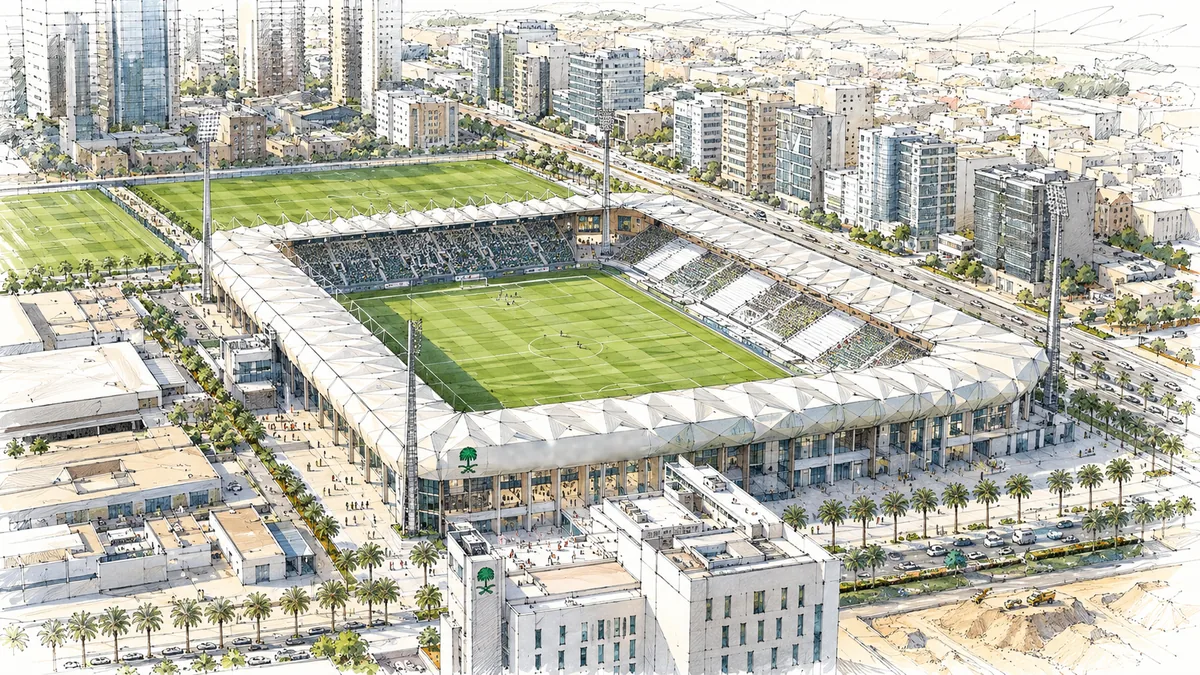
What changed it was a demolition. On September 7, 2021 a contractor began stripping the site: the running track came out, then the floodlight masts, the perimeter walls, and the buildings tucked underneath the terracing. The stands were rebuilt closer to the pitch and covered with a fabric canopy, and the announced capacity went from 10,000 to 15,000. The first training session on the new pitch was held on August 31, 2023, and the ground reopened for league football on October 21, 2023 against Al-Tai, a 2-0 win in front of 11,974.
The listed capacity today is 13,537, and the venue has been branded SHG Arena since September 2025. It is the smallest of the five Riyadh grounds selected for the AFC Asian Cup in January 2027, and the smallest of the eight in the tournament. It is also, by some distance, the one that feels closest to the football.
Getting to Al-Shabab Club Stadium
Public Transit
Riyadh spent a decade building a metro and opened all six lines inside five weeks from December 1, 2024. The relevant one here is Line 1, the Blue Line, running 38 kilometres (24 miles) north to south through 25 stations.
→ Dr Sulaiman Al-Habib station: The nearest stop, second down from the northern terminus at SABB, open to the public since December 8, 2024. No station serves the ground directly, so the last 1.3 kilometres (0.8 miles) is an 18-minute walk, or about four minutes on a bus from Exit 4.
→ Fares: SAR 4 for two hours across metro and bus, SAR 10 in first class. Three days is SAR 20, seven is SAR 40, thirty is SAR 140. Pay through the Darb app or tap a Mada or credit card at the gate.
→ Hours: 05:30 to midnight Saturday through Thursday, 10:00 to midnight on Friday.
→ KAFD: One stop south, and the interchange with the Yellow and Purple lines. Worth knowing if you are coming across the city rather than down it.
The walk is the honest part of this. No shuttle, no station at the gate. Eighteen minutes is nothing in January and quite a lot in June, and nobody has built anything to bridge it.
Driving + Parking
The address is 7063 King Fahd Branch Road, Al Sahafah District, Riyadh 13321. The stadium is not a standalone bowl ringed by lots; it sits inside a club complex of football pitches, indoor halls and a pool, in a residential grid in the north of the city.
→ From central Riyadh: About 11 kilometres (7 miles) north of Kingdom Centre, straight up King Fahd Road and onto its branch.
→ From Hittin and the Riyadh Season zones: Roughly 6 kilometres (3.8 miles) north-northeast of Boulevard City.
No parking count has ever been published for this ground, and the surrounding streets are residential rather than industrial. On a derby night that is a real constraint, and it is the single best argument for the metro.
Rideshare
Uber and Careem both cover Riyadh thoroughly, and Al Sahafa is an easy district to be dropped in. Getting out afterward is the harder half, as it is everywhere. The trick here is the metro station: walk the 1.3 kilometres and order your ride from outside the crowd rather than inside it.
Pro tip: Get a local SIM before matchday. A rideshare app you cannot load is the same as no ride at all.
From the Airport
→ King Khalid International (RUH): About 19 kilometres (12 miles) north-northeast in a straight line. Allow half an hour by road, longer at the end of a working day.
→ Onward to the other Riyadh venues: Four more Asian Cup grounds sit in this city, and King Fahd Sports City, which takes the opening match and the final, is 21 kilometres (13 miles) due east of here, across the whole width of Riyadh. Do not plan a same-day double-header on optimism.
Watching a Match at SHG Arena
Arab News watched the reopening in October 2023 and called the place a cauldron. Eleven thousand nine hundred and seventy-four people, a crowd the paper reported as sold out, tifos across the stands, and a noise that had nowhere to escape to. That sell-out figure sits 1,563 below the capacity the standard listings carry. The paper’s argument was about the rest of the league as much as this ground: most Saudi Pro League stadiums, it wrote, “are relics of the past, designed for a different time,” and “when there is a giant athletics track in the way, the energy of the crowd easily gets lost in the void.” Nearly half the league that season had played a home game in front of fewer than 1,000 fans.
That is the context for a 13,537-seat stadium in a country that builds 60,000-seat ones. The redevelopment removed the void. No track, no moat, stands rebuilt against the touchline, and a fabric canopy over the top to hold the sound in rather than let it drift.
Where to sit barely matters here, which is a luxury. There is no tier stranded behind an oval and no section where the game happens at a distance. The premium end of the building is 200 VIP seats plus hospitality lounges, and if you want the catered version that is where it lives. Everyone else is close. Family sections are marked out separately, each set of supporters enters through its own gate, and there is a dedicated referee entrance, a detail that says something quiet about the design brief.
Food is honest rather than notable. The rebuilt stands were laid out with restaurants and cafes behind them, the concourse carries the usual grills, fast food and coffee, and nothing about it has entered the folklore. Tickets come through Webook, general admission has run SAR 30 to 100, premium seats SAR 250 to 500, and the lounges start around SAR 1,200. Ordinary league fixtures go on sale 10 to 14 days out. The Riyadh derby does not sit there waiting for you.
One thing to check before you book. Since 2025 Al-Riyadh have used the ground as a home venue too, alongside Al-Shabab, and the women’s team played here from 2023 to 2025. The address hosts more football than one club’s fixture list, so read the badge on the ticket.
The 2027 Asian Cup at Al-Shabab Stadium
Five matches, in a tournament running from January 7 to February 5, 2027 across Riyadh, Jeddah and Al Khobar. Tajikistan against Iraq opens the account on January 10, then Kyrgyzstan against Iran on January 13, Thailand against Japan on January 16, and Australia against Tajikistan on January 19. A Round of 16 tie follows on January 22, pairing the Group B winner with a third-placed side from Group A, C or D.
Five is the smallest allocation of the eight venues, tied with Prince Abdullah Al-Faisal in Jeddah. The other four Riyadh venues all run higher: three take six apiece and King Fahd Sports City takes eight. Aramco Stadium in Al Khobar takes seven, and King Abdullah Sports City in Jeddah takes eight. Two group games from Group D is the notable bit of the draw. Tajikistan play here twice in ten days, against Iraq and then Australia, so one squad gets to know this pitch better than anybody else in the tournament.
The AFC’s venue table lists the ground at 14,000 rather than the 13,537 that the standard listings carry. Competition configurations move seats around, so a small discrepancy is ordinary. It is still worth knowing when you are reading a seat map.
Construction & Design
Nobody put a name to this building. No architect of record, no structural engineer, no main contractor appears in the Saudi press coverage, the club’s own material, or the Wikipedia entry, and the 2021 works were reported as a Ministry of Sport program rather than a headline commission. That is worth stating plainly rather than filling with a guess.
What is documented is the sequence. On June 10, 2021 the Ministry of Sport announced development plans for three smaller club grounds at once: this one, Al-Ettifaq’s and Al-Fateh’s. Work started here on September 7, 2021, and the contractor’s first job was subtraction. Out came the running track, the floodlight masts, the side walls and the structures beneath the terracing. The stands were then extended to an announced 15,000, wrapped with restaurants and cafes at the back, and covered with a fabric canopy.
The pitch was relaid in natural grass and the floodlighting installed to AFC specification, which was the point of the whole exercise: a club ground that could be certified for continental football rather than one that could only hold a training session. Al-Riyadiyah’s inventory of the finished building lists 200 VIP seats, first-class seating, family sections, separate entrances for each set of supporters, a dedicated referee entrance and security barriers throughout. The complex around it is large for a football ground. Makkah newspaper’s inventory of the site runs to four football pitches, an enclosed 600-seat hall for basketball, handball and volleyball, three tennis courts, covered squash courts, an indoor pool, three weight rooms, a theater and a lecture hall.
The cost has a document behind it. Saudipedia, the Saudi national knowledge platform, puts the project at SAR 90 million and lists what the money bought: the stands, the pitch, the players’ rooms, the conference hall and the rest of the facilities. That figure covers the 2021 to 2023 rebuild. Not the 1984 ground. None of the sources behind this page put a price on that one.
There is an earlier layer under all of this, too. In April 2012 the site got its first significant upgrade, adding three more football pitches, administrative offices and medical clinics. In July 2019 an engineering team from the approved consulting office walked the ground, running soil tests and technical surveys for an expansion that would not break ground for another two years. The 2021 demolition was the third move on this site in a decade, not a standing start.
History of Al-Shabab Club Stadium
Al-Shabab were founded in 1947 and spent most of their best years as tenants. Six league titles, in 1990-91, 1991-92, 1992-93, 2003-04, 2005-06 and 2011-12, three King’s Cups, and the 2001 Asian Cup Winners’ Cup, almost all of it won in stadiums belonging to somebody else. The club’s own ground existed the whole time. It just was not a match venue. Thirty-five years of that.
Notable events:
- Opened, 1984. Built inside the club complex in Al Sahafa and named for Prince Khalid bin Sultan bin Abdulaziz, the honorary president. For the next three and a half decades it hosted training and friendlies.
- April 2012, the first real upgrade. Three more football pitches, administrative offices and medical clinics went in. The ground was becoming a facility rather than a field.
- January 2, 2019. Al-Shabab hosted Al-Sahel in the King Cup, the first competitive match ever played at the stadium. Nine days later, on January 11, came the first league fixture: Al-Shabab 4, Al-Fayha 1, with Nasser Al-Shamrani, Abdulmajeed Al-Sulaiheem and a pair from Constantin Budescu.
- September 7, 2021 to August 2023. The redevelopment. Track, masts and walls out; canopy, expanded stands and an AFC-grade pitch in. The first training session on the new surface was held on August 31, 2023.
- October 21, 2023. Reopening night against Al-Tai, a 2-0 win through Habib Diallo and Hussain Al-Qahtani, watched by 11,974. Arab News wrote it up as a template for what Saudi club football should be building.
- May 11, 2024. The record: 13,475 against Al-Ahli, 62 seats short of the listed capacity.
- September 15, 2025. The club signed a two-season naming-rights deal with Syndicate Holding Group and the ground became SHG Arena. The announcement was made by acting board chairman Khalif bin Abdullah Al-Huwaishat and SHG chief executive Mohammed bin Abdullah Al-Qarafi, and it carried no published value.
The tenancy list has grown since. Al-Shabab’s women’s team used the ground from 2023 to 2025, and Al-Riyadh moved in as a co-tenant in 2025. In January 2027 it becomes an international venue for the first time, with four Asian Cup group games and a Round of 16 tie. Every venue is mapped in our AFC Asian Cup 2027 guide.
For a stadium that spent thirty-five years as a training pitch, that is a fairly remarkable second act. The interesting part is that it did not get there by growing. It got there by taking a running track out.
Sources & Further Reading
- Wikipedia entry on Al-Shabab Club Stadium: en.wikipedia.org/wiki/Al-Shabab_Club_Stadium. Capacity, ownership, naming history, the redevelopment timeline and the attendance record, with Arabic press citations throughout.
- Arab News: arabnews.com. The reopening report from October 2023, and the argument about athletics tracks and empty Saudi stands that this page draws on.
- Makkah newspaper: makkahnewspaper.com. The Arabic account of what the redevelopment removed and added, plus the club complex inventory.
- Al-Riyadiyah: arriyadiyah.com. Pitch, lighting, VIP seating, family sections and entrance arrangements, and separately the naming-rights reporting.
- Asharq Al-Awsat: aawsat.com. The September 2025 SHG Arena deal and its reported annual value.
- Saudipedia: saudipedia.com. The Saudi national knowledge platform’s Al-Shabab entry, and the SAR 90 million figure for the redevelopment.
Quick Facts
Everything you need at a glance.
Stadium specs
- Capacity
- 13,537
- Opened
- 1984
- Cost
- SAR 90 million (redevelopment)
- Roof
- Partial canopy over the stands
- Surface
- Natural grass
- Tenants
- Al-Shabab (Saudi Pro League), Al-Riyadh (Saudi Pro League)
Construction & location
- Groundbreaking
- September 7, 2021 (redevelopment)
- Architects
- Not separately recorded
- Engineering
- Not separately recorded
- General contractor
- Not separately recorded
- Address
- 7063 King Fahd Branch Road, Al Sahafah District, Riyadh 13321, Saudi Arabia
- GPS
- 24.8031°N, 46.6288°E
Fun Facts
The stadium opened in 1984 and did not host a competitive match until January 2, 2019. For thirty-five years it was somewhere Al-Shabab trained.
The record crowd of 13,475, set against Al-Ahli on May 11, 2024, came 62 short of the listed capacity of 13,537. Almost every seat in the building was sold.
The redevelopment stripped out the running track, the floodlight masts, the perimeter walls and the buildings underneath the terracing, then rebuilt the stands with restaurants and cafes behind them.
Stadium Location
Frequently Asked Questions
- How many people does it actually hold?
- Depends which document you trust. Wikipedia's infobox and the standard league listings both carry 13,537, and that is the figure this page uses. The AFC's venue table for the 2027 Asian Cup says 14,000. Saudi media, Visit Saudi and the club's own press coverage all say 15,000, because 15,000 was the number announced when the redevelopment was approved in 2021. The useful cross-check is the attendance record: 13,475 against Al-Ahli on May 11, 2024. A ground that has never put more than 13,475 people through its gates is not a 15,000-seat ground in any practical sense.
- Where should I sit?
- Anywhere, honestly, and that is the whole point of the place. The 2021 redevelopment tore out the athletics track and rebuilt the stands hard against the touchline, so there is no bad-sightline tier and no cheap seats marooned behind a running oval. There are 200 VIP seats and a set of hospitality lounges if you want the catered version. Family sections are marked separately, and each set of supporters gets its own entrance.
- How do I get there on the metro?
- Line 1, the Blue Line, to Dr Sulaiman Al-Habib. It is the second station from the northern end and it opened on December 8, 2024. There is no stop at the stadium, so you finish on foot: about 1.3 kilometres (0.8 miles), roughly 18 minutes, or four minutes on a bus from Exit 4. A flat SAR 4 covers two hours on the Darb app. Trains stop at midnight, which matters more than you think after a 21:00 kickoff.
- What do tickets cost and where do I buy them?
- Webook is the official platform for Al-Shabab and for the Roshn Saudi League generally. General admission has run SAR 30 to 100, premium seating SAR 250 to 500, and the VIP and silver lounges start around SAR 1,200. Tickets for an ordinary league fixture tend to go on sale 10 to 14 days before kickoff. The Riyadh derby is the exception and it does not linger.
- Is there a roof, and will I be sitting in the sun?
- There is a fabric canopy over the stands, added during the redevelopment, and it is one of the more meaningful things the project did. It does not enclose the ground and it is not air conditioning. For the Asian Cup in January that is a non-issue: Riyadh in midwinter is the whole reason the tournament is scheduled then.
- What is there to eat?
- The rebuilt stands were designed with restaurants and cafes behind them, and the concourse carries the usual Saudi matchday spread of grills, fast food and coffee. No signature item has made the venue's name, and nobody writing about this ground has singled out the food. Come for the noise.
- Which 2027 Asian Cup matches are here?
- Five. Tajikistan against Iraq on January 10, Kyrgyzstan against Iran on January 13, Thailand against Japan on January 16, and Australia against Tajikistan on January 19, then a Round of 16 tie on January 22 between the Group B winner and a third-placed team from Group A, C or D. Five is the smallest allocation of the eight venues, shared with Prince Abdullah Al-Faisal in Jeddah.
- Why is it called SHG Arena?
- Naming rights. On September 15, 2025 the club signed a two-season deal with Syndicate Holding Group and the ground took the sponsor's name. The value was not disclosed in the club's own announcement; Al-Riyadiyah reported SAR 44 million across the two seasons and Asharq Al-Awsat put it at more than SAR 18 million a year. Before that it was the Prince Khalid bin Sultan Stadium, after the club's honorary president, a name it carried from 1984.
- Will the ground actually be full?
- For a big night, yes, and that is unusual in this league. The reopening fixture against Al-Tai on October 21, 2023 drew 11,974 and was reported as a sell-out; the record of 13,475 followed seven months later. Arab News noted at the time that nearly half the Saudi Pro League had played a home game that season in front of fewer than 1,000 fans. A small ground that fills is worth more than a large one that does not.
- Do two clubs play here?
- Yes, since 2025. Al-Riyadh took the ground as a home venue alongside Al-Shabab, and the Al-Shabab women's team used it from 2023 to 2025. Check which badge is on the fixture before you book a hotel around it, because a Riyadh matchday at this address is not automatically an Al-Shabab one.
Last updated: 2026-09-17