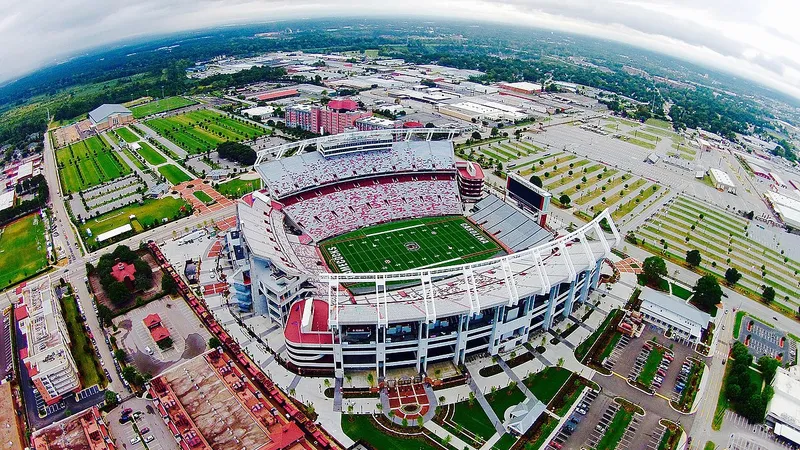
About Williams-Brice Stadium
From the South Carolina State Fairgrounds in Columbia, about two miles south of the University of South Carolina campus, rises one of the largest stadiums in the Southeastern Conference. Williams-Brice seats 77,559, and it is home to the South Carolina Gamecocks, a program that has made this one of college football’s most electric environments without ever winning a national championship.
The Gamecocks are the sole tenants, and the stadium has been their home since 1934, when the city built the original Columbia Municipal Stadium with federal Depression-era relief funds. What started as a modest 17,600-seat concrete structure has been expanded eight times over nine decades, growing into the towering horseshoe that now dominates the Bluff Road landscape.
The game-day entrance is legendary. Since 1983, every home game has opened with the thundering fanfare of Richard Strauss’s “Also sprach Zarathustra”, the “2001: A Space Odyssey” theme, as the Gamecocks emerge from the tunnel. The tradition was started by then-coach Joe Morrison, and it remains one of college football’s most recognizable and intimidating rituals.
Behind the south end zone sits the Cockaboose Railroad, 22 permanently parked cabooses along an active rail spur, each privately owned and converted into luxury tailgating suites with electricity, plumbing, and air conditioning. Individual cabooses have sold for over $250,000, making them some of the most expensive tailgating real estate in college sports.
The east upper deck, added in 1982, is the stadium’s most notorious structural feature. Built steeply above the original 1934 lower bowl, it sways noticeably when fans jump in unison during big plays. Shock absorbers were installed in 1987 to manage the movement, and engineers have repeatedly confirmed the motion is within safe design tolerances, but the sensation of 20,000 people bouncing on a swaying upper deck adds an element of controlled chaos that visiting fans never forget.
Getting to Williams-Brice Stadium
Public Transit
Columbia’s transit options are limited, but the free game-day shuttle makes up for it.
→ From the State Fairgrounds: Free shuttle buses run continuously from the Fairgrounds parking lots (free parking) to the stadium, about a 5-minute ride. This is the recommended option for most fans.
→ From downtown Columbia / USC campus: The Comet bus system operates game-day service. Routes 101 and several campus shuttles serve the stadium area. Walking from Five Points takes about 25 minutes.
If staying on campus or downtown, many fans walk, it’s about 2 km from the Russell House Student Union to the stadium along Bluff Road.
Driving + Parking
GPS address: 1127 George Rogers Boulevard, Columbia, SC 29201.
→ From Charlotte (150 km): I-77 South to Columbia, exit at Shop Road or Bluff Road. About 1 hour 30 minutes.
→ From Charleston (175 km): I-26 West to Columbia, exit at Shop Road. About 1 hour 50 minutes.
→ From Atlanta (350 km): I-20 East to Columbia. About 3 hours 30 minutes.
Parking near the stadium is mostly reserved for Gamecock Club donors. The best option for general fans is the free parking at the South Carolina State Fairgrounds with shuttle service. Private lots on Bluff Road charge $20-40, and they fill early for SEC games. Arrive at least 3 hours before kickoff for any lot within walking distance.
Rideshare
Uber and Lyft operate in Columbia but availability is limited compared to larger cities. From downtown Columbia, expect $10-15; from the airport about $15-20. The designated pickup/dropoff area is on George Rogers Boulevard near Gate 10. After games, expect 30-45 minute waits due to surge pricing and traffic, walking to the Fairgrounds for a pickup is often faster.
From the Airport
→ Columbia Metropolitan Airport (CAE): 10 km southwest, about 15 minutes by car. Uber/Lyft $15-20. Limited airline service, major carriers include American, Delta, and United with connections through Charlotte, Atlanta, and Washington-Dulles.
Construction & Design
Williams-Brice was a Depression project before it was a cathedral of noise. In 1933 the City of Columbia secured an $82,000 federal relief loan to build a stadium on the State Fairgrounds, and Columbia Municipal Stadium opened in 1934 at a total cost of about $113,086, seating 17,600. The contractors were the Virginia Bridge and Iron Company and W.A. Crary. For its first years it was a plain concrete bowl beside a rail line. A long way from the SEC.
The name changed twice. It became Carolina Stadium in 1941, then Williams-Brice Stadium in 1972, after a bequest from the estate of Martha Williams-Brice, whose family ran the Williams Furniture Company in Sumter and whose husband, Tom Brice, had lettered for the Gamecocks in the 1920s. The gift funded the expansion that pushed the stadium toward its modern size.
Then it grew. And grew. Upper decks in the 1970s and 1980s lifted capacity past 72,000, and the 1982 east upper deck, built steeply over the 1934 lower bowl, gave the stadium both its skyline and its most infamous quirk: it sways when the crowd jumps. Shock absorbers went in during 1987, and engineers keep confirming the motion sits well inside safe limits. Capacity now reads 77,559, but on a night game it feels a great deal larger.
History of Williams-Brice Stadium
The stadium’s origins are rooted in the Great Depression. In 1934, federal Depression-era relief funds paid for Columbia Municipal Stadium, a 17,600-seat concrete structure on the State Fairgrounds that gave the University of South Carolina its first permanent football home. The Gamecocks had previously played at a series of small campus fields.
The stadium grew steadily through the postwar decades: upper decks were added in the 1970s and 1980s, pushing capacity past 72,000. The most dramatic expansion came in 1982 when the east upper deck was constructed, rising steeply above the original 1934 lower bowl. This upper deck became famous for its noticeable swaying during crowd celebrations, a phenomenon addressed in 1987 with the installation of shock absorbers. Engineers confirmed the movement is within safe design tolerances, but the sway adds to the stadium’s character.
Key moments in the stadium’s history:
- October 6, 1934: First game, South Carolina defeats Erskine 22-6 before 10,500 fans.
- 1972: Renamed Williams-Brice Stadium after a bequest from the estate of Martha Williams-Brice (reported at figures ranging from $2.5 to $5.3 million) funded a major expansion.
- 1983: Coach Joe Morrison introduces the “2001: A Space Odyssey” entrance, which becomes one of college football’s signature traditions.
- October 6, 2012: South Carolina beats Georgia 35-7 before a record crowd of 85,199, the largest in stadium history.
- August 3, 2024: Manchester United vs. Liverpool friendly draws 77,000+ fans, the first international soccer match at the venue.
Columbia’s climate makes early-season games an endurance test. September kickoffs bring temperatures in the mid-30s°C (low to mid-90s°F) with oppressive humidity, conditions that favor the home team and punish visiting players unaccustomed to the South Carolina heat. By November, conditions shift to crisp fall afternoons in the low 20s°C (upper 60s°F), ideal for football.
Williams-Brice Stadium has never hosted a national championship game, and the Gamecocks have never won one. But the atmosphere, the “2001” entrance, 80,000 fans in garnet and black, the Cockaboose Railroad, the swaying upper deck, is among the most intense in college football. The stadium’s Depression-era bones, nine decades of expansion, and the passion of a fanbase that has endured more heartbreak than triumph make it one of the most authentic venues in the sport.
Sources & Further Reading
- South Carolina Athletics, Williams-Brice Stadium: gamecocksonline.com. Capacity, traditions, and facility information.
- Living New Deal, Williams-Brice Stadium: livingnewdeal.org. Original 1933-34 construction and federal funding.
- Wikipedia, Williams-Brice Stadium: en.wikipedia.org/wiki/Williams-Brice_Stadium. Naming history, expansions, and traditions.
Quick Facts
Everything you need at a glance.
Stadium specs
- Capacity
- 77,559
- Opened
- 1934
- Cost
- $113,086 (original, 1934), aided by an $82,000 federal RFC loan
- Roof
- Open
- Surface
- Natural Grass
- Tenants
- South Carolina Gamecocks (NCAA)
Construction & location
- Architects
- Original architect not recorded
- General contractor
- Virginia Bridge and Iron Co. / W.A. Crary Co. (1934)
- Address
- 1127 George Rogers Boulevard, Columbia, SC 29201, USA
- GPS
- 33.9731°N, 81.0193°W
Photo Gallery
Fun Facts
Since 1983, every Gamecocks home game has opened with the theme from '2001: A Space Odyssey' (Richard Strauss's 'Also sprach Zarathustra') blasting over the PA as the team enters the field, one of college football's most iconic and intimidating entrance traditions.
The Cockaboose Railroad is a row of 22 permanently parked cabooses along the railroad tracks behind the south end zone, each privately owned and converted into luxury tailgating suites. Individual cabooses have sold for over $250,000.
The east upper deck, added in 1982, sits atop the original 1934 lower bowl and is known for its dramatic swaying during crowd celebrations. Shock absorbers were installed in 1987 to manage the structural movement, a feature that only adds to the atmosphere.
Stadium Location
Frequently Asked Questions
- What is the capacity of Williams-Brice Stadium?
- 77,559 seats. The all-time attendance record is 85,199, set on October 6, 2012, for a game against Georgia.
- What song plays when the Gamecocks enter the field?
- The opening fanfare of Richard Strauss's 'Also sprach Zarathustra,' known as the theme from '2001: A Space Odyssey.' This tradition has opened every home game since 1983.
- What is the Cockaboose Railroad?
- A row of 22 permanently parked cabooses along the railroad tracks behind the south end zone. Each is privately owned and converted into a luxury tailgating suite with electricity, plumbing, and climate control. Individual cabooses have sold for over $250,000.
- How do I get to Williams-Brice Stadium?
- By car, take I-77 to the Shop Road or Bluff Road exits. Free shuttle buses run from the South Carolina State Fairgrounds (park free there). The Comet bus system also serves the stadium area.
- Is there parking at Williams-Brice Stadium?
- Yes, but it's limited and mostly reserved for donors. General parking is available in the Fairgrounds lots (free) with shuttle service. Private lots on Bluff Road charge $20-40. Arrive early, lots open 5 hours before kickoff.
- Does the upper deck really sway?
- Yes. The east upper deck, built in 1982, is known for noticeable movement during crowd celebrations. Shock absorbers were added in 1987 to manage the structural movement. Engineers have confirmed the movement is within safe design parameters.
- When was Williams-Brice Stadium built?
- The original stadium was built in 1934 as Columbia Municipal Stadium, funded by federal Depression-era relief money. It was later called Carolina Stadium, then renamed Williams-Brice Stadium in 1972.
Last updated: 2026-07-10