Ask someone to name the biggest stadium in their state and most people guess the local NFL team. They are usually wrong.
In about 35 of the 50 states, the largest stadium isn’t where the pros play. It’s where a college football team plays on Saturdays in front of crowds that rival a midsize city. The NFL builds beautiful, expensive venues, but they top out around 65,000 to 80,000 seats. A handful of college programs blew past that line decades ago and never looked back.
So the map of America’s biggest stadiums is really a map of where college football is king, where the NFL fills the gap, and where there just isn’t a big stadium at all.
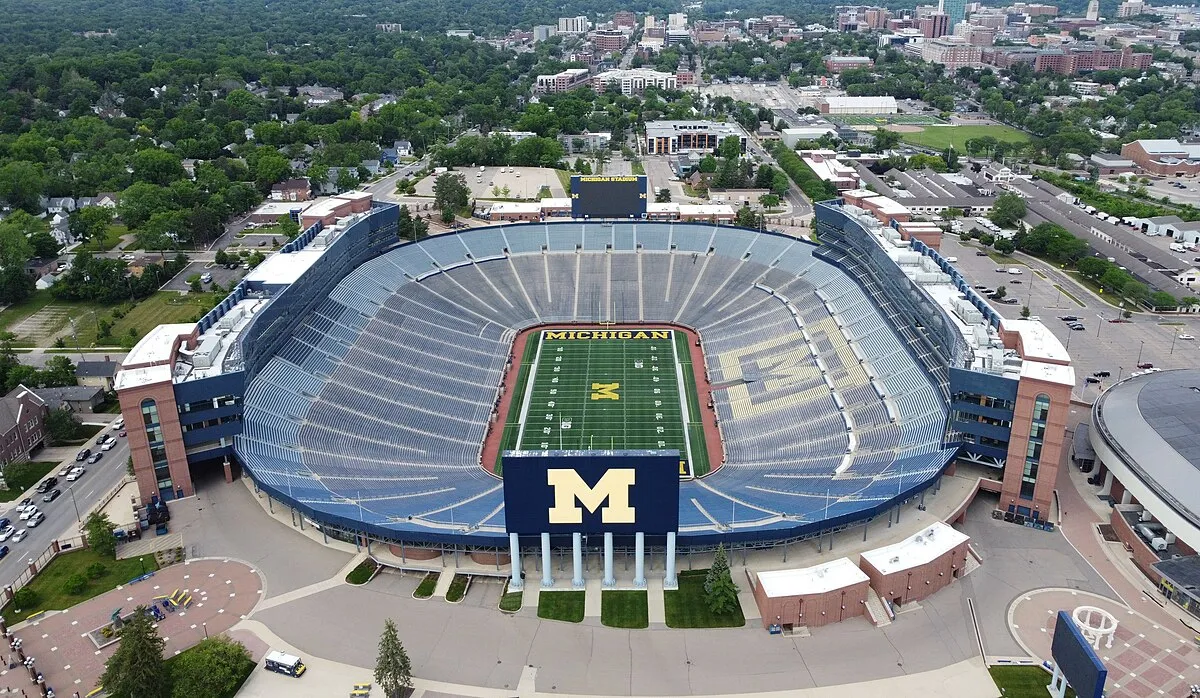
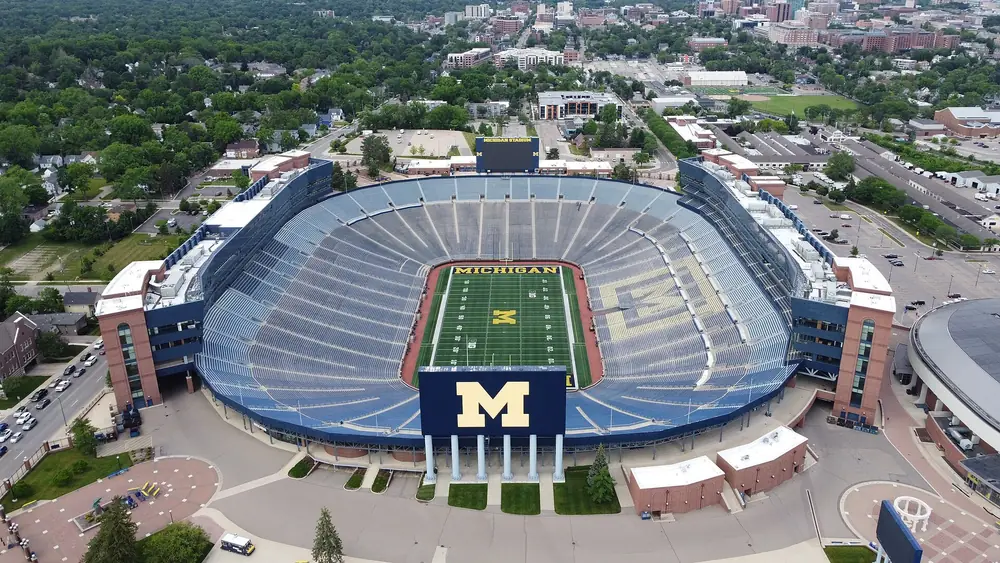
107,601 seats: Michigan Stadium, the largest in the United States, and bigger than the population of most American towns on a game day.
What the biggest-stadium map of America actually shows
The largest stadium in roughly 35 states is a college football stadium, which makes this less a ranking of buildings than a ranking of football cultures. The giants cluster in the South and the Midwest, where college football is closer to religion than recreation: the Southeastern Conference and the Big Ten between them own most of the 90,000-plus venues in the country. The NFL takes the top spot in about a dozen states, and the pattern there is consistent. The pro team wins the state only where there is no enormous college program to beat, like New Jersey, Massachusetts, Missouri, or Wisconsin. And in a small group of low-population states, the biggest stadium is genuinely small, sometimes a campus field or a baseball park, because nobody ever built anything larger.
That split tells you something real about American sport. The NFL is the richest league in the world, but it does not build the biggest buildings. College football does, and it has for a century.
The giants: seven states over 100,000
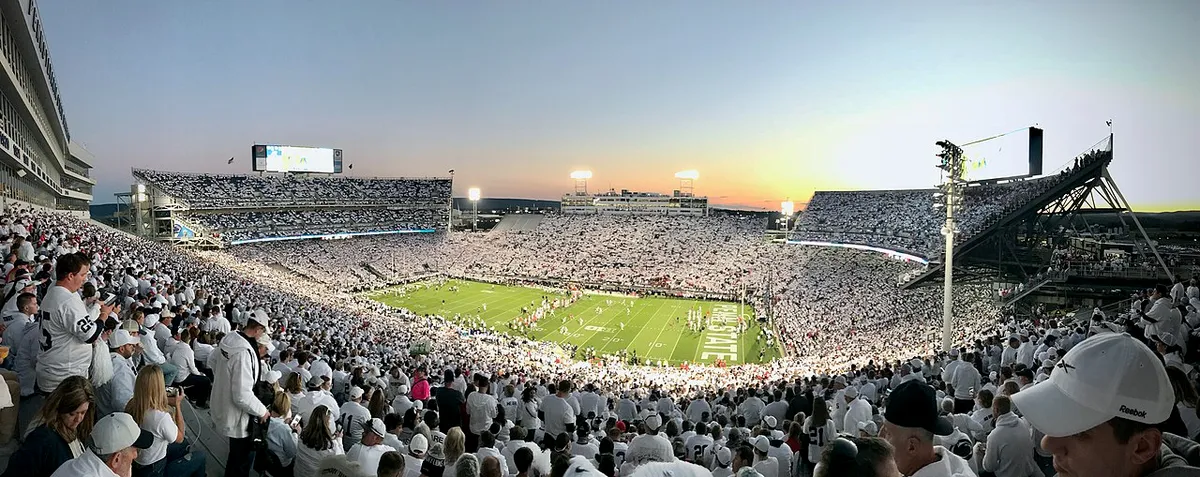
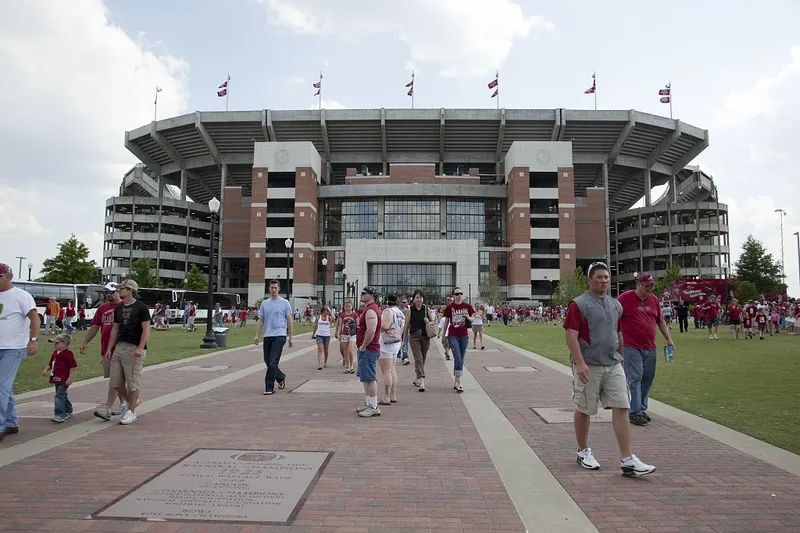
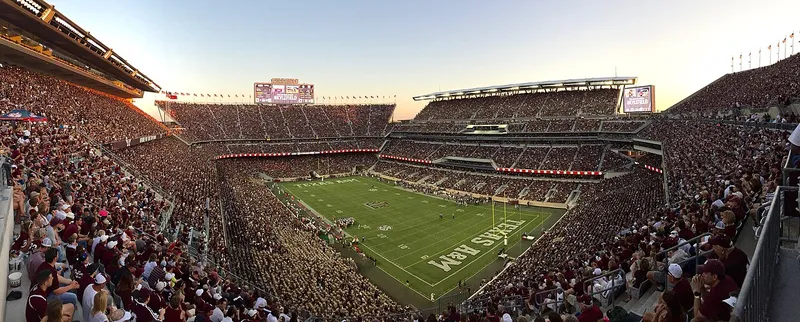
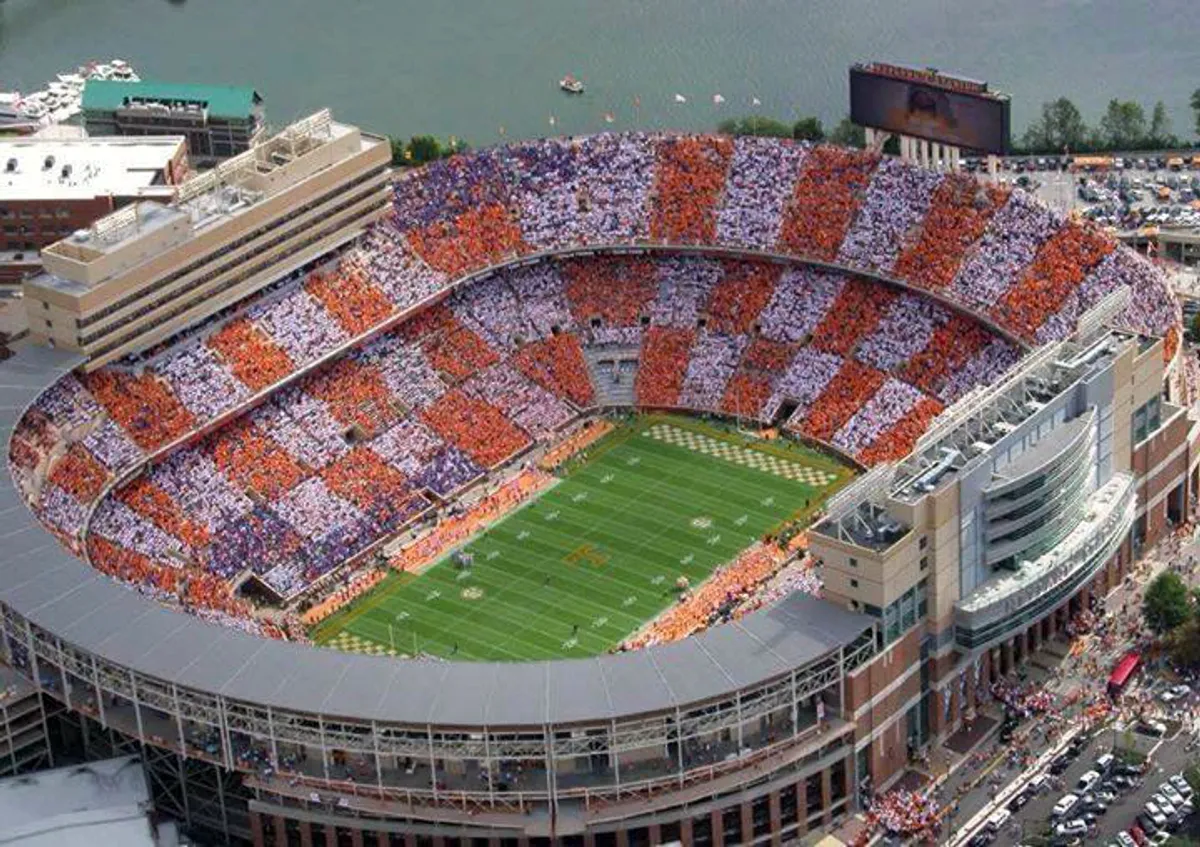
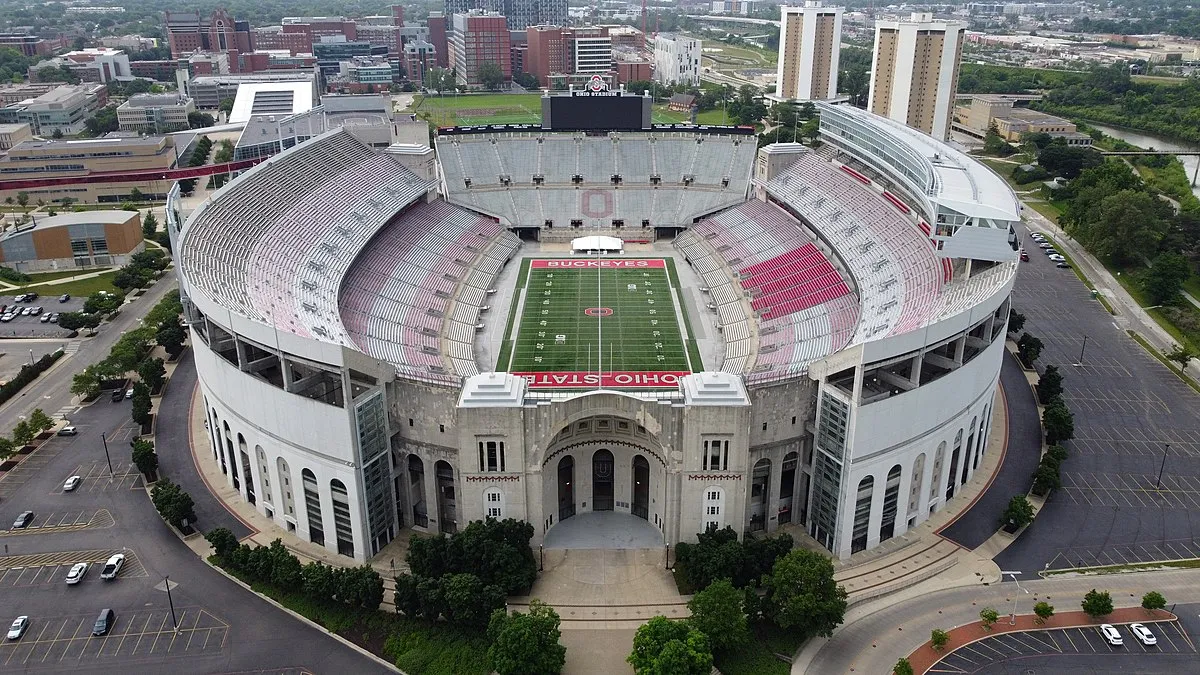
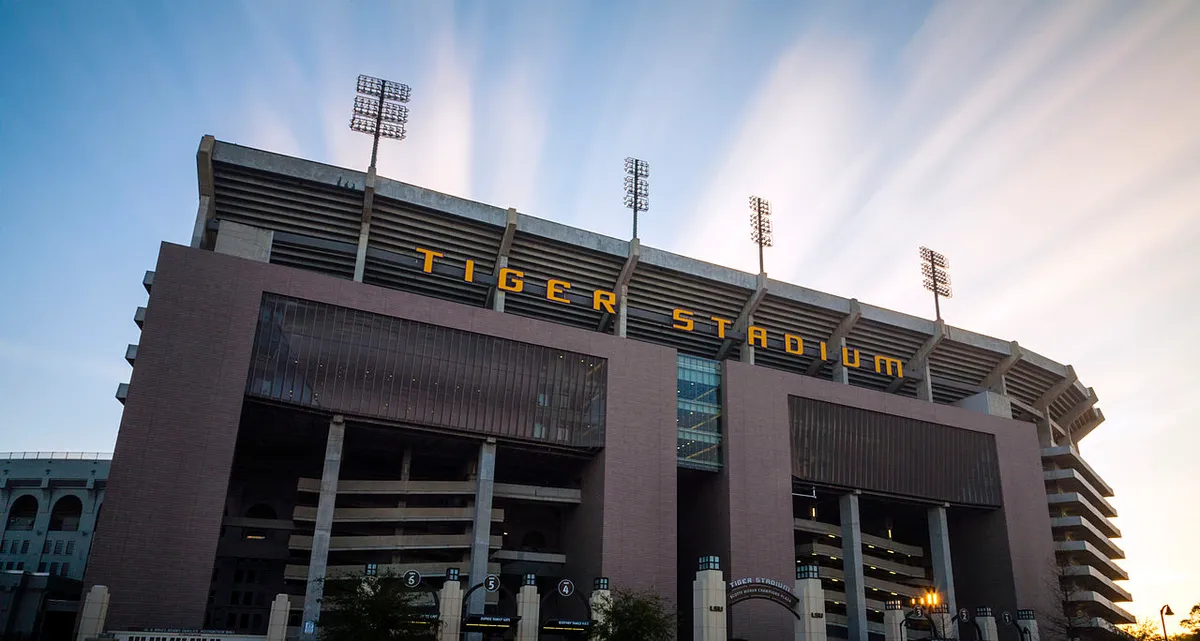
Seven states have a stadium that seats more than 100,000 people, and every single one is a college football stadium. Michigan Stadium leads the country at 107,601, followed by Penn State’s Beaver Stadium at 106,572 and Ohio State’s Ohio Stadium at 102,780. Texas A&M’s Kyle Field holds 102,733, LSU’s Tiger Stadium holds 102,321, Tennessee’s Neyland Stadium holds 101,915, and Alabama’s Bryant-Denny Stadium rounds out the group at 100,077. Not one NFL stadium in the country comes close.
These places empty entire regions on game day. Beaver Stadium turns Happy Valley into the third-largest population center in Pennsylvania for three hours. Neyland packs more people into Knoxville than live in most of the surrounding county. All of it runs on a sport where the players don’t draw a paycheck.
For the global version of this, where these American giants sit against the largest grounds on Earth, see our 2026 ranking of the largest stadiums in the world.
Where the NFL takes the crown
In about a dozen states, the largest stadium belongs to an NFL team, and the reason is almost always the same: no nearby college program plays at that scale. New Jersey’s biggest is MetLife Stadium at 82,500, the venue that hosts the World Cup 2026 final, because Rutgers tops out near 52,000. Wisconsin belongs to Lambeau Field at 81,441, just ahead of Wisconsin’s Camp Randall. Missouri goes to Arrowhead Stadium at 76,416, Massachusetts to Gillette Stadium at 64,628, and Nevada to Allegiant Stadium at 65,000.
The rest of the NFL-led states follow the same logic: Arizona (State Farm Stadium), Colorado (Empower Field at Mile High), Illinois (Soldier Field), Maryland (M&T Bank Stadium), Minnesota (U.S. Bank Stadium), New York (Highmark Stadium near Buffalo), and North Carolina (Bank of America Stadium). Each is a state where the pros simply out-built the local college.
About 12 states: where the biggest stadium is an NFL venue. In the other 38, it is a college stadium, a baseball park, or a campus field.
The small-state surprises
At the bottom of the list, “biggest stadium” becomes a generous phrase. Vermont’s largest is Centennial Field in Burlington, a roughly 4,400-seat baseball park, because the state has no major football venue at all. Alaska has no college football program and no large permanent stadium, so its biggest seated venue holds only a few thousand. Maine (Alfond Stadium, about 10,000), New Hampshire (Wildcat Stadium, about 11,000), and Rhode Island (Brown Stadium, 20,000) all sit far below the national giants.
These states are not football deserts so much as small-population places where no university or pro franchise ever needed 60,000 seats. The biggest stadium in Vermont would be a mid-tier college’s practice annex in Alabama. That gap, from 107,601 in Michigan to a few thousand in Vermont, is the widest in this entire ranking.
When a speedway would beat them all
This ranking covers stadiums, the seated bowls built for football and other field sports. Motor speedways are a different kind of venue, designed around an oval track, so they sit outside the list. But they are worth a mention, because in a few states a speedway dwarfs every stadium nearby.
Indiana is the extreme case. The biggest stadium in the state is Notre Dame Stadium at 80,795, but Indianapolis Motor Speedway holds roughly 257,000 permanent seats, more than any sports venue in the country and more than the next three stadiums combined. Tennessee’s Bristol Motor Speedway (around 146,000) out-seats Neyland. Nevada, Delaware, and New Hampshire all have a speedway larger than their biggest stadium. We left them out to keep this a true stadium ranking, but if the rules changed, the map would look very different.
One note on the numbers: most NASCAR tracks have actually removed tens of thousands of seats since around 2008, so the often-cited peak figures (Talladega at 143,000, Bristol at 160,000) are out of date. The current capacities are smaller, though still enormous.
The biggest stadium in every state
Here is the largest stadium in all 50 states, sorted alphabetically. Capacities are commonly cited current figures, and motor speedways are excluded.
| State | Biggest stadium | Capacity | City | Type |
|---|---|---|---|---|
| Alabama | Bryant-Denny Stadium | 100,077 | Tuscaloosa | College |
| Alaska | Anchorage Football Stadium | ~3,500 | Anchorage | High school / community |
| Arizona | State Farm Stadium | 63,400 | Glendale | NFL |
| Arkansas | Razorback Stadium | 76,212 | Fayetteville | College |
| California | Rose Bowl | 89,702 | Pasadena | College |
| Colorado | Empower Field at Mile High | 76,125 | Denver | NFL |
| Connecticut | Yale Bowl | 61,446 | New Haven | College |
| Delaware | Delaware Stadium | 18,500 | Newark | College |
| Florida | Ben Hill Griffin Stadium | 88,548 | Gainesville | College |
| Georgia | Sanford Stadium | 93,033 | Athens | College |
| Hawaii | Clarence T.C. Ching Complex | 15,194 | Honolulu | College |
| Idaho | Albertsons Stadium | 36,387 | Boise | College |
| Illinois | Soldier Field | 61,500 | Chicago | NFL |
| Indiana | Notre Dame Stadium | 80,795 | Notre Dame | College |
| Iowa | Kinnick Stadium | 69,250 | Iowa City | College |
| Kansas | Bill Snyder Family Stadium | 50,000 | Manhattan | College |
| Kentucky | Kroger Field | 61,000 | Lexington | College |
| Louisiana | Tiger Stadium | 102,321 | Baton Rouge | College |
| Maine | Alfond Stadium | 10,000 | Orono | College |
| Maryland | M&T Bank Stadium | 70,745 | Baltimore | NFL |
| Massachusetts | Gillette Stadium | 64,628 | Foxborough | NFL |
| Michigan | Michigan Stadium | 107,601 | Ann Arbor | College |
| Minnesota | U.S. Bank Stadium | 66,860 | Minneapolis | NFL |
| Mississippi | Vaught-Hemingway Stadium | 64,038 | Oxford | College |
| Missouri | Arrowhead Stadium | 76,416 | Kansas City | NFL |
| Montana | Washington-Grizzly Stadium | 25,217 | Missoula | College |
| Nebraska | Memorial Stadium | 85,458 | Lincoln | College |
| Nevada | Allegiant Stadium | 65,000 | Las Vegas | NFL |
| New Hampshire | Wildcat Stadium | 11,015 | Durham | College |
| New Jersey | MetLife Stadium | 82,500 | East Rutherford | NFL |
| New Mexico | University Stadium | 39,224 | Albuquerque | College |
| New York | Highmark Stadium | 63,000 | Orchard Park | NFL |
| North Carolina | Bank of America Stadium | 74,867 | Charlotte | NFL |
| North Dakota | Fargodome | 18,700 | Fargo | College |
| Ohio | Ohio Stadium | 102,780 | Columbus | College |
| Oklahoma | Oklahoma Memorial Stadium | 80,126 | Norman | College |
| Oregon | Autzen Stadium | 54,000 | Eugene | College |
| Pennsylvania | Beaver Stadium | 106,572 | University Park | College |
| Rhode Island | Brown Stadium | 20,000 | Providence | College |
| South Carolina | Memorial Stadium (Clemson) | 81,500 | Clemson | College |
| South Dakota | Dana J. Dykhouse Stadium | 19,340 | Brookings | College |
| Tennessee | Neyland Stadium | 101,915 | Knoxville | College |
| Texas | Kyle Field | 102,733 | College Station | College |
| Utah | LaVell Edwards Stadium | 63,470 | Provo | College |
| Vermont | Centennial Field | 4,415 | Burlington | Baseball |
| Virginia | Lane Stadium | 65,632 | Blacksburg | College |
| Washington | Husky Stadium | 70,083 | Seattle | College |
| West Virginia | Milan Puskar Stadium | 60,000 | Morgantown | College |
| Wisconsin | Lambeau Field | 81,441 | Green Bay | NFL |
| Wyoming | War Memorial Stadium | ~29,000 | Laramie | College |
A few states are close calls. Washington’s Husky Stadium (70,083) only narrowly beats Lumen Field, Illinois’s Soldier Field edges Illinois Memorial Stadium by a few hundred seats, and Mississippi’s Vaught-Hemingway barely clears Mississippi State’s Davis Wade. A handful of figures, like Wyoming’s, are in flux after recent renovations.
What the list says about American sport
The clearest takeaway is that college football, not the NFL, builds the biggest rooms in America. Seven states top 100,000 seats and all seven are campus stadiums. The SEC and Big Ten own the upper reaches of the list almost entirely. The NFL, for all its money, only wins a state when there is no college giant in the way.
It is a uniquely American arrangement. Nowhere else on Earth does an amateur, student-played sport fill 100,000-seat stadiums every weekend in the fall. The biggest-stadium map of the country is mostly just a map of that one strange fact. If you want to see how these giants stack up globally, the largest stadiums in the world puts Michigan and Beaver alongside the biggest grounds anywhere.
Sources
- Wikipedia: List of United States stadiums by capacity. The primary cross-reference for stadium capacities used throughout this ranking.
- Individual stadium pages on Wikipedia for state-level figures, including Michigan Stadium, Beaver Stadium, and Memorial Stadium (Clemson).
- Capacities reflect commonly cited current listed figures; several venues (Wyoming’s War Memorial Stadium, Idaho’s Albertsons Stadium, Buffalo’s stadium situation) are mid-change due to renovations or replacements and were noted as such.