About Bryant-Denny Stadium
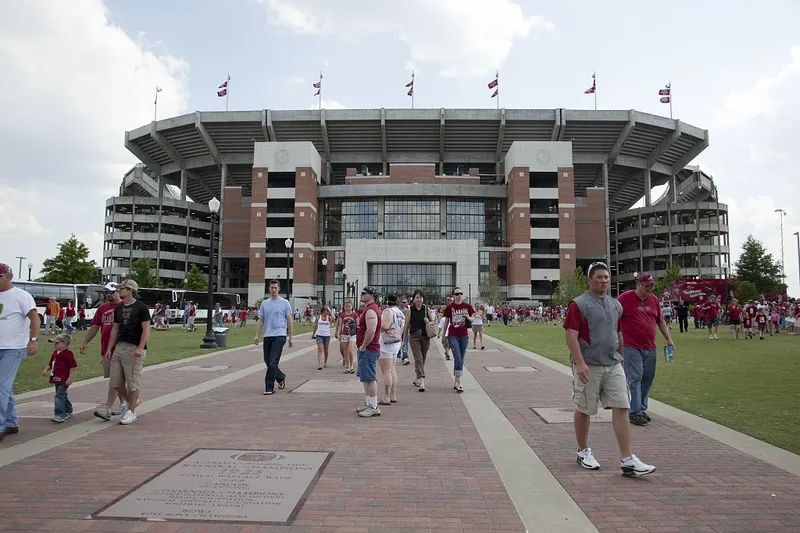
Bryant-Denny Stadium rises from the heart of the University of Alabama campus in Tuscaloosa, a cathedral of college football where 100,077 fans pack in on fall Saturdays to watch one of the most dominant programs in the sport’s history. It is the 8th-largest stadium in the country and the 4th-largest in the SEC.
The stadium is home to the Alabama Crimson Tide, a program that has won 18 national championships and produced legends from Bear Bryant to Nick Saban. The playing field was officially renamed Saban Field in 2024, honoring the coach who went 88-7 at home and delivered six national titles in 17 seasons. “Roll Tide” is not just a cheer here, it is a way of life that echoes through every corner of this building.
The original Denny Stadium opened in 1929 with just 12,000 seats. Since then, it has been expanded nine times, growing to a peak capacity of 101,821 in 2010 before the $107 million premium renovation in 2020 reshaped the seating areas and reduced capacity slightly to 100,077. That project added three new club areas, loge boxes, Founders Suites, and relocated the press box to the east side.
Every home game has been a sellout since 1988, a streak spanning over 35 years. The atmosphere on gameday is relentless, from the Walk of Champions pregame to the final whistle. If you have never experienced a night game at Bryant-Denny, put it on your list.
Getting to Bryant-Denny Stadium
Public Transit
Tuscaloosa has no rail service. The Tuscaloosa Transit Authority operates city buses and gameday trolleys between downtown and campus.
→ From University Mall: Free car parking with a $10 round-trip shuttle to the south end zone of Bryant-Denny. Cash only. Shuttles start at 7:00 AM on gamedays.
→ From Campus Lots: On-campus parking passes include complimentary shuttle service to and from the Quad area near the stadium.
ADA-accessible shuttle service is available for guests with disabilities, contact 205-556-5757 for details.
Driving + Parking
Bryant-Denny Stadium is at 920 Paul W. Bryant Drive, Tuscaloosa, AL 35401. I-20/I-59 is the primary highway corridor.
→ From Birmingham (~57 mi): Take I-20/I-59 West to Exit 73 (McFarland Blvd). Follow signs to the University of Alabama campus. About 1 hour.
→ From Atlanta (~200 mi): Take I-20 West through Anniston and Birmingham, continue on I-20/I-59 West to Exit 73. About 3 hours.
→ From Nashville (~247 mi): Take I-65 South through Decatur to Birmingham, then I-20/I-59 West to Exit 73. About 3 hours 40 minutes.
On-campus lots cost $35 per game (cashless only, bring a card). Lot A season passes run $250 through the Crimson Tide Foundation. Tailgating on the Quad is first-come, first-served starting at 7:00 AM. Grills are allowed but portable generators are banned.
Rideshare
Uber and Lyft both serve Tuscaloosa. Designated pickup/drop-off zones are at Thomas Street behind Publix, Hackberry Lane next to Chimes Condos, and the Randall Welcome Center on Campus Drive. No vehicles can access the campus core from 4 hours before kickoff through 90 minutes post-game. A ride from downtown hotels runs $8–$15; expect 2–4x surge pricing on gamedays.
From the Airport
→ Tuscaloosa National Airport (TCL): 6 miles, about 12 minutes by car. Limited commercial service, primarily general aviation with American Eagle flights to Dallas/Fort Worth.
→ Birmingham-Shuttlesworth International (BHM): 53 miles, about 1 hour. The primary commercial airport with service from American, Delta, Southwest, United, and Frontier.
→ Hartsfield-Jackson Atlanta (ATL): 203 miles, about 3 hours 30 minutes. Best option for visitors flying from outside the Southeast due to its hub status and competitive fares.
Construction & Design
Bryant-Denny started small. When it opened in 1929 as Denny Stadium, the Charlotte firm Atwood and Nash had drawn up a tidy concrete bowl of 12,000 seats, built for $196,000 and replacing the team’s old home at Denny Field. That figure is about $3.7 million in today’s money, which would not cover the videoboards alone now. The stadium has spent the better part of a century growing into its reputation.
It did so in nine distinct waves. The east sideline stands went up in 1937, doubling capacity to 24,000. End-zone bleachers followed in 1946, the west grandstand in 1961, and in 1966 the end zones were enclosed to push the bowl past 60,000. Then came the upper decks: west in 1988, east in 1998 with 85 skyboxes and a south-end JumboTron, the north end zone in 2006, and the south in 2010. That last project, a $65.6 million addition, lifted the stadium to its peak of 101,821 and built the Walk of Champions plaza where the team now enters before kickoff.
The money tells its own story. The 1998 deck cost $35 million, the 2006 north end zone around $47 million, the 2010 south end zone $65.6 million, and the 2020 premium renovation $107 million on its own. Add it up and the modern expansions run well past $300 million, on a building that originally cost less than $200,000.
The surface has flipped twice. Natural grass gave way to AstroTurf in 1968, the artificial era ran through 1990, and grass returned in 1991 and has stayed. In 2019 the stadium swapped its lighting for a full LED system, the kind that can color-wash the bowl for a night kickoff, paired with Daktronics videoboards in both end zones.
The 2020 renovation was less about seats than about money: $107 million for 3,826 premium seats, loge boxes, Founders Suites, and three new club areas, plus a press box moved to the east side. It trimmed the bowl from its 101,821 peak to about 100,077. Four years later, in 2024, the field became Saban Field. A fitting bookend: the building that Bear Bryant’s name made famous now carries the name of the coach who matched him.
History of Bryant-Denny Stadium
Denny Stadium opened on September 28, 1929, when Alabama defeated Mississippi College 55-0 in front of 6,000 fans. Named after university president George H. Denny, the original structure held just 12,000 seats, a fraction of what it would become.
Renamed for Bear Bryant (1975): The Alabama State Legislature added Paul “Bear” Bryant’s name to the stadium. Bryant coached the Crimson Tide for 25 seasons (1958-1982), compiling a 232-46-9 record and winning six national championships. His statue stands outside the Walk of Champions.
First Iron Bowl at Bryant-Denny (November 29, 2008): Alabama shut out Auburn 36-0, ending a six-game losing streak against their rival from Jordan-Hare Stadium and signaling the rise of the Saban era.
The Block (October 24, 2009): Terrence Cody blocked a Tennessee field goal as time expired to preserve Alabama’s unbeaten season in a 12-10 win. The Crimson Tide went on to win the BCS National Championship.
Record Attendance (October 16, 2010): A crowd of 101,821 packed the stadium for a 23-10 victory over Ole Miss following the south end zone expansion.
$107M Premium Renovation (2020): The project added 3,826 premium seats, three new club areas, loge boxes, and Founders Suites, and relocated the press box to the east side, trimming capacity to about 100,077.
Saban Field (2024): The university named the playing surface for Nick Saban, whose 17 seasons brought six national titles and an 88-7 home record.
Bryant-Denny is more than Alabama’s home field. It is where Bear Bryant built a dynasty, where Saban cemented his as the greatest coach in college football history, and where “Roll Tide” has echoed since 1929. The sellout streak continues, and the legends keep coming.
Sources & Further Reading
- Wikipedia entry on Bryant-Denny Stadium: en.wikipedia.org/wiki/Bryant–Denny_Stadium. Construction, the expansions, and capacity history.
- Paul W. Bryant Museum, Bryant-Denny Stadium: bryantmuseum.com. The university museum’s account of the stadium.
- College Gridirons, Bryant-Denny Stadium: collegegridirons.com. A stadium reference and photo history.
Quick Facts
Everything you need at a glance.
Stadium specs
- Capacity
- 100,077
- Opened
- 1929
- Cost
- $196,000 (1929 original); modern expansions exceeding $300 million combined
- Roof
- Open
- Surface
- Natural Grass
- Tenants
- Alabama Crimson Tide (NCAA/SEC)
Construction & location
- Groundbreaking
- December 1928
- Architects
- Atwood and Nash, Inc. (original, 1929)
- Engineering
- Not separately recorded
- General contractor
- Not publicly recorded
- Address
- Bryant-Denny Stadium, 920 Paul W. Bryant Drive, Tuscaloosa, AL 35487
- GPS
- 33.2083°N, 87.5503°W
Photo Gallery
Fun Facts
Alabama owns a 249-51-3 all-time record at Bryant-Denny Stadium. Under Nick Saban alone (2007-2023), the Crimson Tide went 88-7 at home.
Every home game has been a sellout since 1988, a streak spanning over 35 years that began the same year the west upper deck was completed.
The stadium has been expanded 9 times since 1929, growing from 12,000 seats to a peak of 101,821 before settling at the current 100,077 after the 2020 premium renovation.
Stadium Location
Frequently Asked Questions
- What is the seating capacity of Bryant-Denny Stadium?
- Bryant-Denny Stadium has a current seating capacity of 100,077, making it the 8th-largest stadium in the United States and the 4th-largest in the SEC.
- Why is it called Bryant-Denny Stadium?
- The stadium was originally named Denny Stadium in 1929 after University of Alabama president George H. Denny. In 1975, the Alabama State Legislature added legendary head coach Paul 'Bear' Bryant's name. In 2024, the playing field was named Saban Field after Nick Saban.
- How much does parking cost at Bryant-Denny Stadium?
- On-campus lots cost $35 per game (cashless only). Season passes for Lot A are $250. University Mall offers free parking with a $10 round-trip shuttle to the stadium.
- Can you tailgate at Bryant-Denny Stadium?
- Yes. Tailgating is allowed on the west side of the Quad on a first-come, first-served basis. Grills are permitted but must be monitored. Portable generators and on-campus charcoal dumping are prohibited.
- What is the closest airport to Bryant-Denny Stadium?
- Tuscaloosa National Airport (TCL) is about 6 miles away but has limited commercial service. Birmingham-Shuttlesworth International Airport (BHM), 53 miles east, is the primary commercial airport with a 1-hour drive to the stadium.
- What is Alabama's all-time record at Bryant-Denny Stadium?
- Through 2023, Alabama holds a 249-51-3 record at Bryant-Denny. Under Nick Saban (2007-2023), the Crimson Tide went 88-7 at home, losing fewer than one home game every two seasons.
- How much did the Bryant-Denny Stadium renovation cost?
- The most recent major renovation, completed in 2020, cost about $107 million and added 3,826 premium seats, loge boxes, three new club areas, and relocated the press box. (In 2024 the university named the playing surface Saban Field, but that was a naming, not a construction project.) Over its history, the stadium has undergone nine major expansions.
- Who designed and built Bryant-Denny Stadium?
- The original 1929 stadium was designed by Atwood and Nash, Inc., a Charlotte firm that billed itself as architects and engineers. It cost $196,000, roughly $3.7 million in today's money. The names of the contractors on the many later expansions were not separately recorded.
- When was Bryant-Denny Stadium built?
- Construction began in December 1928 and the stadium opened on September 28, 1929, as Denny Stadium. It replaced Denny Field, the team's earlier home, and started with just 12,000 seats.
- How many times has Bryant-Denny Stadium been expanded?
- Nine times. The stadium grew through additions in 1937, 1946, 1961, 1966, 1988, 1998, 2006, 2010, and 2020, climbing from 12,000 seats to a peak of 101,821 before the 2020 reconfiguration set it near today's 100,077.
- What is the playing surface at Bryant-Denny Stadium?
- Natural grass. The field was grass from 1929 to 1967, switched to AstroTurf for the 1968 to 1990 seasons, and has been natural grass again since 1991.
- What is Saban Field?
- In 2024 the University named the playing surface Saban Field after Nick Saban, whose 17 seasons brought six national titles and an 88-7 home record. The full name is now Saban Field at Bryant-Denny Stadium.
- What is the record attendance at Bryant-Denny Stadium?
- The record is 101,821, first set after the 2010 south end zone expansion and reached on several occasions, including a 23-10 win over Ole Miss on October 16, 2010. The 2020 premium renovation trimmed capacity to 100,077.
Last updated: 2026-07-10