About loanDepot Park
loanDepot Park sits in the Little Havana neighborhood of Miami, about two miles west of downtown, on the former site of the Orange Bowl. With 37,442 seats, it’s one of the smallest stadiums in Major League Baseball and the home of the Miami Marlins — a franchise that has won two World Series titles but perpetually struggles to fill its ballpark.
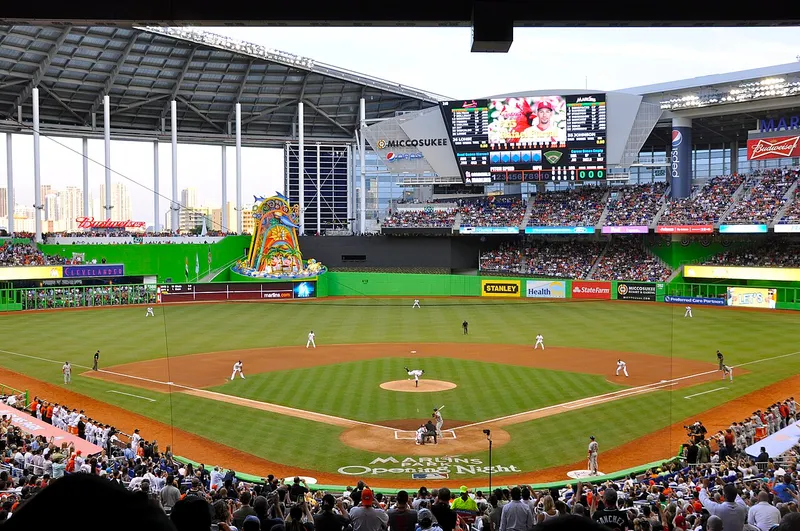
The Marlins are the sole tenants, and the venue was purpose-built to solve Miami’s weather problem. Populous designed the $515 million stadium with a one-of-a-kind three-panel retractable steel roof — the largest in major league sports at 7.7 acres — that opens or closes in about 13 minutes. Rain delays are a thing of the past, and the air conditioning keeps the interior comfortable even when Miami’s summer humidity is at its worst.
The roof is an engineering marvel: 8,000 tons of steel composed of 11,000 individual pieces, carried by 44 transporters with 88 wheels running on parallel steel rails. The center panel rises to 216 feet above second base to accommodate fly balls, while the east and west panels sit lower over the stands. The deliberate spacing between panels prevents pressure buildup during high winds — a design decision that saved $5 million in construction and provides hurricane resistance.
The ballpark earned LEED certification as the greenest MLB park when it opened. It has hosted the 2017 MLB All-Star Game, three World Baseball Classic editions, the 2023 WBC Final (Japan defeating USA), the 2026 NHL Winter Classic, and Beyoncé’s Formation World Tour kickoff in 2016.
Miami’s climate dictates the roof strategy. Summer temperatures hover around 90°F with humidity that can make outdoor activities miserable, and afternoon thunderstorms roll in like clockwork from June through September. The retractable roof stays closed for most summer games, keeping the air-conditioned interior at a comfortable 75°F. During the milder months — late October through April — the roof opens for about half of all events, letting in South Florida’s evening breezes and the glow of the Miami skyline beyond left field. The Little Havana setting infuses game days with Latin music, Cuban coffee, and croquetas from local vendors — an atmosphere unlike any other MLB ballpark.
Getting to loanDepot Park
Public Transit
Miami’s transit options for the ballpark are solid, with Metrorail, bus, and a free trolley all within reach.
→ From downtown Miami: Metrorail to Culmer station (less than 1 mile walk) or Civic Center station. The free City of Miami Trolley runs a Stadium Route loop from Civic Center to the park every day except Sundays.
→ From Fort Lauderdale / North: Brightline to MiamiCentral Station, then take the complimentary HOME RUNNER shuttle to the ballpark (included with your train ticket).
Metrobus routes 7, 7A, and 12 also serve the area. Route 12 drops off at NW 12th Avenue and NW 7th Street, 1.5 blocks from the park.
Driving + Parking
GPS address: 501 Marlins Way, Miami, FL 33125.
→ From Fort Lauderdale (45 km): I-95 South. About 35 minutes.
→ From Orlando (377 km): Florida’s Turnpike South. About 3 hours 50 minutes.
→ From Tampa (451 km): I-75 South to Alligator Alley or Florida’s Turnpike. About 3 hours 55 minutes.
Four parking garages and six surface lots surround the stadium. General parking is $15-$30 (dynamic pricing). Home Plate Garage, Third Base Garage, East 1, West 1, and West 2 are prepaid only. Tailgating is permitted in surface lots with grills allowed, but kegs and tents that extend beyond your parking space are not.
Rideshare
Uber and Lyft pick up and drop off at East Lot 1 (1380 NW 6th Street). From downtown Miami, expect $8-15; from Miami Beach about $20-30; from MIA airport about $26-32. The rideshare apps geofence to the designated area automatically.
From the Airport
→ Miami International Airport (MIA): Just 10 km west, about 10-15 minutes by car. Taxi/Uber $26-32. Metrorail connects MIA to Culmer station near the ballpark.
→ Fort Lauderdale-Hollywood International Airport (FLL): 39 km north, about 30 minutes by car. Uber/Lyft $45-65.
History of loanDepot Park
The Marlins spent their first 19 seasons (1993-2011) at what is now Hard Rock Stadium in Miami Gardens — a cavernous football venue where baseball always felt like an afterthought. The push for a purpose-built ballpark culminated in a controversial $515 million project, with Miami-Dade County covering the majority of costs. Populous designed the stadium on the 17-acre site of the demolished Orange Bowl in Little Havana, and Hunt Construction broke ground on July 18, 2009.
The retractable roof was the centerpiece: three steel panels that eliminated South Florida’s notorious rain delays and created a climate-controlled environment. The stadium also featured a swimming pool beyond center field and Red Grooms’ kinetic home run sculpture — a 75-foot spectacle of spinning marlins and flamingos that became a love-it-or-hate-it icon.
Key moments in the stadium’s history:
- April 4, 2012: Opening Day — St. Louis Cardinals 4, Miami Marlins 1 before a sold-out crowd.
- September 29, 2013: Henderson Alvarez no-hits the Tigers, completed by a walk-off wild pitch (Marlins win 1-0).
- July 11, 2017: MLB All-Star Game — the first in Marlins history. AL wins 2-1 in 10 innings.
- March 21, 2023: 2023 World Baseball Classic Final — Japan defeats USA 3-2 in a Shohei Ohtani vs. Mike Trout showdown.
- January 2, 2026: NHL Winter Classic — Rangers vs. Panthers on an outdoor rink under the retractable roof.
The stadium’s public financing remains controversial — the original deal saddled Miami-Dade taxpayers with hundreds of millions in debt — but the building itself is undeniably impressive. The roof works flawlessly, the Little Havana location gives it cultural character that no suburban site could match, and events like the 2023 WBC Final have shown what this venue can produce when filled with passionate fans. The Marlins continue to rank near the bottom of MLB attendance, but the stadium itself has aged well, and its versatility as a concert and event venue helps justify the investment that Miami made in the heart of one of its most iconic neighborhoods.
Photo Gallery
Fun Facts
loanDepot Park's three-panel retractable roof weighs 8,000 tons of steel and covers 7.7 acres — the largest retractable roof in major league sports. It opens or closes in approximately 13 minutes.
Red Grooms' 75-foot-tall kinetic home run sculpture — featuring spinning marlins, seagulls, and flamingos — cost $2.5 million and originally activated on every Marlins homer before being relocated outside the park in 2019.
The stadium houses nearly 600 unique bobbleheads in a public museum display — one of the largest bobblehead collections on public display in the world.
Stadium Location
Frequently Asked Questions
- Does loanDepot Park have a retractable roof?
- Yes. It features a three-panel retractable steel roof that opens or closes in approximately 13 minutes. It is the largest retractable roof in major league sports, covering 7.7 acres.
- What is the capacity of loanDepot Park?
- 37,442 seats, making it one of the smallest stadiums in Major League Baseball.
- Is loanDepot Park grass or turf?
- Artificial turf (Shaw Sports B1K), installed before the 2020 season. The stadium originally had natural grass from 2012-2019.
- How much does parking cost at loanDepot Park?
- General parking ranges from $15 to $30 with dynamic pricing. Valet is $30-$45 (advance purchase required). Several lots — Home Plate Garage, Third Base Garage, East 1, West 1, West 2 — are prepaid only.
- How do I get to loanDepot Park by transit?
- Metrorail Culmer and Civic Center stations are both within a mile. The free City of Miami Trolley runs a Stadium Route loop every day except Sundays. Brightline riders get complimentary shuttle service from MiamiCentral station.
- What was loanDepot Park called before?
- Marlins Park from 2012 to 2021. The naming rights were sold to loanDepot, a national mortgage lender, effective March 31, 2021.
- What major events has loanDepot Park hosted?
- The 2017 MLB All-Star Game, three World Baseball Classic editions (2013, 2017, 2023 — including the 2023 Final), the 2026 NHL Winter Classic, Beyoncé's Formation World Tour kickoff (2016), and international soccer friendlies.
Last updated: 2026-03-12