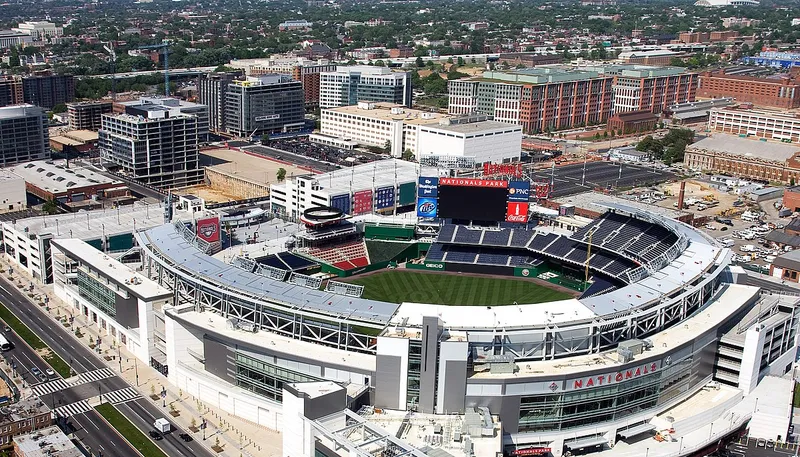
About Nationals Park
Nationals Park sits along the Anacostia River in the Navy Yard neighbourhood of Washington, D.C. — a 41,339-seat ballpark where the Washington Nationals play baseball, where the 2019 World Series brought October baseball back to the capital for the first time in 86 years, and where the playing field sits 24 feet below street level on land that was once a contaminated industrial site.
The ballpark opened on March 30, 2008, replacing Robert F. Kennedy Memorial Stadium as the Nationals’ home. Built for $611 million and designed by Populous and Devrouax & Purnell, it was the first major professional sports venue in America to earn LEED Silver certification — with a green roof, stormwater management system, and energy-efficient lighting that set a new standard for sustainable stadium design.
The name “Nationals Park” was intended to be temporary. Over 17 years later, no corporate naming-rights deal has ever been finalized, making this one of the few MLB stadiums without a corporate sponsor in its name. The ballpark has simply become Nationals Park — and nobody in Washington seems to mind.
The Navy Yard neighbourhood has transformed around the stadium. The Yards Park, The Wharf, and dozens of restaurants and bars have turned what was once an industrial waterfront into one of the most vibrant game-day neighbourhoods in baseball.
Getting to Nationals Park
Public Transit
Nationals Park has one of the best Metro connections of any ballpark in America — the station is one block from the gate.
→ Via Metro Green Line: Navy Yard-Ballpark station is one block from the center field entrance. Trains run every 6–12 minutes. Metro fare ranges from $2 to $6 depending on distance and time of day.
→ Via D.C. Circulator / Metrobus: The Circulator ($1) and Metrobus ($2) serve the Navy Yard area. Multiple stops are within a 5-minute walk of the ballpark.
Metro runs extended hours on game nights. A free bike valet operates near First Street SE and Potomac Avenue SE for cyclists — a popular option from Capitol Hill and the waterfront.
Driving + Parking
The ballpark address is 1500 South Capitol Street SE, Washington, DC 20003. I-295 and I-395 are the primary approaches.
→ From Baltimore (~40 mi): I-295 South / BW Parkway to South Capitol Street. About 50 minutes.
→ From Richmond (~110 mi): I-95 North to I-395 to South Capitol Street. About 1 hour 50 minutes.
→ From Philadelphia (~140 mi): I-95 South to I-295 South. About 2 hours 30 minutes.
GEICO Garage (Garage B) is adjacent to the stadium, typically $30–$50 on game days. There are 14 Nationals-sanctioned lots and garages total, ranging from $20–$49 during the regular season. Pre-purchase via the MLB Ballpark app — spots sell out for popular games.
Rideshare
Uber and Lyft serve the ballpark. Avoid South Capitol Street for pickups — it’s congested after games. Walk a few blocks north toward M Street SE for a faster, cheaper ride. Post-game taxi stand on the north side of M Street SE between South Capitol and Half Streets.
From the Airport
→ Ronald Reagan National (DCA): Just 5 miles south, about 15 minutes by car — one of the closest airport-to-ballpark distances in MLB. Rideshare runs $15–$25. You can also take the Metro Blue/Yellow Line to L’Enfant Plaza and transfer to the Green Line (about 25 minutes total).
→ Washington Dulles International (IAD): 29 miles west, about 40 minutes by car. Silver Line Metro + Green Line transfer takes about 75 minutes. Rideshare runs $55–$75.
→ Baltimore/Washington International (BWI): 33 miles northeast, about 45 minutes by car. Rideshare runs $60–$80.
History of Nationals Park
Nationals Park was built to give Washington, D.C. a proper home for the franchise that had arrived from Montreal in 2005. The $611 million project broke ground on May 4, 2006, on a former industrial site along the Anacostia River that required removing 300,000+ cubic yards of contaminated soil.
First Game (March 30, 2008): President George W. Bush threw the ceremonial first pitch, and Ryan Zimmerman hit a walk-off home run to beat the Atlanta Braves 3-2 — a Hollywood debut for a ballpark that would define the neighbourhood around it.
First LEED-Certified Pro Stadium (2008): Nationals Park became the first major professional sports venue in the U.S. to earn LEED Silver certification, setting a new standard for sustainable stadium design with its green roof and stormwater management system.
2018 MLB All-Star Game (July 17, 2018): The first All-Star Game in Washington since 1969, bringing national attention to the transformed Navy Yard neighbourhood and the ballpark’s place among the best venues in the sport.
2019 World Series (October 2019): The Nationals hosted Games 3, 4, and 5 — the first World Series games in Washington since 1933. The Nats won the franchise’s first championship, defeating Houston in seven games and bringing D.C. its first World Series title since 1924. The road team won every game in the series — one of the strangest statistical quirks in World Series history.
From Ryan Zimmerman’s walk-off on opening night to the 2019 championship to the Capitol dome visible beyond the outfield, Nationals Park is where baseball returned to Washington — a ballpark that transformed a neighbourhood, earned the first green certification in pro sports, and still doesn’t have a corporate sponsor in its name.
Photo Gallery
Fun Facts
Nationals Park has gone 17+ years without a corporate naming-rights deal — the name was intended to be temporary when the ballpark opened in 2008, but no sponsor has ever been finalized, making it one of the few MLB stadiums without corporate branding in its name.
The playing field sits 24 feet below street level — construction required removing more than 300,000 cubic yards of contaminated soil from the former industrial site in 34,000+ truckloads, with the excavation contractor averaging 5,000 cubic yards per day and finishing three months ahead of schedule.
When it earned LEED Silver certification in 2008, Nationals Park became the first major professional sports venue in the United States to receive the environmental distinction, featuring a 6,300-square-foot green roof and an advanced stormwater management system.
Stadium Location
Frequently Asked Questions
- What is the seating capacity of Nationals Park?
- Nationals Park seats 41,339 for MLB games. The ballpark opened in 2008 at a cost of $611 million and was designed by Populous (then HOK Sport) and Devrouax & Purnell. The original capacity was 41,888; minor renovations have adjusted it slightly.
- Where is Nationals Park located?
- Nationals Park is at 1500 South Capitol Street SE in Washington, D.C. 20003. It sits in the Navy Yard-Capitol Riverfront neighbourhood along the Anacostia River, about 1.2 miles south of the U.S. Capitol.
- How do I get to Nationals Park by Metro?
- Take the Green Line to Navy Yard-Ballpark station. The station exit is one block from the center field gate. On game days, Metro typically runs extended hours. Fares range from $2 to $6 depending on distance and time of day.
- Is there parking at Nationals Park?
- GEICO Garage (Garage B) is adjacent to the stadium near the center field entrance, typically $30-$50 on game days. There are 14 Nationals-sanctioned lots/garages total, ranging from $20-$49 during the regular season. Pre-purchase via the MLB Ballpark app is recommended.
- Is Nationals Park cashless?
- Yes. The stadium is fully cashless and accepts credit/debit cards, mobile pay, and eCASH through the MLB Ballpark app. No cash is accepted at any concession stand, retail location, or parking lot.
- Has Nationals Park hosted a World Series?
- Yes. Nationals Park hosted Games 3, 4, and 5 of the 2019 World Series — the first World Series games in Washington, D.C. since 1933. The Nationals won the franchise's first championship, and D.C.'s first World Series title since 1924, defeating the Houston Astros in seven games.
- How far is the airport from Nationals Park?
- Ronald Reagan Washington National Airport (DCA) is just 5 miles south, about 15 minutes by car — one of the closest airport-to-ballpark distances in MLB. Rideshare runs $15-$25. Dulles (IAD) is 29 miles west (~40 min); BWI is 33 miles northeast (~45 min).
Last updated: 2026-03-06