About Ohio Stadium
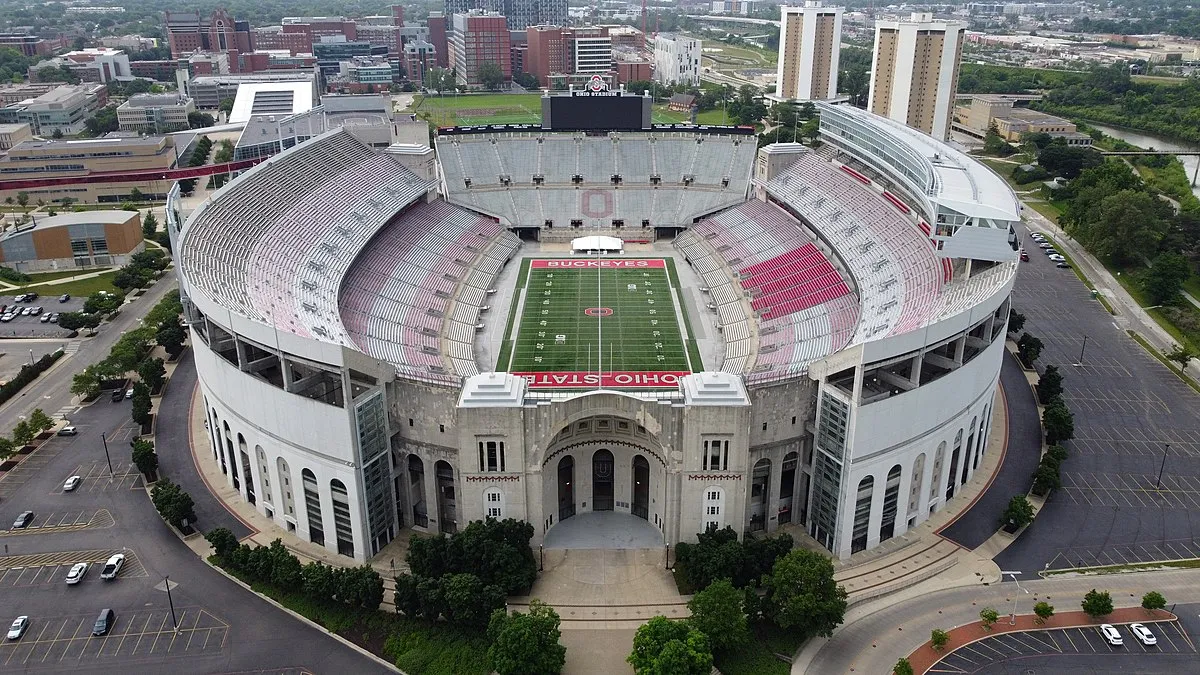
Ohio Stadium sits on the banks of the Olentangy River at the Ohio State University campus in Columbus, about three miles north of downtown. At 102,780 seats, it’s the third-largest college football stadium in America — and on a fall Saturday when the Buckeyes take the field and Script Ohio wraps up, there aren’t many louder places on Earth.
Known as The Horseshoe for its distinctive open-ended shape, the stadium has been home to Ohio State Buckeyes football since 1922. The south end of the bowl was left open by design, originally facing the river, giving the stadium its iconic silhouette. Over 100 years later, it remains one of the most recognizable shapes in college sports.
Architect Howard Dwight Smith designed Ohio Stadium as the first concrete double-deck stadium in America. When it opened, it was the largest poured concrete structure in the world. The original 66,210-seat bowl cost $1.34 million to build. A $194 million renovation from 1998-2001 lowered the field 14 feet, added 81 luxury suites and 2,500 club seats, and pushed capacity past 100,000. Further upgrades through 2020 brought total investment above $240 million.
Beyond football, Ohio Stadium hosted the 2025 NHL Stadium Series (Blue Jackets vs. Red Wings), international soccer friendlies including Manchester City vs. Chelsea in 2024, and concerts from Pink Floyd to the Rolling Stones. The stadium was the first football venue listed on the National Register of Historic Places in 1974.
Getting to Ohio Stadium
Public Transit
COTA (Central Ohio Transit Authority) runs multiple bus routes near Ohio Stadium on game days. Routes 1, 2, 8, 22, 31, and 102 serve the campus area with frequent service.
→ From Downtown Columbus: Take COTA Route 2 north on High Street. The ride takes about 15 minutes and drops you within walking distance of the stadium. Fare is $2 per adult.
→ From West Campus: Ohio State runs a free Football Shuttle from Carmack Lot 1 to the Herrick Drive Transit Hub, just south of the stadium. Shuttles start 6 hours before kickoff and run continuously.
Note: Ohio State’s regular free campus buses are suspended on game days. The football shuttles and COTA public transit are your transit options.
Driving + Parking
Ohio Stadium is accessible from I-71 and Route 315. GPS users should enter “411 Woody Hayes Drive, Columbus, OH 43210.”
→ From Downtown Columbus (~3 mi): Head north on High Street through the Short North and University District. Turn left on 17th Avenue, then right on Woody Hayes Drive. The stadium is on your left.
→ From Dayton (~71 mi): Take I-70 East to I-71 North. Exit at 17th Avenue, turn left. The stadium is ahead.
→ From Cincinnati (~107 mi): Take I-71 North to the 17th Avenue exit. Turn left and follow the road as it curves toward the stadium.
Campus parking is tiered: Premiere lots ($60), Proximity lots ($40), and Non-Proximity lots ($30). All payments are credit card or smartphone only — no cash. Lots open at 5 AM. The free football shuttle connects West Campus lots to the stadium if you want to park farther out and skip the traffic.
Rideshare
Uber and Lyft have two designated zones on game days: Borror Drive near the Schottenstein Center (primary) and 19th Avenue & Neil Avenue (secondary). Streets around the stadium are blocked to rideshare vehicles during events.
Pro tip: Set your pin to Borror Drive for drop-off. After the game, walk to one of the designated zones — don’t try to get picked up right outside the stadium.
From the Airport
→ John Glenn Columbus International (CMH): 10 miles east, 15-20 minutes by car. Full-service airport with major carrier coverage. No direct transit to the stadium — rideshare or car is your best bet.
→ Ohio State University Airport (OSU): 5 miles northwest, primarily general aviation. Offers a football game shuttle service on game days.
Legacy of Ohio Stadium
Ohio Stadium isn’t just a venue — it’s the emotional center of one of college football’s largest fan bases. The traditions here have been building for over a century, and they’re as much a part of the experience as the game itself.
Script Ohio is the signature: the Ohio State Marching Band — “The Best Damn Band in the Land” — forms the word “Ohio” in flowing cursive across the field, and a senior sousaphone player dots the i. It’s been happening since 1936. Special guests who’ve earned the honor include Bob Hope, Jack Nicklaus, and astronaut John Glenn. On game day, the moment the i is dotted, 102,000 people roar as one.
The rivalry with Michigan defines the season every November. The 2016 edition drew the stadium’s all-time record crowd of 110,045. Tailgating spreads across every available surface on campus. And when the Buckeyes win — especially against That Team Up North — the south end of The Horseshoe becomes a sea of scarlet.
History of Ohio Stadium
Athletic Director Lynn St. John pushed for a permanent home for Buckeye football in the early 1920s. He hired Howard Dwight Smith, who won the AIA Gold Medal for Public Building Design for his horseshoe concept. Construction used materials from Marble Cliff Quarry, and E.H. Latham Company built the $1.34 million stadium in under a year.
- First Game (October 7, 1922): Ohio State defeated Ohio Wesleyan 5-0 before a crowd of 72,000 in the stadium’s inaugural game.
- Dedication Game (October 21, 1922): Michigan defeated Ohio State 19-0 in the first “The Game” at the new stadium.
- National Register of Historic Places (1974): Ohio Stadium became the first football stadium to receive this distinction.
- $194 Million Renovation (1998-2001): The field was lowered 14 feet, 81 luxury suites and 2,500 club seats were added, and capacity reached 101,568.
- All-Time Attendance Record (November 26, 2016): Ohio State vs. Michigan drew 110,045 fans — the largest crowd in stadium history.
- 100th Anniversary (October 1, 2022): Ohio Stadium celebrated its centennial during the Ohio State vs. Rutgers game.
- NHL Stadium Series (March 1, 2025): The Columbus Blue Jackets defeated the Detroit Red Wings 5-3 in the first hockey game ever played at The Horseshoe.
Photo Gallery
Fun Facts
Ohio Stadium was the largest poured concrete structure in the world when it opened in 1922 and the first concrete double-deck stadium in America.
The iconic Script Ohio formation has been performed by the Ohio State Marching Band since 1936 — the honor of 'dotting the i' is reserved for senior sousaphone players.
Ohio Stadium was the first football stadium listed on the National Register of Historic Places, added in 1974.
Stadium Location
Frequently Asked Questions
- What is the seating capacity of Ohio Stadium?
- Ohio Stadium seats 102,780, making it the third-largest college football stadium in the United States behind Michigan Stadium (107,601) and Beaver Stadium (106,572).
- Why is Ohio Stadium called The Horseshoe?
- The nickname comes from its distinctive open-ended horseshoe shape, designed by architect Howard Dwight Smith in 1922. The open south end originally faced the Olentangy River.
- Where is Ohio Stadium located?
- Ohio Stadium is at 411 Woody Hayes Drive on the Ohio State University campus in Columbus, Ohio. It sits about 3 miles north of downtown Columbus along the Olentangy River.
- How do I get to Ohio Stadium without a car?
- COTA bus routes 1, 2, 8, 22, 31, and 102 serve the campus area on game days for $2 per adult. Ohio State also runs a free football shuttle from Carmack Lot 1 on West Campus to the Herrick Drive Transit Hub near the stadium.
- Is there parking at Ohio Stadium?
- Yes. Campus lots range from $30 (non-proximity) to $60 (premiere). All payments are credit card or smartphone only — no cash. Lots open at 5 AM on game day. The free football shuttle runs from West Campus lots.
- When was Ohio Stadium built?
- Ohio Stadium opened on October 7, 1922, when Ohio State defeated Ohio Wesleyan 5-0. It was designed by Howard Dwight Smith and cost $1.34 million. A $194 million renovation from 1998-2001 modernized the facility.
- What is Script Ohio?
- Script Ohio is the signature formation performed by the Ohio State University Marching Band, in which members spell 'Ohio' in cursive on the field. The tradition dates to 1936, and the honor of dotting the i is reserved for senior sousaphone players.
- Can you bring bags into Ohio Stadium?
- No. Ohio Stadium enforces a strict no-bag policy — bags and purses of any size, including clear bags, are prohibited. Only wallets and wristlets no larger than 5x8x1 inches are permitted.
Last updated: 2026-02-25