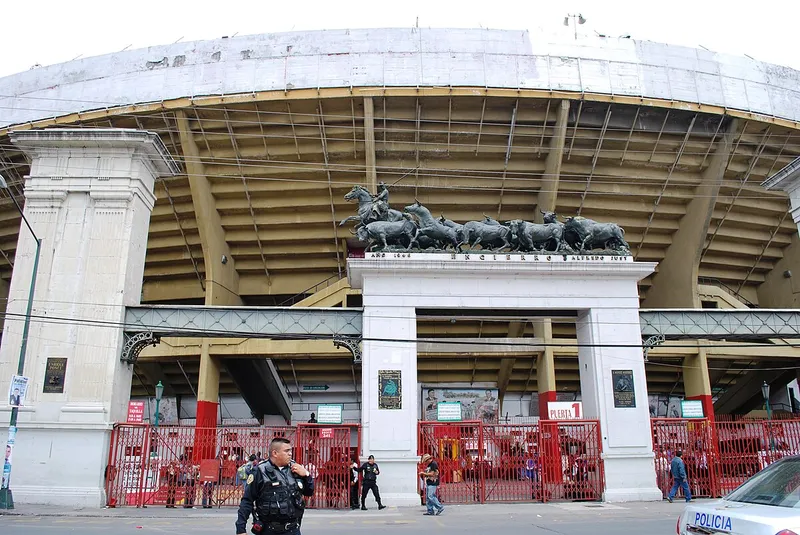
About Plaza de Toros México
Plaza de Toros México stands in the heart of Mexico City’s Ciudad de los Deportes complex, just off Avenida Insurgentes Sur in the Benito Juárez borough. With 41,262 official seats, it holds the title of the largest bullring ever constructed — a distinction it has carried since opening day in 1946.
For nearly eight decades, this was the cathedral of Mexican bullfighting. The Temporada Grande season ran from October through March, drawing the world’s top matadors and tens of thousands of aficionados. That era ended in 2025, when Mexico City’s Congress banned violent bullfighting by a vote of 61 to 1. Today, the venue is reinventing itself as one of Latin America’s premier concert arenas, with 40 shows planned for 2026.
The arena was built on a former brick-making quarry, and that origin defines everything about the experience. The ring floor sits 20 meters below street level, creating a natural bowl of reinforced concrete that funnels sound and energy downward. Engineer Modesto C. Rolland designed the structure for entrepreneur Neguib Simón, who envisioned a sprawling sports campus — though the bullring and the adjacent football stadium were all that ever materialized before Simón’s fortune ran dry.
The venue has already proven it can handle more than bulls. In November 2019, Roger Federer and Alexander Zverev played an exhibition tennis match here before 42,517 spectators — an all-time world record for tennis attendance. Vicente Fernández’s legendary 1984 Independence Day concert drew an estimated 54,000. Alejandro Fernández sold out to 43,000 fans in 2024. The arena has survived the 1957, 1985, and 2017 Mexico City earthquakes without structural failure.
Getting to Plaza de Toros México
Public Transit
The most convenient option is Metrobús Línea 1, which runs the full length of Avenida Insurgentes Sur. Get off at the Ciudad de los Deportes stop — the venue is a 5-minute walk from there.
→ From Centro Histórico: Take Metro Line 7 south to San Antonio station (10-minute walk to the plaza). Alternatively, board Metrobús Línea 1 at Insurgentes and ride south to Ciudad de los Deportes.
→ From Polanco / Chapultepec: Take Metro Line 1 to Tacubaya, transfer to Line 7 south, and exit at San Antonio.
Multiple bus routes also serve the area along Insurgentes Sur, including lines 1, 13-A, 106, and 200.
Driving + Parking
GPS address: Augusto Rodín 241, Nochebuena, Benito Juárez, CDMX 03720.
→ From Zócalo / Centro Histórico (11 km): Head south on Eje Central to Av. Chapultepec, then take Insurgentes Sur south to Ciudad de los Deportes. Allow 25-40 minutes depending on traffic.
→ From Coyoacán (7 km): Head north on Insurgentes Sur. The complex appears on your left just past Parque Hundido. About 15-25 minutes.
Reserve parking in advance through Seeker Parking (plazadetoros.seekerparking.mx) — expect $180-250 MXN per event. Street parking is available but fills quickly. Arrive at least 45 minutes before showtime.
Rideshare
Uber and DiDi both operate here with standard pickup and drop-off on Calle Augusto Rodín. A ride from Centro Histórico runs $80-150 MXN; from the airport expect $200-400 MXN. DiDi typically undercuts Uber by 15-30% in Mexico City. Post-event surge pricing can double fares.
From the Airport
→ Aeropuerto Internacional Benito Juárez (MEX): 14 km east, 20-40 minutes by car. Take Circuito Interior west to Viaducto Miguel Alemán, then connect to Insurgentes Sur south.
→ Aeropuerto Internacional Felipe Ángeles (NLU): 55 km north, 45-70 minutes by car. AIFA serves budget carriers — take the Mexibús or a rideshare into the city.
Beyond Bullfighting
Plaza de Toros México spent 79 years as the world’s most important bullfighting venue. That chapter closed in 2025 when Mexico City’s Congress banned violent bullfighting, prohibiting the killing of bulls during events. The vote was 61 to 1.
The transition had been building for years. A 2022 judicial injunction first suspended bullfighting; the Supreme Court reversed it in late 2023, allowing a final season in 2024 where 54 bulls were killed over nine days. The 2025 law made the ban permanent. Bulls’ horns must now be padded, and animals must be returned alive to farms.
But the venue is thriving in its second act. In 2025, the rebranded “La Monumental” hosted 19 events with over 600,000 attendees. The 41,000-seat bowl — with its natural amphitheater acoustics from sitting 20 meters below grade — turns out to be an extraordinary concert venue. Alejandro Fernández, Junior H, Intocable, and international touring acts have all headlined here. For 2026, management has projected approximately 40 concerts.
History of Plaza de Toros México
The story begins with Neguib Simón, a Yucatecan entrepreneur of Lebanese descent who dreamed of building a Ciudad de los Deportes — a multi-venue sports campus — on the outskirts of 1940s Mexico City. He hired civil engineer Modesto C. Rolland to design the centerpiece: a bullring to seat 45,000.
Construction began December 1, 1944, on a former brick quarry in the Nochebuena neighborhood. That quarry determined the arena’s most distinctive feature — the entire fighting ring sits 20 meters below street level, carved into the earth like a Roman amphitheater. Before opening, engineers validated the reinforced concrete structure by loading it with 120,000 sandbags totaling 6,000 metric tonnes.
Notable moments in the venue’s history:
- Inaugural Corrida (February 5, 1946): Approximately 41,000 spectators attended the grand opening, establishing it as the world’s largest bullring.
- Vicente Fernández Concert (September 15, 1984): An estimated 54,000 fans watched the legendary ranchera singer perform on Mexican Independence Day. The live album Un Mexicano en La México became one of his defining recordings.
- Red Bull X-Fighters (2005-2010): The freestyle motocross series used the bullring as its annual season-opener, filling the arena to 42,000+.
- Federer vs. Zverev (November 23, 2019): The exhibition tennis match drew 42,517 spectators — a certified world record for tennis attendance, set inside a bullring.
- Bullfighting Ban (March 2025): Mexico City’s Congress voted 61-1 to ban violent bullfighting, ending 79 years of corridas at the plaza.
The structure has survived every major Mexico City earthquake — 1957, 1985, and 2017 — without significant damage, a testament to Rolland’s engineering. What was built as a temple to bullfighting has become one of Latin America’s most in-demand concert venues, its sunken bowl now amplifying rock, norteño, and pop instead of the roar of the crowd and the charge of the bull.
Photo Gallery
Fun Facts
Plaza de Toros México is the largest bullring ever built, with 41,262 official seats and room for over 50,000 at peak events like Vicente Fernández's 1984 concert.
The entire arena floor sits 20 meters below street level because the site was originally a brick-making quarry — and the structure was load-tested with 120,000 sandbags (6,000 tonnes) before opening.
In November 2019, 42,517 fans packed the bullring to watch Roger Federer face Alexander Zverev, setting the all-time world record for attendance at a tennis match.
Stadium Location
Frequently Asked Questions
- What is the capacity of Plaza de Toros México?
- The official seating capacity is 41,262, making it the largest bullring ever built. For major concerts and special events, the venue has accommodated over 50,000 people.
- Is bullfighting still held at Plaza de Toros México?
- No. In early 2025, Mexico City's Congress passed a law banning violent bullfighting — specifically prohibiting the killing of bulls during events. The venue now operates primarily as a concert and entertainment arena, with approximately 40 concerts planned for 2026.
- How do I get to Plaza de Toros México by metro?
- The nearest metro station is San Antonio on Line 7, approximately 700 meters away (10-minute walk). Alternatively, take Metrobús Línea 1 (Insurgentes corridor) to the Ciudad de los Deportes stop, about 400 meters from the entrance.
- Where can I park at Plaza de Toros México?
- Dedicated event parking can be reserved in advance through Seeker Parking at plazadetoros.seekerparking.mx, typically $180-250 MXN per event. Street parking is also available on surrounding blocks. Arrive 45-60 minutes early.
- When did Plaza de Toros México open?
- It opened on February 5, 1946, with an inaugural corrida drawing approximately 41,000 spectators. The date is commemorated annually as the Corrida de Aniversario.
- Who designed Plaza de Toros México?
- Civil engineer Modesto C. Rolland designed the bullring, commissioned by Yucatecan entrepreneur Neguib Simón as part of his ambitious Ciudad de los Deportes complex. Construction began December 1, 1944.
- What events are held at Plaza de Toros México today?
- The venue now focuses on major concerts and live entertainment. In 2025, it hosted 19 shows with over 600,000 total attendees. Artists like Alejandro Fernández, Junior H, and international acts regularly perform here.
Last updated: 2026-03-10