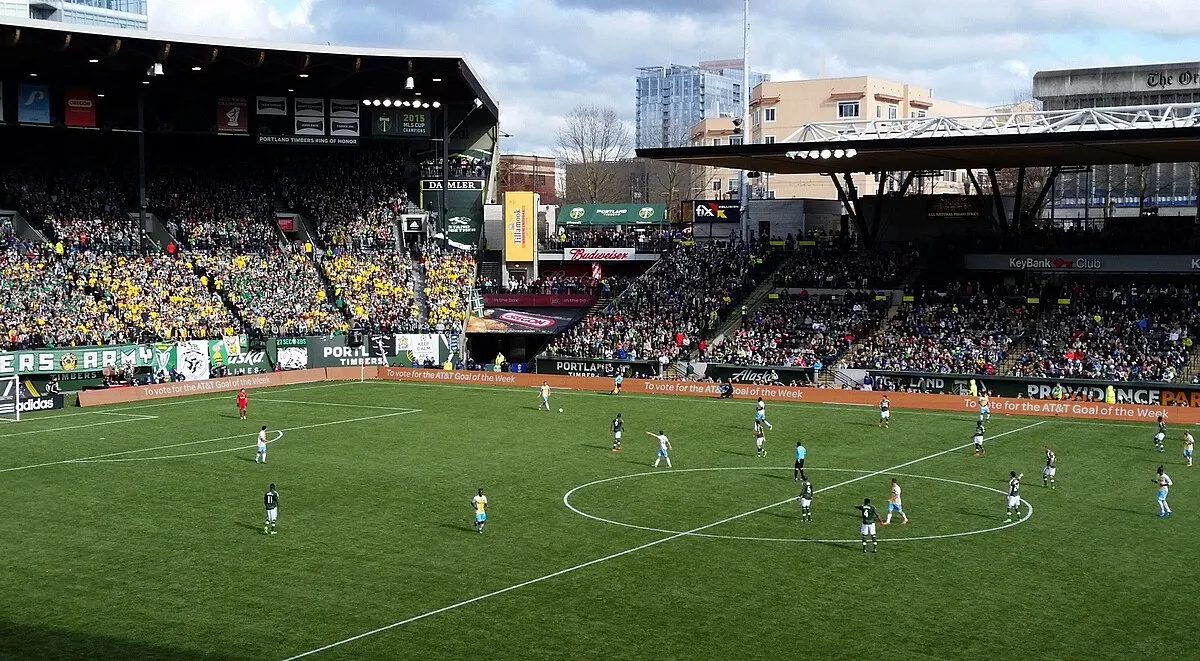
About Providence Park
Providence Park sits in the Goose Hollow neighborhood of Portland, Oregon, just west of downtown and within walking distance of half the city. At 25,218 seats, it’s one of the largest soccer-specific stadiums in MLS — and pound for pound, one of the loudest. The Timbers Army in Section 107 sees to that.
Home to the Portland Timbers since their MLS debut in 2011 and the Portland Thorns FC since 2013, Providence Park is the oldest soccer-specific venue in the league. The site has hosted athletics in some form since 1893, when the Multnomah Athletic Club built a field here. Architect A.E. Doyle designed the full concrete stadium in 1926, and it’s been a Portland landmark ever since — through name changes, sport changes, and multiple transformations.
The most recent came in 2019, when an $85 million privately funded expansion by Allied Works Architecture added three levels of seating on the east side, a floating steel canopy clad in cedar, and new video boards. The design was inspired by Shakespeare’s Globe Theatre and La Bombonera in Buenos Aires. The 923,000-pound steel canopy traps crowd noise, turning an already raucous atmosphere into something truly special.
Providence Park is also one of the most transit-accessible venues in professional sports. The MAX Light Rail station is literally at the stadium’s front door. On match days, the train is the way most fans arrive — parking is intentionally limited in this urban neighborhood.
Getting to Providence Park
Public Transit
Providence Park has its own dedicated MAX Light Rail station, served by both the Blue and Red lines. Extra trains run on game days. This is the best way to get to the stadium — and most fans know it.
→ From Downtown Portland: The Blue or Red Line from Pioneer Courthouse Square takes about 5 minutes to Providence Park station. Trains run every 8-15 minutes.
→ From PDX Airport: Take the MAX Red Line directly to Providence Park station. The ride is approximately 40 minutes.
TriMet bus lines 15 (Belmont/NW 23rd) and 20 (Burnside/Stark) also stop nearby with frequent service. The Portland Streetcar NS Line runs along 18th Avenue for another transit option. Free Park & Ride lots throughout the metro area let you park and ride the MAX in.
Driving + Parking
Providence Park has very limited parking — this is an urban stadium in a residential neighborhood, not a suburban complex with acres of lots. GPS users should enter “1844 SW Morrison Street, Portland, OR 97205.”
→ From Downtown Portland (~1.5 mi): Head west on Morrison or Yamhill Street. The stadium is at SW 18th and Morrison in Goose Hollow.
→ From PDX Airport (~14 mi): Take I-205 South to I-84 West, then I-405 South to the SW 18th Avenue exit. Turn right onto Morrison Street.
→ From Salem (~47 mi): Take I-5 North to I-405 North. Exit at SW 18th Avenue/Salmon Street and head north to Morrison.
On game days, the Stadium Event District activates: street meters jump to $7/hour. Several City Center Parking garages are within two blocks. Your best move is to park at a free TriMet Park & Ride lot and take the MAX. It’s faster, cheaper, and avoids the post-match traffic entirely.
Rideshare
Uber and Lyft serve Providence Park, but SW 18th Avenue between Burnside and Taylor is closed during and after games. For post-match pickup, cross Burnside Street and walk to NW Flanders Street — less congestion and easier driver access.
Pro tip: Surge pricing of 1.5x or more is common after matches. Walking a few blocks north cuts your wait and fare significantly.
From the Airport
→ Portland International Airport (PDX): 14 miles east, 20-30 minutes by car. The MAX Red Line runs directly from PDX to Providence Park station in about 40 minutes — the easiest airport-to-stadium transit in MLS.
History of Providence Park
The site where Providence Park stands has been an athletic venue since 1893, when the Multnomah Athletic Club built a field here. In 1926, architect A.E. Doyle designed the full Multnomah Civic Stadium — a concrete grandstand with wooden benches — for $502,000. Some of those original benches still exist in the stadium today.
- Soccer Bowl ‘77 (August 28, 1977): Pelé played his last competitive match here as the New York Cosmos defeated the Seattle Sounders 2-1 in the NASL championship before 35,000+ fans.
- 1999 FIFA Women’s World Cup: Civic Stadium hosted four group stage matches during the tournament held in the United States.
- 2003 FIFA Women’s World Cup: PGE Park hosted six matches including both semifinals, drawing a record crowd of 27,623.
- MLS Debut (April 14, 2011): The Portland Timbers defeated Chicago Fire 4-2 in their first MLS match at the newly converted soccer-specific venue before a sellout of 18,627.
- 2014 MLS All-Star Game (August 6, 2014): The MLS All-Stars defeated Bayern Munich 2-1 — the first major event under the Providence Park name.
- $85 Million Expansion (2019): Allied Works Architecture added 4,000+ seats on the east side, a floating cedar-clad canopy, and new video boards. Capacity rose from 21,144 to 25,218.
- MLS Cup 2021 (December 11, 2021): New York City FC defeated the Portland Timbers on penalties (4-2) after a 1-1 draw before a sellout crowd of 25,218.
Photo Gallery
Fun Facts
Providence Park is the oldest soccer-specific stadium in MLS — the site has hosted athletics since 1893 and the full stadium dates to 1926.
The Portland Timbers sold out 163 consecutive home MLS matches from 2011 through 2020, a league record at the time.
Pelé played his last competitive match at this stadium — the 1977 Soccer Bowl, when the New York Cosmos defeated the Seattle Sounders 2-1.
Stadium Location
Frequently Asked Questions
- What is the seating capacity of Providence Park?
- Providence Park seats 25,218 following the 2019 east side expansion, which added approximately 4,000 seats. It's the second-largest soccer-specific stadium in MLS after Geodis Park (30,109).
- Where is Providence Park located?
- Providence Park is at 1844 SW Morrison Street in the Goose Hollow neighborhood of Portland, Oregon, just west of downtown. It sits adjacent to the Providence Park MAX Light Rail station.
- How do I get to Providence Park by public transit?
- Take the MAX Blue or Red Line to Providence Park station, which is directly adjacent to the stadium. From PDX airport, the Red Line takes about 40 minutes. Extra trains run on game days. TriMet bus lines 15, 20, and 24 also stop nearby.
- Is there parking at Providence Park?
- Very limited. Providence Park has no large dedicated parking lot. On game days, street meters increase to $7/hour. Several City Center Parking garages are within two blocks. Fans are strongly encouraged to use MAX Light Rail or park at free TriMet Park & Ride lots.
- Does Providence Park have real grass?
- No. Providence Park uses FieldTurf (Duraspine PRO), a FIFA Quality Pro certified artificial surface. It's the only soccer-specific stadium in MLS that doesn't use natural grass.
- When was Providence Park built?
- The site has hosted athletics since 1893. The full stadium was built in 1926 as Multnomah Civic Stadium, designed by architect A.E. Doyle for $502,000. It was converted for MLS soccer in 2011 and expanded in 2019.
- Who plays at Providence Park?
- Providence Park is home to the Portland Timbers (MLS) and Portland Thorns FC (NWSL). The stadium also hosts international soccer matches and occasional concerts.
- What is the bag policy at Providence Park?
- Clear bags up to 14x14x6 inches are permitted. Non-clear purses must be 4.5x6.5 inches or smaller. Lockers are available outside Gates B, D, and F for $15 via the Droplocker app.
Last updated: 2026-02-25