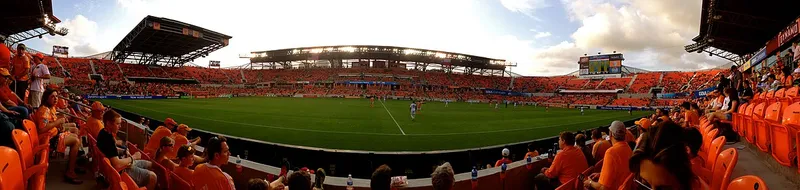
About Shell Energy Stadium
Shell Energy Stadium sits in the heart of Houston’s East Downtown — locally known as EaDo — a neighborhood that was still mostly warehouses and rail yards when the venue broke ground. With 22,039 seats, it’s the shared home of the Houston Dynamo FC in MLS and the Houston Dash in the NWSL, making it one of a handful of American stadiums hosting both men’s and women’s top-flight professional soccer.
Populous designed the $95 million venue, which earned LEED Silver certification — one of the first soccer-specific stadiums in MLS to achieve that standard. The angular roof canopy partially covers the west stand, giving the stadium a sharp-edged profile against the Houston skyline. Inside, the compact bowl puts the farthest seat within 120 feet of the touchline, creating an intimate atmosphere that gets genuinely loud when the Dynamo are on form.
The stadium has become the catalyst for EaDo’s transformation. When it opened in 2012, the surrounding blocks were sparse. Today, the neighborhood pulses with craft breweries, restaurants, and nightlife — much of it directly attributable to the foot traffic the stadium generates. 8th Wonder Brewery, a 5-minute walk from the gates, has become a de facto pre-match gathering spot.
Texas Southern University’s Tigers football team also uses the venue for home games, and the Houston Gamblers of the UFL played here in 2024. The natural grass surface thrives in Houston’s subtropical climate, where the growing season essentially never stops.
Getting to Shell Energy Stadium
Public Transit
METRORail is the best option — and it’s free on Houston Dynamo match days with a valid game ticket. The dedicated Stadium Park station makes access seamless.
→ From downtown Houston: Take the Green or Purple Line south to Stadium Park / EaDo station. The station is a 5-minute walk from the stadium gates. Trains run every 6-12 minutes.
→ From the Texas Medical Center / NRG Park area: Take the Red Line north to the downtown transfer platform, then connect to the Green or Purple Line to Stadium Park / EaDo.
METRO bus routes 40, 41, and 137 also serve the EaDo area, with stops along Texas Avenue and Emancipation Avenue. Bike racks are available at the stadium for those cycling from nearby neighborhoods.
Driving + Parking
GPS address: 2200 Texas Ave, Houston, TX 77003.
→ From I-10 (East): Exit at US-59 South, then take the St. Emanuel Street exit. Turn right on Texas Avenue. About 5 minutes from the freeway.
→ From I-45 (North / The Woodlands): Take I-45 South toward downtown, exit at Pierce Street, head east to EaDo. About 30-40 minutes from The Woodlands.
→ From Sugar Land / SW Houston (40 km): US-59 North toward downtown, exit at St. Emanuel. About 30 minutes.
Private lots surround the stadium, ranging from $15-30 on match days. Lot A on the east side is closest. EaDo street parking fills quickly on event nights. METRORail remains the most reliable option.
Rideshare
Uber and Lyft both operate in Houston. Drop-off at 2200 Texas Ave. From downtown hotels, the ride is $8-15; from the Galleria area about $15-25. Post-match surge pricing is moderate — walk toward the Main Street METRORail corridor for better pickup options.
From the Airport
→ George Bush Intercontinental Airport (IAH): 37 km north, about 30-40 minutes by car. Take I-45 South to downtown, then east to EaDo. Uber/Lyft fare about $30-50.
→ William P. Hobby Airport (HOU): 18 km south, about 20 minutes by car. Take I-45 North toward downtown or Broadway Boulevard east. Uber/Lyft fare about $20-30.
History of Shell Energy Stadium
The Houston Dynamo spent their first six MLS seasons at Robertson Stadium on the University of Houston campus — a fine college venue but far from ideal for professional soccer. When the club won back-to-back MLS Cups in 2006 and 2007, the case for a dedicated home became undeniable.
City of Houston support was essential. In 2011, the city approved a $35 million land deal and infrastructure improvement package for the East Downtown site — a former rail yard at Texas Avenue and Emancipation Avenue. The Harris County-Houston Sports Authority issued bonds to help finance the project. Populous drew up a 22,039-seat venue with a $95 million budget, designed to maximize sightlines and keep fans close to the pitch. Groundbreaking came on March 2, 2011, and construction took just 14 months — remarkably fast for a venue of this complexity.
Key moments in the stadium’s history:
- May 12, 2012: Inaugural match — Houston Dynamo defeat D.C. United 1-0 before a sellout crowd of 22,039.
- 2014: Houston Dash (NWSL) begin play at the stadium, making it one of the first venues to host both MLS and NWSL.
- 2018: Hosts the CONCACAF Champions League semifinal — Dynamo vs. Club América.
- 2021: Renamed PNC Stadium after the BBVA naming deal ended.
- 2023: Shell Energy acquires naming rights, becoming the stadium’s third corporate name.
- 2024: Houston Gamblers (UFL) use the venue for their inaugural season.
The opening months weren’t without challenge. Houston’s subtropical heat — summer matches regularly exceed 35°C (95°F) with 80%+ humidity — has always been the stadium’s defining environmental factor. The venue installed misting fans and shading improvements after early complaints, but the heat remains a competitive advantage for the Dynamo, who are acclimated to conditions that visiting teams openly dread.
The naming rights saga — four names in 14 years — has become a running joke among Houston soccer fans, but the stadium itself has been a constant. It turned EaDo from an afterthought into one of Houston’s most vibrant neighborhoods, proving what a well-placed stadium can do for a city’s urban fabric. The Dynamo and Dash share a home that’s intimate, loud, and genuinely connected to its community. The El Toro supporters’ group and the Texian Army fill the south end every match, and their combined energy makes Shell Energy Stadium one of the louder venues in the Western Conference. Whatever name ends up on the building next, the location and atmosphere have proven their worth.
Photo Gallery
Fun Facts
Shell Energy Stadium has had four different names in its first 14 years: BBVA Compass Stadium (2012-2019), BBVA Stadium (2019-2021), PNC Stadium (2021-2023), and Shell Energy Stadium (2023-present).
The stadium earned LEED Silver certification, making it one of the first soccer-specific venues in MLS designed with sustainable building standards from the ground up.
Shell Energy Stadium sits on the site of a former rail yard in Houston's East Downtown — a neighborhood that has transformed from warehouses to one of the city's hottest dining and nightlife districts, driven largely by the stadium's arrival.
Stadium Location
Frequently Asked Questions
- Where is Shell Energy Stadium located?
- At 2200 Texas Avenue in Houston's East Downtown (EaDo) neighborhood, about 1.5 km southeast of downtown Houston's convention center district.
- What is the capacity of Shell Energy Stadium?
- 22,039 seats. The venue features a steep, compact seating bowl that puts fans close to the pitch.
- What teams play at Shell Energy Stadium?
- The Houston Dynamo FC (MLS), Houston Dash (NWSL), and Texas Southern University Tigers football team. The Houston Gamblers (UFL) also played here in 2024.
- How do I get to Shell Energy Stadium by transit?
- METRORail's Green or Purple Line stops at Stadium Park / EaDo station, a 5-minute walk. On Dynamo match days, METRORail is free with a valid game ticket.
- Is there parking at Shell Energy Stadium?
- Several private lots surround the stadium, ranging from $15-30 on match days. Lot A on the stadium's east side is closest. EaDo street parking fills quickly. METRORail is the recommended option.
- When did Shell Energy Stadium open?
- May 12, 2012, with a match against D.C. United. The Dynamo won 1-0 before a sellout crowd of 22,039.
- Why has the stadium changed names so many times?
- Banking sponsor BBVA held the original deal (2012-2021), followed by PNC Financial Services (2021-2023), then Shell Energy (2023-present). Corporate naming right changes are common in MLS.
- What surface does Shell Energy Stadium use?
- Natural grass. The surface is maintained year-round thanks to Houston's subtropical climate, which allows virtually continuous growth.
Last updated: 2026-03-11